There's another reason why touchscreens are used. It breaks up one of the "long poles" in the project schedule.
Hardware buttons and switches have to be designed, tested, re-designed, and validated very early in the process of designing a new model so that there is time to figure out how to manufacture / source all the parts, how they integrate with the rest of the car's systems, and how they'll be wired and assembled. Just imagine what the impact would be if late in the process a new feature needs to be added! Pretty much forget about it, add it in the next major model refresh.
With a touchscreen all those dependencies go away. The hardware team just says "there's going to be an iPad sized capacitive touch screen here for climate/infotainment, and another custom sized display here for the instrument cluster". The software guys can independently do the design of the UI, changing things down to the very last moment, or even after the last moment if the car can be updated.
The solution to that is simple. Put four/five physical buttons down each side of the screen, maybe along the bottom too, and then you can make everything still programmable in software. I have no idea why you absolutely need to put buttons in the middle of the screen to be touched. It's one thing to put items or whatever that can be selected, or allow pinch/zoom, but in reality almost all interaction just boils down to picking between a limited set of options at any given time.
With a decent response time and hierarchical menus, it's easy to make a system that is navigable without looking. Throw in some (hopefully non-annoying) audio feedback, and it is extremely accessible--even by a blind passenger! In fact, that's a good benchmark. If a blind passenger could operate the thing, then the driver should be able to as well.
This. %100 this. The airline industry figured this out years ago with some of the cockpit controls. (admittedly there are a lot of other buttons and switches for the pilot to worry about too, but it seems like the digital display panels always are flanked by rows of buttons which were used for interacting with the panel. Works great even with gloves on and does not lock you into a single feature set.
Lab equipment does the same thing. Decades ago, oscilloscopes started having banks of buttons corresponding to an area of the screen, and knobs that have context sensitive functionality.
Those can be placed side by side with buttons that have fixed purposes delineated by printed or debossed lettering.
I realize that we're getting pretty far from the automotive use-case, but this style has worked remarkably well over the years, and has made it into all sorts of equipment.
A few months ago I met a teen (maybe 15 y.o.) who was trying to withdraw money from an ATM that had a non-touch screen. He kept failing and trying to tap on the screen.
He was doing it for his grandfather, a wheelchair user, who was nearby. The grandpa couldn't use the ATM himself because there was no wheelchair ramp. Seeing the teen's failing attempts he started asking passerby for help.
My takeaway from this story: we need more wheelchair ramps, not touchscreens.
Seconded. Touchscreens are great in many contexts but I have never liked them on atms. The latency between tapping something and the result might be the bank checking my account balance, or might be something wrong with the UI. When I'm dealing with money stuff I don't want any distracting ambiguities.
Having said that I like machines enough that I assume I can figure anything out because it was intended to be used by someone, so I rarely struggle unless it's a truly awful design. Touchscreens are way more intuitive for most people, though in cases such as you describe I wonder what the helpless people think the buttons outside of the screen are there for and why they're reluctant to try pushing them.
I suppose it doesn’t rain much in your area? Buttons tend to work even when moist. Touch screens tend to give you the wrong amount of money out of your bank account.
This varies widely depending on the issuer of the ATM, at least in my part of the EU (SW Germany).
My banking group has (I guess) >90% of their ATMs indoors; I can only think of ever using 4 or 5 locations that were outdoors (my dataset is probably something like 100 ATMs). But there are also some banks which seem to favour outdoor, or at least have less of a strict "indoor policy".
Especially "generic" ATMs at tourist spots or train stations seem to be outdoors.
When did you last vote? The 2016 election is when I first experienced them. I asked to vote by paper as I wasn't comfortable with electronic voting machines, so they gave me a paper and pen to fill it out, which I was then to feed into the computer.
That's not how it works outside the US. In Germany you fill out the bubbles and throw it in a ballot box. The cobtent of the box is later counted by multiple actual people. Results are very accurate and almost instantly available after voting closes. Thousands of voting locations, properly staffed, make sure of thay. Those preliminary results are later recounted and verified.
> I don't see how that affects the comments you're replying to in any meaningful way. They only mentioned a particular election to establish a timeline.
Because many countries won’t have had a meaningful difference in election systems in that window?
Commit... asked Swen... when they last voted. Now that question is only meaningful if the region Seen... lives in even uses e-voting, so Commit... seems to either assume that Swen... lives in the same country or that virtually all countries use e-voting.
Either option is US-centric - the first is pretty obvious, the second is more along "we do it like that, so all the others probably do it like that as well" (I'm US-centric as well, assuming the mentioned 2016 election was the US presidential election).
It's not like this is inherently bad or anything like that, it's just a remainder that sometimes the inhomogeneous composition of the HN commenters should be considered. And as you pointed out, that's also the case inside the US.
Also, others used the opportunity to state how their country/state uses (no) computers for voting. So there seems to be some meaning to it.
Maybe it's centric to CommitSyn's experience, but I don't think it's US-centric.
> the second is more along "we do it like that, so all the others probably do it like that as well"
2016 is quite recent for a first encounter anyway, so I don't see it as "we do it like that", just an anecdote that it's spreading. No "others probably do it like that".
I'm also surprised to see "electronic voting machines" referred to as something everyone ought to be familiar with. I've never seen one of this type. I last voted a year ago (it was a local election); the last national election was two years ago.
I have seen the bubble sheet type, but the voter interface to those is a pen and paper.
It didn't make waves here presumably because people are jaded with politics, but people in this sub-thread might be interested in this recent story about a quasi-legal effort to penetrate electronic voting infrastructure in the wake of the 2020 election.
The 1st election I voted in was 1987 and the last was a couple of months ago. For the 1st couple of elections I used the giant old school mechanical voting booths with the levers you threw to record your votes.. Since the early 90s I have only used ballots which I filled out by hand and then ran through an optical scanner before leaving the polling place. I imagine quite a few people in the US have never seen an electronic voting machine.
Last time I voted, there was a machine which spat out a paper where you could verify your answers, which was then fed to another machine for counting.
Seems like a reasonable path to me, though I'm still a bit distrustful of the whole process (I live in Texas currently, so Shenanigans(TM) are not out of the question).
That's only half stupid. The last primary I voted in I used a poorly-designed-by-committee interface which then printed out my ballot which I then fed into the scanner.
The style where it prints out a ballot which you feed into the scanner is actually not-insane. It's good for accessibility (e.g. lets visually impaired people vote without assistance) but still leaves a paper trail for recounts and things.
It is weirdly hard to have conversations about insecure voting machines these days. Progressive that care are sometimes shouted down by other progressives that are in favor of dominion suing fox. Conservatives that care are sometimes trying to justify disproven conspiracy theories about the most recent election.
It seems both sides have reason to push for voter-verifiable paper trails, but I'm not seeing a lot of momentum along those lines legislatively.
If you look at those MFDs, many also have rotational controls in the corners (some even have two levels of dials, one sitting on top of the other), which are another key way to keep the UI tactile and promote muscle memory.
Things like eliminating lag, organizing menus into predictable paths that can easily be committed to muscle memory, and designing buttons and dials that can be used even in high vibration environments, are all key design criteria for these cockpit controls. It's so sad that automotive design refuses to take any lessons from that industry.
When using the touchscreen in my old Nissan Leaf, I used to anchor my thumb underneath the display so I could hit controls reliably via muscle memory even when the road was bumpy. Preposterous that we have to do these kinds of hacks when there are much better solutions.
This comment reminds me of this video, where a F-15C fighter pilot breaks down the "Human Interface" in the cockpit where there are over 250 buttons and various other displays including HUD and panels and a button they aren't allowed to press because it requires an engine rebuild afterwards:
https://arstechnica.com/features/2020/06/human-interface-com...
It suggests it was meant to be part of a series but I've not found any other examples????
I was going to cite the example of the Garmin G1000 glass cockpit. Even moving a cursor around a map requires pushing a physical knob in 360° to guide it.
I wouldn't call the Garmin G1000 a paragon of UX design though. I wish there were some serious competitors that would give the UX another try (like Avidyne), but Garmin seems to be the standard now.
Philip Greenspun wrote about some of its problems (back in 2006):
> In some ways this makes life more difficult for the pilot. For example, suppose that you are busily trying to fly the airplane and study an approach plate when ATC gives you a new transponder code. With a less integrated system, you know exactly where the buttons are to enter a transponder code and your fingers will find their way there almost automatically. The buttons are always in the same place, i.e., on the physical transponder box, and they never change their function. With the G1000, you find the soft key labeled "xpdr" and press it. Then some more soft keys take on the function of digits. It is clearly a less direct and more time-consuming procedure.
Similarly for entering a frequency into COM 2. With a traditional radio stack, you reach over to COM 2, which is probably underneath COM 1 and labeled "COM 2". You twist the knob that is always there and that always adjusts the COM 2 frequency. With the G1000, you study the COM freqencies display (typically four numbers) and figure out which number is surrounded by a box. This is the number that you are going to be changing if you twist the COM knob. If the box isn't surrounding the number you want to change, you have to think long enough to push the COM knob to toggle between "I'm adjusting COM 1" and "I'm adjusting COM 2" modes.
> A 1965 Cessna has what computer nerds would call a "modeless interface". Each switch and knob does one thing and it is the same thing all the time. This is a very usable interface, but it doesn't scale up very well, as you can see by looking at the panel of a Boeing 707. Both the Avidyne and the G1000 have some modal elements. Knobs and switches do different things at different times. The G1000 is more deeply modal and therefore, I think, will always be harder to use.
> I wouldn't call the Garmin G1000 a paragon of UX design though.
In some ways I would.
I wouldn't call it "intuitive," but once you understand its semantics, it's phenomenally predictable in its behavior. And quite well thought through I think. Here's one of my favorite examples: On the MFD, in an urgent situation, two of the most helpful pages are the "map page," and the "nearest page." These are (unintuitively) the first and last page. Until you realize that that means you can access both without looking which page you're on by spinning the page knob either all the way left or all the way right.
It isn't perfect, but I find it generally well thought through.
I certainly can't argue with the points about transponder and com1/com2 inputs, but within the parameters for the device, I consider the UX for the G1000 to be ... maybe not a paragon in its entirety, but certainly much more thoughtful than what I encounter in other life daily.
CNC, robotic, and industrial equipment too: Human-machine interfaces have rows of "Soft keys", buttons whose function changes depending on the context. Many machines used soft keys in the ages before touchscreens were available, but manufacturing is slow to change and even with the advent of multi-touch high-resolution color displays, they've remained. For examples:
I'm not so sure that's an optimal solution. If you are going to use the display to show the UI, you may as well just use touch interface, as long as it is responsive enough. Physical controls make more sense when they are optimized for ergonomics so that they can be used without looking.
> If you are going to use the display to show the UI, you may as well just use touch interface
This is just absolutely not true in practice.
Many synthesizers have the described design where you have a set row of knobs or buttons and what those controls do changes based on the current mode or state. A screen tells you the current function of each control.
It is much easier to build up muscle memory that lets you grab the right control and do what you want than it would be if you had to interact with the screen itself. The difference is so stark that it's hard to even explain if you haven't experienced it first-hand.
And this is for musical instruments used in live performance, often in the dark, where muscle memory and interacting instantly and correctly is vital.
Exactly, trying to use a software synth without some sort of hardware interface with physical controls becomes a nightmare very quick in any situation that isn't just sitting on your computer at 12am leisurely editing synth patches.
The same it turns out is true of steering a multi-thousand pound metal rolling deathbrick.
Even those kinds of modal interfaces with physical knobs/switches/buttons are often regarded as clumsy and aggravating compared to knob-per-function interfaces where everything control does just one thing and always that one thing.
I think the point here is that most people who use the interface a few times will learn the necessary key sequences. This learning can happen with the car at rest, and after that the user can keep their eyes on the road. It's not perfect, as some people have a slower learning rate than others, but it's sure better than a touch screen.
Well, if the control all change in meaning depending on the interface state, you can only memorize sequences if there is a reset somewhere. And those will probably be very cumbersome sequences.
A "home" is a reset. A "back" button won't solve the issue.
On a second thought, if the options are hierarchical, the sequence of clicks may not be cumbersome at all. Also, in a car the state can be something really easy to keep track of, like "the car is running", but even then, I'm not sure it's safe to rely on this.
Most of the ones I have used allowed you to navigate the UI using physical buttons on the steering wheel. Something similar to a up/down/select/back button group with some other specific buttons for frequent actions.
Yes, buttons on the steering wheel are ones of the most useful ones, though even they become capacitive e.g. in new VW, BMW, Tesla Plaid.
I have a VW car with a basic HUD (2015-ish era HUD, where a glass pops up). It can show lane keeping state, adaptive cruise control, current speed, recognized signs and navigation directions. Those features are essential for normal driving, so I don't look at all on the instrument cluster (either dials or the screen). The fact that you don't need to look down and change the focus of the eyes makes a significant difference.
That's fine if the controls work without significant lag. Last week I drove a minivan whose blower speed was controlled by a multi-purpose knob, and each speed change took several SECONDS to be affected. Pathetic.
> The solution to that is simple. Put four/five physical buttons down each side of the screen, maybe along the bottom too, and then you can make everything still programmable in software.
This, though functions like climate control, audio, and anything needed to operate the car while in motion should still have dedicated buttons. Touchscreens in cars are an abomination.
> I have no idea why you absolutely need to put buttons in the middle of the screen to be touched.
They don't need to, they're just following the touchscreen all the things UX fad. Turns out capacitive touchscreens were a great fit for cell phones, but that doesn't mean they have a place anywhere else.
Why are capacitative touchscreens such a great fit for cell phones? Because the physical size is so limited. You want to use the same physical space for output (screen) and input (buttons). For a car instrument panel, physical size mostly isn't a concern.
"Touchscreen all the things" was cargo-culting. Apple made a trillion dollars with touch screens, therefore we should use touch screens too.
There are truly obscure things in cars you don't do often. Changing settings. Programming the radio. Changing a drive mode for specialized off-road use. Getting a report on usage / economy / etc.
If an operation is infrequent and doesn't need to be made when driving, burying it in a touchscreen menu sounds great: conserve those physical control surfaces for stuff that matters so you don't have a ridiculous surplus of buttons. You can go and put the majority of functions on touchscreen menu hell. But don't go and put the climate or windshield wipers or even audio modes on touch surfaces, please. :/
> If an operation is infrequent and doesn't need to be made when driving, burying it in a touchscreen menu sounds great: conserve those physical control surfaces for stuff that matters so you don't have a ridiculous surplus of buttons..
That's a bit of a straw man. No one seriously says literally every function needs a button.
And it makes sense to bury seldom-used things in menus. However, there's no reason those menus need to be touchscreen menus.
E.g., in my car, care settings are in a menu, but the screen for it is in the instrument panel and controlled by buttons on the steering wheel. I believe the reason is when it was made they still offered a low-end trim level without a touchscreen entertainment system. This menu is better than a touchscreen, but IMHO it would have been better with done with menu-buttons in the center console screen.
It's not a straw man; it's nuanced agreement. It's a shame that people expect argument so much that they can't see where the edges of one opinion are being offered.
> However, there's no reason those menus need to be touchscreen menus.
Might as well be touchscreen menus. Using up and down buttons to pick things in a modal interface isn't clearly superior to a touchscreen for experienced users and worse for new people.
A good button menu system is better than a bad touchscreen, especially with experience. But in a rental car, I appreciate the touchscreens to pair my phone, etc.
> It's not a straw man; it's nuanced agreement. It's a shame that people expect argument so much that they can't see where the edges of one opinion are being offered.
I understand that, that's why I said it was "a bit" of one.
> Might as well be touchscreen menus. Using up and down buttons to pick things in a modal interface isn't clearly superior to a touchscreen for experienced users and worse for new people.
I like avionics and ATMs where you see these. They're great for experienced users with relatively fixed functionality.
You can't tradeoff UI factors so easily, though. If you usually have 5 options, and found you have 6 somewhere-- you need to break up the section or add a page, etc. And if you add an option the user UI workflow completely changes.
While, with a touchscreen you could accept a smaller target for the least-used option, and adding a new target on a page doesn't change things too much for users (and is arguably more discoverable).
And speaking of audio, make the volume control a real analog knob that's directly in the output circuit, so when I quickly spin it down it immediately goes down. Not some encoder that's trying to rationalize how far down I really meant to turn it, with an inevitable delay.
> make the volume control a real analog knob that's directly in the output circuit
I don't miss noisy potentiometers :D
And having a bus with user operations being streamed to it means that designers can choose mappings and behaviors late.
The issue is the delay. I have a lot of amplifiers with knobs that are perceptually instant, even if they really are encoders behind the scene. Stuff is fast enough now that there's no reason for delay. I've built control systems that use encoders that operate at 1000Hz over slower embedded networks than are in modern cars.
And stop having bizarrely chunky steps between volume levels, too. It annoys me regularly that so many of my digital devices have less than a dozen steps between minimum and maximum, leaving me with either too quiet or too loud, and nothing in-between.
Half a decibel per step is a reasonable chunk; average perceptible change is 1dB but sometimes it's better than that.
Figure maybe 65dB of useful dynamic range in a car + 10dB of range needed based on levels of the recording. That implies you want about 150 steps.
Go ahead and display a number between 1-30 if you want-- that's probably good for usability. I can find "13" and be close to what I typically want. Just, have the actual control surface move 5 steps per number so that I can fine tune.
If you’ve ever rented a car in another country, you will find yourself in those menus. Probably while driving. The best cars are when the menus are easy to get to, using buttons on the wheel.
> But don't go and put the climate or windshield wipers or even audio modes on touch surfaces, please. :/
I agree with that, but I don't see any added value of a touchscreen for the other things you mention. It could as well be a deep menu that is still accessed with many button presses to drill down into it.
And even then… there were people that still preferred the physical keyboards on smartphones even as they fell out of fashion because everyone was chasing apple.
Swipe keyboards are good enough and physical keyboards are out of fashion long enough that it’s been a while since I’ve seen an bluetooth keyboard build into a phone case. But I haven’t actually tested my preference in years.
Car manufacturers are not cargo-culting Apple as much as Tesla. People in industry saw touch screen and went meh, but then people voted with wallets and opinions (Tesla has one big touchscreen, so modern, so much wow, lightyears ahead of everybody else! - heard it gazillion times in the past, no matter how much I tried explain to folks how utterly shitty and cheap that approach is in cars).
In similar way as current/recent SUV cargo-culting. For premium performance manufacturers like Porsche or BMW it didn't make sense, why have bulky car with shitty driving characteristics, slower, much higher roll risk, much higher center of gravity, much smaller inside space than usual family wagons, that costs more to run and buy it from premium brands... thats what you have Fiat Peugeot etc for. Especially for people who drive on paved roads 99/100% of the time, ie typical soccer moms.
I know that inexperienced drivers enjoy higher seating position and feel safer, but I would suggest taking some driving lessons if thats a problem for a given driver, much better results and resulting real safety.
Yet Cayenne and X5 and whatnot sold like hot cakes for premium money because footballers and other celebrities bought them, so eventually every manufacturer jumped on that bandwagon, screw any logic if people buy it. The more performance the brand, the longer it took them to pick this trend up, and thus Ferrari is the last (from what I gathered, not following this topic seriously). And so folks today buy crossovers and god knows what other names are in vogue these days, which are tiny short cars with high ground clearance. To drive in cities.
Even an experienced driver can appreciate not having the view completely obstructed by the clouds of droplets from the wheels of other cars in a rain and no amount of driving lessons can make one see through the water. On top of better visibility in all weather conditions, SUV offer easier loading/unloading, easier access for setting up children in the child seats and, even though not an off-road vehicle, still much better in the adverse weather (snow, floods) because of high clearance. If you're are not racing the only reason to choose a wagon is the few more cubic feet of room are more important to you than anything above. This is why SUVs displaced wagons IMHO, I doubt people buy so many RAV4s and CR-Vs in the US just because of some footballers who bought Uruses.
> Even an experienced driver can appreciate not having the view completely obstructed by...
Couldn't agree more. I have ~50 hours of seat time driving a high performance mid engine car on a track but in any amount of traffic I prefer my truck. Better visibility, and (imo) better safety due to weight.
It's rarely brought up but even an elementary understanding of physics makes it obvious that less massive things are more fragile and susceptible to deformation than more massive things, all else being equal. Sadly that last point involves a zero sum game: the safer a heavier vehicle is to its occupant the more dangerous it is to others. Even more sadly its a game many people are forced to play.
One needs to be careful when analyzing safety. NHSTA and similar orgs abroad have conditioned people to only think of safety as the chances of survival in a collision but if you were to look at the actual traffic fatalities [1] you could easily find that some cars with higher fatality stats have also a higher "safety star" rating and vice versa. Likewise, some heavy trucks score higher fatalities than lighter cars. It might be that some cars are better at avoiding collisions than the others.
Touchscreens let you build arbitrary UI/UX. You can click anywhere and do gestures anywhere and type anywhere. When there doesn't need to be UI, like when watching a video, the whole phone is the screen. So the UI can optimize for the best UX. It's much more powerful.
With physical buttons, software is pigeon-holed into UI designed around those buttons. It's a massive trade-off. Something we take for granted like navigating a website becomes much more tedious when you only have buttons.
Just look how much effort goes into making software-specific hardware like the scroll wheel/drum on old-gen music players like the iPod, yet it doesn't solve something as simple as typing in a song search query.
I would love a cell phone in a Multi Function Display(MFD) format A row of soft buttons down each side(a software ecosystem that expects soft buttons is also needed).
It would be great, there is very little in the way of a worse UI than trying to use a touch screen in a moving vehicle.
> "Touchscreen all the things" was cargo-culting. Apple made a trillion dollars with touch screens, therefore we should use touch screens too.
IMHO, that's one of Apple's biggest competitive advantages. They have so much cachet that everyone assumes whatever they do is "best" and mindlessly apes it. That way they never have any real competition, because followers are always at least a step behind.
> Turns out capacitive touchscreens were a great fit for cell phones
Yes but to be clear they are still an enormous compromise there. Maybe it is this generation of UX people, maybe it is fundamental to the technology, but there hasn't been much advancement in touch interface tech in years. Apple tried "deep touch" or whatever with feedback but then abandoned it because nobody (users or devs) wanted to deal with it. We just deal with all the downsides of touch screens because the rest of the device gives us such an incredible capability, even with the (sometimes literally) painful UX.
I disagree. Increased screen size as a result of removing physical buttons makes up for the loss of physical buttons in my view.
You can now watch a movie, play a game, even browser a crappy website with desktop-only layout on an iPhone Mini. Try to do this if half the screen estate is replaced with physical button.
I am a big fan of physical buttons though, I which apple would add more of them on the sides, with some programmables, that would be awesome. Some Android devices have this for example.
Another solution is to not make every make and model have a completely custom dashboard interface. The physical interface for turn signals is completely standardized. The physical interface for windshield wipers is about 95% standardized (I wish we would finally decide on if the short bar or the long long bar indicates frequency of activation or delay between activations). The physical interface for the radio is mostly standardized, at least the icons on the buttons are well defined and understood. It just gets worse from there. The climate controls look standardized, and often have well-established icons and coloring, but not standard positioning. Then again, even things that are standardized, people can't fully grok: how many people know how to find out which side of the vehicle the gas tank is on while sitting in the driver's seat? It's so goofy, the Mini I drive regularly is infuriating because the touchscreen has a paddle/joy-knob in the center console for navigation, and you turn it COUNTERCLOCKWISE to move "forward" and "down" through menus/option lists.
>> how many people know how to find out which side of the vehicle the gas tank is on while sitting in the driver's seat?
Is there actually a way (apart from pulling a lever to open it and looking in a mirror if it is the type which flips open)?
The symbol on the fuel gauge indicating the side of the tank opening is a myth isn’t it? Doesn’t consistently hold true for my car, and people seem to remember the version the does - does the hose indicate the side of the flap or the side the hose needs to be on?
Encoders are great for this too. Music hardware often uses mappable encoders with LED rings to indicate the current value, and/or with the screen showing what the encoder is controlling.
Yep -- my favorite version of this is in the Ensoniq ESQ-1. 1980s box that helped pioneer the use of digital readouts in synths. Digital readouts eventually became terrible in synths because of "menu diving" (look into the Yamaha TG-33 for an awful example). But the ESQ-1 had a few cool features to keep editing simple:
1. The entire page hierarchy was only one level deep. You had 10 buttons that select a parameter, and a single data entry slider. So, with two hands, you could very rapidly manipulate parameters. I believe the Yamaha DX7 also had this, but what made the ESQ-1 cool was that the button usages were listed right on the digital readout next to the buttons themselves, rather than off to the side and hard-coded to the parameter. So it was like hitting a hardware button that could automatically remap.
2. Again unlike the DX7, there was no button-press needed to "edit" -- you just hit the button and moved the slider. It felt very natural to use even though it was technically a digital parameter being editing. If you needed additional editing power, you could still hunt for the other buttons outside of the 10 "screen" buttons.
I had one about 5 years ago, and swapped it for a JP-8000. I regret it. Very cool synth, very innovative UX.
Even for buttons I've seen small matrix displays beside the button (or even underneath its plastic shell) acting as the label and indicator. This prevents the need of having the programmable buttons next to the screen, but at increased cost.
I have a Roland FANTOM keyboard which has a touchscreen UI, however it also has a row of knobs and buttons that offer an alternate control surface without having to touch the screen. It's so much better.
> With a decent response time and hierarchical menus, it's easy to make a system that is navigable without looking.
There is a difference between working with a touch screen where you can focus on it and using a touch screen where you need to focus elsewhere (like the road). There is also a difference between something like a plane where you have a great distance from other moving objects most of the time and a car where you are regularly around other cars.
My wife has a slightly older car with no touchscreen. We can operate it by feel. Without ever needing to take our eyes or focus off the wheel. My car has a touch screen. I can't operate that by feel. Constant glances are required.
These are different experiences. Looking at the situational environment is important when creating a good user experience.
I wish I could buy a car with more physical buttons. Would make the whole car driving experience more usable with me as a less distracted driver.
Those same systems are used in jet fighters and ground attack planes where they (along with a HUD - another thing now available in cars) are used to support split second decisions.
Having tactile, easily memorized controls with screens is a solved problem in the avionics industry. It's just that car makers refuse to learn any lessons from them.
BTW, what you are describing has a name: "Soft keys", and had first been developed for use in air plane cockpits. (<https://en.wikipedia.org/wiki/Soft_key>)
Computer keyboards have had them for decades also (PF keys, labeled F1--F12), though I've only really seen them used on mainframe terminals and old DOS programs like WordPerfect.
As you say, not much seems to make deliberate use of them as a constant feature such that you could expect familiarity to be rewarded. So, with the Functions on keyboard they are usually a lucky dip.
Soft keys specifically have an intuitively understood relationship - usually through physical placement - with the screen to link them to their purpose. The "softness" is about the keys purpose, as it can change depending on context of the screen.
A key without a intuitive link to the patch of screen, is just another F-key...
Even commercial and fighter aircraft -- which have human-interface requirements of incredible depth and complexity -- are transitioning to large touchscreen displays. ALL of which require physical boundary buttons and knobs as a redundancy for touchscreen controls.
In fact, controlling the screens via buttons are the preference for many pilots since accurately fiddling with touchscreens during turbulence, pulling Gs, evading missiles, while being task-saturated etc is very hard to do, but doing the same with physical buttons is far more reliable. Button-pushing tasks can be performed from memory in the blind (or while not looking) (a.k.a. "memory items").
There's always been a dichotomy in human-machine interfaces between airplane customers (airlines, charters, governments, and militaries) vs. their own pilots. Airplane builders have to keep up appearances and look cool by putting in putting in flashy, futuristic features like big screens and AI, and ditching old button-laden displays and the "old way of doing things." It too often disregards the needs and wants of pilots and "human factors" engineers. Fortunately, safety comes first, so the buttons and redundancy must stay.
FWIW this is what Audi's MMI does. (Or used to do? My car is old.)
The control panel has:
* 6-8 buttons for switching between different MMI modes, labeled
* 4 universal buttons, function contextual to the current screen
* 1 return button
* Turn/press controller
I can navigate 90% of the menus blindfolded. Despite my older MMI not being a marvel of UX, I can access functions 5 actions deep, while driving, from pure muscle memory.
Audi's phased out the entirely physical-button driven interface in favor of touchscreen and trackpad-based inputs. There was a generation in between that also had an odd and extremely large implementation of the legacy combination dial/joystick/button thing.
That sucks. Touchscreens have become so cheap (because economies of scale), Audi is probably saving manufacturing cost by not having physical buttons, simply because of the custom design cost of integrating buttons into a PCB and then programming it[1]. Touchscreens might even be cheaper than non-touch screens. They often have higher resolution. Audi is probably transitioning to using software stacks designed to build touch-screen apps instead of buttons and don't want their software devs to even think in that outdated mode of "buttons". It's completely self-serving and chasing the design trends, tripping after Tesla tech woo, not consumer demand.
[1] Which is totally ridiculous IMHO, because even with my completely amateur skills, wiring up a few buttons to an embedded chip is NBD.
I f'in hate this thing. I've used it on my partner's car, and it doesn't compare to a few real purpose driven buttons. Try adjusting which vents are blowing, or something like that. Total PITA!
Audi have had this for years, dial with four buttons around it down by the handbreak so you don't have to reach up. Also some industrial pick and place machines work this way, I used to operate them over 20 years ago and the speed you could navigate through the screens once you built a bit of muscle memory beats any touch screen.
Dedicated, single-purpose buttons that work all the time are clearly superior to touch screens. That's why even smartphones have them.
Context-sensitive buttons are less awesome. They might be superior, if you memorize the combination, but they're decidedly inferior to touchscreens for the long tail of infrequently used features.
The study linked here focused on "simple" tasks, and the top performing cars probably have dedicated buttons for everything measured. The story would likely be very different for context sensitive buttons, and subjective reporting would likely be unreliable, if studies on the speed of mousing vs keyboarding are anything to go on [1].
More to the point: the missing physical buttons that really grind people's gears are gimmes. You need some way to control the heating and air. Some way to control audio. Some way to control safety stuff like wipers and signals. These have been around as long as the things they control. Decades! It is known. This is the way.
Give those physical buttons and 99.999% of complaints vaporize, and people are happy. Apply your idea for stuff that's up in the air. Boom. Done.
A central rotating knob or directional jiystick that can be pressed is also fairly intuitive. I fortunately they've futzed that one up often too by making it rotate and a directional pad (such as in Honda Odysseys, at least circa 2017), where you can rotate and also tilt the knob left or right, and I can never remember whether a particular menu section wants one or the other to change selections.
To the automakers, when two controls have overlapping things they're good at doing, maybe pick the one that fits best and just include that, but at a bare minimum make sure they are always used consistently and clearly, please.
* a row of programmable buttons with LED or lit e-ink screens for software developers to go nuts with =) – and for end users to customise to their preference.
* static physical buttons for basic functions (climate control, wipers, cruise control, volume, etc.)
And of course a large touchscreen with buttons on the sides as well.
ok, ok, it’s probably too expensive… As an option maybe? Let the end users vote with their wallets.
General-purpose buttons whose action changes with context are just as bad as touchscreens. The whole point of tactile interfaces is that the buttons and controls have a consistent action regardless of context. A button that sometimes does one thing and sometimes does another depending on what is on the screen is no better than a touchscreen, since it requires active attention to operate.
It just requires context. How that context is critically important. If it is a hierarchical menu, then the context is the navigation path (i.e. the sequence of previous button pushes, each of which transitions from one state to the next). Importantly, with a fixed hierarchical menu, the path to a button's functionality doesn't change and can be memorized. With some audio feedback, the current state can also be announced, so that a person's mental state matches the state the interface is in.
There are several problems with touchscreens, not the least of which is the context issue. The next issue is there is no tactile feedback, which requires you to look at where you are touching, often because interactive things can appear anywhere.
Doesn't this assume that you're advancing a state machine from some known initial state? If you are in the middle of a navigation and you are interrupted, in order to figure out what to do next you need to recover context. The more your muscle memory remembers the sequence ( 1 -> 2 -> 2 -> 3/4 for raising/lowering the fan speed ) the less you'll be able to access it consciously and the more you'll have to look at the options to figure out what to do.
The lack of tactile feedback on touchscreens is an issue when using it, but I'm not convinced that it's any better or worse for partial-attention tasks. For full attention tasks (e.g. navigating a settings menu) it's far superior to a button-based approach.
In the context of operating a vehicle I'm going to stick with "just as bad".
When you aren't driving, if you have to set up something (like configure the doors to auto-lock when when you shift into drive or something) then a touchscreen is clearly superior. You can navigate to a menu and read the options and select the appropriate one. But like the camera shutter button, this is a situation where you can afford to pay some attention to the task at hand.
While operating a vehicle, if you're trying to turn up the fan on the A/C, then using a button to switch to climate controls, then using a button to switch to fan settings, then clicking the up button three times, is just as bad as a touchscreen, because if you switched to climate but didn't yet switch to fan settings, and you have to put more attention on the road because you're exiting, you've lost context and can no longer know where you are in the navigation with looking and assessing the situation.
So dedicated climate controls >>>>>> touchscreen or context-buttons. The difference is close enough to be indistinguishable.
If you get a popup saying "there's traffic ahead click here to accept a new route" then dismissing it by jabbing the screen and dismissing by jabbing a button, it's really hard for me to see a lot of air.
Sure, I don't disagree with you here. Climate control should be dedicated buttons.
There's a place for middle ground though: sequences of button presses.
For instance, keying in 1-3-4 to enable this or that feature (where the buttons are 1 to 5).
It can be done purely by touch, but it'd be hard to discover and memorize such sequences without a screen. However, once you discover them, you don't need to look at the screen.
The solution is to have a "mode selector" so that the buttons have a fixed meaning in that mode. Like a 3 position rotary selection switch, all the way the left could mean basic AC control.
I'd love buttons with braille on the surface so I could read what they said without looking at them. Does someone make mems braille screens?
*edit, looks like there is a bunch of stuff in the works
Absolutely. I have a 2016 Outback with a touchscreen that I can't see in sunlight about 90% of the time. I can, however, see the smudge on the screen where I press play for audiobooks. (Plugging a phone in pauses the audiobook.)
I'd love more physical buttons because, and this may come as a shock, usually when I need to use these darn things, I'm driving.
Is there a standard for this or any defaults in an OS for this? In the past, I've been monumentally frustrated by the inability to bind inputs to non standard keys.
I've tried building out several projects like this, and using HID keyboard as standard, you are relegated to ANSI keystrokes or combos that a user/os wouldn't need, or third party drivers that come with their own headaches. Another option is a video game controller.
I never understood why we can have a billion emojis but adding some additional unused input mappings is a bridge too far.
The problem is that it’s contextual, so you still have to look to it you can trust that a hardwired button won’t change purpose; that’s the important property here.
This is not a solution. You still have to look at (or listen to???) the screen. But now you also have to find and operate one of several identical input devices that are not colocated.
This works for cheap oscilloscopes because you're not simultaneously driving a car. What you're proposing would make the safety issues worse, and probably be unacceptably frustrating for most people.
That's not a panacea. My Honda CRV has buttons along the side of the screen, and after seven years of owning it, I still have to look at the screen to do anything.
Exactly. Back in the hardware days of music technology, I had an Akai S2000 Sampler. I could navigate the most commonly used functions by touch alone, using actual buttons - even with complex menus.
With simple menus (or a custom setup of your own), the common things could be on buttons, instead of taking your concentration off the road.
Because unlike airline and medical industry, the auto industry does not have regulation around user experience.
Normalized functionality is required by law for air and medical to reduce risk of operator error.
The auto industry does not have to consider a confused operator killing someone else. That risk is on the individual driver, not a hospital, airline, or airport.
I had a car that had a single physical input: a dial that you could press. The dial would move the focus around the screen, and you'd press the dial to click. This was, in my opinion, a far superior experience than regular touch screens, and it probably doesn't suffer from the problem you're describing.
For use cases where you don't want to look away from the main task you're performing, it's definitely better than a regular touchscreen.
You don't have to aim your finger at anything, you just have to scroll and check whether you're there, yet.
And you'll start remembering how many notches you have to scroll to reach the functions you need, becoming less dependent on the screen at all.
The difficulty is in balancing the number and arrangement of submenus and the buttons/menu entries triggering whatever function, although the same issue exists with regular touchscreens.
I'm starting to feel like I'm shilling for Mazda but this is exactly how the touchscreen control works in all their new cars.
Physical dials and buttons for all the important controls for, y'know, driving the car - but for stuff like interacting with maps, streaming music and all the other CarPlay/Android Auto apps - what you've described is exactly what they have, and I got used to it very quickly. Even though the touchscreen works at low speed, I never use it.
I'm sure there are other manufacturers who have resisted the urge to copy Tesla's omni-screen and I'd love to know who they are.
No but it converts the action into a multi-step process. A button is a single-step process. Multi-step is fine for infrequent configuration-type actions that happen when you are not actively driving but are a distraction while driving.
It’s also a multistep process with a touch screen: 1) find the button on the screen 2) lean over to reach it 3) touch it and look at it while doing so to confirm you did it right.
In a clickwheel car the wheel moves the focus rect. You twist it blindly to approximately the right spot. Then you look at the screen and adjust one or two clicks and press to confirm. You won’t trigger the wrong action by accident and the focus rect makes the operation async: you don’t have to look while you turn the wheel, you can look at the screen when it suits you.
Audi used this through around 2018. It's wonderful. Absolutely superior to a touchscreen. It's very hard to precisely touch a screen at the distance and angle typical of a car touchscreen (and even harder if you're actually driving the car). Wheel-and-button means more scrolling through options, but zero accidental inputs, and you don't need to focus on the precision of your inputs.
It's a bad interface for everything but a car screen, and an unquestionably superior one for a car screen.
AppleTV remotes have a problem where they're too sensitive. You almost can't click without entering a "move left/right" touch command. In many ways, Apple has found a way to get the worst of both worlds by trying to incorporate both worlds into one touchpad (yes, even in the newest remotes).
I agree. The newest remote is a big improvement, but I find the touchpad to be all but worthless (I assume it is useful for games, which I never play on the TV).
I wish there was a way to disable the directional part of the touchpad.
Really? That sounds like the worst of both worlds to me; you still have to look at the screen to see what you're selecting, but you also can't just click the thing you want directly.
> you still have to look at the screen to see what you're selecting
Asynchronously, yes. And since there's physical feedback (detents in the turning), you can do it by feel eventually.
> you also can't just click the thing you want directly.
If it's off screen, you still have to do some kind of scrolling, and hope you don't inadvertently select something while trying to scroll. I do this ALL THE TIME with the touch screen I have.
The jog dial is great. I don't have to watch my finger find the right thing to press on the screen. This more than halves the time I spend looking at the screen.
Also, our car (BMW i3) has 8 programmable buttons (like old-school radio presets) that let me jump around in the user interface to frequently used screens.
Some niche things I use frequently (check my email for new GPS destinations, bypass FM auto-tuner, and advanced energy efficiency monitors) are buried two or three menus deep, so I created shortcuts for them. I use buttons 1, 3 and 8 all the time.
I use the jog dial more frequently than the shortcuts though. The menus provide fast access to more commonly used stuff (pair bluetooth, choose podcast / artist / album, control GPS zoom and routes, turn off screen). You can skip audio tracks and initiate phone calls to people in your phone book with dedicated buttons and a thumb dial on the steering wheel.
There are dedicated buttons and knobs for climate, and eco drivetrain modes.
Does it still have a touchscreen? My 2010 BMW has iDrive which works great for almost everything. It only falls down with text entry because I have to scroll through the alphabet. It does do predictive entry so I don't have to type the whole address but it is the one time a full keyboard would be nice and even I admit that's too much in a car.
The key is to design the menus in such a way that it's easy to memorize (long press to pop up to the top menu, scroll all the way to the right, back two clicks left, press to get into the climate control menu, etc.) The power of this approach is amplified when the controls are thoughtfully designed with precise tactile feedback and multiple dimensions of interaction (e.g. two dials or a dial surrounded by multi-function buttons) and the menus are designed to take advantage of those dimensions.
The BMW i* line is like this, and although it works alright, it's a terribly clunky experience when you're actually driving, even more distracting than a touchscreen.
I don't have any of these problems with the jog dial on my BMW i3. I can use it at any speed, and it is much less distracting than all the touchscreens I've used from a half-dozen manufacturers.
Sadly, BMW seems to be switching to android auto. Having a jog dial is about as important as the overall vehicle form factor, being an EV and safety. Hopefully, they'll become more popular over time.
BMW's i-drive interface is OK but it's not great. What I definitely do appreciate about BMWs, however, is that they provide some dedicated hardware controls, e.g. the volume knob. I also like the fact that they seem to be dedicated to the idea of making most everything doable with the shuttle puck thingy, which lets you sit in a comfortable driving position while going through menus and only glancing off the road briefly.
My main gripe with touch screens is not that you have to look at it at all, it's that you have to keep looking at it while you're touching it. With the shuttle control, you can glance over to see that the focus is on the right item, then look back at the road while you click it. Hitting a button on a touchscreen at arm's length while driving a vehicle over even minor bumps is basically impossible without looking. And in most cars, you have to slightly lean forward as well. Aiming error is introduced all the way from your upper back through your shoulders, arm, and fingertip. It's absolutely ludicrous that some car manufacturers don't see this.
cars that support android auto try to do this. theres a button on the steering wheel that turns on the voice assistant like a phone. you can do a lot an definitely not take your eyes off the road.
I've long had the belief that a handful of multi-function buttons below a touch-screen headunit or something would be ideal. Give me physical buttons and a very clear and easy way to tell what "mode" they're in (and switch it if necessary). As long as you don't have too many functions and have glance-able labeling (perhaps with small OLEDs on the buttons themselves) you'll get the best of both worlds
edit: hire me VW, I'll fix your awful infotainment lol
Yeah, actually. But maybe a bit nicer. Think like 2-4 dials that have multiple functions (adjust temp, volume, seat warmer, etc.) with a small OLED to indicate which, then like 4-6 buttons above the dials (but below the screen) that have ATM style multi-function with the infotainment screen (or themselves have small OLEDs).
Yes, that is definitely a key reason touchscreens are used.
This does NOT mean that it is a good reason.
The design team saves time & project risk once, and every user for decades (the car is supposed to live that long, right?) pays for the entire life of the car, a few pay with their own lives or the lives of a random pedestrian/cyclist because they are distracted by a bad UI at just the wrong moment and end up in a preventable accident.
Plus the test in the article is GREAT! It should be enhanced and required as a manufacturing standard. The test should also include blindfolded trials, or with a screen blocking the dashboard — it's not rare to have to operate the controls without looking at the dashboard — rainy, cool, dark, in 2-way traffic, and your windshield is fogging fast... that should require 1.5sec blindfolded for a person new to the car.
"Hardware buttons and switches have to be designed, tested, re-designed, and validated very early in the process of designing a new model"
To be fair though, the buttons should be pretty standard from the previous model or other models. Vehicle design is generally iterative, building off the prior models.
I'm contacting you to tell you that I bought the house, and I have finally moved, and I love it here.
But guess wha? We have hornets. And I already hate them. 10 minutes ago I removed my first nest. It was a small one, inside our mailbox! Highly inconvenient and disgusting.
There must be some other nest nearby, those buggers keep coming to pester us while we eat.
Do you have any pointers about how to find where a hornet's nest is?
Well, not really. They do make traps for different types of hornets. That can help, especially if you place them in April to catch the queens. You might be able to try "bee lining", but I'm not sure how well that will work for hornets as it's traditionally done with honey bees.
Yes, but a lot of car manufacturers got around this by making a relatively common control suite for all of their cars. There are car-specific items, and luxury versions of a brand tended to change it up from the standard, but most manufacturers seemed to have an identical set of buttons/knobs for climate control in each of their cars.
> Yes, but a lot of car manufacturers got around this by making a relatively common control suite for all of their cars. There are car-specific items, and luxury versions of a brand tended to change it up from the standard, but most manufacturers seemed to have an identical set of buttons/knobs for climate control in each of their cars.
I drive in rental cars quite often and it's always a huge relief when I'm at the desk to pick up a vehicle and they hand me a key for either an Audi or a VW.
Before even I've even seen the vehicle, I know I'll be able to use the controls in it.
I had to look up what a "clutch start cancel" button even does.
For anyone else curious, "allows the truck to be started without the clutch pedal depressed". This generally causes the vehicle to lurch forward as the engine starts with first gear already engaged.
I am curious if you've ever had to use that button?
Not the OP, but I used to use it while off-roading.
If you are in 4-lo it means you can start the car in gear on a tricky section and not have to worry about using the clutch or rolling backwards while the clutch is disengaged. Part of this is probably to do with the unconventional parking brake that toyota trucks use. They have a t-handle under the steering wheel, so it is harder to use the parking brake as a hill-holder than it would be with a truck with a traditional lever style brake handle.
It has a very limited use case, but its handy when you need it.
whoa t-handle under the steering wheel? which truck (or year?) is this? my 4runners and tacoma's all had what I thought was the standard the pull up handle in the centre between the seats!
will say with the newer one has hill assisted breaking, makes starting on hills while off-roading quite a bit easier :) wasn't sure I'd like it, ended up liking it quite a bit
In 3 Tesla's I've owned, voice commands are only 80% accurate. This is with a male midwestern accented (U.S.) English. I can talk with a Texas drawl... if that is necessary, to see if the car gets my speech better.
My wife, on the other hand, thinks voice recognition is a joke, and doesn't even bother trying. Its hard to call voice recognition redundant or helpful to the touch screen.
Having a touch screen means they can (and will) half ass the UI/UX because they can update it later.
Also, this isn't just a car problem. You can see it all over the web and mobile apps. I'm a huge fan of rapid iteration, but it has the unintended side effect of allowing people to ship half baked products because they "will iterate on it over time"
Yeah I'm starting to notice how pre-release slowness is hand-waved away... but the reality is that they may not actually fix it in time for production (or ever).
> if late in the process a new feature needs to be added! Pretty much forget about it
This is a feature of the physical process... can you imagine how annoying it would be if the dial for your aircon or volume control kept changing it's position!
If they can't plan the feature properly, I don't want it, I don't want a buggy piece of software with UI that changes every week. In a way I wish this was true for modern software as well... no more updates at any time, at least try to get it right the first time rather than just rushing any old shit out of the door "because you can fix it later AKA never".
I understand there is a balance to be struck with these manufacturing decisions and quality - sometimes it's worth sacrificing some things so that other areas can benefit and the overall quality can improve or the reach that a product has is greater - but this is nuts, touchscreens in cars is just dangerous and annoying.
In the world I'd love to live we as a humanity would conduct an experiment: design two cars differing only in touchscreen/regular controls, produce, sell them and collect accident history.
Let's say touchscreen version would end up having a bit more accidents, say, one death more per 10000 machines sold.
And then the critical step: for every other touchscreen car ever designed by anyone, charge a manager who signed off the touchscreen with one manslaughter for every 10000 machines produced.
Do aftermarket physical panels exist for consumers to replace their touch dashboard with physical buttons linked to the same functionality? That'd sidestep the long pole issue and give drivers the ability to customize their cars.
If they don't, I imagine the Devil's in the "linked to the same functionality" details. It could be that carmakers make doing this legally or technically impossible or maybe just that there isn't demand for aftermarket adaptor software.
No, we lost what little ability we had to do that when manufacturers abandoned the globally used single and double DIN radios for tightly coupled and proprietary systems tied to each individual car. NOTHING on current cars control and "infotainment" systems is upgradeable or changeable by the buyer anymore.
Oh, and a reminder: Stand for freedom and NEVER buy a car that has a data connection (Internet or private radio) back to the manufacturer. I want my car talking to its manufacturer (and by invisible proxy, the big ad tech corps, governments, and insurance companies) exactly never.
How hard could it be to have physical buttons with miniature lcds in them so that their labels could be programmed as well?
In fact my 2022 Honda Civic has climate controls with dynamic labels like this, with LCDs in them. I see no reason why these couldn’t be programmable.
Also the left half of the gauge cluster in my Civic (behind the steering wheel) is an LCD that can almost perfectly imitate a physical needle gauge one moment and or be a settings menu the next, and a fully customizable output the next.
Or, and hear me out on this, just standardize and keep it as modular as possible. Competition is said to require innovation, but we're all familiar with how this tips into planned obsolescence and just pushing out a new model with largely cosmetic changes every year for marketing purposes. It's not so uncommon to see excellent overall designs acquire incongruous and thus ugly chrome for no other reason than to distinguish this years' model from last.
Genuine question, why do buttons take so long when keyboards are so standardized ?
Mechanical keyboards have mastered haptics, replaceability and reliability over high repetitions. They could easily iterate over a mechanical keyboard housing that's custom, but the individual components within it stay completely interchangeable.
Also, why is it so hard to understand that touchscreens can be good if they've got haptics ? Is a mac-book-sized haptic-trigger motor THAT HARD to facilitate in a vehicle ? Is a blackberry like physically moving touchscreen a complete no-go ?
Lastly, I wonder if touchscreens can be used as a large capacitive backend to put physical buttons on top of. That way the UI can be designed independently, and the independently tested buttons get added last minute onto whichever grounding spot on the touchscreen is agreed upon by the designers.
That's the rationale, for sure; but for mechanical features physically built into the car that can't be altered by software, there should be physical buttons.
I don't even like electronic climate controls. I drove a minivan last week that had a click-wheel for the blower speed, which inexplicably suffered from a several-second lag. Yes, multiple seconds before the fan speed changed, making the selection of one a ridiculous pain in the ass.
And any UI that makes you poke at a button or twiddle a dial to iterate through a list one item at a time, without showing the whole list at once, is a monumental failure. You see this blunder way too often, when there should simply be a drop-down list for a finite number of options.
> With a touchscreen all those dependencies go away
Not quite. You need a rough idea of where the controls are going to be so you can make sure that the user can reach them. The placement of that "iPad sized capacitive touch screen" is incredibly important, especially if the user has to search for the control.
That's no less true with hardware controls, and I'm probably splitting hairs, but it's not as simple as just allowing for it. There is still hardware to consider early on.
And when manufacturers do forget to plan for it, and shovel a touchscreen into an old-design cockpit, it's super-obvious, and awful.
Because this paradigm has been working so well for the software industry. Physical buttons being better (and safer!) for a driver is so obvious it's almost not even worth testing. No science required!
Cost and driver safety are orthoganal. You can't increase driver safety without increasing the cost. And given how we treat companies which don't grow their profits yearly, it's (sadly) an unsurprising output.
> if late in the process a new feature needs to be added! Pretty much forget about it
What are you going to need to do while driving?
Operate the headlights. Operate the wipers. Operate the climate control fan speeds, mode, and temperature. Operate the windows.
There are not an endless number of essential operations that cannot be foreseen at design time. These are the ones that should have single-purpose, fixed context physical controls.
I get it, but how much more crap must you pack into the interface of a car, to the point where you can't decide ahead of time, like with all of the other physical components? This is lazy design and the results are terrible. Is this really what people want, or what the car design echo chamber believes people must want, because Tesla is somewhat successful with it?
As long as the design team has the discipline to freeze the button layout for any given car, so the driver doesn't have to deal with moving or disappearing buttons.
I've heard it's also cheaper from a hardware perspective, because ultimately any modern car was going to have some kind of screen anyway, so you get the screen to replace every instrument cluster. It might then mean using a better screen for usability reasons, but all of the other instrument cluster parts no longer exist; they cost $0.
I worked on a project (not cars, phones) where we replaced an older model that was operated through buttons and LEDs with a newer model that was just a giant multitouch screen. Surprisingly to me, it was way, way cheaper! And cheaper in multiple dimensions: the hardware buttons and LEDs weren't just more expensive, they implied a multi-step manufacturing and testing process on every unit. The touch screen was relatively standard and just came as an integrated assembly from a supplier.
We also went through a phase where we had a hybrid interface, the most common interactions done through hardware controls, everything else on the touch screen. There was always some level of regret associated with the hardware stuff, like we had some extra LED we never actually needed or just one more button would have been nice.
Maybe a button cluster for cars could be standardized? Everything relating to AC, heat, etc could work with similar symbols and placement. Everything else had to go below or above this module?
Games are fine with simple controllers which provide 2 analog sticks and a few buttons. Why can’t cars do the same? They have even put touch displays on steering wheels!
Mazda learned it already and prefers HUDs. Tactile interfaces (buttons, wheels, keyboards...) perform generally better when well arranged. Mercedes did a good job about that thirty years ago. Logical layout, one button one task, LEDs within a button representing the status and the buttons arranged in the layout of the seat.
I wonder how a complete industry just assumed that touchscreens are somewhat better just because their widespread in smartphones. Smartphone are small devices, require visual attention, every app is different and distracts the users, touchscreens are cheap and - therefore working on them is slow. Apple and Lenovo tried both the add a "TouchBar" but the tacticle keyboard has proven to be better. Apple tried also a touch area in Apple Remote, the current one is back to tactile buttons ;)
> I wonder how a complete industry just assumed that touchscreens are somewhat better
They didn’t assume that they’re better for drivers, only for themselves. Touchscreens are considerably better for manufacturers, and their severe usability issues in a moving vehicle were until recently “unproven” and therefore could be disregarded with plausible deniability.
It would be very revealing for automotive reporters to ask car manufacturers what their views of the safety of a touchscreen are compared to physical buttons.
As a Mazda owner, I can confirm the general layout and philosophy was a key reason for me to choose it over others - couldn't be happier. It's not a perfect car, but damn it's got super intuitive controls.
Short range EVs are great as commuter/secondary vehicles. They just need to be substantially cheaper. I still can't find anything cheaper than my 2018 Bolt, which was under 25k after tax credits. (and still cheaper than the Mazda EV before credits)
What are your daily range needs? I bought a used 2012 Nissan Leaf in 2015. The range on a very good day would probably have topped out at around 60 or 70 miles. However, for virtually every need I have, it's worked really really well, and I've been extremely happy with it.
We own a second, gas car for long trips, but if you don't have a need for a second vehicle, you can supplement this with ride sharing, or vehicle rental. Would I like more range? Sure, it wouldn't hurt. But do I need it? Really very rarely, and there are certainly options to charge mid-day if I do.
Going into the office is a 50 mile drive. The mazda might just work but there is no wiggle room which makes me uncomfortable. What if I need to run an errand on the way home? I'll pick a different electric or stick with gas until they can get their range issues fixed.
On one hand, their focus on tactile controls is a key differentiator for their brand.
On the other hand, it is very difficult for automotive companies to diverge from their peers, as we saw with their universal lemming-like cancellation of chip orders in 2020.
Weirdly Mazda MX-30 uses touchscreen for climate control. I tried it and of course it's pain to control. I don't understand why they adopt, maybe they want the model more special(exotic?). I want MX-30 for short-mid range use if UI is sane as like other Mazdas, and has 4WD.
Can confirm. Mazda got it right and it's so easy to use. I only have to move my arm a little to reach the main control button and after a few days/weeks of driving the car you mostly memorize the common stuff you do or you can really quickly peek at the screen and focus on the driving.
Hardware buttons are the way to go, always. The most basic and common tasks apart from driving should be doable without taking eyes of the road (volume, AC, rolling windows, ...).
I've got a 2017 Miata with absolutely no screens at all, which I love. There's a law now requiring all cars to have backup monitors, so I plan on keeping this car for another 30 years.
A backup camera/monitor is a game changer, so not really the best place to draw the line. I think you’re probably more concerned with them also using the monitor to do other things.
They have around double the angular field of view in both vertical and horizontal directions, and their placement at the rear of the car has a clearer line of sight than you do looking back from the front of the car. A rear view mirror (or even turning your head) has huge blind spots in comparison, including below the rear window where children and animals could be walking, and both sides which can be blocked by adjacent cars when parked, or landscaping when backing out of a driveway.
At first, I didn't like the lack of spacial positioning you have when you turn around and look with your own two eyes, but in reality I only need that when navigating an odd route in reverse, whereas I always benefit from the increased view that a camera provides.
A rear camera could have its display in the rear view mirror, it doesn't need a display in the dashboard where it will be repurposed for everything else.
It could, although with the increased field of view, you would either need a significantly larger mirror, or smaller image neither of which are ideal. It would also need to be brighter to be visible with daylight in the background (although that would be good on a dash display as well to minimize eye adjustments).
My car actually has both. I think the rear view mirror display is primarily intended to be used at night to avoid glare, and is enabled using the same toggle as a traditional prismatic anti-glare mirror. To keep the image at approximately the same scale as the real reflection, the image is significantly cropped compared to what is seen on the dash display. It is fine for situational awareness, but I never use it for backing up.
Mazda makes cars that are aimed at maximizing performance/comfort/usability/etc for the driver and nobody else in the car.
With this in mind it makes sense to not have a touch screen, but what happens when the front seat passenger is controlling the music? It's not a great setup if you tend to have multiple people in your car often.
If most of the time you're a solo driver (perhaps like Uber?) then Mazda's focus on building everything with driver in mind makes sense.
Ask how the US Navy thought touchscreens were a good idea for steering warships? Sometimes people don't think decisions through and just got with the bling and institutional momentum makes it hard to change.
Mercedes old layout way great and a good example of a well thought out analog interface.
"Fast" for a warship is 50 mph, they're in theory piloted by a few well-trained sailors, and they're doing that mostly on the open ocean with very few obstacles. In retrospect touch screens were still a bad idea, but they're less glaringly so in that context than in the millions of consumer vehicles being driven by largely untrained citizens at 80 mph in thick traffic.
In 2012, Cadillac went to a touchscreen in their vehicles. They too have come back to regular buttons too. What looks nice isn't always what is the most safe while operating a vehicle.
I drive a 2007 pre-touchscreen car, and have told the dealer every time I go in for service (yeah, yeah) that I will hold on to this car until the bitter end because it has physical buttons. I tell them "I can 'touch type' this car" i.e. I never need to take my eyes off the road in order make a critical adjustment.
I've driven a LOT of rental cars in the last 5 years, and the de-standardization of the interface elements -- even how to shift!, increasing distraction and eye-aversion has made the highway driving experience much worse - both as a driver and someone who has to share the roads with distracted people baffled by their cars.
I see comments like this and I don't really get it. What are you changing during your drives? What are those critical adjustments? I've got a touch screen, but I don't touch it while driving, and I'm not sure why I would. Aside from volume control but hopefully that's not on a touch screen.
Things I regularly adjust...
- seat heaters
- HVAC temp/fan level
- audio volume
- audio track
Last two are via steering wheel controls on both our cars (BMW, Honda). But, on different sides of the wheel, so I frequently hit cruise control buttons when intending to hit volume.
First two are via physical buttons in both cars. However, buttons are located in very different locations, one uses dials and the other paddles. Also, the BMW has what I feel is a needlessly complicated fan control/temp system with a left/right split and also a chest vent temp setting that functions independently of what the HVAC panel displays, which means even in "auto" mode, there are manual settings that need tweaked (and this is all in a small 230i coupe - total overkill).
I can't imagine the mental load using a Tesla, where the seat heat control is burned 2-3 menus deep at the bottom edge of a touchscreen where the virtual buttons actually change function depending on what your doing. It's a UX mess and never should have been allowed.
Heck, Mercedes can't even get steering column stalks right. For decades, they've insisted on an asinine arrangement that combines way too much (turn signals, wipers, mist, clean, high-beams) into one stalk that is positioned so poorly low that you always hit the adjacent (not opposite side!) cruise control stalk when you try to signal a turn or lane change. Truly one of the most horrific physical UI experiences ever....
I will say that my wife had a Pacifica (the crossover, not the minivan) that is one of the best thought-out cars I have ever driven - not the best built (though it was tolerable), but definitely the best thought-out. (And we've owned dozens of cars from America, Italy, Japan, Germany, and Korea) Absolutely everything about that car oozed the thought and consideration of the designers thinking about how the car would be used. We'd still have it if it hadn't been totalled by a careless wench shoving her Jeep's winch deep enough into the Pacifica to total it.
> into one stalk that is positioned so poorly low that you always hit the adjacent (not opposite side!) cruise control stalk when you try to signal a turn or lane change.
I have never ever activated the cruise control when trying to signal in a Mercedes-Benz, and I find the mono-stalk to work well. Really the only difference is that it has wiper controls (since most cars have signal and high beams in one stalk).
I find the BMW way more confusing, since I can never remember which direction does a single wipe and which direction actually turns them on (one of them is up on the stalk, one is down, don't ask me which one was which). And you can't actually know by feel which wiper setting you are in since the BMW stalks are fixed. The Mercedes has completely different actions for single wipe (push button) and activating wipers (rotate the knob) and since the knob rotates, you have tactile feedback of which setting you are in.
My friend has a Tesla and they have 2 different seat/steering wheel/mirror presets they use before driving and I've watched them do it multiple times within a second. They tap a few times and everything automatically glides into place which seems super convenient, that would be 3x different manual motions in my Civic to move the seat, mirrors, etc (finding the steering wheel toggle is always a struggle).
The only thing that seems annoying about Tesla is the A/C is toggled via the screen.
Otherwise it has those same controls for changing songs/volume/assist on the wheel.
They tap a few times and everything automatically glides into place...
Every car I've owned in the last 10 years has had this feature, except it's tied to the key fob, so there's no tapping beyond unlocking the door. If they truly have to tap a few times just to get an electric seat into their saved position, then Tesla screwed that up (but I'm pretty sure Tesla ties those settings to the owner's smartphone/key).
They just bought a Tesla last week so idk if there’s an easier way to trigger the two different presets. I’m guessing two different fobs can toggle one for each person or something? Or the fob has a button to toggle between them?
My friends wife only drives once in a while so I doubt they have to change from the default preset often.
But I’m pretty sure it’s universally agreed on HN Tesla took the touch screen thing too far.
> 2 different seat/steering wheel/mirror presets they use before driving
This was a feature on a truck my dad bought in like 2002. It was mapped to physical buttons near the seat controls. Tapping a few times is a regression.
You don't even need to toggle any buttons. All those things can be tied to your key, or your phone if you use bluetooth as your key. Climate and A/C is also a preset, just set it to 70 on Auto and never think about it again.
A lot of modern cars can be told to tie the presets to the key fob (it's a setting, not usually turned on by default).
If you open the driver's door with your key fob in your pocket, your presets are loaded and the seats and mirrors move to what you want. If your spouse opens the driver's door with their key fob, everything changes to their settings. If you have more than 2 drivers, you can buy extra key fobs at the dealer (expensive!!) and the car will keep track of settings for those too.
Sooner or later, those settings will not be tied to (or saved on) the fob, but your smart phone. Everyone has one of those in their pocket.
I found the car related announcements in Apple's most recent WWDC key note monumental in their reach. Many manufacturers signed on (notably except Tesla, Mazda, BMW) to support the next version of Car Play, which in a sense might reflect a surrender of the UX ownership:
> Ford, Lincoln, Mercedes-Benz, Infiniti, Honda, Acura, Jaguar, Land Rover, Audi, Nissan, Volvo, Porsche, and more
Both AC controls and volume are on touch-sensitive buttons on the new VW entertainment systems. The volume bar/AC temperature buttons don't even light up at night, making it completely invisible under the bright touch screen.
Once in a while, the system locks up, and you can't change AC anymore (can't turn it on/off, can't change the intensity). You have to shut down the engine, walk away from the car (with the key) for more then 20-30 meters and then wait 10 minutes.
I love my Seat Leon for many reasons, but the lack of buttons is not one of them.
Never been driving along on a wet day and had your windscreen suddenly fog up? This happened to me once in a car with unfamiliar controls and within moments I could barely see a thing, even making it difficult to pull over and sort it out. Those kinds of critical adjustments :-)
Exactly. This is very common here, both during winter and summer. Happened to me just yesterday as I was driving on the highway, went from 100% to less than 20% visibility in seconds.
In my current and previous cars, there's been a separate button which turns the AC heat to max, fans to max and directs it all at the windscreen.
When you suddenly lose visibility while driving, you definitely appreciate having a physical button in a known location that fixes the issue.
If you live in less-than-temperate climates, adjusting the AC/heat is very common.
If you listen to the radio, switching stations is common (a not-safe-for-kids story comes on the news, a song you hate comes on, there are obnoxious commercial breaks).
I accidentally turned on manual shift while recently driving I am unfamiliar with. WTF. Didn't know how to turn it off and had to drive that way until I could safely pull over, put in park, and then back in drive. Bat-shit insane.
Yeah in my modern Civic I use Carplay touchscreen all the time. The only controls I need during driving are:
- volume
- change the song
- air conditioning
- signalling
- cruise control
All of those are on the steering wheel besides air conditioning which is still a dial.
For the touchscreen I open Spotify and then Waze and use voice commands to set a destination before I drive (which is pushing one button to toggle voice and one button to select the top result). I might ID a police car or hazard using Waze if I'm in slow traffic but usually my passenger does that. That's the only touch screen apps I use.
Aircon, music volume and skipping songs, emergency blinkers, driving mode (suspension, etc)... These are some things that I could manage with a physical button and are now placed on a screen, forcing me to look since I don't have tactile feedback.
> What are you changing during your drives? What are those critical adjustments?
Lights, wipers, and cruise control are critical adjustments. I also often change A/C and audio settings because I can do it without looking (though it wouldn’t be the end of the world if I couldn’t mess with those while the car was in motion).
I feel the same way! I have a 2005 Porsche Boxster, and it doesn't have a touch screen or junk like that. I can operate all controls without looking at them. People are shocked to find its 17 years old because it doesn't look dated like cars just a few years newer with bad TFT displays, slow touch screens, infotainment, etc. This car is the best driving experience I've ever had, and for less than a new Kia.
The shifting thing has not been standardized in a while. Stick shift, stick on steering wheel, even buttons on steering wheel in some cars. I agree with you tho.
Even within floor-mounted stick shifts there's a bunch of different layouts- reverse can be anywhere from up and left to down and right, and can have various different lockouts (push the stick down, pull up a ring...) or none. And then there are "dog-leg" shift patterns, where reverse is immediately above first (this means that the shift between second and third, which is the one most commonly needed in racing, is a simple straight movement)
The only legal standardization in the US is the PRND layout (and the direction of automatic column shifters). Before this was codified, in the 50s, some cars had PNDLR layouts which resulted in people accidentally selecting reverse while driving.
(There is also a requirement that the shift pattern of a manual car needs to be displayed somewhere visible to the driver, except if it's what is still, amusingly, called the "standard" 3-speed H pattern. The last passenger car available in the US with a 3-speed column shift was the 1979 Chevy Nova, though it hung around on trucks for another 8 or so years.)
Speaking of non-standard controls, it does seem that in the last ten years car designers have just plain forgotten long-standing conventions. It used to be that the fuel gauge would appear on the same side of the instrument cluster as the gas cap for refueling the car. Now it seems to be random. It makes it very frustrating with rental cars.
There are still a lot of cars with physical buttons. My 2018 Camaro, for example, has physical buttons for all normal functions. I don't love that it has screens since they will be impossible to replace in 20 years but at least everything important will be usable.
I'd love to see similar testing conducted on "consumer" avionics boxes used in general aviation. Garmin has moved many of their units from fully-tactile buttons and knobs to touchscreens. This puts the onus on the pilot to fully master the system before entering a situation where you can't simply swipe/scroll your way to success. But using a touch screen in turbulence is nearly impossible; Garmin engineered a physical lip edge around the unit to hang onto to assist the pilot in stabilizing their finger.
There's a reason professional cockpits still largely eschew touchscreens when 250+ lives are at stake in the back.
Same general trend on marine MFDs (basically the equivalent thing for boats). Models with knobs and buttons are the "premium" version, the default is typically just a giant touchscreen, which is not always great when you have wet hands.
The flat screens look good, and work great in calm situations, but in heavy seas and/or rain, they can be challenging at times. In my case the manufacturer (Raymarine) offers a wired remote control, so I have a knobs-n-buttons controller that is easy to reach and offers more direct control when needed.
It is for this reason that I have almost no Garmin avionics. I use Avidyne IFD GPS navigators which can do almost everything without using the touch screen. Even then I find the knobs are too easily turned to use very accurately in turbulence. To use them or the physical buttons in turbulence it is necessary to brace part of your hand or some fingers on the bezel, which is fine.
Critical checklist items for a smoke filled cockpit have zero to do with avionics. And those items are practiced so much that any pilot should be able to handle smoke in cockpit with their eyes literally closed.
One could argue that the EGT and other secondary engine items could be hidden on secondary tabs on something like a G3X. Unless they own their own aircraft, I don't think most GA pilots can do much with their eyes closed.
Which should kind of be a sign that for any important high-stakes task you should be using physical switches.
I predict in 10 years car manufacturers will bring back physical controls for some things (if not all).
One advantage physical controls have is that I can operate them sightless once I learn the layout. Most touchscreens I've seen in cars don't really have that feature because of the design of the system behind it (whole screens shift so returning to navigation isn't often simple, for example).
> I predict in 10 years car manufacturers will bring back physical controls for some things (if not all).
Maybe. If new cars are all self driving, I could see manufacturers keeping with touchscreens. It's safer to stay distracted longer if you're not in direct control of the vehicle.
Touchscreens are fine for performing car-related settings and tweaks.
Eventually if we get to actual full-self-driving they might go that route. That's way more than 10 years out though, I think. You're talking about a point where cars are able to not have a driver at all before that becomes a reasonable option IMO. That said, even elevators have buttons.
Exactly. Why can't we invent better manual controls that don't wear out as quickly, rather than switching entirely to something as problematic as a screen?
Or just design the manual controls to be easily replaceable.
Not hard to make an insertable switch component that snaps into a slot, and which can be removed and replaced in 10 seconds using a simple tool (or maybe no tool at all).
There is one practical argument that can be made against mechanical switches and buttons, and that is they will eventually fail from long-term use.
I've heard from friends in the aviation industry that pilots take extra care to put as little stress on switches and buttons as possible during normal use to prolong their service live.
The uninitiated might think why bother when a switch or button is dirt cheap, like several cents per unit cheap. And they would be right, the best kind of right. But when a switch/button does inevitably fail and needs to be replaced, the cost can easily come out to at least several hundred bucks between the labor, reinspections, and recertifications among other red tape that help ensure safety.
So if (if!) touchscreen interfaces are more durable and last longer, that is one fair argument in favor of them over mechanical switches and buttons.
My experience after flying 737, MD80, A320, A330 and A340 is that nobody takes special care with cockpit buttons. They are work tools and treated as such.
The main ones (autopilot and flight controls), rarely fail if at all.
The only ones failing from time to time are small switches for radio channel volume or cockpit light adjustments and system buttons at the overhead panel that are easy to replace by maintenance.
Touchscreens are not a good option for main controls due to poor visibility(dirt from fingers and sun reflections), hidden submenus, turbulence making hard to press the correct button…
The A350 and 787 are using trackball controlls for submenus and the onboard computers, not a touchscreen.
I must add that one place where we are using touchscreens is in the fly documentation. Most airlines use somekind of tablet, ipad or surface with apps for performance calculation, navigation charts, pdf manuals, etc… they are working mostly ok now a days and I’dont think you can substitute the touch screen with buttons for that without loosing a lot of functions.
> There is one practical argument that can be made against mechanical switches and buttons, and that is they will eventually fail from long-term use.
Before a touch interface fails from long-term use? I highly doubt it. Plus, a switch is a very easy component to replace. Touch screens can be but aren't always.
I think service life arguments are just poor effort. We well understand the appropriate average service life of a variety of switches. We don't understand the same for touchscreens, especially modern ones, as they haven't been around as long.
Also the touchscreen is more of a single point of failure. If the touchscreen fails, a whole range of systems and functions are affected. If on the other hand a single switch fails, only one function/system will be affected.
In my twenty years of driving I have had a single manual control fail in a vehicle and it cost less than $50 to get it fixed. I can’t imagine fixing anything on these modern cars being less than several hundred.
Do keep in mind I was talking about replacing failed switches in the context of commercial airliners. As far as ordinary cars are concerned, I agree those would be dirt cheap and easy affairs.
>using a touch screen in turbulence is nearly impossible
This is one of the biggest reasons I dislike touch screens in cars, yeah. Tons of roads are more than turbulent enough to make it hard to hit buttons. Not having a physical edge / clicking / etc to tell you where you are and when you've done a thing means you have to use your eyes, which means disabling what is by far your biggest safety tool while driving.
I'd personally agree with this, but at the same time, I think aircraft like the F-35 have moved to touch displays instead of 4th gen MFDs (but works with gloves?), and didn't some of the SpaceX stuff have touchscreens. There must be some logic driving it in the defence/space industry...
I bet Lockheed Martin sells a $50K glove that works with the F-35 touchscreens.
It's not that bad, however. In a car you need to be constantly aware of the road ahead of you. On a plane, you are not required to have your hands on the controls while on autopilot and you can pay attention to the screens, as well as operate them - there won't be any wildlife crossing ahead of you, not any red lights forcing you to brake.
And if the plane sees a threat it will warn you well before your human senses can so you can pay full attention to it (and the helmet-mounted displays). I assume the F-35 also has stick-mounted controls to operate in the helmet display.
Touchscreens are potentially very useful in a fighter (maps, general SA, designation etc), but not for everything and not in every situation. But just because you get a touchscreen doesn't mean you have to forfeit frame buttons with onscreen labels, HOTAS etc.
IMHO touchscreens in cars are the beginning (or perhaps a continuation) of the crapification and tiktok-ization of this entire product category.
I remember once driving, I think a Renault Megane, which had all the controls (stereo, climate, etc) replicated as buttons on (behind) the steering wheel. A slight learning curve, but completely seamless driver-car integration once learned. Someone had obviously thought carefully about how this should work, instead of just slapping in a touchscreen and a bunch of menus.
The "crapification" you describe is the creep away from the scientific
principles that once underpinned this field. Before UX we had HCI
(Human Computer Interaction) which was in turn a development of CE
(Cognitive Ergonomics) and other "human factors" sciences.
These sciences were rooted in very rigorous but time consuming tests,
observation, psychology and physiology.
from TFA: "Designers want a "clean" interior with minimal switchgear"
This is where the wheels fall off the wagon. Should "what designers
want" be high amongst the priorities for safety critical products?
> from TFA: "Designers want a "clean" interior with minimal switchgear"
Speaking as someone with an Interaction Design (IxD) degree: no we fucking don't. Tactile buttons being superior has been known for ages. For example, Bret Victor wrote "A Brief Rant On The Future Of Interaction Design" in 2011, so over a decade ago[0]. Not that anyone with the power to change things listened, because these decisions aren't made by the designers.
This is mostly a consequence of people higher up trying to save costs by using touchscreens, which is cheaper to buy and cheaper to develop for. HCI and IxD have always had this issue that we're asked to fix things up after everything else has already been decided. Basically, we're mistaken for graphic designers who decide on what the final product will look like. So we're given a touchscreen to develop an interface for, not a blank-slate car interior (or whatever) for which we get to decide the button layout.
At the risk of pulling a "no true Scotsman", this is a consequence of cost-cutting first and foremost. Don't blame the people who actually have a background HCI or Interaction Design. We all knew this was coming, and we hated it. If we're told to make do with the touchscreens we are given, with the alternatives of actual physical buttons being ignored before we even get to make decisions, then don't blame us for the lack of those buttons.
Bret Victor article is very good. Thanks for sharing.
Some remarks stood out for me:
> talk about technology. That's the easy part, in a sense, because we
control it. (my emphasis)
Yes, I agree with him strongly. But - there's been a dreadful
anti-intellectual tide this past decade - a descent into
"technological determinism", or the idea that technology is its own
process to which humans must bend. It's the idea that we don't
control it. It comes along with the overuse of words like
"inevitable", "ubiquitous", "unavoidable" and endless talk of cats
escaping from bags and genies refusing to go back into bottles. It's
a defeatist and lazy creed that seeks to excuse a race to the bottom
of cheapness, as you describe, with a narrative about how we "have no
choice".
> if a tool isn't designed to be used by a person, it can't be a very
good tool, right?
Increasingly, tools are designed to be used by other tools. Humans are
being sidelined amidst the interplay between machines. For example;
the demise of the Web is largely due to bots and the arms race to
create other gatekeeping bots to defeat them.
> Hands
Bravo! Not "a finger" or "your thumbs". That's why I use a keyboard,
interact through text-based technology, and cannot fathom
thumb-twitching smartphone users. I totally get what he's saying,
having worked in sonic interaction design with musical instruments
(NIME) stuff like the ROLI seaboard (or whatever they changed the name
to)... hands and touch, with mechanical haptic feedback is the way to
go.
I wish more people payed attention to this understanding of our
relation to technology as embodied beings, instead of chasing a
"clean" disembodied dream - which I think hides within sublimated
Orthodox Dualism in the tech community - but that's another story.
Most executives don't have the vision or creativity to come up with these trends; they have to pick them up from somewhere. I think there's plenty of blame to go around though.
The trends adapt to the requirements of the customer. See also: the appeaiance desktop interfaces having phone interfaces that don't fit desktop affordances at all.
Note that "customer" can be a manager or similar higher up in the hierarchy.
The cost of fixing hardware failure in a final product is not the same thing as the cost of developing and mass-producing the product.
For example, we're not talking about one button, we're talking about a lot of buttons, usually custom-made for the car in question. The whole dashboard physically has to be designed around them. Meanwhile Tesla just slaps a screen on a mount in the middle of the car and calls it a day. It's basically "we have to get everything right the first time" vs "fuck it, we can always fix things in a later software update". Which is a way to save costs by cutting corners.
The buttons all have their own complicated logic too, although I suppose that even with physical buttons one can handle almost all of that purely through software these days, so that's not really as much of an issue any more as it used to be (it does make me terrified that cars can be hacked and bricked, but I digress).
Speaking of a lot of buttons, that's the other thing: if all your buttons are virtual, you can have infinite buttons! The only thing we have to do is introduce a ton of mode switches! Which is absolutely terrible when you're driving, but nobody seems to care! So we can cram a ton of features into a screen that would otherwise require a million buttons, and use that in marketing. Even though we'd probably be better off if some time was spent to whittle things down to the essentials and design the interface around those cleanly.
Many buttons also means many more pieces to physically install, and many many more wires. And each one (or small cluster) is often accompanied by even more independently-wired small information displays (small LCDs and LEDs for showing the state / temperature / etc) which are yet more wires.
A touchscreen is largely just a single fused physical unit with ~two cables: a data ribbon and power. Utterly trivial to install and wire up in comparison.
I have a bachelor's and master's in Industrial Design. When I first entered the software industry after grad school in 2000 a master's was the floor for work in UI Design or Information Architecture (Ux wasn't a job title at this time). Many of the people I worked with in these early days were CogPsy PhDs. Design was slow and methodical. This seemed to hold true for the next decade or so. As design as a competitive advantage (or necessity) started to take hold more and more people flocked to Ux. Many in the field today are self-taught, attended bootcamps, or pivoted away from graphic design (thanks Dribble) to Ux. Did we lose something when many Ux practitioners no longer have roots in HCI, library sciences, human-computer interaction, industrial design, human factors? I'm not going to judge. Myself, I transitioned from Ux to programming.
No it's not their job, and I'll try to explain why I think that.
Apart from the remit being just too broad, designers in any case are
part of a complex team that deal with a multitude of functional,
non-functional, regulatory and financial requirements.
Now, we have many different definitions of "designer", which I am very
aware of, but I believe that, in some circles "designer" has become
romanticised and extended to include a set of perceived "magical"
powers to "deliver what a boss wants". That is a distortion of the
role to something grotesque.
Speaking from a domain in which I have expertise; in sound design a
great battle ensued between designers, users (audiences) and the
'bosses' (studios and publishers) as to how music and films should
sound. You probably know this as the "Loudness Wars". I think it
remains a textbook example of misalignment between technical, artistic
and financial factors. It also remains an example of why I think
"Markets are a myth" [2].
Despite listeners saying over and over that they "Don't want it", the
producers, through a mess of internal motives (mainly financial),
repeatedly foisted their values onto them, being obsessed with what
they think users want in preference to flat-out contradiction that
would be evident in even the most cursory market research.
The job of a designer is to balance factors, and in a sense act as an
advocate (stand-in) for the user by mentalising their actual
needs. It's a very demanding and complex skill. Doing "what your boss
says" is absolutely not it and reduces a designer to a tool.
On the other hand, a job of the designer is also to listen to expert
technical advice outside of their skill-set, and so must not get
carried away with any grand "aesthetic vision", wanting to be Steve
Jobs.
A hard line to tread, and one requiring strong will and ethics as well
as judgement.
Related, the challenges sound designers face in making dialogue audible. What seem like simple problems (make car climate control buttons easy to use, make the speech in a movie easy to understand) turn out to be incredibly complex.
Genuinely curious, what do you like about it compared to Win10?
I've only tried it in a VM for a few minutes so far, but was unnerved by the general feeling of 'pretty, but impractical', mainly thanks to the taskbar and the right-click 'hide everything by default' context menu.
Evidently not if the work they're producing is reportedly outperformed by old school physical controls from more than a decade ago and in most of the vehicles tested it wasn't even close.
I worked briefly as a freelance experience designer hired by an appliance manufacturer. I asked if they could send me physical prototypes of controls so they could be tested. They refused and said it would be too expensive. They expected the controls to be designed, spec'd, and sent to the factory without any usability testing.
Designers can do all those things, but often they're not given the space to.
The best products are typically produced in an environment where the people running the company care about the design. This is a rare environment.
Often they recruit kids with graphic arts backgrounds, hand them some fancy post-it notes and a YouTube video of how Zipcar did a journey map, and set them loose.
UX usually focuses on the critical path for the top-5 tasks. So turning on the car radio makes sense, but changing the radio station didn’t make the cut, so some rando engineer guy stuffed it in a menu.
When it’s done well with a great team and time it’s magic. It’s easiest to see when Apple gets software right, like Keynote - the functions of making a presentation are immediately obvious to an elementary school student. But even then, once you leave the happy path, woe to you - modifying a template is a dark art to most people.
Or you could use Apple's iTunes as an example of how to build one of the world's worst and most user-hostile interfaces, but one that every iPhone user must deal with unless they let Apple have complete access to all their information via iCloud.
I'm convinced most people really don't like iCloud, but since the alternative is iTunes, they basically have no choice...
My car radio is completely unusable. I had it for 2 years and never figured out how to tell it to just play everything on the usb. Instead it groups by artist or genre and only plays that.
Eventually the usb port just stopped working so I use VLC on the phone and stream to the car via bluetooth.
I wish I knew what the designers/engineers were thinking when they created the ability to play music from a USB drive. It feels like their target audience is not the type of person that would put music on a USB drive for the car.
I just want it to recognize that I sort my music into folders and show the folder hierarchy. Instead, in my last car, it would flatten the entire structure and then sort by filename. To top off the shitshow, it would also only show up to 99 files, and scrolling through the list was painful. Each tap on the scroll button would only move one line, not one page, so if I wanted to play the 80th song, I'd have to tap to scroll 80 times.
seriously though, the USB audio player is a dumpster fire. They completely redid it with the last update -- and it got worse, not better.
some random examples off the top of my head:
- switch to another input source and you lose your audiobook position
- sorting is completely utterly broken
- audiobook has no skip-back-a-little function
- soooo many bugs
The only nice things I could say is that it mounts linux filesystems plus it plays FLAC and Apple lossless directly.
Gosh darn KIDS these days TICK TOKING all the DARN time, back in MY day we'd just PLANK on RANDOM THINGS then hit the WHIP and yell YEET and post it on INSTAGRAM for LIKES.
I see the analogy. TikTok has streamlined the consumption UI to the point where your control is extremely rudimentary -- you like it or don't. The car makers are doing the same, to some degree -- you follow the 95% use case or you experience pain. I had a rental car last weekend for 4 days. I turned on the radio and didn't like the station. I tried to figure out how to tune a different station and couldn't, so I just turned it off. Perhaps they should switch to a model where they just play me random music and I say "yes" or "no" until they learn how to train me what to like.
Yes, and just wait until they turn on ads. You know it's coming. 'Two for one cupcakes this hour only at Let them Eat Cake!, coming up on our left in 30 seconds. Pull over Yes/No?'. Etc.
When I read your comment, I immediately thought of a car which you exit by removing the floor plating, after which the car lifts itself up, so you can comfortably step away from the underside. Can't wait to see my grandma try that!
Oh hey, this reminds me of a car I saw. Thankfully did not have to ride it. The floor on passenger side was missing and it was a bit lifted , so you could get out the car that way. Was handy because sometimes the door lock got jammed and refused to work. Same goes for the meatgrinder-style window controls.
Other than that - it worked and somehow had all the needed papers to be street-legal.
I learned that when the touchscreen starts flickering, it means the alternator has shorted out and you've got only a few miles before the car goes dead.
This started years ago, my example is the transformation of the Jeep CJ into the wrangler. CJ were fairly cheap, worked fine and came with no frills (I won't talk about rust). The wrangler is an overglorified SUV. When that happened, I went to regular automobiles, which are now getting harder to find these days.
I can understand where you're coming from, but compared to the vehicles I own now my 98 TJ seems "no frills".
The soft top folded down pretty nicely. The rear seat could also fold down, as did the windshield. The half doors were still removable, and there were still only 2 of them.
It was a manual transmission but had A/C. The heater had two settings: "lava" and "off" :D
My cars heater started bellowing hot steam into my car through the vent system a few weeks ago. I took it to a friend who is mechanic and asked how much it was to fix it. He said "we live in the tropics, what would you use a heater for?", then disconnected it completely and charged me a beer.
I think Apple's design choices provide a better analogy but the point is still taken and I tend to agree. They want cars to be disposable technology that consumers are continuously upgrading (like their phone)
One change is that a car ceases to be an 'object' (to show off), or a 'tool' (to get you to work), and becomes an 'experience'; of course, controlled by corporations.
Really, these people are poison to engineering culture, and once that deteriorates, the company soon follows. Look at Palm, HP, Intel, I'm sure there are numerous others.
It's disappointing to me that there's not a manufacturer leaning into a market for people who don't want big screens and spyware in their ride. In every thread, I see a lot of people who share my concerns, but they don't seem to manifest as an actual consumer class to be catered to.
I got a Mazda for this reason. Physical buttons for everything and carplay for navigation+spotify. Best of both worlds. Infotainment has touch screen when stationary, but while driving it can only be operated by voice and console buttons/wheel.
This is what I was going to reply with. Mazda’s viewpoint is that using touchscreens is dangerous while driving, so they specifically deactivate it above around 5mph. Surprisingly this works fine with Carplay: the navigation dial moves a focus outline through the various focusable elements of the screen, then a press to activate it.
Fine for me as the driver, absolutely infuriating for my partner as passenger.
> Mazda’s viewpoint is that using touchscreens is dangerous while driving, so they specifically deactivate it above around 5mph.
My Ford (which brand I will never buy again by the way) disables much while driving as well, which is utterly infuriating for the passenger. If they think it's "safer" then they didn't do much research because it just leads to us using our phones instead, which are far more distracting.
Thanks for mentioning this about the Mazda. I had considered looking at one for my next purchase, but I'll look for something less tyrannically paternalistic and full of misplaced self confidence and hubris.
> My Ford (which brand I will never buy again by the way) disables much while driving as well, which is utterly infuriating for the passenger. If they think it's "safer" then they didn't do much research because it just leads to us using our phones instead, which are far more distracting.
Toyota owner checking in with this exact pain. Whenever my wife and I go on a road trip, we rarely use the built-in nav because the car needs to be at a complete stop in order for you to program it, even if it's the passenger manipulating it which has effectively zero safety risk. Total madness.
Yes absolutely. I bought a practically brand new vehicle from them (Expedition) and have had all manner of crazy breakages, and even the dealer can't fix them properly (but will still charge me $2,000 for the "repair" even if it didn't actually work). Just the top things:
1. The backup camera faults out about 40% of the time. Usually it gets riddled with digital artifacts that make it impossible to see important details (like was common when watching video files under weak hardware during the 90s/00s). This becomes a major problem when backing up to a trailer hitch or backing into a tight parking spot. I took it in twice to the dealer and the first time they said they couldn't find anything wrong at all (and charged me a hefty diganostic fee) and the second time they said the camera was bad and replaced it (for almost $1,000). Within a few days the new camera was glitching like the old.
2. The Throttle Body fails every two years and has to be replaced (which is not cheap). When this happens also, it enters "limp mode" which essentially leaves me stranded wherever I happened to be when it decided to die. Unlike an older (and better) vehicle it doesn't give me the owner/operator (who has to pay the bill) the option of saying, "I accept the risk and command you to run." I lived in Alaska for a few years and this could literally be a death sentence to somebody if it happened in the wrong place. As much as I hate the inconvenience of the design, I can't even imagine the rage and hate I would have after freezing to death because it refused to operate.
3. The blower motor stopped working, so Heater and A/C don't work. This is at best highly uncomfortable (and when paying $40,000 for a new vehicle, is unacceptable), but at worst it's a major safety issue. In the winter time the windshield and windows will fog up and I can't clear them. The dealer has replaced nearly every part involved (blower motor, resistor, etc) at $700 per pop, and it never fixes it. Utterly infuriating.
4. The bluetooth is awful. I frequently have to pull over to the side of the road and reboot my vehicle in order to fix the damn radio. It's like having a windows 95 powered car.
5. The physical controls for the rear heater/AC (which does at least blow unlike the main) are broken for some inexplicable reason.
6. The tail light bulbs burn out every few months and frequently need to be replaced. It's not terribly hard but I have to get out my tools and take off the tail light to change the bulb. Takes about 15 minutes but I'd much rather do something else with that time, and I hate randomly becoming a cop magnet every time one burns out.
The problem for (1) is not the camera. It's very likely moisture in one of the connectors in the wiring harness in the tailgate. The fix is contact spray and taping up the connector with duck-tape. (You can test if this is the problem by opening and closing the trunk when you’re in reverse to see if that makes the video worse/better)
Too late to edit the original but wanted to add, this is a 2017 Ford Expedition and all of these problems have existed since I bought it in late 2017 (except item 3, which started in December of 2019).
I've been considering a light-duty hybrid/electric vehicle for a while and the Ford Mavericks have caught my interest - I've been holding off because I don't want to be an early adopter of new technology that may or may not spontaneously break/wear out after a few years.
I'll have to do more research on vehicles - It sucks how you can only get massive heavy-duty giant trucks in North America - there's an entire market segment that wants light-duty trucks but nobody wants to serve it (regulatory emissions restrictions or otherwise)
That's last gen. Current gen they removed touch altogether (not even when stationary), and since the screen is no longer touchable, it no longer needs to be within arm's reach, and they actually moved the screen to a better position closer to the driver's pov (it's upper, further, and slanted towards driver)
Disabling chunks of the UI while the car is moving should be illegal. First, I learn how to use the car while it is not moving. Then, I have to re-learn the damned UI on the freeway with people cutting me off because I'm swerving or whatever.
I wonder what percentage of rental car accidents are caused by this effect.
Joking aside, I wonder if it's a difference in much pride is tied to cars in USA vs Europe, or if there's the same amount of pride but just fewer predatory loan offerings allowed in Europe. Is it a legal limit, or just people unwilling to commit to 8 year loans?
I suspect if there were some government mandated limit of 5 years on car loans you would see no-frills cars take off like gangbusters in the USA as well.
There are three groups of people buying high-end cars that might require a 5+ year loan in the US:
1) The independently wealthy, who don't finance anyway, but pay cash (unless the manufacturer offers 0% financing - never turn down a chance to use someone else's money for free...)
2) Those who want to keep up appearances with their richer friends (often in group 1), but are financially savvy enough to lease rather than finance a loan, especially since they would not be caught dead in a five-year-old car. This is by far the largest group, and why there is (or has historically been) such huge depreciation on high end luxury/sports brands, excepting Lexus.
3) The group who really wants to fool people into thinking they have more money than they do, and actually takes the idiotic road of financing a depreciating asset in such a way that they will be perpetually "upside down" on it, and responsible for horrendous maintenance and repair bills once the warranty period is up.
It varies wildly, but I think that credit is perceived and granted differently in Germany, compared to Canada. Where I live, we also need to drive less than in North America, so many of my friends don't have a driving license.
I'm tempted to say that cars matter less here - they're usually parked out of sight - but I bike to a different neighborhood and there are young guys in pristine luxury cars cruising around. If you visit a different part of the countries the composition of cars changes too.
It definitely varies according to nationality, too. Perhaps it's a function of culture, insurance prices and petrol prices.
Seconded. Their 3rd gen Sandero and new Jogger (basically Sandero Stepway estate version) are really great value for money, and have physical controls for almost everything important.
I just want a "dumb", but good and kinda long-range EV.... (that's affordable somehow)
I don't need any big screen or surveillance things. I just want to drive, with a little music and that's it. Nothing more nothing less. Maybe navigation, but even that is not necessary. I have my phone, which works fine.
A basic Bluetooth interface to the car amplifier and microphone, a sturdy tablet stand that takes multiple sizes... And that's it - cheap and future proofed.
... But no way to keep the commercial relationship going after the sale - huge downside, for the manufacturer !
Kia Niro EV. It's basically just a car but with EV systems. I've owned one for 2 years now. The newer ones have slightly larger touchscreens for Android Auto/Apple Carplay but there's buttons for everything. The Hyundai Kona is basically the same thing but I don't have one to compare.
I'm hoping for two things, and I mean "hope," not "expect." The first hope is for the growth of aftermarket mods that electrify internal combustion cars.[1][2] They don't save you money right now but maybe costs will come down. They'll never be as slick as the OTS stuff.
The second is even more distant, and that is for the right to repair to extend to cars so that we can safely mod all the software that comes with a modern car. Then, at least if we don't want it we can turn it off.
One bright spot though is a massive growth in non-car transportation. I work by the window in a lower middle class neighborhood in a small town and I already see all kinds of cool e-bikes, scooters and hell-knows what whizzing by the house. No room for awful electronics on those, they're just wheels, motors, and helmets. Here in Colorado something like that would serve 80% of my transportation needs. Maybe renting a car for the other 20% becomes more of an option.
The layers of separation between stakeholder interests (what does the customer want?) and operating behavior (what gets built?) is fascinating.
In this case, I wonder what the story is. Ideas...
- Feedback loops are very slow to close in auto design/manufacturing, widening the stakeholder-execution gap.
- I have the impression that disconnected, unaccountable "futurists" lead auto design and obfuscate real human needs
- Classically, there is a big gap between what people say they want and what they're actually willing to pay for
Cost - as others are pointing out, it costs a lot more (in time and money) to design a physical interface, and then you can't deliver updates if there is an error, so you gotta really take the time to test that everything works.
The other is that, when it comes down to it, consumers probably care more about other things, like price, MPG/range, exterior styling, brand loyalty, etc. This means that even if the car has a sub-optimal UX, customers will still buy it (because the positives outweigh the negatives).
There might just not be enough demand overall to justify creating lower tech versions of cars. Similar to how car enthusiasts tend to like manual cars. The economies of scale for companies just often isn’t there to create manual versions across multiple models of cars.
It should in be easier to create low tech versions of cars (no need to have an entirely different transmission) so perhaps this is a flimsy reason.
People with a bias, working for publications that take massive advertising dollars from the auto industry, design biased tests and publish them, is one contributing factor.
But then consumers who imagined all sorts of problems with a system sit down and try the system in real life (not in a contrived test) and they find they surprisingly like it and it works very well.
I don't think we can expect manufacturers to lean into this. They care about sales. It seems like regular folks are more impressed by whiz-bang, "wow, this new Bronco played a video of beautiful scenery on its HD screen when I got in" than, "hey, this car's button layout is just like my last couple of cars, there won't be any learning curve". The automakers know which trims and options have sold best and presumably they're competent at interpreting this data and catering to the whims of the market.
It may make more sense for regulators to get involved. "Include physical buttons for commonly-used controls" is a clear common-sense goal, although I'm not sure which things would qualify as commonly-used. And of course automakers could maliciously comply - maybe Tesla would bury tiny controls in the bottom of the center console or something and just keep focusing on touch-screen controls and minimalist dashboards.
> The automakers know which trims and options have sold best and presumably they're competent at interpreting this data and catering to the whims of the market.
Based on conversations I've had with people involved, I think presuming competence is too generous. The huge number of variables and gigantic bureaucracy involved is highly stifling to legitimate improvements and ends up making terrible decisions. They do try to make data-driven decisions, but they're quite incompetent at it. And, most of the decisions they do are to comply with regulations and protect their asses from lawyers. Much better (from their perspective) to have an enraging user experience for navigation than to have a person crash because they were plugging in an address while driving.
Definitely don’t want government involved in car UI design. Imagine if government dictated that phones must have BlackBerry-style keyboards. Even the FAA doesn’t go that far. Speaking of aviation, avionics is where UI gets really good for the most part. The Garmin G1000 is nearly perfect in my opinion — powerful tech with great hardware controls that are easily to use when task saturated in difficult flying conditions. Car makers could learn a lot from Cirrus, Garmin, and Embraer.
I guess you might say that you don't want government further involved in car UI design. They're certainly involved already with plenty of regulations around speedometers, the familiar "PRNDL" shift order, etc.
Just a thought, incentive-wise. Could part of the motivation for automakers to use touch-screens involve regulatory risk? It is one challenge to freeze requirements within a companies own process well enough in advance. It is a risk to have those requirements changed from outside. And what if regulators start to assume touchscreens and lower cost of implementation.
Regulators, at least in the US, have not made last minute changes to motor vehicle regulations. NHTSA usually gives multiple years of advanced notice and a phase-in period.
I bought a 2020 Honda Civic hatchback a while back and found it reasonably designed. There's a small touchscreen for Apple/Android integration, but the car itself has no internet connectivity, and the center console has plenty of physical buttons and knobs to control sound and climate.
Honda said they're not too keen about touchscreen-mania [1], but that seems to have gone away in more recent model-years (at least based on what I saw displayed at a recent auto expo).
Just a note, this is because in the 2016-2017 Honda Civic Hatchback, they went all in and buried all the physical buttons and knobs for sound and climate in the touchscreen, and got major negative customer feedback to the point where they brought them back.
Which functions were buried? All the images I can find of the 2016/2017 model have the same sound and climate controls as the 2020. The only major difference was that they replaced the capacitive buttons next to the touch screen with real buttons, but I think that happened before the 2020 model. The 2022 seems to have the same controls as well, but rearranged (and the touch screen moved farther away)
All the climate control was in the touchscreen. No knobs, only a button that took you to the climate control screen, but you had to change all the settings on the touchscreen. (Looking at the photos, you could change the temperature but nothing else. No fan speed, A/C, etc.)
The capacitive slider for volume seems fine, until you realize it was implemented entirely in software, so if the touchscreen hadn't finished booting, or was slow because it was too cold, that experienced extreme lag. Since the steering wheel buttons ALSO didn't work until the touchscreen booted, it meant if the wife was listening to music super loud with the windows down at night, when you turned the car on in the morning it took about 10s to be able to turn the volume down.
Our 2009 Honda Fit has a gloriously button-face radio with a giant knob that's primarily for volume, but can serve a few other (and harder to access) functions. It's absolutely the easiest radio to use, kind of like a FIsher Price toy.
The Fit was redesigned with a touchscreen for 2015. ONe of the biggest owner complaints was lack of a a volume knob for the audio system. In 2018, Honda responded with a mid model change that added a knob. I have a 2018 with Android Auto, with a side array of fixed buttons (Home, Back, Menu) that have proved useful when underway and making split-second decisions (need to see map right now for instance).
The Fit's HVAC system is delightfully simple: Fan, Temp, and a mechanical lever for fresh/recirc. We would have liked dual zone controls and the dozen-speed fan control in higher models instead of just 4 speeds, but also I'm old enough to remember car air conditioners with 3 speeds (1964 Impala, for example). To me even the 4 speeds still seems like something of an upgrade.
Sadly the HR-V with its increased weight, cost, and height siphoned off sales from what was an already anemic sales performance for the poorly marketed Fit.
It was dropped in the US in 2021. The Jazz (the moniker for the Fit in most places) continues to be available in sales territories when people still buy cars.
Probably we are like linux users. In total, over whole globe, we make up quite a sizeable number, but in each geographic location we are still a rare breed (not enough to get the enough momentum).
Many of the top rated comments in here are kind of missing the point. “No touch screens” isn’t the optimal configuration. Instead, you want buttons on the dash or wheel for commonly used actions, and you want less common actions on a nice large touch screen that also functions as a good GPS screen. The touch screen, since it can have scrollable menus, gives significantly more customization opportunity than pure physical controls allow.
I’d also point out many of the things they asked the driver to do are things you wouldn’t normally be doing once you’re already driving, you’d do then before you started. A much more representative sample of things you’d do while driving would be something like “turn down volume, turn on windshield wipers”.
> “No touch screens” isn’t the optimal configuration
[citation needed]
> Instead, you want buttons on the dash or wheel for commonly used actions,
Yes.
> and you want less common actions on a nice large touch screen that also functions as a good GPS screen.
No, I don't want a whole second set of controls tossed willy nilly into an entirely different physical interface as a second-class afterthought because the designers were too lazy to figure out how to do it properly with physical controls. Consoles like the XB1 and PS4 have been doing fine building gamepad-driven user interfaces with a relatively limited number of physical inputs, no touchscreens required. Yes, including such things as scrollable menus. And given the disappointing nature of bespoke car GPSes (my current one can't even handle my home address!) I'd honestly prefer a proper phone dock replacing that touch screen, and allowing my car's manufacturer to focus on their core competencies, and allowing me a modular choice for handling what the car lacks.
> [...] gives significantly more customization opportunity than pure physical controls allow.
A power which is used for evil far more than it's used for good. "Customizable" and "bespoke and standardsless" are synonymous here. The limitations and constraints of physical controls are a wonderful forcing function that made for more consistent, tactile interfaces, that will inevitably be skipped over for some gauche touchscreen based vomit whenever there's an opportunity to do so.
> > “No touch screens” isn’t the optimal configuration
> [citation needed]
Yeah, citation isn't going to convince me. Touchscreens are still shit. Data can be tortured into submission depending on how and what metrics we look at. To be fully thorough is hard.
I'm seriously considering "downgrading" to a flip phone with real buttons and no touch screen, despite the absolute ubiquity of touch-driven mobile software - so no, that's a premature narrowing of my words. I disable touchscreens on laptops because 90% of my interaction with them has always been accidental, even ignoring the cases where an overheating panel "touches" itself. Even a touchpad demands a physical toggle, or palm-triggered touches while typing will make using the device an exercise in masochistic self-flagellation. My poor mom is constantly accidentally triggering her's cellphone's touch screen by the slightest brushes of a trailing finger, or simply by holding the edges of the phone.
Put another way: I dispute the existence of touch interfaces - at least for cars - that aren't poorly designed. I will admit the possibility of the existence of touch interfaces for other things that aren't poor, but I'm becoming ever more skeptical of that over time as well.
>The touch screen, since it can have scrollable menus, gives significantly more customization opportunity than pure physical controls allow.
You can do this while also having actual physical interfaces. You just have to put actual effort into making a design. Touchscreens are not the end-all-be-all of good design.
> The touch screen, since it can have scrollable menus, gives significantly more customization opportunity than pure physical controls allow.
I do want a screen for GPS navigation, and for the backup camera, but I don't need it to be touchable at all. I'd rather have fewer features that need customization than add a whole system that allows me to customize those features.
What you described should be the industry ideal. I point to my 2017 Kia Niro as a good example of this. For the most part, it offers physical buttons for all common and "while driving" actions, leaving the touch screen to be an effective passive display for navigation. In fact, this is largely why I purchased the vehicle after test driving a few others that had much bigger touch screens, but less physical buttons. The Niro felt the most balanced.
Oddly (perhaps not?), I use this same thought process when shopping for smartphones. One or two physical buttons is not enough, especially with screens being prone to the same failures they were 10 years ago.
So my wife owns a 2017 Kia Niro and I have a 2017 Hyundai Ioniq. The cars have the same drive train and the infotainment systems and controls are similar but there are small differences between the two of them. For one both cars have dials for controlling the temperature but my Ioniq has a dedicated display for the temperature while the Niro only has a display overlay that appears when you adjust it.
Just always thought it was odd to have a physical control for something but then relegate the display for that control to a pop up on the touch screen.
If the only way to access the extra "less common" features is via touch, then it's a fail. Mazda has lots of menu options, and you can access it all via their click wheel. It's a great UI, and if you like touching, you can touch the screen too.
Familiarity is my personal favourite part of driving. Knowing the road, how much input you need to apply to a turn, knowing where the buttons for things are, just being able to feel for a control and know its purpose. All while my eyes are on the road.
I wonder if any of you that consistently spew all this hate for touchscreens own a new-ish Tesla. I was skeptical at first but it's far better than the myriad of buttons and knobs in any car I've had before. The combination of automation and voice commands cover most of the cases where you'd be fiddling with controls. And interacting with the display really isn't all that difficult either, especially when you've got lane keeping on, where you can afford to look at it for a couple seconds.
There are also physical controls on the steering wheel for the most used functions, but they aren't absolutely necessary.
I'm also curious about how they accounted for bad UX in this study. They didn't just test Teslas, but also other cars with touchscreens. My experience is that the touchscreens in other cars are smaller, slower, more janky and have worse UX in general.
My family has two cars - a 5 year-old Subaru and a relatively new Tesla. The Subaru has great physical controls for pretty much everything. It has a slightly janky touch-screen for changing audio sources (with nice physical buttons on the wheel for pause/skip/change channel). The touch screen is a little frustrating to use, but I rarely need it. I can imagine I'd be pretty annoyed if it was required for car functions or climate control. But the buttons and knobs are great.
The Tesla touchscreen is very good. I would be annoyed if I frequently had to use it while actually driving, but I don't. Everything in the Tesla is pretty much automatic, including climate control, windshield wipers, lights, and door locks. It's easy to use the touchscreen to raise or lower the temperature a degree - that's the main thing I find myself doing while driving that requires the screen. Everything else I do has a physical control on the wheel. The one frustrating exception is defog which the latest update put behind a menu. I have them shortcutted on the home screen but it is obnoxious.
I think having a big screen is nice. It does require thoughtful UX design and a few physical controls. Tesla probably errs a little too much on the side of automation + no buttons but it's generally well done. As driving becomes more automatic I think it really is less important to have tactile controls and more important to have screen real estate.
Totally agree. There is so much less interaction required with the controls (whether hardware or software) with a Tesla. I also have a relatively recent Audi Q7 in addition to my Tesla and holy crap the physical dials and buttons are horrible to use in the Q7 compared to the Tesla M3. With the Tesla, all my settings such as my last listened to Spotify station, seat position, auto wiper/lights preferences, etc is saved and I never really have to interact with the screen unless I need to enter in a map destination.
Even for map destinations, I always use voice control. Don't remember the last time I entered an address manually - the voice recognition is nearly flawless.
I drive a Tesla and to be honest I would appreciate a few more physical buttons, e.g. for climate control and seat heaters.
But the touch screen is not as bad as it sounds like. The trick is to grab the screen by the edge and use the thumb to tap it precisely. It can even be done withou looking.
Steve Jobs said it best in 2007. They have all these phones with full physical keyboards. But what happens if three months down the line you get a new brilliant idea on how to improve the interface? You can’t add more buttons! The devices have already shipped.
I agree, but I think it's more a problem of the latest software update rather than a fundamental issue with the touch screen. Older versions of the UI had climate control and seat heaters always up front and in the same location on the main screen. They recently buried these in version 11, which was a huge mistake. I think they believe that climate and seat heaters are better automated and don't need user interaction but I don't know if that's true.
I've owned a Tesla for nearly 3 years and I love the touch screen and the lack of dashboard buttons. From a purely design point of view, buttons/switches/dials, IMO, really make a dashboard look like an ugly mess. I get the heebie jeebies whenever I drive my wife's older Honda. As others have pointed out just about everything can be done through the steering wheel buttons and/or voice control.
I'm wondering about the test though. "the drivers had time to get to know the cars and their infotainment systems before the test started". They tested 12 cars, how many testers? How long did they really take to get to know the system? I know for me, when I'm driving a new car I feel like I just stepped into the pilot seat of a plane. It takes me several days to get comfortable with any car. In addition, they only performed 4 tests which could have easily been memorized prior to driving. One test being "Reset the trip computer" give me a break, who does that and while driving??
Does safety improve as length of ownership increases? Does age make a difference? Do people who grew up with touchscreens fare better than those who didn't?
Well that's partly sampling bias. You're not likely to own a Tesla if you hate the touch controls. My wife and I went through the car buying process this year and test drove a Model Y. I was pretty meh on the touch interface and my wife hated it. We ended up with a non-Tesla EV.
Maybe it is, maybe it isn't. Like I said I was skeptical at first. There's also a bit of acclimating to a new way of interacting with the car - e.g. trusting it to turn on the lights and wipers for you, as well as learning how to use the voice controls. I don't think it's biased to say that automation and voice are more ergonomic than buttons and knobs while driving. The screen is mainly used for visualization in the Tesla. The navigation experience is so much better than other cars.
Touch screens suck. My twenty year old son and I were just discussing this a couple days ago. He has been working part time as a valet to make some extra money, so he gets to drive a lot of different cars, just to park them, but has to interact with the transmissions, at the very least, and often has to turn off blaring sound systems (yeah, people drop their cars with the valet with the radios cranked.)
His daily driver is a 2012 Hyundai Elantra GLS. He also occasionally drives my 2007 Ford Fusion. Both have fairly logical physical controls.
He hates how non-intuitive the touch screen controls are, and how you physically have to look (even if briefly) at the screen to see what state it is in, and to find the buttons. You cannot just operate them by feel.
He also does not like electronic shifters. I have never driven a Mercedes, but he says the shifter on the newer Mercedes is frustratingly slow. You have to put you foot on the brake, tap the lever, then wait for the indicator to actually change.
What I find particularly frustrating on all this, I know that the knob driven climate controls are just inputs to a computer that is driving servo motors under the dash. There are no cables. But it is intuitive, it is tactile. I don't have to look to change the fan, or the temperature, or the vent configuration.
Same with the radio. I know where the on/off and the volume is. I know where the AM/FM/CD buttons are. I know where the six preset buttons are. I can run the radio with out looking. And when I move the shift lever on the Elantra, it has a very distinctive 'gate' flow. It is easy to know what gear it is in without looking. Doubly true for the five speed manual in the Fusion.
So this change to glass panels is not for the consumer, it is for the manufacturer. It is for the designer. We have reached the age in electronics where the display is cheaper than physical controls. The manufacturers are trying to sell it as a 'feature'. It is not a feature, it is cheapness. It is crass.
I've commented on touchscreens before[^1], but here's my latest anecdote: we finally got a replacement washing machine in the apartment (owner's choice, not ours). It's top loading and has a touchscreen and a spinny wheel for selecting the program. So it's a hodgepodge of physical, mechnical, electronic, and touch sensitive controls with a screen.
Except it's not a screen at all, the interface is entirely static and the function of each "button" is always the same; so really it's "touch sensitive buttons" with something masquerading as a screen. I don't understand why. They're annoying because they don't always register the touch, and sometimes over register so you go past the option (e.g. setting the timer or spin speed).
Then there's the start/pause/stop button, which is a mechanical switch/button that is also touch sensitive. It boggles the mind, we interact with this thing a couple of times a week - why does it need touch sensitive buttons rather than just being fully mechanical switches?
My wife’s car is a Hyundai Tucson, which is a touchscreen. Mine is a Mazda CX-5, which is a touchscreen, but one which is disabled when the car is in motion. Instead, the primary mode of input is a set of buttons and a wheel. I much prefer the buttons and wheel. I feel like I can safely navigate both the native and CarPlay UI with the wheel while my eyes remain on the road. In my wife’s car, I’m extending my arm and trying to counter movement from bumps in the road, while trying to tap small touch targets. That said, my wife isn’t a fan of the buttons and wheel in my car, so it might be more of a case of what we’re used to. But even then, if it is easy to get used to a mode of input that keeps your eyes on the road, I feel like that is a good thing.
The button/wheel combo in my CX-5 is fantastic. You can develop actual muscle memory for the most important tasks: switching to/from currently playing song, and switching to navigation guidance.
This mostly comes down to the fact that Mazda has buttons for those right alongside the wheel.
The trend to touch screen and touch control in general is so pointless and regressive.
It’s not just cars. You now get high end cookers with touch buttons that can’t be quickly adjusted, require long presses to turn on and off and don’t work when wet.
Same with high end digital cameras. My old SLR from the 90s had instant access to shutter speed, focus, f-stop, +/- with clicky dials that you could use with your eyes closed. Modern ones have half that buried in a menu somewhere.
The Touch Bar on mac - now you have to look at the keyboard to use shortcuts. Useless.
This was a god damn solved problem! Buttons let you use them without looking, touch screens don’t.
No shit. This is why all the good professional gear in any field (think of 100 k€ cinema cameras or high price audio recording equipment) has physical switches on it. Having a 5 position turn switch that you can turn blindly (with a satisfying physical response) will always be better than a touch screen that you have to look at to figure out:
- is the touchscreen in the right context? (Sure you could make important controls the same independent of the submenu, tab, page etc, but you still have to hit the right button)
This is true for many things, but mostly the ones you use often while driving. Windscreen wipers, temperature, volume, yes. Much of that, however, can be done on the steering wheel already.
What annoys me is that many manufacturers are still adding as many buttons as possible as some form of luxury. Seat memory buttons in the door that you only use once per drive max, can easily be added to a screen (or smart, through key recognition). This adds a much larger number of options too. There are other options like this too that would be much better suited for screens than buttons.
I wish that, in stead of picking 'buttons or screens' as the options for cars, manufacturers will start looking at the best choice for specific functionality in stead of continuing how they are right now.
Agree strongly. For things like vehicle status or configuration, the touchscreens are far superior to the old method of strange things like holding down the "unlock" button on the driver door for ten seconds and then pressing lock twice to enable flashing headlights when remote locking the car, or messing with the fuse panel for the same purposes.
Configuration settings like "always try bluetooth first for audio and just wait for it to connect instead of falling back to FM radio" are too subtle to be done by switches, and seat adjustments seem like another easy one where better UI would make a big difference.
At the same time, I think if it could be done securely [1] then having an app-based configuration would be much better; like configuring a consumer router or similar. You just use an app or a browser on your phone to make all the necessary static settings for your car, and the car then needs very little interactive UI.
[1] Although most likely it cannot be done securely. Cars are too mission-critical to move very far down the security/usability tradeoff curve.
I have nothing against an interface with menus, but nothing can beat physical buttons for input, IMHO. Put 4 pushbuttons down each side of a screen, have a set of hierarchical menu options that I can memorize, and that's the best of both worlds. Those buttons near the screen are fine to have overloaded functionality.
For critical things like all the normal vehicle functions, they should have dedicated controls that aren't overloaded.
Oh, and a big damn volume knob that shuts off the radio/entertainment system.
Seat adjusters need to be available from the OUTSIDE, not from the screen… otherwise a tall person cannot physically get into the far to adjust the seat after a short person has been driving, unless they remember to reset it.
That's easy to fix. Just add a camera that looks at the person who is trying to get in, estimate their height and perhaps other things like their body shape and arm lengths from the image, and automatically adjust the seat. On the luxury models also add a weight sensor on the floor in front of the driver, and as they step in estimate their weight and adjust seat firmness.
I am of course joking, but sadly I would not be surprised if at least one manufacturer actually tried something like that if they decided to fix the problem of the previous driver not resetting the seat.
My seat control is a physical button—a giant bar that allows me to slide the seat in less than a second. Or in the newer model, giant bar for horizontal and giant lever for vertical.
My in-laws' Jaguar has preprogrammed settings on the door, that take about 5 seconds to settle.
I chuckle every time I swap cars with my wife and savor the four seconds saved.
I’m driving a rental MG on vacation right now and today I managed to hit a button that made the speedometer on the digital gauge screen go away. It’s just… gone.
Hoping it comes back after being turned off overnight, or I’ll have to find a manual online somewhere.
I know of at least two recent BMWs that were sold without handbook and instead it needs to be read on the touch screen in the car. It's terrible. Welcome to the future.
I mean, there's some positives to the digital manual to that assuming its done well. The manual will never get lost, it won't get wet, it won't get dirty. Searching on it could potentially be better than flipping to the index. Its not like it being on the screen is less safe or something, you shouldn't be reading the manual while you drive the car.
I don't agree with not giving you a paper copy of the manual though, especially when its a luxury car. The digital manual should be in addition to the paper one. They shouldn't be pinching pennies like that.
Oh yes, I wholeheartedly agree with you. There is nothing wrong with having the manual available from the entertainment system. But not having a paper copy at all is terrible. If I buy a new car I want to know all about it. I'd read that paper copy front to back straight away. I wouldn't do that sitting in the car scrolling through a screen though.
I miss the buttons and dials from my old car. Muscle memory meant I could just turn on air con, change the fan speed, zone, volume etc with taking eyes off the road. Having to do this with the touch screen is bit of a pain in my new(er) car.
A lot of these experiences focus on the driver's experience using the center console while the car is in motion. But, when the car is in motion, the driver really shouldn't be messing with the stereo or most anything else in the center console. Any controls the driver should need should be available on or immediately around the wheel, where the driver's hands and focus already are.
What about the experience when the car is not in motion, or by the passenger? Personally I like having a large touch screen when going through the media I'd like to play rather than a tiny screen far away. Same for going through the settings of the car. Same when planning out a route or even just entering a destination.
I have a car with a big touchscreen. I have a car with a ton of buttons and a small screen. I prefer the car with the big touchscreen, hands down. When stopped it's a much better experience as I'm almost exclusively using the screen. When driving, I'm practically never pressing any of the buttons on the dashboard. Meanwhile, the screen being much smaller makes the map and directions harder to see, just about the only thing I do bother to to care about on the center console while the car is in motion.
My car with a bunch of buttons has lots of buttons that practically never get pressed. That's such an immense waste of space on that dashboard.
You're telling me having a SETUP button is useful for driving? INFO? BLUELINK? Should I be using the PHONE button to scroll through my address book while driving? No! All of this is essentially a waste of space. I shouldn't be pressing most of these buttons while driving, so the argument of safety of a physical button is moot.
I agree. I think touch screen is a balance that should be designed thoughtfully rather than an all or nothing thing. My car isn't the best but I think it struck a good balance.
It has a 10" infotainment screen with physical climate control. I much prefer looking at google maps on a bigger compared to using a phone mount. It's easier to glance and get the direction, where I am, next turns with a bigger screen. The steering wheel has change tracks, change mode, volume which is all I ever need while driving and can be navigated by feel without looking at them. A bigger screen also allows for a bigger backup camera view and 360 view. The climate control has knobs to change the temperature which is perfect.
> What about the experience when the car is not in motion, or by the passenger?
Yep, on the right seat, navigating the map with drag, pinch to zoom is intuitive. Using Android Auto/Carplay without a touchscreen or with a poor one is a miserable experience. My friends have always commented on the intuitive infotainment and thought about replacing the ones on their cars or looking at cars with the same infotainment.
There's only one button I press for my climate control, AUTO. Everything else is just a waste of space to me. Auto climate controls with some decent low-emissive tint on my cars have been fine for over 20 years, and I live in a place that gets snow and >100F temperatures over the course of the year, at somewhat low latitude for the US so I get lots of long sunny days.
I do agree with the idea that not everything should be behind a screen. There's one button I miss on my car with mostly just a touchscreen. My many-buttoned car has a button to engage the 360 cameras while at a low speed even in drive. That's so useful for parking rather than waiting until I get close to something for the car to automatically show it.
But even then, theoretically that could easily be achieved without me needing to press a button. I'd love for there to just be a toggle to say "if I'm creeping and the radar senses I'm probably in a parking lot or garage, engage the cameras". It wouldn't be that hard for the car to tell that I'm going slow in a narrow space with lots of probably-car-like-things on the sensors and cameras.
Oh my, I also have the same complaint regarding the 360 camera. The 360 camera can be selected in the infotainment but navigating to it takes 2-3 steps which isn't great.
However, I have figured out that I can turn on the turn signal and the 360 cam will turn on and stay on after the turn signal is off.
I view my car as a tool for driving. You seem to view yours as an entertainment center. I think consumer preference sides with you, and thus manufacturers cater more to people with your line of thought, but I don't think your line of thought lines up with safety on the road.
When my car is not in motion, I don't care what's on the screen because I'm probably about to get out of it.
> When my car is not in motion, I don't care what's on the screen because I'm probably about to get out of it.
So do you just not stop at stop lights? When you enter your car, do you somehow manage to get it to engage into reverse without you being in it and you jump in it while its moving?
No?
I guess when you get to a stop light you shift into park and step out of the car then?
No?
Huh. I guess you probably do spend some amount of time with your car not actively in motion then.
> I view my car as a tool for driving. You seem to view yours as an entertainment center.
If anything my comment is arguing the opposite. I'm arguing when you're in the driver's seat, and the car is in motion, the only thing you should be doing is driving. You shouldn't be fine tuning to a radio station or changing some other stereo setting. You shouldn't be adjusting the AC. You shouldn't be pressing that PHONE button or BLUELINK or INFO button or NAV button while you're driving the car. You shouldn't really be doing anything on the center console, at all. Both your hands should be on the wheel, and all your attention should be focused on the road ahead, the environment around outside the car, and how your car is currently moving.
So with that, it shouldn't matter what the center console is like, because the driver shouldn't be messing with the center console at all while driving. It might as well not even exist to the driver. That's my argument. I'm far more leaning towards your car being a tool for driving when you're in the driver's seat and the car is in motion than you probably are, as I imagine you'll probably say the driver should be adjusting the fine tuning of the radio, the driver should be changing how the AC is blowing, etc.
When I'm driving my car, if I can't do it from the steering wheel or the toggles immediately around the steering wheel or is manageable from the voice commands, I don't mess with it when my car is in motion. When I'm at the wheel and the car is in motion, my focus is on driving not playing around with dozens of buttons and knobs and wheels on the center console.
> So with that, it shouldn't matter what the center console is like, because the driver shouldn't be messing with the center console at all while driving. It might as well not even exist to the driver. That's my argument. I'm far more leaning towards your car being a tool for driving when you're in the driver's seat and the car is in motion than you probably are, as I imagine you'll probably say the driver should be adjusting the fine tuning of the radio, the driver should be changing how the AC is blowing, etc.
That is the ideal scenario, but its not realistic. The fact is that there are situations where the driver needs to be able to turn the volume down, adjust the ac or whatever and they don't need a giant screen to do it - they need easily accessible controls that don't require them to take their eyes off the road.
You can wrap it in whatever justification you want, you're still arguing for a car to be an entertainment center first and a usable tool second.
I agree, there are situations where the driver needs to turn the volume down. Most cars these days in the US have steering wheel media controls, so it does not require messing with the center console.
As for adjusting the AC, if their car is equipped with auto climate they shouldn't need to adjust the AC when the vehicle is moving. I've driven many, many thousands of miles through changing weather without needing to adjust my AC on any car I've owned all the way back to a 2000 Honda Accord which also had steering wheel media controls.
I do agree, not all cars have steering wheel media controls. Not all cars have auto climate. But if your car does have these things, you should not need to mess with the center console while the car is in motion. And any car that puts things like climate behind the screen almost certainly has auto climate controls and almost certainly has steering wheel media controls.
When you're driving a car and the vehicle is moving, your sole focus should be driving the car. Not making fine adjustments to your stereo. Not messing with the air conditioning. Not changing some other settings on the center console. Just driving. If you cannot achieve it with the buttons on the wheel or immediately around it, you probably shouldn't mess with it while driving because its probably not entirely a necessary thing to moving the car safely. If it is something that's necessary to move the car safely, it should be on the wheel or immediately around it, not the center console.
I really recommend you practice never using the center console while the car is in motion. Try and drive your car with only the things on or directly around the wheel. Try trusting your auto-climate. I made a point to get into the habit of never touching the center console, and I've definitely found you never need to mess with it on a modern car. Try focusing on only driving your car when it is in motion instead of making any adjustments to the center console. It can be done, I do it practically every trip I take.
> You can wrap it in whatever justification you want, you're still arguing for a car to be an entertainment center first and a usable tool second.
I'm literally stating over and over again that the only thing you should be doing is driving the car when the car is in motion. How can that possibly be seen as the car as an entertainment center first? I'm literally saying you should not mess with your radio while you drive. I'm even saying you shouldn't mess with your AC while you drive!
I don't know how else to say it. When the car is in motion, driving the car should be your sole focus. Do you disagree?
>I don't know how else to say it. When the car is in motion, driving the car should be your sole focus. Do you disagree?
I don't. But adjusting the AC is normal for most cars, I've also driven thousands of miles across the US in a much newer car and had to adjust the AC depending on the weather. I've also had to adjust the playback or volume of audio because it was distracting (i.e. songs with sirens or car sounds in them, sudden change in radio station volume, etc).
Either A) The car should not have any of these options at all.
Or B) Those options should be adjustable by the driver without taking their eyes off the road.
There is no scenario in which it is both safe to have those options and those options require the use of a non-tactile interface. Your perfect ideal of never interfacing with the non-driving portions of the car is not something that could every possibly apply universally.
> I've also had to adjust the playback or volume of audio because it was distracting
You've bought a recent model car that didn't have steering wheel media controls? Why would you choose a model where you had to take your hands off the wheel to do such a basic media task that a driver would probably do a lot? Or have you just trained yourself that its so normal to take your hands off the wheel that you haven't bothered to build the muscle memory of using the wheel to control the media volume? Even my 2000 Honda Accord had steering wheel media controls. You have to almost go out of your way to find one without it these days. Taking your hands off the wheel to control the volume is not a valid reason for any car with steering wheel media controls.
Can you clue me in on why you had to adjust the AC? Were you using auto-climate? Did you have it set to a reasonable temperature, or an extreme temperature? Did you have it set to auto-fan speed? Did you actually have to do it, or are you just so accustomed to playing around with your AC instead of just trusting the auto-climate that you felt compelled to adjust it while moving? What bad thing would of happened if you didn't make a change right then instead of waiting until you weren't moving?
Note that I do not consider defrosters a part of the AC those are a part of controlling visibility like wipers. Those should have physical controls near the wheel to engage which all my cars with screens have a physical defroster toggle. Do note I'm not anti-physical-controls, physical controls for important safety features absolutely make sense and should be on the wheel or immediately surrounding it.
I've made over a couple dozen trips totaling several hundred miles in my cars since the start of this comment thread. I've gone from >100F bright sunny days to 60F overcast days with high humidity (lots of storms). I have made zero adjustments to the AC on either of my cars and they're still wonderfully comfortable. Not only have I made zero AC adjustments, I haven't had to make any adjustments to the center console at all while the vehicle was in motion.
It seems you suggest that just by having tactile controls its then fine for the driver to operate while the vehicle is moving. Take a look at the list of tactile controls on my picture above. Sure, I could press SETUP and use the knobs to navigate menus in the car to toggle all kinds of settings. But I should never actually do that while driving. There's no reason to, there's no excuse to. But hey, its physical, tactile controls I can use, so I guess I can feel free to play around with those knobs as its safe because its physical!
In the end, there will be a lot of controls in a modern car that should never be adjusted by the driver while the vehicle is in motion. Even older cars, you shouldn't be going into the passenger glove box while the car is in motion, you shouldn't be reaching over to the passenger side door to adjust the little mirror adjustment knob or the hand crank window while the car is in motion. Should cars just have not had a passenger side adjustable window? Should the cars not have allowed someone to try and adjust the mirror from inside the cabin of the car? Should the car just not have a passenger side glovebox in the dashboard? All of these things are unsafe for the driver to operate while the car is in motion, so option A states those features shouldn't have been on the car to begin with.
People want navigation in their cars. Having something like navigation means there will be controls which are unsafe for a driver to attempt to operate while the vehicle is in motion. But, navigation can be used safely by a driver, pretty easily. It just means they need to set their route and routing options ahead of time. If its a good navigation system the trip information is well integrated into the rest of the system and it can be referenced easily in the same way the driver references other gauges and critical operating information. These days navigation steps will show up on heads-up displays and on the instrument cluster, places either within or near the driver's focus. Knowing and having confidence on your path is absolutely a part of the driving process. Having a good, well-designed navigation system in a car is a good thing when used properly.
Even something like pairing a phone with Bluetooth is an example of a feature of a car which makes a lot of sense to include but shouldn't be adjusted by the driver while the car is in motion. Its entirely possible to play back music through Bluetooth through the car safely while the car is in motion, but you shouldn't be opening your phone to change the music nor should you begin the pairing process while the car is in motion. But to your standard, a driver should be able to pair the phone or choose a different app to play music on while driving, or there shouldn't be Bluetooth available at all. This is even though its entirely possible to set it up before you're driving and then use the steering wheel controls to make adjustments once moving.
And no, an AUX cord isn't somehow magically safe compared to Bluetooth. You shouldn't be juggling your phone, the cable, and the car's jack while you drive the car, even though its physical. And using an aux cord pretty much means you're not going to have any next/previous controls from the steering wheel.
Once again, I really recommend you try never touching the center console while the vehicle is moving. It can be done, I guarantee it! Just set up your car properly before you start moving, and you shouldn't need to make adjustments outside of the steering wheel controls or controls immediately surrounding the wheel while you're in motion. Reflect after your drive all the times you adjusted something on the center console and think about how you could have set it up so you didn't have to do it while driving. Reflect on if you even really needed to make that change at all. Over time I imagine you'll find all the things that you tweak throughout your drive, you probably don't really need to. You'll break the habit of making tons of micro adjustments to your AC and you'll resist making unnecessary changes to your stereo. You'll stay more focused on driving, something you claim to highly value.
> Your perfect ideal of never interfacing with the non-driving portions of the car is not something that could every possibly apply universally.
Touchscreens work well for functionality that the driver shouldn't be touching while in motion. Stuff like adjusting settings or configuring bluetooth. And some car manufacturers do use their touchscreen primarily for these sort of tasks.
The issue is when car manufacturers put stuff you need modify while driving in their touchscreen. Stuff like climate controls, pausing music, or switching driving modes. Sometimes these controls have associated buttons on the steering wheel, but not always. This causes issues because it's harder to navigate touch interfaces by feel, which forces the driver to look down at the screen to make necessary changes.
There's little reason why that couldn't be completely automated. The car knows the outside temperature. The car knows the inside temperature and can easily know the humidity. Its pretty basic math to figure out if the window is going to fog up or not.
You shouldn't need to engage your defogger, your windows should just never fog in the first place.
I do agree though, most cars sold today don't bother automating this and that critical safety controls should be controllable by the driver. I think defrost controls should be controllable on the same stalk that lets you control the windshield wipers, its a pretty similar concept of controlling outside visibility, even if there automatic systems in place to prevent fogging. I don't think it should necessarily be at home on the center console seeing as how its an important safety control a driver should be in charge of and should take precedence over any climate setting.
> But, when the car is in motion, the driver really shouldn't be messing with the stereo or most anything else in the center console.
In a fantasy world where everyone follows every single rule, correct. In the real, actual world, I'm driving 70mph down the highway and want to skip this song without risking my life to do so.
In every car I've owned for over 20 years skipping a song is something that can be done from the steering wheel. It would be a less safe choice for me to use the center console to change the track than just using the control on the wheel.
When I'm sitting at a light I'd prefer a large and easy to navigate interface to change what playlist I'm in or maybe change to the podcast app or something along those lines instead of a clickwheel. There's a reason why I don't have the MacBook Wheel.
When I'm sitting at a stop light and want to change the music, I prefer a big touchscreen versus a single-row seven segment display, several knobs, and a bunch of dials.
When I'm wanting to quickly type an address I prefer a QUERTY keyboard on a touchscreen than a list of letters alphabetically and a wheel to scroll and select them.
Sure, but that wasn’t the statements I was replying to?
I’ve always thought touchscreens were a huge hassle and terrible for anything you needed to do regularly without looking. I bought my current vehicle avoiding touchscreens.
But the assertion was it shouldn’t be a thing using any non-driving essential controls at all while driving, correct?
> It is when you’re sitting at a light, or crawling at 2mph on the freeway and can keep an eye on traffic. Do you really think it’s ridiculous to change the radio in those scenarios?
When you're sitting at a light, sure, adjust the stereo, adjust the AC, change your seat position, change your driving mode, do whatever with the center console. You're stopped. Just make sure to start going when the light turns green and the intersection is safe.
When you're creeping in stop and go traffic, no, I don't think you should be making lots of stereo adjustments or fiddling with the AC or doing anything else with the center console. Your car is in motion! You should be paying attention to the road! Maybe if we didn't have people fiddling with the center console and actually focusing on just driving we wouldn't have so many rear-end collisions of people crawling in traffic. Why do you think its OK to be distracted when the car is in motion, even if only at low speeds? Why is it OK to be distracted by buttons and knobs but not a screen? In my opinion, doing anything other than driving when the car is moving is less safe than just focusing on driving. But for some reason lots of people here think buttons and knobs are perfectly safe to play with while driving but screens, those are the devil!
If the car is in motion, you shouldn't be messing with the center console, at all. And when I drive my cars, when my car is in motion and I'm in the driver's seat, I do not mess with the center console. At all.
Believe it or not, it’s actually possible to pay attention to two (or more!) things at once! It’s even required to drive effectively, such as paying attention to side and rear view mirrors while also paying attention to what’s going on in front, while also paying attention to vehicle handling and road conditions.
Or are you white knuckling while staring straight ahead the entire time, and thinking you’re being safer?
And no, I haven’t had any accidents despite driving a lot.
You're right, driving involves paying attention to and doing a lot of things all at once. None of those things should be making fine adjustments to the stereo or manipulating the climate controls or placing a phone call or adjusting the drive mode (whatever that means) or any of the other features on your center console.
I'm not white knuckling it, but I'm also not lying to myself and thinking that messing with the stereo or anything else isn't reducing my focus on driving.
Why is it OK to be distracted by adjusting buttons and knobs that are superfluous to driving when the car is in motion?
If you're spending upwards of 4 hrs a day 'in motion', like many people in many areas are, AND it isn't any more distracting than adjusting a mirror or figuring out what the idiot driving next to us is doing (when there isn't an idiot driving next to us), why not?
If someone can't handle it, then sure. But pretending the moment someone glances over and taps a button they're going to die isn't borne out by real life experiences either.
> AND it isn't any more distracting than adjusting a mirror
You shouldn't be adjusting mirrors while you're driving, they should already be adjusted before you even put the car in drive. Do you really start driving first, and then once in busy streets decide that's the time to adjust your mirrors? It's incredible the number of things you don't even realize distract you while you drive and think it'd entirely normal and fine to be distracted.
Next thing I know you'll be telling me you need to be buckling your seatbelt while driving highway speeds and that everyone eats sandwiches while behind the wheel.
It's not a matter of handling it or not. You are less focused when operating distractions on the center console, no matter who you are. I'm not saying the moment you look away to press a button you're guaranteed to die, don't put words in my mouth.
Why do you think it is OK to be distracted with buttons and knobs when driving your car?
If by distracted you means ‘occasionally pokes it when necessary for comfort when it’s safe’, and ‘operates it as a normal human being’ (including tweaking a mirror when you notice it’s not where you want to be able to see, including gasp while driving when safe) then the NTSB, every state and federal government, and 99% of the driving public says yes. Including me.
Seriously, do you think anyone actually is going to stop and pull to the side of the road to tweak their AC setting or change the channel on their radio unless it’s some crazy scenario where it’s actually not safe to do so?
So you do think its acceptable to be a distracted driver, because plenty of other people are also distracted and don't bother adjusting their mirrors ahead of time.
I don't think people should pull over to the side of the road to change their AC setting or change their radio. Lots of cars these days have auto climate controls. Lots of cars have media controls on the wheel. There's practically no excuse to touch a single button or knob or screen control on the center console when the car is in motion.
You're saying its necessary to play around with the stereo. Its not necessary to change anything with the radio that you can't do from steering controls while you drive. You may want to do that. People may want to eat a sandwich while they drive, but that doesn't mean it doesn't distract them. Maybe they think its necessary to text someone they're running late while they're driving. That's a common thing people do. I guess by your standard of "a normal human being does it" then its OK. Something tells me you'd probably think its not a safe thing, texting and driving. So maybe your standard of normal people do it all the time should probably be adjusted?
I haven't even had to adjust my AC once in the last several dozen trips, and I definitely don't live where there's only nice weather outside. You shouldn't need to adjust it either. I haven't needed to make any kind of minute adjustments to my stereo outside of changing to different presets or hitting next track or turning the volume up or down or using my voice to change what playlist or artist I'm listening to. I set all my presets of the stations I care to listen to ahead of time and make playlists of the music I like and I don't need to mess with the stereo while the car is moving.
You're bringing up the NTSB and arguing you can easily multitask and the NTSB agrees with you. You're wrong on that one. Don't drag people into an argument unless you can actually cite them.
> Many drivers believe they can multitask and still operate a vehicle safely. But multitasking is a myth. Humans can only focus cognitive attention on one task at a time. That’s why the driving task should be a driver’s sole focus.
The NTSB agrees with me. When you're operating your vehicle, "the driving task should be a driver's sole focus." Not messing around with the stereo. Not adjusting the air conditioning. Not playing around with your mirrors. Not adjusting your seat. The sole focus of the driver should be driving the car, what I've been saying all along. Please show me a citation where the NTSB says "its perfectly fine to play around with your stereo while you're driving a 4,000lb death machine 110 feet per second." I imagine they say nothing of the sort.
Why do you think it is OK to be distracted with buttons and knobs when driving your car?
You're definitely crossing well outside the rules of this website my friend.
None of what you're responding to are things I've said, and your evidence doesn't contradict what I said either - if you read it as we're supposed to be reading it in this forum.
But you keep doing whatever you're doing, I guess.
Just about all of that comment relates to something stated in this chain.
> Believe it or not, it’s actually possible to pay attention to two (or more!) things at once!
Here you're suggesting it's not a problem to mess with the stereo because you can multitask. This is directly against the quote from the NTSB, which relates you arguing:
> If by distracted you means ‘occasionally pokes it when necessary for comfort when it’s safe’, and ‘operates it as a normal human being’ (including tweaking a mirror when you notice it’s not where you want to be able to see, including gasp while driving when safe) then the NTSB, every state and federal government, and 99% of the driving public says yes. Including me.
The NTSB does not agree with you. They do not agree it's fine to adjust your stereo when you drive, they clearly state the opposite. They state you should only focus on driving. Not just that it should be your primary focus, but that it should be your sole focus. There's zero way you can read that as an endorsement from the NTSB that it's OK to adjust your stereo while moving, which you absolutely claim here.
Another part of the comment is based around the concept in that above quote that if the majority of the public (measured how? Who knows) thinks it's OK, then it's OK (99% if the driving public says yes). You're definitely making that argument there, that since 99% of people agree messing with the stereo while driving is acceptable then it is. I don't know where you're getting that 99% figure, as obviously the NTSB disagrees. I'm then pointing out that just because a ton of other drivers do some action or find it acceptable, it doesn't mean it's truly a safe thing to do. If you took a poll and 99% of drivers admitted to texting and driving, what would your position be?
Then finally I'm arguing against your statement of it being necessary to make changes to the center console. It's not necessary, I assure you that the car will continue driving down the highway regardless to however you configured your AC or if your radio is getting nothing but static. Making those adjustments are definitely not necessary to drive the car, which the NTSB says should be the sole focus. If you're needing to make center console adjustments so you can continue safely driving the car while it's in motion, you didn't fully configure your car before it started being in motion. I know it's not necessary, because I haven't touched my center console while the car is in motivation for many thousands of miles. And I routinely do hour+ long highway drives, so it's not like I'm stating this only driving short drives with lots of lights.
This is coming largely from Tesla-envy, and for them it made sense…
In 2016, They thought they were going to be pushing level 4 self-driving capability to their cars in 2021. As soon as a car has true self driving, a giant screen makes the most sense.
But now we are getting a bunch of cars which still require traditional steering and that’s obviously much worse.
I tried to be open-minded with Tesla but way too many features are in 2nd & 3rd level menus and it's just plain annoying. Their UI sucks
I need a sub menu to switch the headlights to parking lights
I need a sub menu to adjust the mirrors
I need a sub menu to open the glove box
Not knowing for sure if your car is locked when you get in or having to walk several feet away before it auto-locks is really bad if you live or stop in sketchy areas. Instead of a quick lock button you have to go into... you guessed it: sub menus. This may seem benign but let's say you walk out of your house a couple minutes before your passenger and you're waiting for them. When they get to the passenger door is it open or not? With a Tesla you don't really know until they try to open it. Now what if you're in a sketchy block and you just got in? You also don't know. There's no quick "lock all doors" button.
If you want to idle/wait in your car somewhere with everything off you have to go into sub menus and power the AC and headlights off one by one. It's not like an ICE car where you just flick the key back until only the radio is on.
I thought voice commands would redeem it:
"turn on parking lights"
"set lights to parking"
unknown command
It's worse than siri. Car UI designers need to understand that we are not online shoppers needing to be funneled into a single call to action. We are operating complex machinery in sometimes life-or-death situations - minimalism and machinery are a bad combination. Even if we achieve full self driving in 10 years we'll still be piloting our cars not just sitting in them waiting for the AI to guess what we want. We need instrument panels too.
You don’t have to go to a submenu to lock and unlock the car. Just tap the padlock status indicator. It will also tell you if the doors are locked or not. It’s right there in the top row!
The mirrors are automatic and set themselves for you as soon as you sit down based on the profile tied to your phone. Changing driver profiles is super slick in the Tesla and way easier than any other car.
I’ll take the glovebox being behind a second tap because I also get to put access to the glovebox behind a PIN.
And I think Tesla could get away with it, because to a point they were trying to be like Apple for cars, and Apple has reinvented some user interfaces very successfully - including touch screen interfaces in favor of physical buttons.
It can work. I remember so many people sticking with their Blackberry for so long because it had physical buttons. And to be honest, I'm still not comfortable with touch screen keyboards. However, I can see a lot of benefits in having a touch screen for text input; predictive text, language switching, character set switching, 3rd party keyboards to combine emoji into monstrosities (https://emoji.supply/kitchen/), etc.
The cost was ergonomics; the gain was dynamic options as described above.
Anyway, I think that's what Tesla was aiming for, I don't know if they or other car manufacturers have achieved it. I don't have experience with it myself, only drove a VW for a while that had a screen for the gauges so you could change the styling and get some sweet animations; I didn't mind that, it was workable enough, and allowed for more efficient use of available real estate.
Dynamic keyboards are great but the main reason physical keys lost out on phones was because the space trade off wasn’t worth the extra screen real estate afforded by virtual keyboards.
That’s not a problem with cars. Particularly American ones. “Acres” of dashboard to work with there.
As a teenager I built a Car PC for my Toyota Corolla (I was pretty cool, I know). I added 3 control mechanisms:
  1. Video touch-screen
  2. Mini numeric keypad
  3. Audible User Interface
The touchscreen allowed me to navigate through my custom menu system by touching the screen. The numeric keypad worked as "arrow keys" as well as allowing numbered inputs. The Audible User Interface gave me voice feedback of any selection I made, and would ask me to make a selection; I could make my selection by voice feedback, the numpad, or the video screen.
Voice feedback was iffy and the touchscreen was distracting and finicky. What ended up sticking was the numpad and audio feedback. I could navigate every single aspect of my UI without ever taking my eyes off the road. I would hit a "Menu" button, and the car would say "Main menu." I would hit the down-arrow and it would say "Music." Another down-arrow and it would say "Settings". Hit the Enter key and it would say "Settings menu." And on and on... Any selection could be made by scrolling through a menu or typing a number, and I could hear where I was in the menu.
To impress people at car shows (well, to impress girls) I mapped an RF remote control to the numpad. I'd stand outside the car and hide the remote behind my back and talk to the car, then hit the right button on the remote, and the car would talk back, like Kitt. People loved it :) mostly guys though :(
That was 18 years ago. I don't know of a single device that provides an Audible User Interface today, but it's still my favorite.
I have several friends who owned multiple Volkswagen products, and they all swear they won't buy them any more after trying the latest generation cars with their idiotic controls. It's literally a cancer on cars, that some idiotic marketing types are pushing because it looks "more modern". I just hope that the market pushes back on it hard enough that they are forced to revert some of those insane decisions.
There was a massive backlash towards the new (MK8) GTI because of this. I'm somewhat okay with the infotainment being all touch. But, the capacitive touch controls on the steering just goes over the line. I can't imagine a single person who prefers this.
I think vw messed up because in my opinion the buttons on their steering wheels are usually terrible.
In my experience I have more false touches on the capacitive versions but it balances out reasonably well by being able to swipe. Swiping is better than buttons or a scroll wheel for me.
Are they different than Audi? I bought a new S5 last year and a big part of the choice was that, while there is a touchscreen, all the basic important controls have duplicates on the steering wheel or center console. I never have to touch it while in motion.
VW went for the worst of both worlds, and created physical buttons that don't respond to physical press, but are capacitative instead.
So you just don't know if it's receiving your inputs, there's no tactile feedback, and it's too easy to activate things by accident. Especially faux-buttons on the steering wheel activate if you just rest your hand on them.
The worst of the worst is the window switch in the ID.4.
Like, just changing the window open/close button to a capacitive touch surface is bad enough - you rest your arm there, and the window opens.
But no, that wasn't bad enough for VW engineers - they reduced the number of buttons from 4 down to 2, + another(capacitive of course) button to switch between front and back windows. How do you know which ones are being controlled? The button lights up, of course! Don't you love looking down by your elbow to see which window you are about to control? It's great! So futuristic!
Here is a side affect of having touch screens in new cars. As a blind person when my wife is driving I have to be very careful when changing the radio or music playing on Spotify as not to fuck things up or put her off driving. All so I cant change the AC in my half of the car. All so using my phone to play music is so laggy over blue tooth I cant use my screen reader to make things better. I all so have a friend who was born with one hand. He has to pull over if he wants to make changes to his radio or AC. In a car with nobs his stump can make most things work with out mutch of a struggle.
If they didn't do the test with people already quite familiar with the car's interface, I don't consider the results all that valid:
Most cars, most of the time, are driven by people who are very used to their particular interface. I couldn't find mention of this in the article, but it's necessary to state.
Furthermore, increased automation in many of these cars means you don't have to do many of the listed sequences as often, or at all:
"Lower the instrument lighting to the lowest level and turn off the center display." Why would I ever do such a thing when this is fully automated already?
My wife drove a 2002 Honda Insight for 2 years. She never did understand the "window override" switch on the dashboard that disables the power windows in the doors. She taped plastic over one side for a week the first time she hit that button and the windows stopped working. She took it to the mechanic a couple times "the windows stopped working again" because the switch on the dash was easy to frob by accident.
Why was that switch there in the first place? Being familiar with the car didn't help her remember it existed, even when she encountered the "windows wont move" problem repeatedly. Assuming you want a "stop the windows working" switch, why put it up in the corner of the dashboard and in a form where it's easy to hit accidentally and hard to tell that it's not in the right position?
The problem is deeper than screens and older than "legally required backup cameras;" the ergonomics of the car interior became secondary to "but marketing says people want feature $X" checklists.
The switch typically disables the passenger and rear windows, and is there is that the driver can stop kids or pets controlling the windows. It’s been next to the window controls in every car I’ve ever driven that had electric windows.
To verify that a mountain was indeed being made out of a molehill, I checked the manual [1] for the 2002 Insight: page 78 explains this is the case in a single sentence.
Genuinely curious, how does she hit a button on the dashboard by accident? To me, the dashboard is behind the steering wheel and shielded from accidental presses.
Its up in the top left corner by the vent, and its a rocker switch. Quite easy to hit without noticing on entering or exiting the car, it got me several times too.
Touchscreens just seemed cool as they were a cool fresh futuristic tech and I were a kid. Now as I'm more rational and touchscreens are ubiquitous, it seems obvious to me analog controls are almost always better. The only exception is when the number of controls you need to fit really is too much so you better switch pages.
Couple of more such tests and modern car designers will maybe finally read the Design of Everyday Things. In this 1988 book the interface of cars was praised, but then the companies of course had to improve it.
I bet it would end up looking better as well. High quality switches and buttons feel really luxurious.
If you look at Gordon Murray's latest car, the t50, he spent a lot of time sourcing buttons and switches for the car because he cares deeply about their tactile feel. There is also not a single touch display in the car. Because he passionately hates them.
If you are into sports cars you kind of want to cry when you look at how badly some of the dashboards tend to age. Some of them look like embarrassing student projects where a 1990s web designer has crammed all manner of animated gifs with a horribly infantile palette onto the dashboard.
> High quality switches and buttons feel really luxurious.
That's part of why I have an Audi.
It's a 2021 model with a touchscreen. But it also has high-quality buttons and knobs for each of the tests in the article mentioned and would thus pass with a very low distance measured.
There are some weird issues, however. The audio buttons control the current audio source but don't fall back if the current audio source disappears. Like if you are playing music through your passenger's phone via CarPlay. If you drop them off at their house and keep going, the physical audio controls do nothing at all until you select a new audio source on the touchscreen.
The thing I hate most in new car is clicking forever on the temperature button to get to the min or max degree setting. At time it's really distracting from the road. All I want is either maximum cold, maximum heat or off.
> "Instead of developing, manufacturing and keeping physical buttons in stock for years to come, car manufacturers are keen on integrating more functions into a digital screen which can be updated over time."
That's lame. 3D printing buttons is a very quick and simple solution to that problem. They can even use my lasts-forever, contactless analog hall effect Void Switch design: https://github.com/riskable/void_switch
Keeping buttons--something that's so quick and easy to 3D print--in stock seems like a huge waste of storage space.
I really love the idea that the Hummer EV has which is a row of large (hopefully clicky?) switches that each have a tiny display above them indicating their function. They can be reprogrammed by the user, but still interacted with entirely by feel. I'd loove to see this concept taken to much greater lengths! User-programmable knobs, toggles, buttons, etc., with tiny embedded displays that aren't (too) modal in use.
Disclaimer: I haven't actually been inside the vehicle.
Buttons are easier to find without looking. Nice tactile "you pressed it" feedback instantly.
And the fact that all of the cars have such horrible touchscreen UI design. We're used to Apple and Android, and what the cars have is so crappy. And it's always those junky feeling plastic screens. Like how is it they don't just hire Samsung or any tablet maker to build something nice and then hire good designers to just blatantly rip off Apple?
Honda seems about as good as any I've used. I was in a Ford the other day... it was horrible. Just unusable. I couldn't find how to turn the radio on. It was tucked away under "input" and it took me literally 5 taps to get from power off to music playing. And forget trying to tune the damn thing, I had to pull the car over before I realized those buttons were on the steering wheel.
Cars used to be really standard. You could hop into any car and you knew the radio was in the center console. And the lights were on the left (or right if you're foreign), but the brights turned on the same way in all cars. It's just the wild west right now. The designs aren't just non-standard, they're really bad. The tech the cars are using is really bad.
This reminds me of how the US Navy had touchscreen controls which ultimately were found to be dangerous, especially for ship throttle controls. All these touchscreens result in gorilla arm and engineers know this. It's not like it's an unknown problem as aircraft control designers have had to deal with the same pressure to make controls look fancy and new.
And the new generation are all using touchscreens which need you you take eyes off the road to find the fan settings (return to home screen, touch near the bottom centre, then find the wedge-shaped fan speed widget and adjust that). Temperature needs to pop up another pane and set that by clicking the temperature number and then manipulating a bar chart thing. None of this except the "return to home" button is tactile in any way.
Before: turn the dial. Done. Temperature is the one next to it.
Adjusting the sound balance is downright dangerous (pull down the Android-esque menu and click though levels in the UI). Old car: press the tactile centre of the volume wheel until it says balance, then use the wheel.
Same situation with even modern land cruisers, with the exception of the hvac system in the top end models. A common modification is to order the base model modules from Australia and get rid of all the touch screen components.
Here in BC we have fairly tough distracted driving laws (ie don’t even think of touching your cell phone while at the wheel). Yet the proliferation of touch screens in cars seems like it’s almost exactly the same type of distraction as looking at your phone. In both cases you have to look away from the road. Tactile buttons given you “no look” control.
At least 10 years ago, there was talk of touch screens that could modify their surface to expose physical buttons. It's still not the same as physical controls, but it seems like it would be an improvement.
I really liked the physicality of the Fiat Uno satellites - you could operate all the more important functions without moving your hands off the steering wheel.
Buttons and instruments would vary depending on the model, of course, but the satellites were there for a long time before being replaced with more usual levers.
In a sense, it's a design reminiscent of the Citroën Karin concept:
Touchscreens seem to me to be wrongheaded primarily because they inevitably end up with multiple screens and layouts that require "navigation" to perform a task. Every navigation action is a hand-eye-brain coordination problem to be solved. Moving common tasks to a touchscreen multiplies the cognitive and re-focus burdens very quickly, and sometimes by quite a lot. Environmental controls are a great example of this. I can turn down the heat on my Tacoma with at most a single glance at the dash, followed by a "muscle memory" action to turn a knob counterclockwise, with haptic feedback as to how far (one, two, three clicks). Put that on a slider on a touch screen and I may have two or three purely navigation steps to get to the right screen, and find the slider, and then a visually engaging task to move it. This is nuts, as the Swedish study shows.
With my touchscreen, I can set the temperature controls to precisely 72F and never touch it again.
Perhaps I'm a counter narrative -- I find touchscreens vastly simpler than a bunch of old buttons: you have vastly superior configuration potential, connecting to other technology is easier, the few buttons you have make scrolling through options easy (eg steering wheel for audio & channel select), and the UIs are constantly improving via software updates. Yes, you lose some of the physical affordances, but the benefits outweigh the drawbacks.
> ith my touchscreen, I can set the temperature controls to precisely 72F and never touch it again.
Sure. I can do the same. That doesn't eliminate the fact that I frequently do want to adjust the environment controls. And the temperature, was, of course, just an example. My argument goes for any common control operation that gets stuck onto a touch screen for the manufacturer's convenience.
That has nothing to do with this touchscreen issue. Any car with a decent thermostat works like that, going back to at least 1991 (the model year of the oldest car I recall with a decent thermostat). There are plenty of cheap cars today with physical, non-thermostat climate controls.
Doing evaluative research on "screen v. buttons" you'll find that even on smartphones physical buttons outperform touchscreens. The reason people choose no-keyboard is the benefits a phone brings them as a multi-purpose device outweighs the benefit of "more accurate typing than on a screen".
Creative Selection is a good book to read. It details the process at Apple from the dev who worked on the very first keyboard of iOS. The design of the keyboard + autocorrect needed to be good enough that people could type on it reasonably well. It was one of the credited reasons why the Newton was said to have failed so they put A LOT of effort into this feature of the handset.
Does this apply to a car screen? Probably. A car is also much bigger than a handheld device so maybe you don't have to choose. But in the end great design is always about making good choices.
The whole thing with touchscreens in cars reminds me of the touch bar in MacBooks.
It's a nice looking gimmick if all you want is to show off but not suited for serious use.
Part of the problem is the car industry operates in 10 year product horizons, given costs to amortization and legacy systems. I consulted at a 2012 LA autoshow workshop led by a major vendor of in-car systems and equipment (Faurecia). The default assumption for two days was in 10 years (this year!) we’d have self-driving vehicles for most of our in-car experiences. So design that cabin. These screens and legacies are part of that false belief from 10 years ago. Tesla’s “success” has only helped fuel the assumption. If you got that assignment this year for the year 2032, what would your in-car experience look like? It’s a really hard problem to build big, costly, deadly consumer products into. Knobs and buttons still seem preferable cause they just work and work well for 10 years or more.
There is one way to make a touch screen suck even more, which is found in my car. As your finger is under way in mid air to press it, it detects this motion, and then changes the UI. Some pulldown hover menu pops up, displacing the thing you wanted to touch.
This is also a car where when you slowly park close to something (bushes, wall) it has a complete meltdown as if in a car crash.
When in a traffic jam, 10 minutes later it loudly alerts "slow traffic ahead".
It even auto breaks in situations where I had plenty of response time, and then some more.
It feels like I'm in some sociology test. How far can we push this guy before he drives this piece of shit off a cliff? I imagine a team of engineers watching me on a live feed for Friday afternoon entertainment.
This strikes me as an unjustifiably harsh/absolutist conclusion based on a tiny sample. Reality is more complicated.
For some things (e.g., turning on blinkers, turning on a windshield wiper), a physical control may be the best choice.
For other things (e.g., scanning the map of an area, configuring trunk opening height), a touch screen may be the best choice.
And for yet other things (e.g., choosing a destination, finding a charging station), a voice command may be the best choice.
Finally, if we ever get fully-conversational self-driving cars at some point in the future, most physical controls may become unnecessary. For now, I'm OK having a modest number of physical controls for common everyday tasks and a touch-screen and voice commands for all other tasks.
I also do product safety risk assessments , yet in other industry . But from safety perspective , I cannot come up with any reasoning how touch screens are acceptable . For sure they distract eye from the road when you try to find the right button . In a good car , your hands find the right function without the need to look for them .
And not to speak of Tesla tachometer on the touchscreen. To my understanding , this has to be banned . It would’ve been acceptable if the things would drive themselves , yet as this is not in sight , that kind of distraction from the road seems unacceptable . I would never buy a car designed like this just out of safety reasons
I love cars with physical controls like the amazing (IMHO) central console jog dial that naturally rests under your right hand (in left-side drive models) in some Audis that lack a touch screen. That and the option to physically hide the screen (it slides down) and enable a fully tactile driving. Coupled with Android Auto (which is great when it works, but pain when doesn't) is all I need from a car aux function control. Contrary, I can't deal with the likes of the latest Golfs (the ones with a nipple for a shifter) where even setting the seat heating is hidden away behind some menus, and the dashboard has views that have no driving information at all.
This article is spot on. I am not even a fan of how the manufacturers switched from sliders and knobs on the HVAC controls to up/down buttons with a digital temperature reading. Does it really matter if you set the heat to 78 or 79? Most people I venture would be happy with all the way low, all the way high, and the midpoint. It's so much quicker and less distracting to be able to turn a knob for temperature to your desired level without even taking your eyes off the road. Up/down arrows with a readout require you to look at the current reading, then press the correct button a number of times, sometimes 20+ times to get your desired setting.
Even worse, those digital temp settings try to make your cabin that temperature. No, no, no. Let me pick the temperature of the air that blows out of the vents, and just keep on blowing at that temp. If I'm in the sun in my car, I'm going to need cool air (but not necessarily the coldest setting) blowing on me to avoid discomfort. But no; it's winter, and now my choices are either coldest setting or at least somewhat warm air. I'm in winter clothes; the sun is more than enough heat.
Re:long term costs for maintenance, seems like there should be a secondary market for 3D-printing replacement knobs, buttons, and related parts. No inventory needed. Especially if the knob designers had that in mind at the outset.
I would love what you describe. Producers would have to design and manufacture like this from the outset (like you said) but also open source their CAD files.
There's already a market for these things. But the prices are often crazy high because the supply is limited to the parts that people are able to get from scrapped vehicles. For example, see this $200 plastic radio bezel for a 1995 Toyota: https://www.ebay.com/itm/264805497008
In my car, there are physical buttons on the steering wheel. A left and right button with a scroll wheel in between on each side. Those buttons change context depending on what you're doing. Left side is usually audio controls and the right side does a few different things but I mostly use it for adjusting the adaptive cruise control. I find no other need for buttons all over the place. Climate is set to auto, most everything else used for driving is on the stalks. I don't understand this great need for lots of buttons. Just have a few useful physical buttons and controls.
The number one thing you should be doing in a car is paying attention to the road, not glancing at a touch screen because there's zero tactile feedback.
And even worse, putting what would have been a physical button on an old dashboard, or car stereo, 2 levels down in a touchscreen menu. If we have to have touchscreens in cars, then at least put "the most used buttons" at the top-most level.
The current touchscreen-in-cars is a dangerous UX disaster.
Frankly, I'm surprised there hasn't been more accidents. Perhaps annual accidents statistics will increase as more cars get touchscreens.
Looking at a touchscreen isn’t a big deal, people look down and around their cabin all the time while driving. People here sound like you have to be staring at the road without blinking to drive. In reality people are always looking around the cabin while driving for all sorts of reasons.
I wish the Model 3 had more physical buttons. Some of the important stuff requires reaching and looking. Man, even the odometer requires turning your head down and to the side to view.
I knew touchscreens were a nightmare path we were going down when I had the Sidekick phone and I was typing without looking at a very rapid clip, while the iPhone had come out and typing on a shitty feel-less keyboard became the latest fashion.
And here we are. I hit backspace probably 15 times typing this (and that's with word prediction). Not on an iPhone though.
If I weren't sure that car makers would botch the security, I'd be in favor of legislation that requires that for a specified list of controls or categories of controls if the car does not provide dedicated physical controls for them (either solely or in addition to non-dedicated controls) the car must also must provide an API for those controls to allow third-party add-on devices to operate them.
The API and how it as accessed (e.g., OBD port, Bluetooth, USB-C) would be specified, along with an extension mechanism to allow car makers to optionally allow more than just the required things to be controlled in a way that wouldn't conflict with extensions from other makers.
Then go ahead and go full touchscreen if they want. I'll buy a nice third party set of controls and use that with the car, and since the API and interface is standardized I can move it to my next car and so on, and so not have to learn a new layout for each car.
I say "non-dedicated controls" above instead of "touchscreen" so that a manufacturer can't do something like have a knob and a couple buttons coupled with a screen where you use the screen (via touch or using the knob and buttons to navigate) to choose a set of functions from a menu tree, and then activate/adjust those settings with the knob and buttons, and say that they don't need to provide the interface and API because they are using physical controls.
Physical buttons outperform touchscreens in every situation, but they're not always compact and portable. Smartphones and tablets work better with touchscreens because portability matters more, and because no two apps have the same input expectations.
A physical knob, slider, or lever is always going to be a more effective control, but if it's only usable a small percentage of the time, it's pretty wasteful to have it always sitting there taking up space.
There are contexts in which the space and uniformity matters more, like smartphones and tablets, and contexts in which the effectiveness of the control matters more, like in a car.
Cars invented by computer people have touchscreens because they're cheap and easy, and because some computer people don't understand effective interface design. Of course, now cars invented by car people also have touchscreens because they're cheap and easy and because Tesla's getting away with it, so why can't they?
Having a round knob (or slider, but a round knob is standard in cars) always in the same place for volume control is better than having a touchscreen widget that might or might not be visible at all times, because it can be found by touch and doesn't require anyone to take their eyes off the road while driving, and because it can be spun or pushed quickly when needed.
This frustrates me to no end in our family car. Even if I "turn it off", which turns off the radio, the screen still shows a clock over a globe and still glows. There is no escaping it.
Hard to read in direct sunlight, too. (Partially-)Reflective displays with perfect dailight readability exist (used in aircraft), but they would likely not satisfy the cheaper-than-buttons requirement.
But cars without roofs are getting out of fashion anyway. Next step after no steering-wheel will be no windows.
I can't believe some of the choices they make with touchscreen. Some screens in my car have tiles -- large squares where 8 of them fit on the screen -- which are easy to press. Then there is the phone number listing for dialing, which is are line items which only fit 4 or 5 per page, they are wide, but short. So if you're driving and the road isn't completely smooth, it's very difficult to press the correct line, and requires a lot more attention on the screen.
I think physical buttons are better anyways and I do not like touch screen. I also think physical buttons are better than voice controls, too. This would be applies to other computers too though, not only the car.
We have computer with a full keyboard, that all of the commands can be entered, and many key combinations are possible, so a touch screen is not needed. Even many function should not need mouse but sometimes mouse is helpful, though.
Specifically in a car controls (I am sometimes passenger, not the driver), tries to lock some controls while car is moving, preventing the passenger from adjusting the controls. It is better to allow the passenger to adjust the controls in order that the driver will not be distracted from driving the car, I think.
I think that a reasonable design for buttons will including a numeric keypad. You can include other controls such as volume, channel, play/pause/stop/rewind/fast-forward/previous-track/next-track/eject, radio (AM/FM), and possibly a few other function if needed, but many function can be done by combination of other function, e.g. sequence of numbers for a more complicated function option
Even better than buttons are good old fashioned dials and knobs, those little twisty things that click into place and give you mechanical feedback when you are adjusting something in a car. Rocker switches are great too.
I hardly know anyone who uses an internal GPS provided by the car. Everyone uses their phone, either through CarPlay or just putting the physical phone up somewhere, somehow. Every car manufacturers' GPS's I've seen or heard of have terrible UX compared to phone apps such as Google Maps, Waze, or Apple Maps.
Polestar, and probably new cars from the sister Volvo,have a really good Android Auto based (not the screen cast Android Automotive) navigation screen using Google Maps for navigation. On electric cars it uses information from the car to build better routes, estimate battery usage and suggest charging stations.
The problem with touch screens is that they're lazy design.
If you have to design an interface with physical buttons you need to fully design that interface because you can't easily or cheaply update it after you ship it. This is expensive. This is in addition to physical buttons themselves being expensive.
With a touch screen a UI change is just a software update. The net effect of this is you can be lazy about UI/UX development because hey you can always fix it later.
For cars in particular, physical buttons allow some use without looking at the display. Touch screens do not.
Phones went touch screen because of their limited size, so much so that on iPhones we even lost the home button (which I still miss). Actually the home button is a perfect example because the swipe up gesture is strictly worse. Example: which direction is "up"? It depends on orientation. Also some apps are only in, say, landscape orientation so "up" is actually "right" from the user's perspective.
Driving with a giant iPad is generally suboptimal.
They should have tested opening the glovebox while driving too.
TBH, the test should have been more real world:
- Turn off the heated seat (this is more likely than turning it on... most turn it on when getting in and turn it off later)
- Turn on the wipers when rain starts
- Use the washer fluid
- Turn on the headlights when it gets dark
- Change the navigation destination
- Change the climate temperature
- Change the vent direction
The results would have likely been more ambiguous for a car like the Tesla. Heated seats can be automated, so that would depend on whether the person liked the Tesla algorithm. Wipers and headlights are likely automated in the touchscreen car too. Voice works pretty well in some for navigation selection, and probably doesn't work well in the non-touchscreen cars.
OTOH, Tesla would do really poorly at climate temperature changes and vent direction. I suspect some other cars would fare badly at those too, but probably Tesla is uniqely bad at vent direction.
So folks are aware: this isn't research, this is a single test designed by Vi Bilägare, which is a Swedish auto industry magazine. And like the US auto industry rags (Car & Driver, Motor Trend) it's dependent for its revenue on advertising business from the industry being reviewed. And Tesla doesn't advertise.
Indeed this "test" is laughable.
"the drivers had time to get to know the cars and their infotainment systems" really though? Like an hour? Is it their personal car?
"...By photographing the same driver in all cars..." How many drivers were involved and how long did they use their car?
A photo of the winning 2005 Volvo V70 shows it is a pure traditional all controls, zero screen interface. So only intentions that are possible in that era are testable. It is not feasible to have a button for every possible command today.
I've been driving Audis for several years, with their rotary dial interface, and it takes a maddening amount of time to do anything, so much that I often just give up and don't do whatever task I was trying to accomplish.
On a touchscreen, I can be driving along, then
1. take perhaps 0.1s to glance at the screen
2. while watching the road, move my hand to hover a finger where I think is the right place.
3. take another 0.1s glance where my finger is. If I was right, just tap and immediately look back at the road.
4. If I was wrong, while watching the road, adjust and repeat.
At no time am I ever looking away from the road for more than a fraction of a second, and since I don't have to think about finding where some "currently highlighted screen element cursor" is, my mind is relaxed to focus on driving, and each glance at the screen is just to look at EXACTLY what I know is the location of the feature I want to touch.
"$EXTREMELY_OBVIOUS_THING that literally everyone outside the corporations knows, $STUDY_FINDS"
...I lose a little bit of hope for humanity.
Physical knobs, levers, buttons etc. have superior usability and the fact that car manufacturers deliberately closed their eyes on that is only saying bad things about them.
What's even more despairing is seeing comments arguing in favor: "it's cheaper". Yeah well, it's also cheaper to die on the road because you couldn't press the touch-screen control and not live 20-50 more years and pay those pesky bills and food now, is it? Both what they say and what I said are complete non-sequiturs.
What's "cheaper" might seem like an awesome idea to some manager looking for a promotion but they never play the long game. They'll be gone and another more sensible human will take their place... eventually. Any day now... Maybe this century?...
Is anyone surprised? On my current car I can do literally everything without looking. Everyone around me said I would get used to a touch screen quickly, but having driven a car with touch controls as much as I drive my personal car for about half a year I still cant even change the temperature or turn the butt warmer on.
Physical buttons also give me positive control over a thing. Touchscreens are software inputs. I will never buy a vehicle that has software control over anything. Even cars made in the early 2000's stretch my limits. Software bugs, remote control and RF interference can change the state of software controlled devices. Even cars made a long time ago had some aspects of this. Some models of cars had cruise controls that could be manipulated by driving close and whistling into the microphone of a CB radio and a tiny linear amplifier of only 50 watts.
On a related note I would never own a vehicle that has software control over steering, drive train or brakes. This will be an unpopular opinion right now but I think it will sadly and unfortunately age well with time.
One of the things I like about my 2022 Nissan Leaf is physical buttons and switches. It has a touch screen but it's only really for config stuff, the radio, and of course showing maps from the phone which is its primary role.
The lane keeping works very well too.
Only thing that sucks about the car is the CHADeMO fast charge port. There's a good number of them around here but not as many as CCS or Tesla and they're probably on their way out. Of course I don't road trip with it that much so it's not a huge deal for me personally.
There are some indie folks working on a CHADeMO/CCS dongle but it's non-trivial. It can't just be a dumb dongle. Basically has to emulate both sides. Will end up being expensive, and would also mean your car has a dongle. But then again in the future everything has a dongle.
While I like the Mazda I own with physical buttons, it can get confusing for newer users to traverse the screen in Android auto. There's the spin knob, the click action and the up right down left rocking motion.
I know how to use this but most people I know prefer to start with the touch screen.
My wife's new car, to many screens. My old car, buttons I can touch from memory without looking. The worst part about her car, you can customize the screen in front of the driver but not really. 3 items on the screen - circular thing, status thing, circular thing. There are a total of ~12 versions of the stuff in the circular thing. The information in circular things would work just fine on either side. However for some reason they spilt it 6+6. You want item from right circle to be on left side, nope! There is no reason why. It is a flat display (ie, on flat screen, not 3 screens) and it is just software. No reason for this. It is a display.
For everything that is normal, like AC, etc. please just stick to buttons!
My wife's new car, to many screens. My old car, buttons I can touch from memory without looking. The worst part about her car, you can customize the screen in front of the driver but not really. 3 items on the screen - circular thing, status thing, circular thing. There are a total of ~12 versions of the stuff in the circular thing. The information in circular things would work just fine on either side. However for some reason they spilt it 6+6. You want item from right circle to be on left side, nope! There is no reason why. It is a flat display (ie, on flat screen, not 3 screens) and it is just software. No reason for this. It is a display.
For everything that is normal, like AC, etc. please just stick to buttons!
"I don't think he can fill that void". --Tony Brouwer
My wife's new car, to many screens. My old car, buttons I can touch from memory without looking. The worst part about her car, you can customize the screen in front of the driver but not really. 3 items on the screen - circular thing, status thing, circular thing. There are a total of ~12 versions of the stuff in the circular thing. The information in circular things would work just fine on either side. However for some reason they spilt it 6+6. You want item from right circle to be on left side, nope! There is no reason why. It is a flat display (ie, on flat screen, not 3 screens) and it is just software. No reason for this. It is a display.
For everything that is normal, like AC, etc. please just stick to buttons!
My wife's new car, too many screens. My old car, buttons I can touch from memory without looking. The worst part about her car, you can customize the screen in front of the driver but not really. 3 items on the screen - circular thing, status thing, circular thing. There are a total of ~12 versions of the stuff in the circular thing. The information in circular things would work just fine on either side. However for some reason they spilt it 6+6. You want item from right circle to be on left side, nope! There is no reason why. It is a flat display (ie, on flat screen, not 3 screens) and it is just software. No reason for this. It is a display.
For everything that is normal, like AC, etc. please just stick to buttons!
My wife's new car, to many screens. My old car, buttons I can touch from memory without looking. The worst part about her car, you can customize the screen in front of the driver but not really. 3 items on the screen - circular thing, status thing, circular thing. There are a total of ~12 versions of the stuff in the circular thing. The information in circular things would work just fine on either side. However for some reason they spilt it 6+6. You want item from right circle to be on left side, nope! There is no reason why. It is a flat display (ie, on flat screen, not 3 screens) and it is just software. No reason for this. It is a display.
For everything that is normal, like AC, etc. please just stick to buttons!
Is "no shit?" a reasonable comment here?
My wife's new car, too many screens. My old car, buttons I can touch from memory without looking. The worst part about her car, you can customize the screen in front of the driver but not really. 3 items on the screen - circular thing, status thing, circular thing. There are a total of ~12 versions of the stuff in the circular thing. The information in circular things would work just fine on either side. However for some reason they spilt it 6+6. You want item from right circle to be on left side, nope! There is no reason why. It is a flat display (ie, on flat screen, not 3 screens) and it is just software. No reason for this. It is a display.
For everything that is normal, like AC, etc. please just stick to buttons!
Not a surprise to me! I resonate a lot with the study findings, sometimes I just dream of a world with high precision physical devices(buttons, high precision geared wheels) for using productivity apps but also for filling out forms of everyday life. Being mostly a UI developer I believe touch screen interfaces need to be researched better, we can’t just produce nicer and nicer animations to give some feedback, they still feel annoying and every ui is designed and developed by different thinkers and everyone has its quirks. I don’t know as I user I just have the feeling that a geared wheel or a big pushy button could let me feel more productive. As a developer I would love to just listen to the click event of a button I haven’t designed
I once worked on a user interface for passenger use in military vehicles and field testing similarly showed that hardware buttons were superior. I wasn't even a driver interface so glanceability was not the issue, it was the improved haptics and being able to differentiate buttons by touch in a moving vehicle.
Given the added cost of physical buttons, the compromise was a series of physical buttons along the edges of the screen.
One technique used to convince stakeholders that the added cost was worth it: have them sit an an office chair and ask them to complete tasks on each prototype while someone holding the back of their chair occasionally jerked it around to simulate vehicle movement. Never had objections from anyone who went through one of those presentations.
Another thing, in countries that drives on the left (right-hand side driving) it's hard to use a touch screen using the left hand for most of the people. Physical buttons are always good, and makes use of muscle memory to operate without taking eyes from the road.
I really dislike touch buttons in car, for some reason looking at that screen is a distraction that feeling for a button is not. Even worse, though, are physical buttons that digitally change. I drove a Landrover like that and it was very, very frustrating.
I love driving a Tesla with no buttons. I hate buttons. The two multipurpose buttons on the steering wheel are enough for me. I don’t even like having a HUD. Just useless information in front of my face. Just give me a big touch screen and I’m happy.
Absolutely. My theory is that most of the people hating on touchscreens in this thread are using horrible solutions provided by manufactures other than Tesla.
It's similar to when everyone claimed that touchscreens on phones wouldn't work. They were right until they weren't. Touchscreens on phones didn't work until Apple fixed that. Tesla has done a proper job on car touchscreen UX, but everyone else is putting out garbage.
Sure, phones are a marvel ans show what you can do with touchscreen apps but that is nothing like driving. I also can't play games on a phone well without a controller (or keyboard and mouse for FPS) for the same reason (computer aim/walking assistance is cheating, why bother?!). I use an external mechanical keyboard even when on the road (Keychron K7) because I don't find even the M1 Macbook Pro's keyboard good enough for real work.
So yeah, the touchscreen puts me off getting a Tesla (alongside a bunch of other cars) almost as much as the amount of remote control they have over their cars. No thanks, as much as I love the idea of owning a Tesla.
It’s funny how I’m the opposite. I play FPS games on my phone as good as with a mouse and keyboard. I like low profile laptop keyboards because I can type faster with minimal down distance and force per finger. In the car the touch screen is so much bigger and nicer than any button interface in a legacy car.
Would you use a PC without any of keyboard hotkeys?
I’m not fanatical about this, I would use it if I would be forced by circumstances. But I would not be happy about it.
And I still would try to educate/convince older colleagues that hotkeys make things quicker/easier/“reliabler”.
From your speculation of source of touchscreen hate, I see that you feel that tesla has superior car touchscreen experience. And I don't doubt that. But however good you can be with touchscreen, you can do even better if you also have bunch of physical buttons (in addition to touchscreen/must look then point device).
> Would you use a PC without any of keyboard hotkeys?
That's not a good analogy. The main interface to the car is not the controls/screen, it's the steering wheel and pedals. The controls and screen are interacted with only intermittently. There is more information available allowing for automating most of the controls, and voice control for the rest, meaning the screen is mostly just used for visualization and the occasional action.
Blind operation of a car is a very important notion and existing research is pushed aside to cram screens into cars to make them hip and cool.
I have a 2002 Ford Focus, and I can use everything while still looking to the road. This is very important for my and everyone else's safety. Every other newer car I have driven needs much more attention to do simple tasks, and I'm traveling 80km/h at that point. This is dangerous.
I have read that Ford had a vehicle simulator to test cognitive loads of their consoles and dashboards during driving, but can't find the article now. Hope they're still using that, because new screens are a clear step back with no tactility.
The other huge advantage to physical buttons is no blue light. I get too much already, and I really don't want to be seeing the glow of a screen in my car. If they came out with an eInk model, they might get me then. :D
I just picked up a new Mazda 3 Turbo, and absolutely _love_ the dial interface. It took a little bit to get used to, but the muscle memory is now there and I can do most everything while barely even glancing at the screen.
I have the touch screen in my Porsche, as well as in my fiancée's Civic. But I definitely prefer the dial.
All that being said, there are some quirks. Mostly around CarPlay "losing" the focus. It might just be an app thing (it pretty much only happens in Apple Music). I'll scroll through some options, and just as I'm about to click something, the focus goes back to the first option.
One of the features of modern cars is conversational UIs (CUIs) that enable a truly hands-off approach from controls altogether, both touchscreen and analog.
I hardly use my car's touchscreen except for discoverability, and definitely not while driving. Speaking to the car is easier and more efficient:
- "I'm cold"
- "Turn on the windshield wipers"
- "Navigate to work"
CUIs have evolved to the point where controls are generally a hindrance to consumers and manufacturers both. Why include expensive, breakable analog controls when you can give the driver a better user experience hands off.
Clicking a button is orders of magnitude faster than casting a spell. Voice controls fail more often than analog controls break. You do not want a delay to turn on your wipers when you are at 60mph and hit a sudden localized rainstorm.
> Clicking a button is orders of magnitude faster than casting a spell.
It depends on how many buttons there are and how familiar the driver is with them. I like not having to remember/look for the positions of analog buttons on the dash.
> Voice controls fail more often than analog controls break.
I haven't had a voice control failure, but any system can be designed with varying degrees of reliability. CUIs have a lot to offer in the way of safety and convenience.
> It depends on how many buttons there are and how familiar the driver is with them. I like not having to remember/look for the positions of analog buttons on the dash.
If it's your car, this problem will solve itself for you in short order. There's not that many functions that a dashboard needs to do that you won't familiarize yourself with it in a month or two of driving.
Look to a computer for an example, some shortcuts that you probably use on your keyboard are downright arcane, but because you use it so frequently it's probably natural.
I agree with this. Voice control fitted to cars is pretty terrible still. It interrupts playback, takes a long time to resolve an input and takes even longer to repeat it back to you before doing it. Siri makes this a little bit better, but she's not been given access to the AC APIs of my car.
Buttons are the way. Or those cool switches from fighter jets... I'd like to see those in a car.
> Voice control fitted to cars is pretty terrible still. It interrupts playback, takes a long time to resolve an input and takes even longer to repeat it back to you before doing it.
I can't speak to all cars, but this isn't the case for Tesla. It's a very good user experience. It may be inconsistent across manufacturers right now, but as that evens out I don't see a barrier to more adoption.
Alternatives are important for accessibility, but I don't agree that they need to be available to all drivers at all times. The idea of going back to panels of analog controls that I have to reach for and memorize the positions of just isn't appealing. They break, the paint fades, they chip. CUIs are easier and safer in general.
"turn of windshield wipers"
What speed? I know intermittent. I don't know what the fast speed is called, I call it crazy wipers, I suspect the manufacturer's don't call it that. And that's just a 3 speed wiper, some have more speeds.
"I'm cold" well if you say 'goodnight' to Alexa, she says goodnight and carries on with the music which isn't what I want. I can imagine "I'm cold" being the same, and even if the car does get the hint what do they set the temp to?
"Navigate to work" I know where my work is, I mostly want to navigate to places I don't know, and are therefore not in the memory. So it's "car navigate to some street, city X"
"Would you like 1 some street, 2 some street, 2a some street...."
Or
"Do you mean some street or sum street or summ street?"
And that's assuming they know the pronunciation, the locals of Slaithwaite can't agree on the pronunciation. And theres many places pronounced weirdly.
Start with telling it what you want in natural language. Conversational AI is good at understanding variations like "I want, " "I need," "please," etc. The touchscreen can help you discover what features the car supports, and those should have CUI commands that are easy to intuit, which you can then use while driving.
Sorry, but this sounds like a nightmare to me even if it worked well, but the actual quality and robustness of CUIs is nowhere near what you imply. In any case, there’s about 0% chance any car computer is going to do the right thing if I say “I’m cold”. And in no world is saying “turn on the windshield wipers” a better user experience than turning a knob within easy reach, especially if you are listening to anything or if you have other people in the car.
> the actual quality and robustness of CUIs is nowhere near what you imply
I don't agree - I've been very happy with my car's CUI. I can't see going back to analog controls or touchscreen. There just aren't that many commands that I need to execute while driving, and the CUI understands them all.
Mine triggers when I say my kid's name with different vowels and number of syllables. I had to turn it off.
If I have to press a button to make it work I might as well press the button that does what I want.
It seems like a good idea for adjusting the climate control but I apparently didn't pay enough and it replies something along the lines of "I'm sorry Dave, I'm afraid I can't do that."
So far it hasn't offered a monthly subscription to enable that feature.
My car has full touchscreens and can't understand even the most basic voice commands. Ask it to navigate to the town of Drachten (NL) and it's likely to route you to some village in Serbia or just say "i don't understand".
It's utterly useless.
Probably also to appear more modern. The problem with that approach is that, besides well known touch screens usability issues, it takes only one bump in the wrong spot to screw all the interface, so it's cheaper only until something goes wrong. They seem to know this though, as Space-X ships have all important functions replicated on real physical interfaces.
SpaceX did it on the Dragon too. Hard to imagine an environment that is more mission critical and less cost sensitive than a space ship under severe engine vibration or tumbling out of control though space.
I think that's different though. Spacecraft have orders of magnitude more features that need to be controlled than cars do. Just look at how busy the space shuttle cockpit was.
Another fun facet of in car touchscreens that I've seen - icons and 'home screens'...
Lets have a home screen consisting of a 2x5 grid of icons, and because we have 14 icons to fit in, lets make that scrollable by swiping, but not give any visual indicator of that at all.
And just for fun, lets have half the icons overlap in functionality, so Radio, CD and USB Media are all different icons to get to mostly the same functionality, and we have two different settings icons, so if we did a better job of grouping functionality we could manage with <10 icons...
I think my (old, 2nd gen) Prius was a decent balance of physical controls and touchscreen controls. It does have a touchscreen integrated, but it's used primarily for display and very secondary functions. Most of what you need to do is controllable from the steering wheel or physical controls on the dash, it's only secondary things like adjusting the A/C (which isn't needed frequently since it auto-adjusts to temperature) and maps (which is clunky as hell but ideally is being manipulated when you're stationary.
The best thing the prius does is put the display forward where your hands and steering wheel spokes can't obscure them. This is cancelled out by that godforsaken shifter that returns to the same position regardless of the gear it's in and is only one step above the stupid FCA knob.
Why not testing the navigation system or the radio? I suspect they would not get the same results. Like who cares about changing the luminosity of the instrument system while driving?
I'm faster with one thumb on t9 than two thumbs on a touchscreen and I don't need my eyes except to proofread. Those phones with the transforming screens changing from smooth to textured.
I remember going from my small "t9" style flip phone button texting to my first touchscreen texting and thinking it was a huge downgrade- I had internalized my keypad well and could easily text one handed under a desk or in my pocket without looking at what I was typing, whereas on the new smart phone I was constantly accidentally fat fingering one letter over another even while staring directly at it using both hands. Not to mention how much bulkier smartphones are compared to flip phones, the battery life being way worse, etc.
This got slightly better with autocorrect fixing some of the accidental misses, but it's really a bandaid over the fact that key misses still happening constantly on touch screens, and now anytime you need to type something other than what the autocorrect expects it becomes doubly hard, since you have to not only fight the touch screen but also fight the autocorrect trying to help by actively changing your inputs.
I'm still looking for a great "smart" flip phone. It should have a decent screen and camera, real buttons, be not too big, but still be able to use most standard apps like maps, web browsing, etc. I did see a friend with a foldable double screen smart phone, which is... sort of in the right direction? Cool tech, but doesn't help with the tactile feedback issue.
Would've interesting to see how long the actions took to perform for the first time vs for the 10th time (it's not apparent to me what they were actually measuring in the test).
Also, after having just read the title my immediate reaction was "duh". I've been aware of this ever since phones switched from keyboards to touchscreens. Back in the day I could text with the phone in my pocket, or while driving. Nowadays I have to steer with my leg so that I can operate the huge mobile phone with both hands.
My 2010 Opel/Vauxhall Astra has tons of buttons/knobs, and I love it. I hope the next time I'll have to buy a car (in 3 years? 5 years?), the touchscreen fad will be over.
As much as I'd like to have a phone with a keyboard again, I have low expectations about an crowdsourced device of what will ultimately be a small production run Shenzhen phone.
I had few nitpicks. The worst thing was some apps only work in portrait mode (not the fault of the device when MS Teams behaves that way).
Next nitpick was that you couldn't use the screen at various angles - it only had an "open" and "closed" position it wanted to stay in. Minor gripe.
Third nitpick was that it didn't have any kind of water resistance. (Hence why the Gemini is dead - my fault)
The phone version of the Gemini was just a little too big for a phone, IMO. Although I do love the clamshell design more than the slider design. Nobody yet has made something close to the Nokia e90 which was any good.
I'm sure manufacturers have known since before the proliferation of touch screens in cars that it's a worse product, but they chose it for convenience. Maybe there's an argument that the convenience allows them to make things cheaper or spend the development budget elsewhere, but I'm not convinced it's a good trade-off. The lack of a tactile button is a huge downfall when one needs to keep their eyes on the road.
My 2004 Fiat Stilo has dedicated buttons and no single touch screen. The "board computer" is a 5 "pages" menu that is able to adjust simple things like dashboard lighting and disable my door light, that's it. I never have to search for anything and, even more important, don't have to take my eyes off the road to adjust heating, radio, etc.
This tendency really drives home the fact that my last car was probably my last car, and new ones aren't objects of desire. I forget this sometimes, until I drive a rental or something and expect to be able to adjust volume or heat without much thought while driving. Nope, gotta slide some laggy fucking thing on the middle of the dash.
Bad physical controls can be almost just as bad initially, but easier to remember and feel for.
Being a driver of a car with a buttonless touchscreen... it's such a joy when something screws up in the software, and you stop being able to alter any of the climate control settings, or change any of the audio until after rebooting the infotainment system by holding down the on/off button for 10 seconds...
But at least it doesn't happen very often, only half a dozen times a month...
This finding has been known for decades. There used to be heads up displays with info projected on the windshield. Seems futuristic and compelling. Until you investigate how long people look away from the road to focus on the display. The brains in us meat bags are embodied from birth, baked into our how we think and act with precision. Driving is a risky proposition, milliseconds lost can be deadly.
I'm so happy to have physical buttons on the steering wheel because the touchscreen, powered by some obviously ancient chip(feels 2009-ish), is mostly useless, aside from maybe showing the map.
That being said I don't actually use any features during driving, except for adjusting climate control and compulsively checking fuel economy.
I'm curious what features people miss now that physical controls are mostly gone.
Given some manufacturers are experimenting with subscription models on car features (see Mercedes with heated seats) I don't hold much hope the touch screen only controls will be disappearing any time soon.
Much simpler to remove something from a digital UI in a way that the consumer knows what's happened than it is to disable a physical button and leave the customer wondering why it no longer works.
Anyone who works in automotive manufacturing/pricing: what does the touchscreen/cameras/“smart” part of the vehicle cost?
I’d love to buy a “dumb” chassis/motor/battery/interior from Toyota (for example) and plop in a tactile console with a simpler controller. I wonder if there’s a market for something like that at a possibly lower price point.
One of the reasons I like Nobe - https://nobecars.com/100gt/ - is the fact they have a very simple,tactile user interface while being an EV. We really need more auto makers to get that not everyone sees an EV as a media experience that also provides mobility.
The automotive industry is moving to self driving cars. Screens will be needed for entertainment and trip planning. You won't need simple physical buttons to quickly actuate while you're driving, since you won't be driving. The car will drive. You'll be a passenger like on a plane for most of the time.
I don't believe the mantra. Not every road is in the US and there are more driving scenarios than highways. There's a long way to go until self driving cars will be able to master the tiny streets and complex (behavioral) patterns fond, say, in a medieval Italian town. And there is more to driving and the car as a product than just commute. Will BMW change the slogan from "aus Freude am Fahren" to "play Solitaire while being bored?" I think, manual driving will be always at least an option. And, if self driving really becomes a sorted thing, it's the manual driving option that will define a car as a product.
Not so sure about those medieval towns: you can't navigate them by bus, anything rail-related is out of question for the terrain, but transport is still essential. It won't be internal combustion engines, but still cars.
Could you make an example? In any town I know that stepped away from cars, you can easily go around on foot/bike/wheelchair. I don't see how the same wouldn't be feasible on other towns too
My favorite thing about the touchscreen on the used car I bought 2 years ago is how the lower third of the screen no longer accepts any input. Given that many important buttons and options are only present on this region of the screen, I'm essentially locked out of using them. To this day I've never been able to configure Bluetooth.
>The screens in modern cars keep getting bigger. Design teams at most car manufacturers love to ditch physical buttons and switches, although they are far superior safety-wise.
Why do those have to be in conflict? I want a big screen, and physical buttons (for the most common car functions - AC/Heat, Volume Control, windshield control, etc.)
Touchscreens in cars just add yet another layer of abstraction to the user, rather than permanent controls.
You have to wait for it to boot, button layouts change in different modes, it will be updated by the manufacturer.... All these things add to a feeling of less control which is not what I'd like in a manually driver car
"New cars must have dedicated physical controls for critical functions A, B, and C, and always-present displays (physical or otherwise) for critical info X and Y"
Can leave room for nonessential functionality to live on a touch screen
I think it's a safety issue and I think manufacturers will never be motivated to do it otherwise
I have a touch screen, hud, voice, and my steering wheel has controls on it. I haven't missed having a knob once and rarely do my hands leave the wheel.
What controls are we talking about? Air conditioning? Radio? What else? I've always felt the analog controls were made out of cheap plastic regardless of how expensive the car was.
My 2012 Prius has the most commonly used controls (sound system, temperature, answer a call) right on the steering wheel meaning they can be accessed without taking my eyes off the road. That's much safer than a touchscreen (it also has a small touchscreen but that doesn't have to be used nearly as much).
I was trying to use my e-tron to change radio station this week. But it kept registering my press on the station as a small scroll. Probably due to the slight undulation of the suspension. Very frustrating and dangerous when travelling at speed on the motorway. I guess it's better just to not use it.
I'm not sure this was ever in question, but it's good to see supporting research. The problem would seem to be economic in that the market seems to be going in the latter direction. (As wikitopian points out, there's a lack of manufacturers offering non spy-screen based dashboards.)
Touchscreen interfaces in cars never made even an iota of sense to me. What if we make an interface that requires you to stare down at it... while driving...
After a few months in a car with tactile controls it is easy to turn on the A/C, radio, whatever with a quick glance or not looking at all.
It's usually bad form to claim that you had some special insight prior to anyone else, but this should have been obvious to everyone from the start. How such a terrible idea made it through various teams of experts at these large car companies, I'll never understand.
I really like my 2015 Yaris. Modern air bags and traction control/ABS, but windows/locks/AC controls/seat adjustments/everything big is all mechanical. Changing where the air blows with the dial is mechanically opening and closing valves using wires attached to the dial. There are of of course toggle buttons for defroster/air recirc but I love not having to worry too much about computer crap breaking. I had to replace my alternator and managed to do it in an AutoZone parking lot in a couple hours (and only got attacked once by someone with substance abuse problems - this was in Seattle). Great car.
That does sound nice; most cars I've driven this side of the century annoy me with pointless "eco" gauges and infotainment screens that just serve to distract.
"Perfection is achieved, not when there is nothing more to add, but when there is nothing left to take away." Hence why the Miata Is Always The Answer.
There is a single "eco" light on the dash that is based only on revs - if you engine brake downhill and are using nearly zero gas it still goes off. I've considered pulling the bulb for it
I think my car has it right, it does have a touch screen but there are tactile buttons for the common ancilliary controls (air con, hazard lights, shortcuts to navigation, radio, settings) underneath.
To me it seems "why not both?" with proper thought to the UI is the right approach.
I love my Tesla model 3. It's the best car I've ever owned from a comfort standpoint, an economic standpoint, a cargo-space standpoint, and a performance standpoint. I do four hour road trips with the children regularly in it, no complaints.
I just want the touchscreen buttons for a choice to be separated on the screen by more than a finger’s width.
Every yes/no choice is right next to each other, and driving and hitting 1cm^2 a millimeter away from another 1cm^2 is not good UIX.
That's what I like about Tesla, it has buttons for stuff you'd expect (lights, cruise control, wipers, volume, media navigation, a/c) and touchscreen for something complex like navigation or for settings that aren't used frequently.
There are two kinds of cars with touchscreens, ones that will always be driven by a driver, and ones that probably eventually won't be. Only the latter ones really can justify their touchscreens. (And even then it's a bit of a tough sell.)
I think this is more a problem of standarisation and if car companies got together and pitched in a bit of research to find out what worked well with users they could all get an interface (or a set of standards) that worked well for most users.
100% this, I've been saying this for years. A touchscreen is a horrible interface for the situation. You need to take your eyes off thr road, with a tactile button it can be felt, found, and actuated without sight.
I would have purchased a Tesla by now if the controls were not touchscreen-only.
Critical (to me) operations like volume control, should be manageable from any context, and with physical controls for precision and no-look-requirements.
Toughts on touch screens aside, I think they needed to include more than one button-only car if they wanted to title the article like that. Mostly they were just testing different touch screen cars against each other.
I see much parallel with this and MacBookPro touch-bar failure. Visual interaction need much attention, so switching from primary attention(Road/MacBookPro main display) seems to be a slow/tiring overhead.
Maybe one day touch interfaces will evolve into serious performance but most of the time physical interfaces got enough performance as they were before smartphone came into play.
We need an in between interface. Maybe a physical interface that can remodel itself to present different button options based on what the user needs at the time without requiring visual interaction.
I do prefer touchscreens although I wish design philosophies would shift away from tiny buttons to bigger ones, also I really wish Tesla etc. would offer haptic feedback on their touchscreens.
I don’t know about other cars but the 2020 Prius touchscreen is laggy. It reminds me of early android phones. If your going to make touchscreen the main input source please make it responsive.
I think a lot of automakers have landed on pretty good ux. Some physical buttons / knobs for commonly used features and a touch screen for less commonly used things.
The guy who thought that it was a good idea to put volume controls on touchscreen needs a spanking. It baffles me that some companies still think this is a good idea.
I wonder if the engineers working at car companies use keyboards with physical switches or if they've moved on to superior touchscreens laid flat on their desks.
I have done a lot of work in this area. In commercial, industrial and aerospace applications (not automotive). If I had to summarize it to a single word I would say touch screens are dangerous.
Context is important, of course. Many have mentioned airliners with buttons surrounding a screen. That is very different from the automotive use case. For one thing, the cognitive load required to interact with a full touch screen or one with buttons and knobs around the periphery is much comparable. The difference is that pilots are able to take shift their sight and attention to the display for as long as necessary to operate it. Anything important during takeoff and landing is on a physical interface they can just reach for. Also, outside of single-seat fighter jets (which is an entirely different category) you have a copilot to assist. Anything works if there's another person who can focus on the UI while you do something else. And, of course, let's not forget that pilots have far more training on the aircraft they are flying than the average driver has on their vehicle. It isn't about experience, it's about having to pass tests to obtain qualification to operate the equipment.
The problem with touchscreens is cars is that it takes a non-trivial level of concentration, focus and physical interaction to operate them. Beyond that, they are fragile. Very fragile. I don't mean in the mechanical sense (not talking about breaking them). Randomly run your hand on the surface of your iPad and see what happens. That's a fragile UI. It's OK for a tablet, where you are focusing on that task. Not OK for a vehicle where you could end-up in some undetermined state if you touch the wrong area on the screen. I've been involved in some pretty high level evaluations of touch screen technology for aerospace. The outcome is always the same: For things that matter, add dedicated physical buttons.
A long time ago we worked on a project to add full touch-screen control for an industrial CNC machine. The end result was to abandon the idea completely when a mistake caused the Z axis to crash into the table at high speed, causing severe damage. As I said: Dangerous.
I would argue that the issue on the road has nothing to do with being able to operate the touch screen and everything to do with potentially causing a horrible accident due to the shift in focus. I am sure accidents have already happened because of touch screens. They are probably not recorded in statistics for us to be able to understand just how prevalent this might be. I know I still see tons of people messing with their smart phones while driving on the highway, which isn't a formula for safety.
"So in what way have these screens affected safety? Vi Bilägare gathered eleven modern cars from different manufacturers at an airfield och measured the time needed for a driver to perform different simple tasks, such as changing the radio station or adjusting the climate control. At the same time, the car was driven at 110 km/h (68 mph). We also invited an ”old-school” car without a touchscreen, a 17-year-old Volvo V70, for comparison."
"The easiest car to understand and operate, by a large margin, is the 2005 Volvo V70. The four tasks is handled within ten seconds flat, during which the car is driven 306 meters at 110 km/h."
That's my car (2004 actually) and it fits like the proverbial glove. I am pretty anxious about getting a new car. I may just get a newer V70 - like a 2015.
I cloud had saved some money and told them this from beginning. Driving around is hard enough. You need some tactile feedback when you press something in the car.
> WHICH TESTS WERE PERFORMED?
Activate the heated seat, increase temperature by two degrees, and start the defroster.
Power on the radio and adjust the station to a specific channel (Sweden’s Program 1).
Reset the trip computer.
Lower the instrument lighting to the lowest level and turn off the center display.
never liked the buttons on the smart devices. It is annoying to have to look at a button to push it. With old dump phone, can call people with almost looking. Physical button always out perform touch screen.
To be fair, the test is pretty biased as they only tested use cases that are bound to be better as physical controls. It would have been more interesting if they had includes cases like selecting a route on Google Maps or navigating an app like Spotify.
It seems that most marketers and automotive interior designers live in another universe. I really, really want to ask them if they really thought that this is appropriate and why.
And at least early on in the adoption of touch screens and probably somewhat still today the average consumer assumed touch screen was better because it was new.
Probably there is/was the "ooh shiny" factor of making everything be screens, and "ooh shiny!" sells/sold cars better than "ooh, functional!" which is also "ooh, looks outdated" in the mind of buyers of the last decade or so.
But after a while living with the stupid UX, the buyers would probably rather have the functional than the shiny.
"Now the screen is the button? Or is the screen not the button? I don't know! Maybe we'll all find out by the time when we're compacted like tuna fish in a can!"
This is precisely why I'm so infuriated so many people (me included until recently) aren't aware of the excellent alternative manufacturers like Mazda are offering in their cars, their Command Controller:
  - no touch screens
  - no embedded screen below the dash, instead screen is at instrument cluster height
  - in center column, where your hand natural can rest, a palm-sized wheel:
    - tactile feedback on rotation
    - multi-directional shifts (cardinal & diagonal)
    - pushing/clicking wheel is selection/confirmation
    - finger tips buttons surround wheel with shortcuts:
      - navigation (either CarPlay/Android Auto nav app or GPS)
      - music (either radio or CarPlay/Android Auto currently playing music app)
      - favorites (can be radio, satellite, etc.)
      - home (one click -> CarPlay Home, double click CarPlay Dashboard with map & media)
      - back
I've seen myriad folks passing judgement on these systems because they've lived with touch screens in cars for a very long time. I was lucky to skip that entire generation going from a minimal LCD digital screen straight to a Mazda with this system. It took a few weeks to feel comfortable, but not once did I ever feel as insecure as I have in a vehicle with an touch screen located below the instrument cluster line.
I think we've numbed ourselves to the routine distraction of touch screens which (generally) bypass most people's ability to mentally map physical buttons to specific actions. It's obvious as has been mentioned in this thread that touch screens are a massive cost saving (initially at least) and vehicle production timeline trick.
The huge missing story for touch screens is user experience and safety. The Mazda input system does take some time to learn, and it does divide my attention when I use it, but it has trained me to be more sparse with my interactions with the multimedia system and to rely far more on voice input control whenever I absolutely need to input data into the system (music selection, route finding, text response, etc.)
This isn't even getting into the surprisingly well-designed software and hardware intermingling that Mazda has accomplished between the instrument cluster (which features one central LCD gauge that mimicks the two real physical gauges that surround it) and the multimedia operating system navigation.
Here's some references for folks who find it interesting and are interested hardware/software design for safety in vehicles:
Touch screens are just their 60+ year old fossils deciding "that's hip, that's what kids want!" and probably their testing audiences responding more positively to images of flashy touch screens and shiny lights.
Driving a car with touch screens (new BMW or Mercedes) has left me very unimpressed. My 2016 VW Golf has actual buttons, switches, and knobs to twist and turn and press and flip.
Car reviewers, too, often say it's a shame that car manufacturers are switching to touch screen nonsense. It's such a shameful trend if you think about it. The BMW series of pre-2022 had buttons in the dashboard, but the upcoming new series will do away with those entirely.
Touch screens even find their way onto steering wheels and doors.
Of course, it's easy to understand why:
1. It's cheaper to produce;
2. It looks more expensive, so the price goes up;
3. Testing audiences respond positively to shiny lights;
4. Fossils decided that this is what the young people want.
Honestly, I hope European legislation makes it illegal at some point. For the sake of safety. With touch screens, even the most simple task requires you to take your eyes off the road in front of you; with regular buttons you could do many task just with touch.
What was even more surprising, to me, is that Mercedes had this amazing nice center console unit to control things with your arm in a rested position. They removed that piece of brilliance!
So, now you need to do everything with an outstretched arm in a moving vehicle to operate tiny buttons on a flat touch screen.
Oh, and the touch screen can only barely hit 60 frames per second and often feels much slower. They're even saving costs on GPU power in their fancy luxury cars.
My brother works in automotive engineering, it isn't 60+ driving this trend. It is the design team, which skews young, and the marketing team, which also skews young.
Tesla does not skew 60+ anywhere in the company, and they introduced these oversized screen based displays years ago.
So on you four bullets above:
1) True
2) I don't know, perhaps?
3) Maybe a quick 'image' audience, but are they doing usability testing?
4) Completely false.
The big weight is on point #1, for two reasons.
1) Those displays may seem expensive, until you actually price out the panels they are using. Then go and see what those physical buttons cost. They are not cheap. And there are a lot of them. And both technologies have micro processors behind them, so using physical knobs and buttons doesn't save money there.
2) Using modal displays to cover multiple controls saves dashboard real estate, and eases design constraints. Designers love it.
One of the things I hate the most, is that I want a mostly dark interior when I drive at night, and now I'll be stuck staring at an illuminated display that I hate using in any case.
I can guarantee you that they are doing exhaustive usability testing. I've had friends that worked in Ford's design and usability group. EVERYTHING is extensively demo'ed and discussed to death. My friends in the design group complained that the actual engineers would take their designs and fight them constantly on every change and that what WAS a nice interface was junk by the time it went into the vehicle.
I suspect that the engineers fighting them is really just a case of the hardware team and the software team not understanding the world the other lives in. The hardware team is working with a slow as molasses processor that is the only thing thats been approved for the ridiculously rugged life that a car CPU lives and the software people don't understand that just because a webkit rendering engine is completely fluid on their 6 month old Precision workstation it won't be on a 500mhz in dash processor.
* The one and only physical button car took 10 seconds total to complete their tasks
* Two touch-screen cars (Volvo C40 and Dacia Sandero) took only 13 seconds to complete the tasks
* Most touch-screen cars take 20-40 seconds
These results are certainly consistent with the hypothesis, "A moderately well-designed physical interface is likely to be better than an extremely well-designed touch-screen interface". But it's not really enough data to support the hypothesis that all physical interfaces are better than all touch-screen interfaces. You'd want to see what the curve looks like -- with it so close, it's quite possible that some, or even many, physical interfaces would take longer than 13 seconds for their benchmark.
And if you slow people down by 30% but reduce costs by a significant fraction, I think that's probably worth it.
More likely they are doing testing but aren't measuring the right things or are performing the tests improperly. I can say with high confidence that any of today's UX folks don't understand the scientific method nor statistics.
Or they know what they're doing, hate it but decide for it anyway due to some sort of FOMO (the competition does it also!) Maybe it's comparable to the glossy laptop screen fad some years ago.
It all makes sense from just the financial point of view. So that means it isn't going away any time soon, unless there's a huge backlash from consumers.
Perhaps the best thing we can hope for is 1 car manufacturer deciding: "Buttons first, touch screen(s) second."
Let consumers decide with their wallets. Though, I wouldn't be surprised that many consumers go for an inferior product just because it looks cool. Because that, unfortunately, is how humans work.
Night driving is especially annoying if there is a lot of backlight bleed through the display. Perhaps OLED displays would make this better, but of course... more expensive.
The cars with a lot of buttons simply look outdated and people feel bad on choosing a car with a small screen.
The whole marketing is built on it, you get a small screen and lots of buttons if you get the basic version of the car and you get giant touchscreen if you buy the premium package.
If your new car has a large touchscreen your friends who own 5+ y.o. car compliment your choice and express jealousy(at the time of purchase, most people don't have real world experience with touch screens on cars and touch screens are in these cutting edge electronics that are expensive, so they must be good).
If your new car has a small screen you need to explain why this was the logical choice and how much you saved.
It's even the same with the iPhone 13 mini. That device is amazing, you can use it with one hand and fits in every pocket and the screen is actually larger than the first large screen iPhone(the iPhone 6) but people will try to understand why you bought that one. Are you poor? Why would you buy a tiny phone?
It's very strange, the word on the street is that the larger the screen the better. If your $30K product instantly becomes much easier to sell when you replace buttons with touchscreens without increasing the costs wouldn't you do that? I guess you need to have a niche, snobby traditionalist brand to be able to reject that demand from the consumers.
> people will try to understand why you bought that one. Are you poor? Why would you buy a tiny phone?
I mean, fsck them. If I had people in my life who though like that (I don't), I'd get rid of them. If they're family and cannot be simply cut off, I'd minimise the contact.
The only thing sillier than judging people based on the size of their phone is cutting them off or "minimizing contact" rather than just explaining to them why they're wrong and moving on.
Heh funny you mentioned the iPhone 13 mini. I just got a new phone and picked the iPhone mini. It’s by far my favorite phone since the iPhone 5. It’s also one of the cheapest new iPhones you can get. Like buttons on a dashboard the iPhone 13 mini is far and away a better product (for me).
And sells poorly, you can have hard time finding accessories for it because it sells poorly. Unfortunately, according to the leaks so far, it appears that there won't be iPhone 14 mini.
Relative to other iPhones, yes. I read that it accounts for 3% of iphone 13 (Pro, Pro Max, mini, standard) sales. The 13 line itself accounts for about 75% of sales. If Apple sold 40M phones per quarter, that 120M of the 13 line, so 3.6M of the 13 Mini. At 699, that's a 2.5BN business. Not too shabby.
You really don't, and the fact that people consider it a given that you do says some very bad things about society. You should be buying the things that work the best for _you_, not the ones that will impress your friends.
Sure, my laptop looks outdated with a keyboard. But compared to touch screen I'm more productive, faster, make less mistake, can wear gloves, don't have to look, can use it in sunlight, and it was never unresponsive.
If your new car has a large touchscreen your friends who own 5+ y.o. car compliment your choice and express jealousy
Does this ever happen? I've never heard anyone express jealousy regarding not having a big enough touchscreen in their car. I've heard several owners of modern cars with touchscreens bemoan how complicated and slow to use they are. In my experience literally no-one who actually buys and drives cars thinks they are a good idea and many people - including myself - are deterred from buying a new model specifically because of the technology.
The thing is, it's actually really hard to judge quality of a design(takes a bachelor degree in Industrial Design and masters in related field and a few studies like the one in question to objectively evaluate a design). Most people like the new trendy one and unfortunately in cars that's a large touchscreen.
Don't think of car enthusiast, think people who like the car because of the shade of its color and feel of the leather - which is most people.
>The thing is, it's actually really hard to judge quality of a design(takes a bachelor degree in Industrial Design and masters in related field and a few studies like the one in question to objectively evaluate a design).
Horse hockey. Spend a couple years in Quality Assurance with your eyes open. It:s trivial to seperate wheat from chaff. The key that your Industrial Design might give you insight on is the fact that Industry has decided unilaterally that cost to produce > joy of end user in use. I.e. if it's cheaper to make and sell, it's higher Quality, rather than it's damn good, now lets streamline it.
Yes, your process weighs into it, but I assure you, the cognitive load of a haptic interface vs a touchscreen is so much lower it's absurd to even try to compare. If you really care about the end user, you take the time to get them buttons, and don't distract them with touchscreen finicky BS.
Don't think of car enthusiast, think people who like the car because of the shade of its color and feel of the leather - which is most people.
Those are exactly the people I'm talking about though. I'm in the UK - maybe the current culture is different here to some other places?
Of course it's also possible that my own experience hasn't been representative but I've heard the same story so many times for so long now that it's hard to believe I've encountered some freak sample of outliers.
I don't know for sure but on most brands you literally have to pay more to get the large touchscreen. Don't you think that the car manufacturers would put desirable features to convince the customer for an upsell?
Put in cheap features and then try to make them desirable definitely seems to be closer to the reality. Bonus sized cheap features definitely goes into that.
Also, chalk me up as someone who has never heard a positive thing about car touch screens after a week or so of interaction.
> Don't think of car enthusiast, think people who like the car because of the shade of its color and feel of the leather - which is most people.
Precisely. Millions of people (intelligent, rational, highly-educated) still buy cars with specific color/trim as their primary motivator. Until the trend reverses, a screen will continue to be a value-add to any vehicle because of the "modern" association.
I started buying base versions of cars to get away from the trend of shoddy touchscreens with bad software. Even if everything is done perfectly I get lost in them...which is not a safe feeling.
Honda has features they implemented in some attempt to streamline the experience but you still get lost easily.
After having a few vehicles with large touchscreens and then buying an F-150 XL to simplify, I can't even describe the elated feeling of operating a vehicle where the screen does what it's supposed to do with the vital controls all being physical. Yeah, I look like peasant but I get to keep my sanity.
I wonder if there's a way to make physical controls feel more premium via materials / design. In other consumer goods, there's definitely a market for physical design that feels more well-engineered with things like using metal and thoughtful trim. It's not surprising that people find black plastic buttons not particularly premium looking.
It's somewhat interesting because I'm finding that I don't find touchscreens particularly "premium" looking. Touch screens and LCD screens seem to be everywhere nowadays in low-class places and look like obvious cost-cutting like Walmart and fast food drive-thru.
Back in the day, you could easily tell the difference between an expensive high-quality amplifier and a molded piece-of-plastic mass-produced boombox.
I think the way is to make them configurable. When you first setup the car you decide which controls will be "exposed" to the hardware knobs. In the winter time you may configure a knob to give you heated seats, during the summer you reconfigure it to provide max AC in one touch.
Car companies are already kind of doing this, usually just a button or two on the steering wheel. But IMO the entire dash should be a bunch of blank configurable buttons.
BMW did this in the 7 series and I think some 5 series. A row of buttons in the center console that you can choose what they do. Unlike old style "preset" buttons they have a sensor in them to detect your finger being on the button before pressing it, and then it shows at the top of the iDrive screen what that button is programmed to do. I thought that was quite an elegant way to fix the "can't remember what I made this one do" issue you get with programmable buttons.
The complexity of modern car interfaces--including those that use random buttons--is already a massive pain in rentals. At least for nav, things like CarPlay standardize to some degree. But I frequently find myself hunting for all sorts of things on a rental.
Definitely, I believe BMW for example had a big knob that just feels padded and luxurious. Same with car interiors; thicker padding, better noise insulation (e.g. when closing a door) makes things feel more premium.
On the contrary, rich narcissistic people already have the touchscreens in their cars. Those who wish their cars had a large touchscreen are people who can buy a new car every 5 to 10 years and they bough 2-3 years ago and didn't pay for a touchscreen upgrade.
I have a touchscreen on my 10 year old minivan. 10 years old and mini-van both loudly scream that this is not a vehicle that you buy to show off. 15 years ago a touchscreen was a novelty to show off, but now everyone has them.
Most people are not rich and car companies want to sell as many cars as possible, which means they need to sell it to the most people who are not rich.
I think the trend towards touchscreens has to do with the halo effect of the iphone. The fully touchscreen phone was much more modern-feeling, and also better and easier to use than previous phones with buttons.
The irony is of course that the decision to have very few buttons (not one, not zero, but very few) with almost all input via the screen was made very carefully by Apple with very specific justification based on understanding of how phones were used and could be used. This is clear from Jobs' iphone keynote.
If Steve Jobs, Jony Ives etc were redesigning car interfaces it's far from obvious that they would have made similar decisions.
Physical buttons: 1. Are expensive 2. Need space on the PCB 3. Need ICT 4. Need special soldering sometimes 5. need a dedicated interrupt interface on the microcontroller ( that's why are more responsive) 6. Need software both at "kernel" (BSW) level and at userspace (application) level. A touchscreen "button" needs only a callback to a routine and a lot of patience from the user.
> What was even more surprising, to me, is that Mercedes had this amazing nice center console unit to control things with your arm in a rested position. They removed that piece of brilliance!
Mazda also has this beautiful dial-joystick which we can operate in a rested position. It is so intuitive that I stopped using the touchscreen console itself.
On the other hand even when we operate using a dial and buttons we take our eyes for an instant to look at the screen to check the changes. Now imagine looking away at a touchscreen just to see what operation to perform etc. This is a major distraction.
Mazda has actually been going in the opposite direction by removing their touchscreens; 2016 Mazdas came with touchscreens, but the newest models go without. Personally, owning a 2016 Mazda I never actually used the touch screen once, due to as you note, the great dial interface.
BMW at one point had (and may still have) a dial joystick, but I found it really unintuitive. Maybe it was poor software design, but it was never clear to me when I needed to turn the dial vs move the stick to navigate menus. Did you find it easier to use the control in the Mazda? Was the UX better?
> Touch screens are just their 60+ year old fossils deciding "that's hip, that's what kids want!" and probably their testing audiences responding more positively to images of flashy touch screens and shiny lights.
It's mostly a cost saving measure.
Physical buttons are expensive. I you eliminate them, the car gets cheaper to make.
That's all.
It's a sign of low quality and I expect that in 5 to 10 years, consumers will start to realise this.
Years ago when I was working in IT at FoMoCo I recall seeing a piece of paper on an office bulletin board outlining how they had managed to save like $40 on the production cost of a Taurus, a vehicle that at the time was about $20,000. Those savings were the result of multiple sub-$1 to several dollar cost savings tweaks made between production years.
Ford has built something like 8 million Tauri, save a few dollars on each of them and it adds up to real money, like enough to redecorate the executive cafeteria.
I guess its the installation. One touch screen is one process. 15 buttons require 15 operations to finish the dashboard.
You have to save everywhere, else costs will run up. Small savings become huge at scale.
104 key mechanical keyboards have 104 buttons and may go for $30. Maybe it is the knobs? But you can get a midi keyboard with 8 knobs, 49 keys, 12 pressure sensitive pads for ~$100 (but maybe it wouldn't last in car cabin heat).
Those keyboards don't have the same environmental requirements. Automotive environmental is hard. Temperature extremes, high and low, plus humidity extremes.
There are also reliability expectations. If I need defrost because the windshield just fogged over, it better activate when I turn that knob on my sixteen year old car. And so far, it always has.
Every little counts when it comes to exec bonus time.
My favourite feature of touchscreens in cars is when you try to click a button but go over a bump[1] so your finger misses and you press something else. Genius.
I do get that touchscreens allow manufactures to add and remove controls though.
Rolling out UI changes for self-driving cars, like getting rid of the, knob behind the wheel, will help with safety no end.
1. Not sure what the bump was, probably the neighbour's kid or dog or something. Too busy trying to get the latest Smartless. That Will Arnet, what a card, etc, etc...
The reason cars are as insanely cheap as they are for the level of manufacturing and design sophistication within them is because of many, many such cost reductions across the whole vehicle (which is made possible by the large scale on which they are manufactured).
> It's a sign of low quality and I expect that in 5 to 10 years, consumers will start to realise this.
I'm not so hopeful. The same can be said about household appliances. Yet more and more random things figure they should have touchscreens, or at the very least touch buttons. And this trend has lasted for far more than 10 years.
> It's a sign of low quality and I expect that in 5 to 10 years, consumers will start to realise this.
Consumers is the key word here. Manufacturers already know that buttons have the "disadvantage" that they break independently. They are also easier to fix with a generic replacement part. Which means that you won't have to scrap your car because it suddenly became unusable.
Force manufacturers to provide replacement parts for 25 years after original purchase, and see them flocking back to the basics. But that prob. won't happen in EU (because it's against the interests of Germany) or USA (because "communism"). So I guess we're depending on the common sense of Japanese and Korean manufacturers?
> Touch screens are just their 60+ year old fossils deciding "that's hip, that's what kids want!"
Is there evidence it was 60+ year-olds who decided to lean on touchscreens for cars?
If that's just an assumption, isn't an equally likely ageist guess that it was pushed by people who came up through the ranks in the era of "UX"? (Since I'd expect that old-school, pre-UX human factors engineers, who grew up on research coming from aircraft cockpit optimization, safety, and UI in service of the user... would research the heck out of a new technology option like this.)
The parent comment could not have gotten it more wrong. It was not "60+ year old fossils" that made this decision. It was "30-40 year old disrupter hipsters" that told the older people in charge what looks immediately appealing to the average person (and not just young people, who can't afford to buy new cars).
With touch screens, even the most simple task requires you to take your eyes off the road in front of you; with regular buttons you could do many task just with touch.
Sort of related, I have the exact same issue with portable music players while walking or cycling. Most of the time the only task I need to do is play/pause or forward/backward track.
For a player with buttons it takes a small amount of attempts and after that you've learned the position of the buttons by heart and can control the device even while it's in your pocket, without needing to see it. Usually aided by some tactile feedback. Fast, convenient, and somewhat safer since we're talking traffic situations.
With a touchscreen-only player that is much harder, sometimes impossible (depending on which screen you're in the controls might not be in the same place or not be there at all).
Sad thing is, this was already the case like a decade ago, leaving me wondering if designers have any pride in their UX, simply don't know they're doing it wrong, willingly just focus on other things apart from usability, etc. In any case: driving a heavy vehicle at high speeds should be the last case where simple things like switching a radio station actually requires you to take your eyes of the road. That's just insane.
5. Backup cameras. They're legally required in some jurisdictions (so I heard), and genuinely contribute to safety, but they require a screen. Once the screen is there, there's both less space for buttons and a virtual hook for features.
All cool until there's a wall or something like that starting right at the height of the roof. Can't see it in the camera but can in the mirror. Most cars with rear view cameras even warn: don't reverse by relying on camera only.
I have been surprised to learn that regulations only require that the backup camera turn on when you go into reverse; not that it stay on while you are in reverse. Some cars let you navigate away from the backup view even while moving backward.
There is so much opportunity for better regulation, without making more numerous regulations.
You can just use the screen for infotainment and satnav though.
I already have a screen showing what radio station is playing, and one on the dash telling me where to go. If a screen is required for a backup camera, just combine it. If I'm reversing I probably don't need the satnav anyway, whereas if I'm reversing or using satnav I probably do need other functions which just means you need an even bigger screen so you can fit everything on.
Sure, but the screen need not have any touch capabilities. It doesn't need to be large either. A 2 inch screen is large enough for the camera functions.
These days the instrument cluster is being displayed with an lcd. It could be used for the backup camera and wouldn’t be practical to be a touchscreen.
You shouldn't use your smartphone while driving because you might cause an accident while you are looking away from the road and not using both hands to hold the sterring wheel.
To be fair, while I agree that touchscreens are far worse for distraction than physical controls, they're far, far better than a smartphone. Phones are designed to hold your attention, have small text sizes and interface elements, require actually holding the phone vs just using the touchscreen, and a lot of distracted driving comes from wildly inappropriate activities like texting vs advancing to the next song on Spotify or something.
And the reality is that fiddling with the radio, fiddling with climate controls, looking at physical maps and written directions, etc. were all things long before touchscreens. (To say nothing of mobile phones, including before they got "smart.) Let's not pretend that distractions weren't a thing before touchscreens in cars came along.
> Touch screens are just their 60+ year old fossils deciding "that's hip, that's what kids want!"
Do you have any evidence for this? Seems pretty outlandish to me.
> 1. It's cheaper to produce; 2. It looks more expensive, so the price goes up; 3. Testing audiences respond positively to shiny lights; 4. Fossils decided that this is what the young people want.
What does 4 even mean? If we took 1-3 as fact, then should businesses have disregarded them and instead made something more expensive to produce that looked cheaper and sold for less because people don't respond so positively?
> Touch screens are just their 60+ year old fossils
Please don’t play this game where a bad design decision was finally recognized as bad design and a scapegoat is found rather than admitting the “experts” who did it have no clothes.
UX branding itself “UX” rather than any of the half dozen other names we used to use was a clear statement of “It will be different this time, I promise.” It wasn’t. The design trends we got were different, but bad interaction design is still bad interaction design.
I have a 2021 BMW and I really like the alternatives on button and touch screen it offers.
I barely use the touchscreen and when not needed I outright turn it off. This is quite easy because BMW has 8 buttons that can be mapped to any function in the touchscreen including turning off the main screen.
Another thing I enjoy is the gesture detector. It sometimes has false positives when I gesticulate a lot but it works when I actually intend it to. It is very satisfying to mute the radio or change an annoying music with a hand gesture. If they would keep trying to integrate and perfect it I think it would be the right direction for innovation.
Touchscreens are fine when parked or for the passenger. Anything else they are useless and often have too much distracting info, so they are turned off.
I ordered a new 3 series (2023) which does away with those buttons and a few others. I would have preferred having at least the temperature controls as physical buttons but other than that they do have the navigation knob/joystick which is well positioned to control the system. It feels like a reasonable compromise.
The joystick in BMW's is awesome. Gives you access to every function in the car with minimal glance at the screen needed. If you get the one with the HUD, no need to even look at the map.
Mine displays navigation and media information along with speedometer and street signs. It does not have all the car's info available.
Was looking at [1] and even with the joystick it is less than ideal. I would need to try though. The joystick is good to navigate the screen but navigating a screen while driving is still not the way it should be.
There is one benefit - you can update the UI of a car with a touchscreen but not one with buttons. Tesla's first touchscreen [1] now looks slightly dated, but they're able to just update the entire fleet.
No doubt it'll get to the point where you can't update it any more - either due to hardware incompatibility, lack of processing power, or some new technology being added. But it has meant that a 2013 Model S looks more modern today than it would have otherwise.
Equally, tech tends to look dated much faster than physical buttons do. It's too early to really say which has more long-lasting appeal.
The change is important during product development, though. I think touch screens are a reaction to PMs at car companies wanting to make last-minute changes, and being told "no, we already spent 10 million dollars on the injection molds". Put it in software, then your lazy engineers just have to stay late for a month. And if they don't finish in time, hey, just fake it in Photoshop for the ads and update the UI later!
I feel like the contribution of project managers to the humanity is net negative. UIs, whether on screens or as hardware controls, need to be built to suit the human body and to not require thinking to operate once one develops muscle memory. Every other concern — including aesthetics — is secondary. Touchscreens in cars are very contrary to that because they require visual feedback.
>you can update the UI of a car with a touchscreen but not one with buttons
A car is a dependable tool. Changing the UI during a car's lifetime is dangerous and unprofessional. I'd say the same is true for smartphones and computers but I guess the majority of people think of them as simple "cool entertainment devices"
Speak for yourself. My car gained the ability to display directions from CarPlay in the heads-up display overnight, while parked in my garage, increasing the value to me massively.
There is one benefit - you can update the UI of a car with a touchscreen but not one with buttons.
This is a bug, not a feature.
If I'm driving then I'm driving. I want any non-driving controls to be as simple, consistent and reliable as possible. I don't want any non-essential controls at all. I don't want anything I might want to use while driving that requires me to take my eyes off the road at all. I couldn't care less what some flashy touchscreen UI looks like because I should never have to look at it.
The physical controls on the dash of every vehicle I drive regularly still work as well and feel as comfortable to use as they ever did. In some cases those vehicles are over a decade old. I'll take that over the modern touchscreen junk any day.
It's interesting to see a parade of people object to the updatability.
Sure, on a minute-to-minute timescale, anyone must obviously agree.
But over the long term of owning a car, it is an immensely valuable feature. My 2018 car still feels quite new and fresh - much less reason to replace it than if it were falling behind.
It absolutely is not. I do not want my 2 ton moving vehicle updated on a whim. My 2019 has a screen I can never really turn off that is bright at night, my 2008 has a slow laggy UI that an update will never fix. The 2000 Miata sitting in my garage has the best interface of them all. Push buttons and dials for climate control, two window switches in the middle tombstone area and that's really it outside the typical steering wheel controls for signals, lights and windshield wipers. It's amazingly simple and should continue working even when my newer cars are dead and gone.
Since I cannot directly reply to you (ajconway) -- this is thoroughly untrue. Tesla does it at the very least and I'm aware that is becoming a "feature" offered in other vehicles now too.
If you click/tap on the time stamp next to a message you reach a dedicated page where you can reply (same thing I had to do to reply to yours at this conversation depth).
For devices that connect to the internet, such as for updating maps and real-time traffic data, does the lack of security updates mean that your 2-ton moving vehicle is now somebody else's 2-ton moving vehicle?
Completely agreed. Mainly, I wanted to make a distinction between "cannot be updated" and "can be updated but isn't". The former is a design choice that removes entire classes of vulnerabilities. The latter is a usage choice that keeps vulnerabilities open.
I'm with you on this, I do understand people not wanting the extra cognitive load to learn new changes in the UX but as a tinkerer I really love that my car can get OTA updates that add/changes features.
Actually many (most of?) Tesla owners have a Tesla also for this reason. Source: lurking in Tesla owners forums/groups.
> You'd buy a new car because the UI feels a bit dated?
There's a substantial group of people who lease cars, and just get a new car after the lease is up. For that group of people, that's probably a substantial reason along with the exterior styling.
Not with any urgency of course; it's one factor among many. We have a 2015 car that feels like 2005, and a 2018 car that feels like 2022. The terrible map/etc. experience will certainly be a motivator when replacing - and makes old car worth much less on the used market than one that updates.
> What was even more surprising, to me, is that Mercedes had this amazing nice center console unit to control things with your arm in a rested position. They removed that piece of brilliance!
My MB is a UX disaster.
Have a guess how many controls there are in the car for navigating the (non-touch!) screen?
1? Nope. 2? Nope. 3? Yes 3. A touch surface in the centre console, a spinning wheel in the centre console (which is also a joystick), and finally a little joystick thing on the steering wheel.
Volume controllers? 2.
And don't get me started on how dangerously absurd it is trying to switch between MB's own system and Apple Carplay/Google Auto whilst driving.
You are missing the actual real value. It's flexibility. A modern car is software and gets updates. With a touchscreen you are least constraint by your previous assumptions and can change direction any way you like.
> You are missing the actual real value. It's flexibility. A modern car is software and gets updates.
The updates are only for bug fixing.Maybe this will change with SaaS but today i never heard of any Car company which does this. And no, i don't consider Tesla a car company.
I think points 1-3 are valid and certainly contribute to the decision, but many manufacturers believe that the future of the interface is a mixture of voice control (environmental, cabin lighting, navigation etc) and manipulation of steering wheel controls with HUD feedback (infotainment and everything else). Failure to embrace voice interfaces and demanding a button for everything is making 'fossils' out of 20-100 year olds.
Source: I work at one of the big German car manufacturers and have mostly drank the 'use voice, don't look off the road' koolaid.
I can see voice control being useful and far cheaper (modulo the issue of how to deal with jackass passengers, but that's pretty easily dealt with using a push-to-talk button on the steering wheel).
In a previous discussion someone mentioned that part of this trend toward screens in cars is that new cars are now required to have rear-view camera. So once you are required to have the screen, it's really almost nothing to waltz over to touch screens. Of note: the "winning" car is so old it doesn't have rear-view cameras.
The impressive thing about the touchscreens in BMWs is that you don’t need to touch them at all. [I’ve not seen the new models though. I’m sure they are not better than the ones being replaced.]
> The main part of the BMW iDrive system is a control wheel, which can turn clockwise and anticlockwise like a volume dial. It can also be pushed forwards, backwards and to each side as if it were a joystick, and the centre acts as a button that can be pressed to confirm a choice or select an option. As mentioned above, later versions have adopted touchscreen technology, gesture control and voice commands, so there are multiple ways to operate a newer iDrive system in addition to the rotary control.
It's a physical user interface with buttons and a joystick. Which is basically what everybody here wants.
Maybe I'm weird. I don't use the center console that much. For music, I'm either streaming or shuffling what's on my phone. And then I have the screen showing maps. If I want to put in a destination, it's usually done before I even get out of park.
My steering wheel has volume controls and the environmental controls are still button based.
5. The manufacturer can change functionality and user interface with a simple software update.
If Toyota half-way through shipping their latest car realize it's better to have two knobs on the dashboard, they can very easily add one if the dashboard is just one big touch screen.
What this "we can change it later" option creates is designs that are not very well thought out. When you have physical buttons you must be double sure that this is the best layout that you can come up. You need to commit and double (triple) check with multiple people. Allocate resources for manufacturing/tooling. But you are forced to think about it really really hard.
With touch screen and OTA updates, you can skip the hard part and leave it for future you to improve if needed. But as we all know, when it's already sold there is no motivation to spend money to improve. So touch UI stays half baked. And only gets improved with future models.
In some way that's even worse though. Everything should stay put. When driving a car, all this stuff is a secondary activity. I need to be able to develop muscle memory to ideally perform these finds blind while giving my main attention to the road. Buttons help doing this without looking. I might be able to do navigate a touch screen quickly if everything is in the same place all the time. Moving things around is just another opportunity to force more attention to the secondary activity
I'm not sure how you juggle the cognitive dissonance of cramming "Testing audiences respond positively" and "Fossils decided that this is what people want" into the same explanation.
I do agree with the premise that physical buttons and knobs are generally far superior to touchscreen UI's, at least for the common core basic things.
However, I don't agree that it's about the boomers, or the capitalists, or any other Internet strawman forcing something onto the masses against its wishes. I think it REALLY IS a matter of test audiences and "casuals" having tastes that differ from power users and other people that think deeply about a thing. You see this in many different domains.
More generally: I want to be able to feel the state something is in. Whether it is push/pull, turn, or flip doesn't matter, but it has to physically maintain the state I put it in.
An exception to this of course are functions that are used temporarily, like the horn, and the wipers swipe-once. And if direction indicators turn off automatically, the input device has to change its state accordingly.
I’m a flight sim nerd and it’s immediately clear when you have to keep track of more states than your are used to how much attention is needed and how much is freed up if you can reach over and feel the state of the switch.
I would love that for many functions in a car. And a knob with some bump or whatever at the ac temp setting, so I can adjust its position based on feel alone as well.
On a modern keyboard the caps-lock key would probably benefit from one too =)
I think switches that can set themselves to current state (flip back) are a bit pricey but can be had from $12 or so (iirc).
My car has a quiet indicator tick, it's so frustrating not being able to hear if the indicator is on. Particularly because they (Vauxhall/Opel) butchered the indicator stem switch meaning it doesn't click, which would be fine, except it returns to middle, which would be fine, except the dashboard indicator lights are hidden by the steering wheel, which would be fine ... if the indicator tick wasn't too quite.
Honestly it makes driving a real chore and is a huge safety problem; just that one little anti-feature ruins driving.
I completely agree with this.
I never understood how this became the new normal and mostly acceptable in the new generation vehicles (especially the EVs) in the name of progressive/futuristic design.
I hope the automobile manufacturers take a note of this, and bring back some of it that’s worked for decades. I believe few German manufacturers like the Mercedes-Benz to have a sense of this, hope they don’t get along with this trend too.
It's just cheaper to design and certificate one part and put it on multiple models than making dedicated analog controls for every new design. Touchscreens are just cost cutting measure. I wonder how many people died fiddling with car radios so one pencil pusher could get a bonus for skimming $10 off manufacturing cost.
If a function can be controlled from more than one place (such as power windows or locks that can also be controlled from the driver’s seat or key fob, or anything controllable by software via central control panel) then you can’t really have a manual, state-full control for any of it since it can go out of sync with the state of the function.
The exception would be to put a tiny motor on each control to keep it synced up, but the cost to reliability (not to mention just money) would be unacceptably high.
As substitute for physical state inputs I could accept separate inputs for different states (this excludes off/on toggle buttons, but could be satisfied e.g. by separate off and on buttons) and a state indicator in a visible location, preferably close to the input.
Power windows are close to fulfilling this (up/down separated, and it might be argued that the state is sufficiently obvious, though questionable for the rear windows). A central lock controlled through a common lock/unlock button does not satisfy this.
Yeah and I guess some things, like door locks, are actual mechanical things that involve having a motor there anyway so it shouldn't be too hard to just expose some part of that mechanism in a way that indicates the state. This is done now with that little nubbin that sticks up, but I think can be made more obvious.
I think the big sticking point is usually climate control and radio since that's what people fiddle with most while driving. Maybe little things like the ride mode selector (but I'm not sure how many people actually fiddle with those sorts of things in practice). But nowadays the "radio" is rarely just radio or disc/cassette player. It's music, audiobooks, or podcasts off a phone. I don't really know how you do that with integrated controls that aren't screen based, like most luxury cars already have the little control wheel and also controls on the steering wheel. So what more would you need? Maybe some haptics on the control wheel to give you more feedback?
Joking about the price aside I always loved that the original design goals for the F1 included that if someone found one in a barn in 50 years time they should be able to repair it.
I think that leads to quality, simple, tactile controls.
It is no co-incidence that the book "The Field Guide to Understanding 'Human Error'" By Sidney Dekker contains case studies mostly drawn from aircraft incidents. They're less numerous than car crashes, but more impactful and better understood.
Love the controls in my Model 3. Whenever I see people complain about this, I always think "What is it that you're fiddling with your car so much that you need a shortcut button for everything?" because I don't fiddle with my car while driving, and little while parked.
Not surprisingly, this test is highly contrived and nonsensical. Let's review:
> 1. Activate the heated seat, increase temperature by two degrees, and start the defroster.
> 2. Power on the radio and adjust the station to a specific channel (Sweden’s Program 1).
> 3. Reset the trip computer.
> 4. Lower the instrument lighting to the lowest level and turn off the center display.
1. Seats, steering wheel, air are warmed by the app before I leave. Seats and air temp are set on auto and I rarely have to change them during a trip. defroster is a button on the bottom.
2. I click a button and say "Play <Blah> on Spotify". Sometimes I play stuff from my phone. Four years in, I have not yet used the radio.
3. Car has auto trips from last charge, last park as well as two manual ones. They are burried deep, in the menu. But why is anyone resetting trip counters while driving on the highway?
4. Ugh, it's set on auto brightness and I've never touched it after setting it up. Switches to dark mode on sunset as well.
Touchscreens are better because you don't need to fiddle with the cars they come with.
Is this the case for all cars with touch screens or Teslas in particular? I've seen some pretty horrible touch screens in cars. For a recent example, the MK8 Golf GTI.
Good lord, no. Voice control is the worst possible UI, because it’s just as easy to flub or mumble or be misunderstood as it is to aim wrong on a touchscreen. It’s far more vague than actual buttons, knobs, and touch screen controls. How to even describe what you want is a challenge, or even knowing what’s possible. Plus if you are listening to anything or have other people in the car, it’s incredibly disruptive, not to mention the risk the car will misinterpret something actually being said.
Agreed, I use scroll wheels on my steer for volume and next/previous song. Voice control for temperature & navigation and if an text comes in do a quick reply.
Honestly I barely feel the need to use the touch screen in my car while driving, and if so I always make sure autopilot/high way assistant is turned on as extra safety.
I'm not sure they would work well if you're listening to loud music or something. Personally, I don't think I'd ever buy a car that uses voice control as its primary interface; I greatly prefer physical buttons.
It actually does work on my Polestar even when music is played, it pause the music while listening. Polestar uses Google voice recognition which is great, but still I hate using it except for rare cases at it is slow and prone to misunderstandings. It is ok-ish for listening to incoming messages though.
If we had to dial every number we want to call manually, physical buttons on phones would outperform touchscreens too. But nobody does that anymore. And it is nicer to select the name of a friend on a touchscreen than to type it with physical keys.
Same goes for cars. Humans spending their time keeping the car in lane, stopping at red lights, starting when the light turns green, doing turns etc will phase out more and more over the next 10, 20 years.
The interaction we still want to have with a car is probably nicer on a touchscreen. Especially when you are not dabbling with a steering wheel anymore.
Stuff like seeing the route on a map, selecting waypoints etc. We would not want physical keys for that when we are at home at our computer, right? I think dedicated keys are just legacy from the "I'm busy with the steering wheel and need to do other stuff blindly" area.
Much of it will probably also move to voice control.
Voice control is not an improvement imo. An anecdote...
I wanted to make a call to my partner recently, whilst driving. I have an old car, with all physical controls. But my phone was in front of me with maps running. I said "OK Google.." and waited for it chime that it registered. "Call [my partner's name]", I commanded it. It responded that the name was unrecognised - even though it repeated the name back to me, so it wasn't a case of mishearing. I repeated this at least 5 times, getting increasingly frustrated.
Then eventually it started calling. Joy! But I notice it doesn't say my partners name on the screen, just a phone number. "OK", I think to myself, "perhaps this is some quirk of voice dialing, it doesn't show the name" (I don't know my partners number by heart so I could not recognise it).
It rang through to voicemail, and whilst the name given by the voicemail recording was correct it was definitely not my partner's voice. It turns out my phone had just dialled a random mobile number from the Internet that matched that name. It may have been a business, or a personal number, I'm not sure. Either way, I would never want this behavior!
I guess the point is that voice commands have terrible error handling and recovery modes. Give me physical controls any day. Even if they're slower, at least they are accurate, discoverable, and do not make guesses about intention
The click wheel is a very good interface, especially when you are very often setting a scalar value (volume, temperature, fan speed, etc) or navigating a linear list (songs, contact names, call history, etc) and using one hand without looking at that hand. So it's a good fit for both MP3 players and cars.
Not so good for typing, but can be quite good when there's a good UI that narrows down options for you at each entered letter.
Any quantifiable arguments that 10-20 years is aggressive?
Google started development 13 years ago and now already has fully autonomous taxis on the road in a 4 cities. If they double the number of cities every year, in 10 years they will be in over 4000 cities.
Tesla started around the same time. Looking at videos of tesla in self driving mode, my feeling is that without human interaction, it would crash maybe once every 50 hours of driving. Double that every year and in 10 years it will crash once every 50000 hours. A human driver, driving 1 hour a day, would need 136 years of crash free driving to achieve that. But the average driver has 4 accidents in their lifetime. So we are already in superhuman territory by then.
I guess my argument against the aggressive timeline is that I have been working in MV/AI for the last decade or so, and am pretty deeply connected into NVIDIA, AMBA, a few SS lidar companies and so forth (though I do not deal with autonomous driving, I am in physical security/surveillance).
While there has been a lot of progress made to date, much of it (IMO) has been around the low-hanging fruit kind of stuff. Sure, we've mapped a lot of roads and covered many of the basics. But none of the systems are really able to do human-level context awareness, like you see a bunch of kids running around near, but not on, the road a few hundred feet up, might want to slow down or at least be extra aware, or people clearly driving in "tourist mode", etc.
My personal assessment is that we are still 20+ years away from the point where the human driver is mostly along for the ride (and thus to the point of this thread, can fiddle with a poorly implemented touchscreen UI without risk). I am led to believe the ultimate solution is going to involve altering/enhancing the road infrastructure, along with the general improvements for the in-vehicle stuff (which itself has at least a decade of development still to go). Combine those things together, and we're still quite a ways off from the vision that was sold 10 years ago.
So the "argument" you give is your gut feeling when you look at how things are now.
I expected something like this. That's why I said "quantifiable". We humans are animals of habit and have a hard time imagining a changing world. But every time a few decades pass, we look back and see - damn! - a lot has changed.
A way to get away from feeling and towards a rational prediction is to look at rate of change. In my experience, doubling the performance of a new technology (self-driving is only 13 years old) is usually doable. And that means 1000x improvement in 10 years. And from where we are now, that gives us Waymo in every major city and Tesla with super human capabilities.
So your response is essentially your gut feelings then?
I do not think your rate of change assessment is accurate. With many newer technologies, like the DNN/CNN frameworks, we see a more or less immediate order of magnitude improvement, and then declining rate of improvements as the easier bits are done and we are forced to do deeper development or refinement.
Saying that Tesla has super human capabilities sounds to me like you are not assessing it rationally. Super human would mean, to me, that it manages to do better than humans in extreme conditions. Instead, we have seen a number of very preventable causalities in the current generation systems.
What evidence have you that growth in self-driving capabilities is inherently exponential, much less doubling every year? Indeed, if I extrapolate your numbers into the past, when Tesla started self-driving it would have been crashing minute or so, which is laughable.
The amount of data grows exponential. Not only do the existing Teslas keep adding data, but more and more Teslas are added to the fleet, accelerating the pace at which data is generated.
Crunching the numbers gets exponentially faster, because compute power is growing exponentially.
The algorithms used to crunch the data become better.
As more and more revenue comes in, more and more can be spent on data crunching.
The sensors become better.
Maps become better.
All of these factors multiply. Adding another exponential force. Even if the data would grow at a linear pace and the algorithms would get better at a linear pace, this would result in exponential improvements, as these two factors multiply.
Perhaps when driving is no longer the main focus of the driver in the car, a touchscreen interface might make sense. Except that is not the case for any car on sale right now in any state of being (save for being parked and motionless). Yet there is still much eagerness to move everything to touchscreens right now...


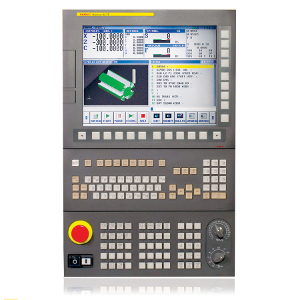
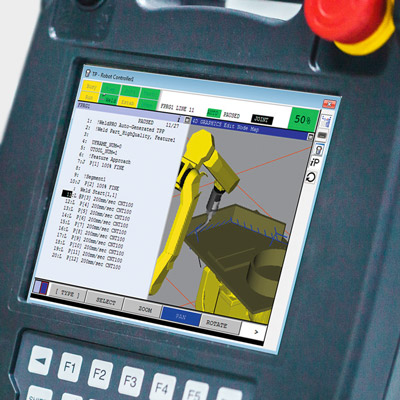

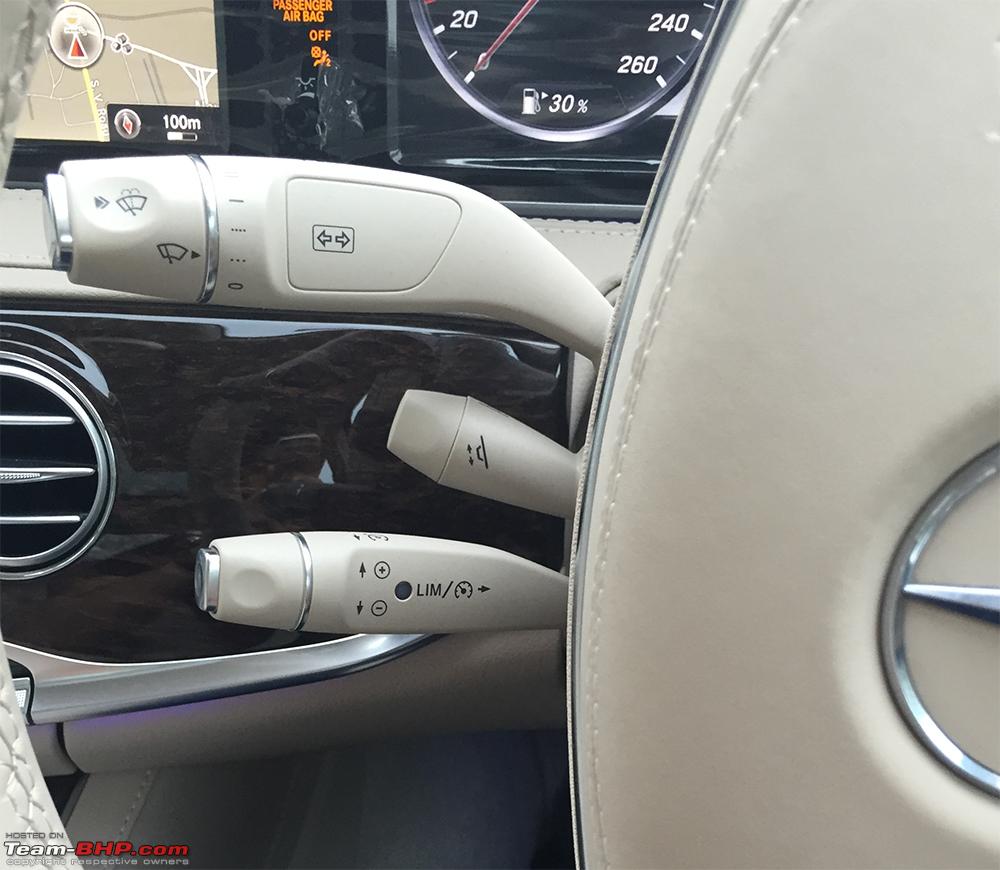

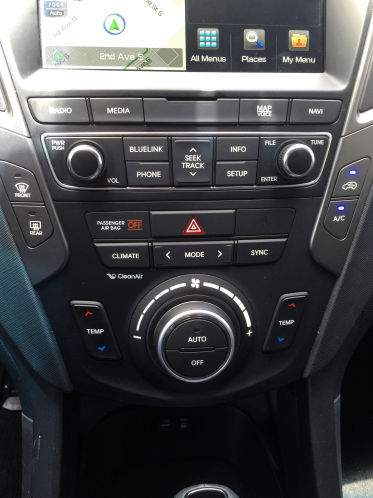

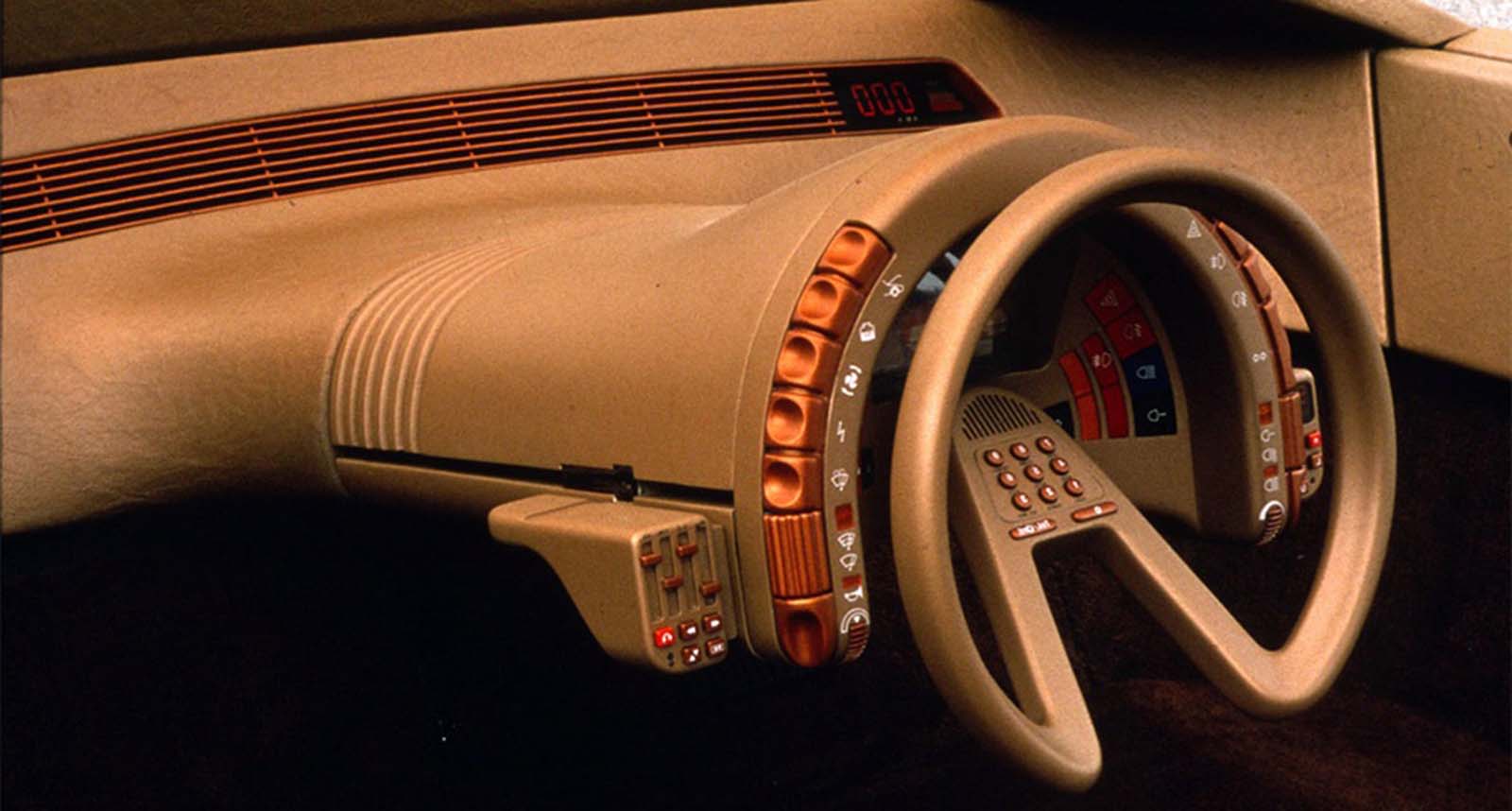
Hardware buttons and switches have to be designed, tested, re-designed, and validated very early in the process of designing a new model so that there is time to figure out how to manufacture / source all the parts, how they integrate with the rest of the car's systems, and how they'll be wired and assembled. Just imagine what the impact would be if late in the process a new feature needs to be added! Pretty much forget about it, add it in the next major model refresh.
With a touchscreen all those dependencies go away. The hardware team just says "there's going to be an iPad sized capacitive touch screen here for climate/infotainment, and another custom sized display here for the instrument cluster". The software guys can independently do the design of the UI, changing things down to the very last moment, or even after the last moment if the car can be updated.