One thing that inflation does that is rarely talked about is how it affects time preference (long-term orientation) of the population as a whole. As inflation rises, low time-preference folks are punished, and high time-preference are rewarded. high-debt w/ little savings is smart, YOLOs are natural.
A 22 years old now that saved 10% of his salary toward an index fund with 4-5% expected returns over a decade is disadvantaged versus someone who just spending his money for material rewards now (in 7%+ inflation long-term environment.)
It infects everything in society and absolutely not some benign monetary problem that the markets will adjust too.
"Low time preference generations produce prosperity, which produces high time preference generations, who bring ruin, which produces low time preference generations."
An index fund isn't going to return 4%-5% over a decade in a 7% inflation environment. Stocks offer a degree of protection against inflation (obviously if prices are going up then revenue is going up). There's other vehicles that can offer some degree of inflation protection.
The other thing is that as inflation goes up you'd expect interest rates to go up. Going into something like bonds at the height of that cycle can get you higher real rates than at any other time.
So what matters isn't inflation but rather real rates and valuations (P/E), certainly there are times where people are more motivated to save and there are times where they're more motivated to spend but I don't think it's as simple as saying that you shouldn't save at a 7% inflation environment.
What inflation does do is it motivates you to buy sooner. If you know the price of something is going higher, and you have no options to get a good return in the short term, and you want it, then you want to buy it sooner.
Yep. Real glad I bought my home before all of this pandemic/inflation craziness. Its estimated value is now up 33% from where it was four years ago. If I had waited until now to buy it would have been more difficult, as even though I've switched jobs and I'm making more money now I probably wouldn't have increased my savings enough for what I'd need for a downpayment and would have to dip into my investments to pay for it.
The value of saving 10% of your income isn’t only about what rate of return you can get for it. It’s also about normalizing your expected standard of living to 90% of your salary, instead of >105% as most people do.
If you get to old age having spent every penny you earned, your standard of living will fall off a cliff when you can’t or won’t work anymore. Someone who saved has both a larger budget and lower expectations of burn rate.
People who can’t fathom having a 6 month emergency fund are somewhat self perpetuating. People with 3 months will find they’ve moved the goalposts closer, and they just need time to get there, but less than they expected when they had 1 month in the bank.
Honestly thinking you will save your way to a great lifestyle is a middle class and very flawed concept. Nickel and diming your life by not going to starbucks and living in a cheaper apartment does nothing.
In our demographic there are a lot of people who struggle far longer and harder than they need to. But there are also a lot of people struggling to stay in the middle class, and some of the same advice applies.
The watershed moment for me was when I realized I could pay for a burst pipe or a dead transmission or a spontaneous road trip without reaching for credit cards. Not just financially but emotionally. Money stress leads to more money stress, on and on in a loop. Had front row seats for that my entire childhood. That thread runs through my entire life. I'd rather find a way to improvise around not owning a specific tool than buying a cheap one. The "best" one is often the third most expensive, but occasionally it's the third least expensive. Making the time to think it over saves me at least as often as not.
$5 on Starbucks has different connotations for different people and in different contexts. If you can't pay your bills and have a daily Starbucks habit, then the Starbucks is a sign of a real problem you need to look at. But if it's the glue that maintains important social rituals, then maybe you keep it. If you have white coat syndrome, and that $5 Starbucks is your reward for getting that thing on your arm checked out, then spend it. Get a scone too. Because that could be the best $10 you spend in your entire life. Same for your favorite ice cream or perfume or steak after asking for a raise, or doing an interview that intimidates you.
Hedonism is not your undoing. It's the treadmill that undoes many people.
Counting pennies doesn't save anyone, no. In fact it's my r/unpopularopinion that counting calories doesn't make you lose weight either. It's the mindfulness about calories or money that works, if in fact anything dues. Treating food or spending as an emotional bandaid doesn't work and creates a greater need in the future. Fad, elimination diets suck all the fun and pageantry out of consuming food. Which is why so many impossible ones seem to work for some people. Food and money aren't fun. They're fuel. Where can you get with them?
You're mathematically incorrect, unless you consider a typical worker saving 25% of their take-home "doing nothing".
A typical take-home for a month's work in US might be $3000. Cheaper rent could net you $300-$600 more, which is between 10-20% of your take-home. Not going to Starbucks every day, saving $5 a day let's say, works out to 5*30 = $150 bucks a month, a full 5% of the take-home pay.
Is 25% really nothing? Maybe you make so much money that $450 bucks a month isn't a big deal, but most people don't see the insidious nature of costly habits and how they're spending thousands per year on their quality of living.
Sure, Starbucks is negligible, but that much rent (assuming you're not in San Fran) makes the difference between a nice apartment in a nice location or a bad one in a bad location (or some such mix) in many place. There's all sorts of other implications that come with a better place that we can't necessarily chalk as simply extravagant unneeded spending.
I think where people get into trouble with fractions and especially where money is concerned, is in not realizing that lowering an expense by 1/4 means that the same money lasts 1/3 longer.
I can't count the number of times I've had to explain to someone, especially in project roadmap discussions, that ±20% doesn't cancel out. 1.2 x 0.8 != 1.0. ±5% almost does, and people extrapolate to larger numbers and make strategy based on it.
Let's say you forego your $5 Starbucks just one day per week and put it into mutual funds. $5 * 52 weeks = $260 extra invested per year.
Let's say you keep doing that each year from the age of 20 until you turn 60. Assuming an average annual rate of return of 8%, that Starbucks money would be worth ~$73,000.
Even though you only put in $260 * 40 = $10,400 total over that 40 years. Just accumulated compound interest over time works out to that.
Do it for 10 more years (50 years total), and a $13k total investment will grow to $161k.
So I'd say it does more than nothing. You don't have to go nuts with it, but even just starting early and putting in money every month, will eventually add up to a lot more than you put in.
By the way, it doesn't HAVE to be a Starbucks coffee you forego, it could be anything, or just a certain amount set aside for the investment, it's just a common luxury that's easy to replace (make coffee for a tenth of that at home) and cheap enough for illustrative purposes, which is why they use it a lot as an example. Keep the Starbucks and eat out one less time per week, or buy one less video game per month, or whatever.
If you're poor and don't really have the room in your budget for $260 a year, do whatever you can afford. Even $60 a year ($5/month) would become ~$37k after 50 years (for only $3000 put in). And hopefully over time you can better your circumstances and afford to put in a little bit more.
Disclaimer: Assumes global stability, no WW3, no environmental devastation in 40 years, etc...which is starting to look less likely.
Did pretty much that for twenty years (more than one kid) - I considered it a positive 'nickel and dime' expense that has paid off with kids graduating (honours) without a dime of student loan debt. Initially it was driven by 'not having that opportunity ourselves (spouse & I) and looking into the future and deciding that whatever education choices our kids made it wouldn't be lost value to save a bit.
One thing I'll note is that like a coffee habit, after the first year or so the concious thought of the expense disappeared - 'out of sight, out of mind'.
If your kid isn't a dummy, they don't need a college fund. If the kid is a dummy, they also, don't need a college fund, because they shouldn't be going.
I had no idea scholarships were a thing until I was well into university. No one ever mentioned them to me and I had no idea of the concept so I didn’t ask.
That said I wouldn’t have got one anyway because my life started falling apart in the last couple years of high school. Still got a physics degree though.
What an asinine take. I was only able to afford college because of the post-9/11 GI Bill, and even then I still walked away with student loan debt.
I'd be in a much better position today if I didn't have to spend time in the military and income today to pay for college. So I'm ensuring that my kids won't have to do the same. Why would I ever want to burden my kids like that.
I got a job in college that opened a lot of doors for me later in life, but at the time what mattered the most is that I could work fewer hours and still pay my bills, allowing me to pay more attention to school work and the other life skills that going away to college are supposed to teach you.
I had friends who made it all work far better than I did, juggling a job and studies and extracurriculars, but only a fool couldn't see that they were walking around with a handicap in the form of having to pay as they went.
Not working at all in school ends up being a liability when you graduate, but if the alternative is being forced by necessity to work to graduate, I'm not sure how much better the cure is than the disease.
This guy almost certainly makes more money off his blog now than he did before "retired", so he's not a good example (although there's some good information on that site).
Proper retiring at 30 (not just "I'll keep hustling but in an unconventional way, i.e. having a popular blog" requires a lot more savings or a much more austere than people assume. And often doesn't take into consideration future medical expenses (especially in the US).
Couldn't find anything for 30 specifically, but here's for 35. Assume even higher numbers for retiring at 30:
"To retire early at 35 and live on investment income of $100,000 a year, you need to have at least $5.22 million invested on the day you leave work.
If you reduce your annual spending target to $65,000, you'll need a starting balance of about $3.25 million in a taxable investment account."
Edit: I think your point still stands though. In situations where inflation is out of control or where you don't have access to stable investments, then spending your income as soon as you get it could be more rational than saving it.
Good point. Related- stocks are traditionally considered a good inflation hedge. Even this article partially debunking that idea shows positive real returns in all inflation regimes, and suggests that inflation up to 5% doesn't hurt stock real returns. Long term inflation over 5% has happened and could happen again, but it would be very surprising to most economists.
That's a great resource. I'd argue that inflation isn't "real" until it gets to around the 5% mark.
High inflation attracts Fed interest rate increases which attracts bond investment over equity investment.
In the US, we now have a triple whopper of post-pandemic supply chain adjustment, tight labor market due to early Boomer retirement, and now war-related energy cost increases. I don't think the economists have updated their model fast enough. I'm thinking we're going to have "real" inflation for a while now.
The last 25+ years of American history prove this wrong.. and it’s not like the last administration was concerned with massive deficits, adding $7T during strong economic times. It seems a bit odd to blame progressives for this one…
It's the opposite, our deficit is the way we run our worldwide financial empire that easily absorbs inflation. Your econ101 household analogies are for other little baby economies.
Instead, inflation comes from energy shocks (70s) or supply chain shocks (now). And the current one is mostly because everyone started online shopping due to being stuck at home.
This isn't my personal theory here, it's the standard explanation.
It basically only happened once. One reason is that preventing deflation is the Fed's job and they've been doing it. Another is that for a wage-price spiral you need both things to increase; in the 70s we had wage spirals because we had a lot more union workers with automatic cost of living increase contracts. Losing those means inflation doesn't happen as fast, and workers don't exactly expect wage decreases the same way, so it's assymetric. (Japan does have wage decreases, and has been stuck in deflation for decades.)
It’s “stable prices and maximum employment” ie preventing both. They mostly fail to cause inflation, which is why we undershoot the 2% target more often than not.
Compare to Argentina for a country that really fails at it.
> You can't have trillions in deficits without massive inflation
You empirically can, because the US has at times done so, but progressives (particularly MMT practitioners) not only recognize the relation between government spending balance, they hold up monetary effects like inflation as the only valid constraints on government spending balance, rejecting the idea that spending balance ought to be governed by the pretense of a fix purse that must be filled by tax or borrowing (the “fiscal” approach), while monetary concerns are controlled exclusively elsewhere on the system.
That assumes all the other variables remained the same. The 2008 banking collapse may have resulted in deflation without the big spending program, which just countered the deflation.
And in periods when investment returns are especially low, it can be better to invest some of that money in yourself, to improve future prospects. Anything from taking classes to going to conventions to paying down debt.
> A 22 years old now that saved 10% of his salary toward an index fund with 4-5% expected returns over a decade is disadvantaged versus someone who just spending his money for material rewards now (in 7%+ inflation long-term environment.)
I would disagree here. This now 32 year old was saving their income during one of the longest booms in American history, and depending on where he invested, now has multiple years worth of investments producing solid returns.
Also, this 22 year old was in a better position to buy a house or car because they also lived through a bust time where lending was much more restrictive in the past. No savings means no house.
The person who went into debt still has all that debt, but now will be buried in a rising interest rate environment. Since they never saved, they are facing rising rents, plunging them further into debt.
People with assets benefit from high inflation environments. People spending more than they earn aren't in a position to acquire assets.
For example, I know people that were scared to take out massive mortgages in past years and instead saved. That turned out to be the wrong move. In our money printing world, it has been much better for folks to buy as much house as they can. The house appreciates and the debt is wiped away by inflation.
Yes if you saved in a savings account, you were screwed. If they instead bought the S&P 500, over the last 5 years they would be up 80%. Still having the bigger house is better than not buying anything at all, but there are many assets that are effectively as liquid as cash, which the government has bent over backwards to protect.
You're forgetting about how leveraged housing is though.
If you bought a 500k house five years ago with 100k down, and now it's worth 1m -- you've effectively gained a 500% return on your 100k, maintained your principle, and you could live in your investment to boot. A house with 20% down (or less) in many housing markets would have blown the S&P out of the water in the past several years.
Yes, you can leverage in the stock market too -- but rarely at a 4:1 ratio -- and if you did leverage up too much, you would have been wiped out by a margin call in 2020.
Leverage, and refinancing. It's not like taking a mortgage locks you at that market rate. With refinancing, you can take advantage of market rates to improve your leverage even more.
I refinanced last year to a 15-year mortgage at a sub-2% rate. The math happened to work out that my payments didn't change, but it halved the amount of my payment going to interest each month. Which, in turn, accelerates my payoff date by about 10 years.
Yeah, but those other assets don't let you live in them. You have to subtract out the cost of your rent for those other assets if you want to compare it to a house.
My mortgage for my house I just bought costs me $7k a month including taxes and insurance. Of the $5.3k I pay a month to service the debt, ~$3k just interest on the debt. Only $2k goes towards paying down the principal.
Which means that I'm forced to pay down this mortgage by $2k every month instead of investing it into stocks. If my house value goes up 50%, that's fine, but if it doesn't or goes down, then that could be a big missed opportunity.
People need to live somewhere. You're either gradually buying yourself property or you're gradually buying your landlord property. Your scared friends weren't saving that money. They were just paying rent instead of making mortgage payments. If you're referring to the down payment, the only economic difference between holding $X in cash versus holding $X in home equity is home equity is going to appreciate faster in most decades. They're certainly punished even more by inflation, but they were already being punished.
Its an example of a possible scenario so not really possible to be suspect. All you need understand is that if inflation is greater than expected return potential you are in the described scenario. It can come about from either lever: confidence in returns is lost causing no one to invest, or inflation outstripping expected returns for a significant period of time (like in Venezuela).
> Its an example of a possible scenario so not really possible to be suspect.
This doesn't follow. I would expect any financial planner worth their salt to consider many different scenarios and make decisions based on which scenarios they think are likely... not based on which scenarios they think are possible.
The fact that it's possible for a decision to put you in a disadvantageous position does not mean that you made the wrong decision. It may just mean that you made a reasonable decision but failed to predict future market behavior.
The idea of using a 40-year high for inflation to do your long-term planning sounds like some pretty outrageous incompetence to me.
It seems pretty unreasonable to take Vanguard’s equities return projections over the next 10 years and simultaneously ignore their inflation projection from that same source.
Equity returns and inflation are not independent and the assumptions that led to their equities prediction are embodied in their inflation prediction.
> 10 year returns in the range of 2.3%-4.3%. And inflation is at 7% right now.
Usually those sorts of estimates are on real returns, so factor in inflation (i.e. 2.3%-4.3% above inflation). That is about right in historical data over most 10 year periods.
That said there have been periods of negative real return, but are you sure this is what Vanguard is predicting?
Annualized returns for the S&P from 2013-2021 was ~15% per year. For 2019-2021 the average was 24% per year.
The idea is that future returns will be lower because those some of those expected future "real" gains (i.e. gains from growth and dividends) are already reflected in the current price (i.e. speculative gains). That these recent years of high returns are due to speculation is clear from the abnormally high PE ratio.
Of course, Bogle has been saying stuff like this for awhile, so who knows. He was saying that future gains would be lower back in '17, and look where we are now.
If I cast the slide ruler over these numbers it suggests the period of time is decreasing, while the returns for said period are increasing. Thus the next values in the series are as follows;
Full year 2022 +33%, H1 2023 +42%, Q3 2023 +51%, August 2023 +60%, first 10 days of Sep 2023 +69%
During the 1970s real returns were negative. Inflation-adjusted S&P 500 was 632 in 1970; it was 395 in 1980. After the 1970s it shot up; it was 788 in 1990, and then 2322 in 2000.
I've seen some academic papers remark that investors tend to undervalue the earnings side of inflation. They will discount future earnings by the high interest rates that go along with inflation, but they will fail to account for earnings growth that goes along with having a profitable business in a high-inflation environment, and for the changes in competitive dynamics that follows inflation. (When rates and expenses rise, it tends to flush out the more marginal and unprofitable firms, which means dominant firms have less competition.) Warren Buffett made a large portion of his fortune by investing in businesses with little competition during times of high inflation.
Basically, it's good to be a stock buyer in times of inflation, and bad to be a stock seller*.
That makes intuitive sense because stock valuations depend on interest rates. Long periods of low interest rates -> high P/E. Long periods of high interest rates -> low P/E.
How reasonable is it to expect a 22 year old to be able to take out a mortgage, given their age and likely lack of any meaningful down payment?
When I was 22 all I had was about $5K in savings, less than a year of experience at my first full-time salaried position and student loan debt to pay off. I imagine any reasonable loan officer would deny me on the spot for a mortgage given my liabilities and lack of proven ability to make payments.
For most of the '60s, inflation was below 2%, while interest rates were 3 to 5%. Inflation started picking up north of 3% in 1967, and interest rates climbed along with it, to 8%.
High interest rates (especially above inflation) create an incentive to save money, and keep property prices low. The higher borrowing costs keep the bid prices of property down, and the positive real interest rate means people don't need to speculate on assets like real estate to save their money.
I see similar arguments with vehicle prices, where vehicles are more expensive, but they are higher build quality, have more features (heated seats, blind-spot warning, etc.), so it's not technically correct to use the term "inflation" since the product is different.
But it still feels wrong to say that this isn't a concern and to dismiss it with that argument, since people still need entry-level options, even if we tout the new bells and whistles we've added to the houses or vehicles over the past few decades.
Saying "housing prices are ridiculous" followed by, "but you get more features!" is no consolation to the family looking to get their foot in the door of the housing market.
Do you have a citation for that claim? I searched for it but didn't find a great source - the one I found put homeownership at ~22yo in 1960 at less than 20%.
Also, it's quite a risky assumption as an individual that one's able to make a long-term profitable bet against an army of professional investors that dedicate lots of resources towards making profitable bets in the same market.
As an individual, one is most likely to outperform other non-commercial individuals. It's rather likely in a complex investment environment that money will flow upward from the less well informed and less well equipped investors towards the big players.
Which is why individuals should be extremely cautious where they invest .. lots of options can probably be summed up as: individual lends big player their money gets negligible real return, while big player makes orders of magnitude bigger return.
Why would asset diversity be considered prudent rather than being an incompetent means to chase mediocre returns?
It's not necessarily high leverage, since you don't know anything about the person's balance sheet. It matters a lot more how much (and what type of) debt the person has, not so much how much debt the real-estate has. Their monthly debt payment to income ratio may be low for example, such that the mortgage isn't a problem at all (and it's an inexpensive way to borrow while inflation is high and mortgage rates are well below that rate of inflation, which is a historical oddity for the US).
Diversification-as-mantra is for people that don't know what they're doing and don't know where to focus. This is what morons on television preach, and other pop investment experts, because they too have no idea what they're doing, they just know that spewing out "diversify" won't get them fired and it seems safe (mediocre returns are anything but safe).
The typical person is incapable of being an expert at many asset categories. It is possible, over time, to become an expert at one or a few however, including real-estate. If you acquire competency at real-estate investing, it will pay off handsomely over time (as with equity investing). Unless you're born wealthy or acquire a lot of money in some other way, you're going to start off buying one property. Certainly one can reasonably debate the amount of down-payment to start with on that first property, depending on personal finances.
The most prudent investment path is to focus on an area narrowly, concentrate at becoming good at a thing, develop as much skill at something as possible. That competency is your safety, not diversification (which is primarily useful when you have little to no skill and need to spread your investments around widely because you don't know what to focus on to generate superior returns for yourself; this is why someone like Warren Buffett advises the average person to just buy a low cost index fund, it's because they're incompetent investors ill suited to managing anything on their own - they simply do not have the skill to do so - and the index fund provides relatively safe generic diversification in the stock market, and the matching returns for that as well).
Asset diversification is important because we don’t get the average expected return from a portfolio, we get the actual returns from only one roll of the dice.
Since you can be foreclosed upon and walk away, your downside is capped at the money you put into the property (and however much you value your credit rating for the following seven years). Your upside isn't strictly capped. So for certain high-earning, low-net-worth individuals (say, a 22yo programmer), the expected value for such a risk is high enough that there's a good argument for rolling the dice.
only in non-recourse states, of which there are twelve. if you don't live in one of those, the downside is still capped, but it's the full purchase price of the house.
it's not a good idea to yolo invest like this unless you really know what you're doing.
True, but those twelve comprise a large portion of the country (mainly since they include Texas and California).
Honestly, in most states your greater risk is likely that a renter just stops paying and you have limited or slow recourse options. But like most undiversified investments, it's possible everything could go to zero (see Detroit).
Right now, you can borrow a large amount of money (larger than pretty much any other loan type) at a low fixed interest rate and pay the bank back less than what they loaned you in inflation-adjusted terms. It's basically free money at this point, and one if the reasons I don't sweat my rapidly deflating salary as much as I otherwise would be.
Oh yeah - that's generally a horrible investment compared to the market as a whole. In essence, you end up losing so much of your profit through taxes and you've managed to take on a business now that requires your time. Land lording is generally a terrible investment unless it's done at a scale and professionally. Not saying you don't make money on it - but that same money is probably better in an index fund for 30 years.
Because in the long term, property values can only go up, given the political power of NIMBYs, all levels of government bending over backwards to protect paper wealth of boomers, and low interest rates.
especially now where in all likelihood you are going to overpay for the property, and at anytime the government just decides that your tenants can stop paying rent for a year or more, but you still need to make your mortgage payments, property tax payments and keep insurance and the heat on etc.
Some people do well with rental properties over the long haul, I wouldn't touch it with a ten foot pool these days - especially if you live in a state where tenants have more rights than the owners of the property.
Monetary inflation is a nominal phenomenon. It's not the returns to investment that are changing (that is determined by the free market) it's just the returns to holding cash. It's the measuring stick for value that is changing.
You can still save and get real market returns through owning real private assets like stocks.
> It's not the returns to investment that are changing
How so? Quantitative easing controls the yield on bonds, and stock prices adjust accordingly to keep their yields consistent with the bond yield + risk premium. We've seen the earnings yields on stocks plummet as a result. After a short-term rapid climb (caused by the step change in interest rates), low interest rates can cause the long term growth of stocks and other assets to also remain depressed, even while consumer prices climb. This is the "stagflation" scenario and is a very real possibility.
This is working as intended. See "the paradox of thrift". You can't eat money. Inflation means money is less valuable than presupposed, because productivity is lower than presupposed, and people need to create more value now.
Losing savings to inflation means you sod your labor in a market that was oversupplied with labor, and spent it in market that is under supplied.
Economicaly, to optimize returns, you should have taken time off from selling labor when inflation was low, instead of hoarding cash.
If you have a good use for your money, you can invest it to beat inflation. Otherwise, you are just seeing the correction for your inflated (ha!) estimate of the value of money.
Inflation isn't bad, it is merely the messenger of the previously hidden misallocation of resources -- either "printing money" (not your fault, but blame the printer, not inflation, or accept it as a wealth tax), or real economic destruction like a natural disaster (Covid) and arguably the political respite to it, or war.
This is only true if you consider financial savings the only type of savings.
Preppers, for example, are very low-time-preference people who have chosen food storage, energy capture and storage, machines, tools, land, structures, raw materials, cabling, conduit, lumber, etc as their mode of savings. They will tend to do very, very well in high-inflation environments.
This also ignores the fact that many assets owned by low-time-preference people (and/or the funds they hold) are leveraged, whether it be real estate leveraged by long-term mortgages, or 4% dividend-paying equities leveraged by 2% margin accounts. Inflation helps these people quite a bit.
Slight nitpick -- I think that's only true as long as interest and investment returns don't rise to keep up with inflation + real return + tax levels on investment income. But, not relevant here, since they're definitely not keeping up.
> One thing that inflation does that is rarely talked about is how it affects time preference
I don't really understand how you got there - it may be left implicit in some conversations, but essentially the entire discussion about monetary policy wrt inflation rates is about managing this preference trade off. The general consensus seems to be that swinging too hard in either direction is a bad thing, hence targeting nominal 2%-ish.
Yea, that's the conversation among academic economic paper, but not among normal people. It's unfortunate that the accepted dogma is that the economy can be managed optimally by making savings unattractive.
There is down-stream effects from the population becoming high-time preference. Spending might go up (thus stimulating the economy), but so would be a lot of undesirable behaviors.
I am reminded of a recent US official who said people not commuting to work and thus not needing a whole suit of services such as restaurants are “bad for the economy.”
What you’re describing is basically the need for monetary policy. When the fed raises rates to combat inflation, this makes debt more expensive and makes yield expectations higher on investments (by raising the risk-free yield of bonds).
> "Low time preference generations produce prosperity, which produces high time preference generations, who bring ruin, which produces low time preference generations."
Inflation severely disincentivizes savings and rewards consumption. This affects the behaviors of entire generations of people. If you really want an example, look at the USA post ‘71 (up to this very day) and its ever-increasing rate of consumption.
This is an horrible example given that since 71 the este of inflation in the US has gone down, not up, while at the same time during the post warn, and during the strong keynesian period it is considered to be a golden age where anyone could buy a house, while at the same time the inflation rates where the highest
What op doesn't mention is that high inflation doesn't per se desincentivize saving, rather it encourages to invest in high returns endeavors, or in assets which don't strongly devaluate, as for example housing, of which most people on the planet being able to own their own small home is their biggest investment of their lifetimes, and again, part of what made "the American dream" what it was, sadly all of that is dead now, so we have millions living in tents in Cali
You’re missing the long term. The inflation went down after having changed buying patterns, and that inflation didn’t disappear. Hence, it is (in general) always better to operate on debt than on cash as long as your interest rate is low (which has been the case for 30 years now). This drives up consumption patterns over-all.
Next, while this does drive the purchasing of investment class assets, those are not necessarily high-return. The reason the stock market keeps going up is not that everyone is suddenly making double the revenue. The stock market has turned into a ponzy-esque scheme where the higher and higher valuations are driven only by people seeing the numbers go up. The actual returns per share are not rising as quickly as the share prices.
Funny you should mention housing, as the housing market predictably crashed in 2008 (Ron Paul called it quite well, as did those who bet against the market). It will happen again as many of the same mistakes have been made. Even without derivatives on property, or even the easy lending, people have been taking massive loans due to interest rates, and this has driven a dramatic rise in housing costs. As more and more people are priced out, and rents continue to increase the potential buying/renting pool shrinks which will eventually cause another crash even if nothing else does.
>Funny you should mention housing, as the housing market predictably crashed in 2008 (Ron Paul called it quite well, as did those who bet against the market). It will happen again as many of the same mistakes have been made. Even without derivatives on property, or even the easy lending, people have been taking massive loans due to interest rates, and this has driven a dramatic rise in housing costs. As more and more people are priced out, and rents continue to increase the potential buying/renting pool shrinks which will eventually cause another crash even if nothing else does.
If you want to avoid housing bubbles and crashes, you have to legalize building more houses.
Also building up. Higher density housing should be the norm in most places. In the US it's the exception and leads to poor public transport, the need for a car, long commutes, etc...
Actually, 2008 was supposed to be the end of the economic system. It should have resulted in a great depression and a massive increase in political polarization and violence. Yet for some strange reason, we are merely limping away from it and that event is becoming a faint memory in another decade.
People didn't take on massive loans due to interest rates, banks were handing out massive loans and this forced them to lower interest rates.
People save first, then the money must be invested, either directly in stocks or indirectly through loans where the borrower invests in his company.
If there is a flood of savings, then there will be a flood of loans as well.
The problem with Keynes is that he dismissed Silvio Gesell's idea of having expiring bank notes. Yes, a modern implementation will probably look very different, no stupid stamps but the principle is much better than attempting to eliminate liquidity preference with inflation.
>Inflation severely disincentivizes savings and rewards consumption.
Good. We've been suffering from deflationary policies that led to demand shortages and low productivity growth since the 1980s. There's a healthy balance, but ultimately there's no moral virtue in economic austerity.
Just to make sure I’m understanding, is the suggestion that people who lived through that high inflation period became more inclined to spend and less inclined to save, culturally, to this day? Do you have any links discussing this further?
If you have the money to buy, e.g., an Xbox, saving it will not neccesarily return you the same amount of money to buy an Xbox in the future, because inflation raised the console's price more than the extra money you got in return of your investments.
If you buy the console right away, you can be sure that your asset is "One Xbox" in value, no matter the amount of inflation.
the assertion, as I understand it, is that if you lived through a period of inflation your generation will be spending more, and not saving as much, for _the rest of life_, meaning even in low inflation periods like the 2010s
Interesting. I’ve lived in the opposite (my entire adult life has been in the low inflation period following the 2008 recession) so I can’t personally relate
Why save money today when tomorrow it will be worth a fraction of what it's worth today? You're better off spending it on anything. Inflationary currency sucks by design, you're supposed to get rid of it as soon as possible.
I’m sure people more educated than I can debate about this all day, I’m just saying that in the system we have as it exists today, the expectation is that the federal reserve will increase interest rates to combat inflation, and in turn this makes debt more expensive and increases the risk free yield rate
Edit: and just to be clear where I’m going with this, the market adjusts along these expectations. Why has the housing market been so insanely hot for a year now? In part because money is easy, and everyone believes inflation is coming/here, so getting a 30 year loan on 3% interest is a killer deal. Consequently home values are through the roof. But this counterbalances: you end up with a higher principle and lower interest for the same monthly home payment, and take on the risk that you will be underwater on your mortgage if asset values crash when rates rise.
You are assuming a simulated environment without permanently increasing entropy. Gold doesn't really suffer from increasing entropy but humans do. That's the fundamental problem that makes it impossible to maintain a gold standard or a fixed supply currency that does not account for entropy.
If you were to account for increasing entropy with a negative interest rate then you could maintain a fixed money supply though I would recommend price level targeting to adjust the money supply to the population and economic growth because of psychological biases.
A fixed supply demurrage currency (negative interest) that is deflationary could in principle work just as well as one that does price level targeting however, the need to adjust prices would remain which is undesirable because we suffer from money illusion.
So no, monetary policy is not what is causing inflation. Inflation is a backwards way of representing an increase in entropy. By that I mean the exponential x% creeping monetary inflation. A supply shock can obviously cause an arbitrary amount of inflation within an arbitrary time span.
This is an absurd conclusion. Time preference is a function of wealth, not the other way around.
If you are a billionaire and can't even spend all your money without being completely reckless then your wealth will grow by the sheer nature of the exponential function, i.e. you spend 3% of your wealth but it grows by 6% so your wealth will grow by 3% forever until the economic system collapses since you have completely absorbed it.
Your time preference is basically 0% as you are unable to spend the vast majority of your wealth.
The time preference of poor people is very high, because their fixed costs like shelter and food massively outweigh the capital gains they earn. Yet every single cent they spend is partially paying the capital gains of the rich.
This has nothing to do with not doing YOLO or being smart or being rewarded, the system is simply rigged.
If this was a free market the interest rate would fall below time preference. In fact, the interest rate would actually have to go negative, not because time preference can be negative, but instead because time preference is actually unable to capture the nature of interest to begin with. It's a complete myth that time preference and the interest rate are the same thing. It's fundamentally impossible as time preference can only exist relative to the highest risk free interest rate minus time preference.
What is the highest risk free interest rate? Fucking 0%. Why is a 0% interest floor terrible? Because the real world undergoes a permanent increase in entropy and requires a perpetual energy input to stand still. So, getting 0% interest actually requires someone, anyone, to pay a non zero interest rate which represents the amount of energy that was added to the system to keep it standing still. In other words, the interest floor is below 0% and we simply forced it to be 0% by decree, against the will of the vast majority of humans on the planet. This is not a free market, it's an oppressive and coercive market.
Obviously, it is impossible for us to simply declare entropy increase nonexistent. The dust we have swept under the rug is still there. It's accumulating. You can see a little mountain forming under the rug. Yes, I'm talking about inflation. Because we refuse to face reality, we either have to perpetually grow the economy to make the mountain of money seem appropriate or we implement negative interest rates through the backdoor, with inflation where people start noticing the dust mountain getting in their way.
No, a gold standard does not solve the fact that we are mortal. It's just another way of ignoring entropy by decree.
You have dollars and you have cheeseburgers. People exchange dollars for cheeseburgers. If you suddenly increase the number of available cheeseburgers, eventually the market will correct and you'll get more cheeseburger per dollar. Most people accept this, but tell them if you increase the number of dollars but leave cheeseburger production the same, you'll need more dollars to get the same amount of cheeseburgers as you did previously, and they insist this isn't true. As a bonus you can replace cheeseburgers with labor and they will say "lump of labor fallacy".
Inflation would probably happen more evenly if we got over these economic myths we have invented for ourselves.
It might be a surprise to you, but Economics 101 supply/demand models for a single good actually don't capture all the complexity of actual market behavior.
Where you say 'you increase the number of dollars but leave cheeseburger production the same' - how exactly do you do that?
I mean, there certainly are institutions that can increase the number of dollars. But those institutions can't constrain cheeseburger production to make sure it stays the same, can they? Cheeseburger makers are free to adjust their production.
So nobody's doing what you suggested - increasing dollars while holding cheeseburger production steady. Instead, they're expecting cheeseburger production to change (maybe it's changing all on its own, as people develop new cheeseburger recipes and tastes in cheeseburgers change), and they are adjusting the number of dollars to compensate.
Which, yes, suggests you are committing the lump of cheeseburger fallacy.
This isn't relevant in the case of broad increases in the macroeconomic supply of dollars, since they affect the supply/demand curves of everything in the economy simultaneously (albeit more at the source of injection as described by the article, e.g. stocks).
For example, you can't really "ramp up" production of burgers in response to higher dollar supply without ramping down the production of salads, unless there were people doing nothing to start with (which is why inflation is related to unemployment, to a degree). But by the same token, those dollars used to incentivize higher production can at best drive a short-term boost in production, as the costs to produce the burgers quickly rise as inflation propagates throughout the rest of their supply chain and the real value returns to where it was. Meanwhile, the expenses for everyone have increased and people who save money or don't want to hop jobs to get an inflation raise have been punished.
What’s “not relevant” in the case of macroeconomic money supply changes are models that try to imagine the whole economic system as if it’s a barter economy containing just dollars and cheeseburgers.
As you rightly point out, you have to have other goods, like salads; a labor force; and concepts like supply chains from which cheeseburger suppliers get their resources, before you can even begin to think about what will happen in an economy when you add more dollars.
And then you need a better way to measure the effects than just using dollars. They’re one of your variables.
I’m not remotely denying that adding dollars to the economy is inflationary, by the way! I’m just unimpressed by simple models that have little explanatory value and lead to bad thinking.
> you can't really "ramp up" production of burgers in response to higher dollar supply without ramping down the production of salads, unless there were people doing nothing to start with (which is why inflation is related to unemployment, to a degree)
Yes I agree inflation can be related to unemployment, and I generally agree with your whole point but I just want to clarify you’re missing one big variable in the formula: Automation.
Cheeseburger Supply = Labor*Automation
As such (like we have today with accelerating automation) we don’t really need more labor to make both Cheeseburgers and Salad.
> those dollars used to incentivize higher production can at best drive a short-term boost in production, as the costs to produce the burgers quickly rise as inflation propagates throughout the rest of their supply chain
Additionally, I want to point out Wage Inflation incentivizes Automation. As such even the production cost increase is a short/mid term concern as long as we can Automate more of the process (e.g. lab grown meat, Beyond Burger, farming automation, online ordering vs in-person ordering, etc).
I don’t think any of this is insightful or will change your mind on anything, but do factor Automation and Accelerating Automation into your equations about the economy.
There's a difference between supply and quantity supplied. The OG is referring to "cheeseburger production" as supply and you're reading it as quantity supplied.
Yes, a cheeseburger becomes more expensive will attract new producers and the aggregate amount of cheeseburgers sold will be higher. But the marginal cheeseburger being sold is at a higher cost to produce (otherwise it would have been produced to fulfill the original demand).
I think the supply/demand model is useful. I think when people claim "its more complicated", they are trying to get around inconvenient truths and basic axioms. You print more money out of thin air, the price of goods is going to go up since its more money chasing the same goods. Creating wealth by printing money is kind of a perpetual motion machine. You need a lot of mental gymnastics to deny the fact that printing money doesn't cause prices to go up. Everyone knows this. Keynes knew this, as did Lenin. Keynes wrote the following:
> Lenin is said to have declared that the best way to destroy the capitalist system was to debauch the currency. By a continuing process of inflation, governments can confiscate, secretly and unobserved, an important part of the wealth of their citizens. By this method they not only confiscate, but they confiscate arbitrarily; and, while the process impoverishes many, it actually enriches some. … Lenin was certainly right. There is no subtler, no surer means of overturning the existing basis of society than to debauch the currency. The process engages all the hidden forces of economic law on the side of destruction, and does it in a manner which not one man in a million is able to diagnose.
> But the marginal cheeseburger being sold is at a higher cost to produce (otherwise it would have been produced to fulfill the original demand).
This may have been true at the time of Keynes but this statement of your hasn’t been true for a very long time. Because of Accelerating Automation “Economies of Scale” (i.e. the marginal cost of a cheeseburger goes down as more are made).
The reality today is that the extra cheeseburgers are made because of a risk calculation on upfront capital investment and opportunity costs. I.e. a low inflation environment makes individuals more likely to save (play it safe) but also makes companies more likely to play it safe and not over allocate capital for supply.
With higher inflation it also incentivizes companies to play less safe and buy more supply chain. Best example, as wage inflation occurs it incentivizes companies to invest and buy robots to make more parts of their burgers. But this is true for all input costs to making burgers. If tomatoes go up, buy tomato farms to reduce their costs.
I don’t think this alleviates all of your concerns (and I’m not trying to, I agree with a bunch of them) but just do take into account Accelerating Automation in your calculations about the economy.
> I think when people claim "its more complicated", they are trying to get around inconvenient truths and basic axioms.
Absolutely.
Many people appear to habitually deny the existence of zero-sum-games, when in reality they are pervasive.
They're just complex and can't easily be be recognized in the chaos of endless interconnections of society.
I think if your model of the economy assumes it amounts to a zero sum game you have definitely missed something.
As time passes, human beings capture energy and use it to do work, and - against all thermodynamic probability - in doing so they locally reverse the inexorable entropy gradient of the universe and create value, by arranging atoms in useful structures, constructing useful or amusing arrangements of information, or transporting matter or information from one place to another where they might be more useful.
This means that the world tomorrow is a little bit better, in some ways, than today. It contains a bit more utility.
And we keep making more people and finding more useful ways for them to spend their time and our collective efforts make it look like that trend of arranging matter and data into ever more useful forms will continue into the future.
(Of course, we do need to consider that this growth trajectory does rather depend on us not screwing up and breaking the systems that sustain us and enable us to continue surviving and thriving, so please don’t take this as a naive assumption that infinite growth without consequences is just inevitable)
But basically, if there’s always more work to do, and more value to create, and more benefits to distribute, every day…
… surely any model that is based on a static pie that can only be cut up so many ways is in flat denial of reality, and falls at the first hurdle.
Take land for instance. There's a finite amount of land on earth. If 8 billion today own all of the land there is on earth, and in 2060 there's now 13 billion people, how are these 5 billion new people going to own land (when all of it is already owned by the other 8 billion)? For the 5 billion new born people to acquire land, means some previous owners must lose ownership of some of their land. Put it another way, if we divided land equally amongst all human beings, with every birth, the amount of land per person will decrease, which means the sheer birth of humans makes us poorer when it comes to the amount of land we each individually own.
Heck you can apply this to most anything. Take iron. If all the iron on earth has been mined and been used to construct steel buildings and cars, and I want to make a new car made of steel, then I would have to dismantle an existing car or building in order to acquire the material to do so. Only reason this doesn't happen today, is because there's still more iron that we can mine out of the ground; I'm not yet forced to "mine" it out of my neighbor's car.
> I think if your model of the economy assumes it amounts to a zero sum game you have definitely missed something.
What I wrote hardly supports your guess about my model of the economy. I merely claim that zero-sum-games appear more pervasive to me than most people are willing/able to admit/recognize.
So no, I don't think "the economy amounts to a zero sum game" is all there is to my model of the economy. But maybe you correctly infer more about my mental model than I myself know about it, who knows.
> ... thermodynamic probability ...
Since you appear to be familiar with thermodynamics, you'll be able to follow my reasoning easily:
Every aspect of society/economy that can be expressed by an equation in a useful way, can be thought of as a zero-sum-phenomenon. Why? Because every ordinary equation can be restructured as a zero-sum equation.
Example:
Y = a * X + b^2 * Z
... can be written as:
0 = a * X + b^2 * Z - Y
> ... so please don’t take this as a naive assumption that infinite growth without consequences ...
To my mind, the mere combination of "infinite growth" and "without consequences" sounds naive, to be honest.
> ... surely any model that is based on a static pie that can only be cut up so many ways is in flat denial of reality, and falls at the first hurdle.
Well, I never claimed that the pie that gets cut up - and this methaphor for the economy is ironically equivalent to the term "zero-sum-game" - be static.
How the size of the pie develops over time (grow, shrink, remain the same) is completely separate from the question of how the pie gets cut up.
The pie always gets cut up, thus there's always at least this very basic zero-sum-game.
I agree basic supply/demand models are almost hilariously simplistic, but I don't think you can really invalidate his point about what happens if money supply goes up but product supply doesn't just by saying "well product supply does go up".
Interestingly actually, Bitcoin is one of the few asset classes that is de-coupled from its supply/demand.
Unlike say, gold and oil - if that increases in demand, more mines are opened, more sites are evaluated looking for it etc. Whereas bitcoin, the higher (or lower) demand doesn't affect the fact that on average a block is only mined once every 10mins adding 6.25 BTC to the supply... And that throwing more resources into mining it just increases your odds of getting that block reward, but not increasing supply as would happen with the above commodities, or in the example - cheeseburgers.
--To the point - when we have increasing amounts of something like dollars, there certainly are things that can't and wont 'rise with the tide' of those dollars increasing in supply.
Bold comment after 2 years of mailing out money to mass population of people who weren't working or running their businesses, resulting in 7% inflation.
Neither Kenyes nor Hayek were idiots. Yes giving money (even more than a govt actually has on hand -- printing) can stimulate labor by market-making to enable barter across space and time. And yes printing more money doesn't magically create more productivity forever.
Nonfarm business sector labor productivity increased 6.6 percent in the fourth quarter of 2021, the U.S. Bureau of Labor Statistics reported today (March 3, 2022), as output increased 9.1 percent and hours worked increased 2.4 percent.
I wonder if inflation=7% and the absolute productivity through automation at 7% (9.2% - 2.1%) is a coincidence, just correlated or causal.
My guess based on a lot of armchair speculation is that inflation pegged to absolute productivity would result in the best possible economy. Maybe with a bit of a buffer just to be safe.
That’s a good idea. I think it still misses a needed link between productivity increases and increases to the lowest wages. Maybe loosely tying minimum wage to productivity?
Could also be modeled in law as “$15 in 2022 and inflation adjusted for every year after”, where inflation as we said is pegged to absolute productivity.
> Most people accept this, but tell them if you increase the number of dollars but leave cheeseburger production the same, you'll need more dollars to get the same amount of cheeseburgers as you did previously, and they insist this isn't true.
The "leave cheeseburger production the same" is doing much of the heavy lifting here. There are many studies that show that prices tend to be sticky[1]. However, when prices do go up, more production does come online to capture those higher prices[2]. However, this can fail to materialize due to a number of reasons.
You forget to mention that if you diminish the number of available burgers you'll need, also, more dollars to the get the same amount of cheeseburgers.
And if you diminish the quantity of some essential product used for everything, as, for instance, energy, you will get the same effect.
Also, people confuse a one time increase of prices with inflation (that is a constant increase in time), and inflation with hyperinflation (two different phenomena).
Increasing the number of dollars spent beyond the economy capacity will cause inflation (at least if the spending is not done in investments that increase capacity) but that's almost never (never?) the cause of hyperinflation.
See (1) for hyperinflation examples.
The article is about models not faithfully showing the reality of inflation and, by extension, the flawed use of inflation models outside of their useful applications.
I'm not sure that using an oversimplified model to make your point about inflation will help clarify the article here.
For every complex problem there is a simple, easily explainable and wrong solution.
You are flying in the face of decades of empirical economic research, you are performing the epistemological equivalent of saying "and then they'll say that everything is made of atoms!"
For a tech-focused discussion, it's interesting (and incorrect) to focus on labor vs. the outputs of labor: productivity. Productivity has outpaced the minimum wage over the last few decades, thanks to technology and other advances.
As someone else said in response, the first chapter of a HS economics textbook is not sufficient to explain the modern economy.
"Labor" is a shorthand for business outputs. Allocation of profits within the business (shareholders, managers, employees, externalities) is a related but different issue.
> As a bonus you can replace cheeseburgers with labor and they will say "lump of labor fallacy".
The trouble with this simple and seeming obvious hypothesis and labour (by which I assume you mean immigration) is that labour sits on both sides of the equation.
If you increase the supply of labour, then you're also increasing demand of all the things the immigrants consume, which means you're increasing the demand for labour.
(How much you're increasing each side of the equation - and how long each side takes to adjust - left as an exercise for the reader.)
> then you're also increasing demand of all the things the immigrants consume, which means you're increasing the demand for labour.
How much of what you consume is even produced domesticly anymore? Take a look around the room you are in. The immigrant now with more money may decide to buy themselves a iPhone and that probably helps someone in China who would like a job assembling them but it still drives down the cost of labor locally. Much of the services immigrants use domesticly will be low margin, like grocery stores and restaurants adding little to the domestic economy.
Exactly the same arguments apply against claims that low-skilled migrants have much impact on wages though. They tend to work in low margin industries which compete internationally against imports from countries which pay lower wages, the existing domestic workforce has little negotiating power or ability, and often the jobs they take are either already at a minimum wage level so their existence literally can't depress it any further, or can't be filled at any reasonable wage level.
Not all their additional consumption goes to the US economy and they only pay a little bit of tax, but they don't need to have very much impact on consumption and production to offset the impact of their slightly lower wage demands.
Plenty of people in the US were involved in getting that iPhone to the person who bought it. Hardware and software engineers at Apple, distribution center employees, truck drivers, customer service reps at the AT&T or Verizon store where many people still buy their phones. Even some of the internal parts of an iPhone are manufactured in the US.
Just because many goods are assembled internationally does not mean that buying those goods does not stimulate the US economy in any way.
Why would that be the assumption? Labor supply varies due to all sorts of things - childcare availability; education and skills; internal migration, which ties into things like housing markets; population growth and demographics; productivity and availability of capital; with remote working, even things like access to high speed internet affects the available labor pool... it's not just 'how many warm bodies are inside the border?'
I thought the phrasing of the person I was replying to implied they were grinding that particular axe.
Of course there are more complex things to discuss here, and in practice reality here is not yet modelled successfully with maths, so we certainly won't figure it out with verbal reasoning.
I was just a bit disappointed with their obvious-yet-probably-not-correct argument, and felt maybe I could respond in a way that made them think it through a bit more.
You're disregarding the fact that both cheeseburgers and dollars can increase, counterbalancing each other. And that if there aren't more dollars while the number of cheeseburgers increases, well, cheaper cheeseburgers. Deflation in a simple world where only cheeseburgers are sold.
Same with labour. Increase the number of people making cheeseburgers, and you get more cheeseburgers and more people buying cheeseburgers. There is no fixed amount of labour to be done. It depends on the number of people.
Not to argue against the ultimate conclusion, but I think you've oversimplified the situation. To make a stronger argument, I think you would need to factor in the fact that dollars can be exchanged for almost anything, whereas cheeseburgers can only be exchanged for dollars. And perhaps other facts, like the fact that cheeseburgers have a much lower value being left in long-term storage than cash.
If you think about a economy it has some amount of productive capacity. You can sort of use GDP to see it, but that is denominated in dollars so it can hide the effect to a large degree. When people shift to alternative goods, productive capacity can shift to producing those new goods, however if the total capacity remains the same those dollars still purchase less productive effort than they did previously. As dollars are the reward for productive effort in the economy, if your wages remain the same your proportion of the efforts of the economy has gotten smaller, but your contributions remained static. I imagine this has contributed to income inequality to some degree.
So, you have some guys that predict inflation for 30 years and are always wrong, after a global pandemic and an energetic crisis, inflation happen and they feel vindicate.
It has to be great to have a model that's never wrong because you just have to wait enough. Not very scientific but great.
Hum... There are plenty of threads about housing here on HN and conversations about people becoming homeless after a disease, or bankrupt due to education costs.
If you want to claim the US hasn't have a large amount of inflation on the last 30 years, you'll need some data that doesn't ignore those.
A rise in economic rents isn't the same thing as monetary inflation. You can't actually erase blockages in the real economy by changing monetary policy. Neither inflation nor deflation will fund public higher education to keep tuition low, break up health insurance oligopolies, or legalize building more housing. Those are political-economic problems, not monetary ones.
I didn't say anything about the USA, and, maybe I'm wrong, but somehow I doubt there was not people becoming homeless, after a disease, in the USA, 30 years ago.
Anyway, if you are not going to use the official indicators of inflation there is not point in discussing anything. I could tell you that my indicator is computing process per dollar and claim a terrible deflation.
On nearly any other country, you won't find people claiming "you have some guys that predict inflation for 30 years and are always wrong", because their non-misleading numbers almost always have some period of high inflation on the last 30 years. But if you have some other one in mind, it will be interesting to look at it.
> somehow I doubt there was not people becoming homeless, after a disease, in the USA, 30 years ago
Take a look of healthcare expenses there compared to personal income going back those 30 years. If you still think it was as easy for a person to get bankrupt by them back there as it is now, well, I'm curious about your analysis.
I'm extremely against MMT - but that are compelling arguments versions of it would not cause CPI. Haven't seen any compelling arguments it wouldn't cause asset price inflation, though.
I don't know what you mean by preach. Modern monetary theory is just an accounting framework. It is kind of true by definition if you define money as credit and assume that central bank money is issued by a central bank and commercial bank money is issued by commercial banks.
That doesn't change the fact that it doesn't address the problems that a negative interest rate would solve.
I have played a game called prosperous universe. The fact that there are money printers that encourage you to engage in economic activity, i.e. the additional money encourages you to invest is something that I tried to question.
Why does an increase in the money supply encourage people to produce more? From the perspective of the community, producing more is certainly a good thing as the economy is not very well developed and there are some progression cliffs as getting engineers and technicians are basically a form of luxury as only ship building is really dependent on their products.
So, more money is somehow good, but why? One idea I had is that creating new money rewards people for doing something they would have otherwise not done. In other words, people receive a share of the economy in return for their economic activity even if half the economic activity is simply being throwing into an NPC dumpster. If you were to represent that share as a percentage of the economy, then your percentage grows as you obtain more created money. It also means that the share of the economy of others shrinks. One could say that this is a way of decentralizing power.
When you think about the opposite idea. A fixed money supply. The economic share of all players may effectively be frozen. Since your power may never shrink, unless you want it to shrink, it becomes very easy for the system to be dominated by a few players.
So ultimately, the problem is the fact that those who need money cannot get it and those who have too much want to keep it. Redistribution among players somehow ends up benefiting both yet this is not the natural order of things. If one person had too much wheat and another too little and the first one has too few tomatoes and the second one has too many, one would obviously see the opportunity for a trade, the market apparently solves the exchange of goods but why does it fail to solve the exchange of money properly? New players are obviously dependent on older players to give them money, but the older players have no incentive to buy from new players, they can just buy from other old players. Lots of people give up at the start, precisely because they don't feel they are being needed.
In fact, I think I would describe the biggest fear that I have experienced in life that I am not needed by anyone. Yes my boss pay me a salary. My parents like me. I have some nice friends. I have had plenty of experiences that make me glad I was born. If reality was a game I probably would have quit, not because of some angry capitalists exploiting me or because of violence against me. I would have thought, this is a nice game but I feel out of place, enjoy your time here, I unfortunately won't be participating.
In fact, a lot of males are sent to fight wars to keep them busy and feel needed. A lot of child soldiers start that way.
What's the solution? Well, the solution doesn't sound that bad or even impossible, it may even sound obvious. Essentially, there must be a purpose for every life. The supply of labor must drive the demand for labor. Interestingly, there is even a law that postulates such a thing to occur. It is known as says' law and yet full employment has remained elusive. If economics predicts that supply and demand will balance themselves automatically, then the only reason for that to not happen is that we have built a machine that prevents this from happening. Money, when used as a store of value, is essentially the ability to decouple supply and demand and we have decided that one should be allowed to do so eternally. Imagine if everyone saves half their salary and nobody borrows that money and money is saved until that person dies. Half the supply would fail to generate demand! Half the people in the economy would be redundant!
This is the ugly truth, we are trying to make each other redundant for fear of becoming redundant ourselves as someone must be redundant at the end of the day the moment the economy is saturated. It's not really a lump of labor fallacy. Those who save, will at some point spend their money even if they do so in a single second at the end of their life. The problem is the mismatch between when the money must be spent and when it is actually spent. A negative interest rate effectively indicates the point at which spending can no longer be delayed and savings must be reduced.
Here is a good chart illustrating the heterogeneity of goods/services inflation[0] over the last 20 years. I would love to see it extended into 2022.
Technological progress is often deflationary in ways we can’t easily quantify, even after hedonic adjustments[1]. A $500 smartphone today would have cost tens of thousands of dollars only a few years ago, if it were even possible to manufacture then. Some people estimate that a smartphone’s total computing power would have been worth several million dollars in the 1990s[2]. Yet someone with a $500 smartphone today doesn’t consider themselves a millionaire relative to someone from the 90s; we simply cannot quantify the monetary effect of having millions of dollars of 1990s computing power in our pockets[*].
Similarly, a new $40,000 Honda Accord is superior in every way (power, amenities, ride quality, etc.) to a $200,000 Rolls Royce from the 90s. Conversely, if a car identical to a 90s Rolls were manufactured in modern factories, it would probably cost far less to manufacture than the Accord, owing to its relative technological simplicity. Yet we don’t typically consider middle class Accord owners in 2022 as driving around in cars only attainable to millionaires 30 years ago, even though this is objectively the case.
[*] I guess the “realistic” 1990s equivalent to a smartphone would be a team of personal assistants who could immediately look up any fact from reference materials, simultaneously call multiple businesses for information about their stock or hours, give real-time driving directions via carphone while reading a map, etc. Definitely more realistic than magically stuffing mainframes worth of compute in your pocket, but still only something that the extremely wealthy could afford.
> $500 smartphone today would have cost tens of thousands of dollars only a few years ago, if it were even possible to manufacture then
Would you have spent ten thousand dollars on such a phone a few years ago? I wouldn't have. I'd have put that money towards renting a nice place to live.
Are you spending, today, ten thousand dollars to buy pre-production builds of next year's smartphone? Is it worth it to you?
The reason people buy smartphones today is because they're a few hundred dollars. That's the point where the cost of the thing falls far enough below the value it delivers to make it worth buying. You can buy one and use it to access your bank account and stress about how to pay back your credit bill next month. So even if that phone would have cost a million dollars decades ago, you don't feel like a millionaire because you aren't one. If you were a millionaire in the 1990s, you'd probably have a house with a swimming pool. If you were poor in the 1990s, you would be stressed about your credit card bill, but maybe doing it on paper.
If someone gave a million dollars to a poor person in the 1990s, they'd probably have spent it to pay off debt, get a roof over their head and feed their family, not blow it all on a prototype palm pilot, a portable TV, and a Cray. In other words, they wouldn't have spent $1,000,000 on smartphone-equivalent functionality, because that functionality would still only have been worth about $500 to them.
The technological deflation gave you a $500 phone, it didn't give you a million dollars of value.
By that logic, 200 years ago we didn’t need cars or trains or modern medicine to be a high-functioning, successful adult. 1000 years ago most people didn’t need any formal schooling to be a high-functioning, successful adult. 50,000 years ago we didn’t need buildings or agriculture or anything at all from modern society to be a high-functioning, successful adult. So any costs associated with a post-hunter/gatherer society are a modern tax at any price point.
This isn’t entirely accurate. A hunter-gatherer society is not a civilization, and life-expectancy was low. We can also assume that due to injury, disease, and periodic starvation that the hunter-gatherer society didn’t have a surplus of adults, much less high-functioning ones. This is precisely why, over time, the hunter-gatherers of the Earth voluntarily chose to settle, to farm, and to organize into civilizations. The car or the horse is, generally speaking, not a tax on the individual as these allow higher rates of productivity than an individual would otherwise have. The smart phone, however, does not offer sizable gains in productivity, and conversely actually steals attention from the individual and therefore is a net tax on the individual.
Some indigenous tribes (not necessarily hunter-gatherer, but no civilization either) are among the healthiest populations ever observed, eg https://en.m.wikipedia.org/wiki/Tsimané
Whereas the ancient Egyptians, a civilization, documented Type 2 Diabetes and coronary disease / heart failure. Settling down and forming civilizations had advantages, but improved health probably wasn’t one.
In hunter-gatherer groups, life was, and is, undeniably hard, but their lifespan was not as short as the numbers press us to think. If you were a hunter-gatherer and you made it to adolescence, there was a strong likelihood that you would live a long and healthy life – not so different from modern humans.
[...]
Modern life does have many benefits, but when it persuades us to use transport, sit in a chair at work, or watch TV for extended periods, we increasingly have to turn to medicine for solutions because these habits are killing hundreds of millions of us each year.
You can check your bank account and credit statements anywhere and any time. Even cashing checks. No more walking (or driving if you could afford it) to the nearest location. That’s value.
You can check the news anywhere. You can make sure your mom hasn’t fallen and hurt herself, that’s stress relief. You can educate yourself (and many people do) in very nuanced topics from the bus stop. You don’t need a second TV/computer for the kids to keep everyone in the home happy. You can quickly find great recipes from your kitchen to cook more healthy. Even just looking up stuff like “calories in salmon” have made me healthier. Yea some of this could have been on my computer, but that would take more time.
>Similarly, a new $40,000 Honda Accord is superior in every way (power, amenities, ride quality, etc.) to a $200,000 Rolls Royce from the 90s.
To be pendantic, the ride quality of the Rolls Royce is still superior. We've had hydropneumatic suspension since the 50s, and that's not a feature anyone thought to include in an economy car. They don't compare to the electronic dampening we have today, but even vintage Rolls Royces are incredibly smooth and quiet.
The adaptive damping suspension available in modern Accords provides a pretty dang smooth ride. I’d love to see someone compare its ride quality head-to-head with a 90s Rolls. I think it would be much closer than you’d think.
Citroën used their fantastic hydractive suspension in their saloon cars - my first two Citroën C5 cars had it, and it was absolutely fantastic. I loved it, but sadly they've now dropped its use.
On the other hand in 1990 the smartphone was no necessity to take part in normal society, so the 500$ and monthly data fee is an additional cost weighing on people, if wages and the price for a bag of potatoes remained equal. It's complicated. (Predictably the bias is to downplay inflation, to allow "printing" more money.)
>On the other hand in 1990 the smartphone was no necessity to take part in normal society, so the 500$ and monthly data fee is an additional cost weighing on people
That's only if you don't consider the cost savings from that. Today you would use your smartphone to handle your online banking. In the 90s you would do what? Drive to the bank and talk to the teller? That costs a non-negligible amount of time, and money for the bank which presumably gets passed on to you.
Also, there's no reason you need to spend $500 on a phone, if all you need is "take part in normal society". That can be done with a $200 android phone, or a $180 iphone SE[1]. I would wager that even with the purchase cost + monthly fee (of a reasonable plan), you'd still be coming out ahead in terms of time savings.
You're looking at this entirely wrong. People are concerned with the price of a phone they can purchase today, not at the what it would have taken to purchase that phone 10 years ago.
For example, a new iphone costs a little more than last year's model cost. You can claim the exact same goods weren't involved, but the available goods have increased in price year over year.
The increase in the quality of available goods often greatly outpaces the increase in price (the opposite of shrinkflation). People don’t mind this because they are ultimately concerned about their overall quality-of-life. Take cars as an example. Both build quality and available features have dramatically outpaced the increase in prices over the years. If there were a significant demand for crappy cars with 90s-era quality (and commensurately low pricing), they would be available for sale. The fact that they’re not means nobody wants to buy them. It would be extremely cheap to manufacture a basic car with few features (thus requiring fewer overall parts) and low build quality (thus requiring a less sophisticated factory), but nobody wants a new car with no air conditioning, minimal sound deadening, low horsepower, crude construction, and 5 digit odometer reliability.
90s era cars aren’t close to meeting current requirements. The new requirements may in fact explain all of the price increases. I imagine there would be a market for a “new 2005” civic at say 7k$, because one exists for the old ones at 2k.
New safety and emissions standards are part of it, but don’t explain everything. Engines have gotten more powerful and more efficient, and the extra power isn’t just to keep up with additional weight due to all the new required safety features (which are a good thing, BTW!). Compare 0-60 times and handling between old and new cars. A new Accord Sport does 0-60 in 5.5 seconds, which was firmly in serious sports car territory in the 90s, and was borderline supercar territory in the 80s.
Materials and fit and finish of new cars are also way better than they used to be. Reliability has greatly improved too over the last few decades, though that’s plateaued somewhat in the last decade or two, likely due to increased complexity. Remember, in the 80s and even into the mid-90s, cars often came with 5 digit odometers because they weren’t expected to last more than 100,000 miles.
If there were a robust market for brand new 2005 Civics, automakers would capitalize on it. The Mitsubishi Mirage[0] is the closest thing on the market I can think of to this. It has the feel of an economy car from around 2005, and sells brand new for $14,000, which coincidentally is almost exactly the non-inflation adjusted MSRP of a 2005 Civic. It sells poorly. Most people don’t want to buy a new car that feels like it’s 15 years out of date.
In my backwards East European country, most people outside of cities use cars for utility purposes. As such, they keep very old cars, and if they need to change, they buy some second-hand ones from Germany and so on. With the new environmental regulations, they are no longer allowed to do that, so they are forced to buy better (for the environment, also maybe features and finishes) second hand cars.
It doesn't really feel like a choice driven by the desire for new features, moreso a choice majorly pushed by new safety and emission standards.
It's odd that you are even creating these arguments that prices don't increase.
Not everyone cares about Price/component cost/feature set/quality. The truth is that the actual real-world cost for what people view as the same item, in this case an iphone, has increased year-over-year.
> People don’t mind this because they are ultimately concerned about their overall quality-of-life.
Of course people mind paying more and more each year.
> nobody wants a new car with no air conditioning, minimal sound deadening, low horsepower, crude construction, and 5 digit odometer reliability.
Those portions essentially cost nothing in the overall build cost of a car. Every car has had A/C for years. An odometer, seriously? Again, the truth for buyers is that the cost of a car goes up year over year. If we set your hyperbole to the side, people do purchase entry-level vehicles when they are introduced to the market. Many times the demand outstrips the supply, because of price.
>Some people estimate that a smartphone’s total computing power would have been worth several million dollars in the 1990s[2]. Yet someone with a $500 smartphone today doesn’t consider themselves a millionaire relative to someone from the 90s; we simply cannot quantify the monetary effect of having millions of dollars of 1990s computing power in our pockets[*].
The thing is that if you have millions of dollars of computing power in the 1990s, you have something extremely scarce, so you can trade it for an abundant supply of other things you need. If you have computing power today, it's abundant, while the other things you need are much more scarce. Dollar values here are just illusions hiding the disparity in productivity improvements between industries, as well as the disparities in market concentration, regulatory capture, etc.
The problem is that you cannot "deflate" land. You need to talk with the existing land owners and they don't want to share. It's like a completely different economic problem.
Like, economists have spent centuries figuring out how to solve the "scarcity problem of reproducible goods" but they haven't spent a second figuring out how to solve the "scarcity problem of non reproducible goods". The suburban sprawl nonsense only exists because we can't figure out how to redevelop existing plots within the city in an equitable way. Yes we have to kick the old residents out, there is no other way but we also build more housing than the numbers of people that were kicked out so if this were done at scale you wouldn't have to worry about leaving the city, just the block you are living in.
The chart is misleading because it plots nominal wages[0] against CPI-adjusted cost of goods. So really, the baseline is at 0%, not the line they denote “average hourly wages.”
(The chart is still valuable for contrasting inflation adjusted costs, but its deceptive inclusion of nominal wages alongside adjusted costs clearly belies the AEI’s agenda. FWIW, the chart used to not include that line.)
> but still only something that the extremely wealthy could afford.
Something only the extremely wealthy could afford, but also something the extremely wealthy never bothered with.
If you think a modern, middle class lifestyle is in any way comparable to the rich in the past 60, 70 years then you have no clue what it means to be rich. It isn't the gadgets they can buy, its the people they buy that completely removes the need to even think about all those things you listed.
The rich don't do self service. This is why the whole discussion makes no sense.
She had initially named the idea the "Vimes Boot index" after the Terry Pratchett character: "The reason that the rich were so rich, Vimes reasoned, was because they managed to spend less money. Take boots, for example. He earned thirty-eight dollars a month plus allowances. A really good pair of leather boots cost fifty dollars. But an affordable pair of boots, which were sort of okay for a season or two and then leaked like hell when the cardboard gave out, cost about ten dollars. Those were the kind of boots Vimes always bought, and wore until the soles were so thin that he could tell where he was in Ankh-Morpork on a foggy night by the feel of the cobbles. But the thing was that good boots lasted for years and years. A man who could afford fifty dollars had a pair of boots that’d still be keeping his feet dry in ten years’ time, while a poor man who could only afford cheap boots would have spent a hundred dollars on boots in the same time and would still have wet feet." https://www.theguardian.com/books/2022/jan/26/terry-pratchet...
The problem with the story is that it is vaguely correct but it makes subtle mistakes.
The problem isn't the fact that the boots are longer lasting. It's the fact that buying new boots is an emergency so you cannot just delay it. It's a fixed cost that everyone has to pay. The rich person can afford to buy both the crappy boots and the good boots and still have enough left over for everything else.
a tailored narrative at best. Vimes could have borrowed money to buy the good boots - as long as he could earn more than the interest when using those boots.
it is, but the narrative was that the total cost of the flimsy boots is some 10x the cost of 1 of the good one. An enterprising financier could charge 5x the cost of 1 good boot, over the life time of it, and the wearer is still going to be better off (and he obviously could afford it because previously he was paying 10x over the same period).
So the only reason this isn't done is because the flimsy boots aren't 10x the cost, but likely only 2x the cost. There's no room for financing option since transaction and friction costs would absorb any possible profit.
Argentinian here. I agree with almost everything in this article. Except for
> high-inflation Argentina has almost no mortgage industry.
Real state is 100% dollarized since the late 70s [1]. It is not just about inflation because you can have adjusted interest rates [2]. We don't have mortgages because of the government currency exchange restrictions, and also our salaries didn't adjust as much as the inflation rates.
What I also find with a bit more years of experience is that different groups are impacted quite differently by inflation and price shifts like currently happening.
Take my 15 year younger self. I was driving to university 35km (around 22 miles) and back every weekday. Additionally 4 - 5 times per week I drove this for my job as well (I was working as a bartender while in university).
I paid for gasoline from my tip. The rest money was for costs of living. I was happy when I was able to buy a book for leisure reading. The price for gasoline in Germany skyrocketed in the last few weeks. I would have been hit so hard by these prices.
Nowadays, with a stable job, working from home and earning quite well I don't drive that much by a long shot. This gasoline price surge doesn't hit me so hard nowadays. Because I am in a privileged position to be able to WFH and earning more than enough, that it would not impact me so hard if I would need to drive to the office every day.
In my opinion people with less available/spendable income are hit harder. Rural people are hit harder (at least in Germany gasoline is more expensive in my experience in rural areas). People who absolutely need to commute to work are hit harder.
Within the past few weeks, what with the JWST coming online and more radioastronomy happening than ever, and also economic inflation coming into the news for the first time in a while, this is unfortunately not the first time I've had to play "spacetime or finance?" with an inflation headline recently.
> I've heard multiple Americans say that "inflation is good for workers because it erodes debts", but they forget that wages are generally the last thing to adjust.
This seems to completely ignore bargaining power and what the corresponding state of the labour market is when inflation is about: Typically it's a tight labour market that's really good for wages, particularly low-end wages! I really like Devon's writing usually but I think this one isn't telling the whole story.
Even though wages are last to adjust, over the long term inflation is good for those with a lot of debt at fixed interest rates. Those large debts get smaller over time and eventually wages catch up.
Note the qualifacations on that though. Change any and things change. In the US real estate often does fit the specifics.
Those are a minority of all debts by total value. People won't refinacne to a higher rate, and those who get high rates plan to refinancing in a few years when rates improve (might not happen but that is the plan)
For a bit over half of Americans inflation is good for their situation over 10 years.
Financial assets which are close to the money printers are the most affected by inflation. In the case of financial assets such as stocks, the effects appear to be positive initially, but the increase in stock price adds fragility which means that when people start selling their stocks (e.g. employees start retiring and selling their shares), it will crash very quickly if reserve banks don't step in to bail out the markets.
> As a result, the inflation rate each person experiences is very personalized. It's hard to agree on what "the inflation rate" is, because it depends on what you need to buy. If you drive a lot, fuel inflation will impact you more. If you're vegetarian, meat inflation isn't going to hit your pocket book.
Investopedia defines inflation as "the decline of purchasing power of a given currency over time". [0]
Prices diverging is not inflation. It's reallocation of value in response to a changing world and changing perspectives.
I don't understand your objection or what quoting Investopedia is supposed to show?
Here's a paper from the New York Fed that contains the sentence "Because the basket actually purchased by each household potentially differs from the CPIís basket, the
inflation rate faced by any given household might be very different from the CPI-inflation rate."
The question is, how do you quantitatively define "purchasing power" when prices are diverging? Is it the number of cheeseburgers you can buy? The number of TVs? The number of houses? If you take some average, the average of which set, and why?
One idea is weigh by reported actual expenses in each category you're measuring. But that way, you're just measuring the trend in expenses, which should be proportional to GDP per capita.
Edit: no, not all GDP is consumer spending (there is also investment, government expenses, and net exports).
Investopedia is using just one type of inflation there.
The truth is, money printing and/or government spending beyond tax revenue is the source of inflation. Every loan a bank makes in fractional reserve systems will be inflationary, and every time money is printed for the government it will be inflationary. Due to the cartel structure of banking in the modern world, the inflation will first hit things like stocks, bonds, land, and other asset classes. It takes time for that inflation to leak into all other things, but it does. As businesses expand, as people move, they are then forced to pay these higher prices, and this drives up the price of goods produced and bought.
If inflation occurred constantly and smoothly, I would assume the relative prices stay in sync.
If you see crazy swings that have occurred during the pandemic - real estate crashing in central business districts while going up for industrial areas [0] - that has nothing to do with government money printing and everything to do with pandemic restrictions.
That is true. You must keep long term in mind tho. Long term all real estate prices have gone up and up with short term crashes. This is people needing to park money, which will eventually backfire when no one can afford the prices anymore.
> As a general rule, inflation disproportionately harms people who can't easily adjust their income upwards.
That's actually interesting. Especially in countries with job safety, where you can't fire one easily, nor reduce their salary without consent (such as France, Germany, ...) this seems to be an easy way for employers to "adjust" salary and essentially get people fired who earn "too much" from the perspective of the employer.
On the other hand, this is good for people who _can_ negotiate their salary upwards.
Would be interesting to have this part covered in more detail.
I think this is where inflation really hurts in the long run: the ability to somewhat accurately forecast based on the current state of the world. Ultimately a lot of companies will get it wrong, have too much/too little inventory, and some companies will struggle or go bankrupt due to this.
I had the realization that economists only look at identities that hold in the "steady state" after a shock to a system, like the printer going brrr for a while, and don't consider transitory states because they are difficult to model and calculate.
That's why you have smart people going around saying inflation doesn't matter and other dumb stuff like that.
There's no steady state, people! The system takes longer to reach steady state than the time between shocks!
You're only wrong in one respect: economists don't only look at steady states. Keynesian macro looks at frictions, for example. Economists are quite aware that inflation propagates through the economy unevenly; they are not that naive as a rule.
I did learn general equilibrium in grad school, but we were not told that it was a precise description of reality.
Can we at least all agree that the 4.7% inflation for shelter in the CPI is utter bullshit? It's almost as if they wanted < 8% inflation, and just kept adjusting that number down in the spreadsheet until we hit 7.9%.
Here on Earth, actual rent is up 19% and housing is up 18% YoY.
It's also 1/3rd of the CPI basket.
If shelter was set to 18.5% YoY instead of 4.7%, CPI would be well into double digits.
-----
In reply:
CPI isn't about things you're not buying. It's about new purchases. By definition.
That said, 40% of homes in the US have no mortgage.
~6 million homes are sold every year. The CPI should be about the cost of those purchases changing YoY, not about "well, if we include all of the things people bought in previous years, as you can see, prices didn't go up."
Rent is not the entire housing bucket (only 35% of Americans don’t own a home) and it’s also not uniform. If you have a house with a fixed mortgage, your housing cost has increased by probably about the increase in property tax due to assessed value rise. What you’re probably looking for is a local cost of living index rather than nationwide CPI.
"Little or no consideration has been given to the possibility that higher prices may simply be the market allocating resources and not inflation.
Prices reflect the indifference levels where buyers and sellers meet.
If, for example, there is a freeze in Brazil, the price of coffee may go up. The higher price accommodates the transfer of the remaining supply of coffee from the sellers to the remaining buyers"
Higher prices across the board is the market trying to allocate resources, but not being able to do so efficiently. Higher prices, by definition, IS inflation...it doesn't matter what the cause is, whether it is a freeze in Brazil or a ship getting stuck in the Suez or a war. If prices go up, your purchasing power goes down, and it is inflation.
One thing I’ve noticed is the things that have increased way above inflation for the past few decades are:
Medical care,
Urban Housing,
Education
These are things that disproportionately affect middle class families and below, as they are so important and a much bigger proportion of their budget.
These are also things that are sometimes referred to as a ‘right’ and are massively regulated by the government.
Countries with socialized housing, healthcare, and education do not experience the cost increases of those things seen in the US. So you have it backward. The US runs these things like a half-assed free market so public wealth is efficiently siphoned to the owning class.
On the contrary, US housing is incredibly socialized, which is why we have some of the worst affordability in the world. The capitalist, free market approach would be to allow landowners to build almost anything they want on their land, but US housing construction is incredibly tightly regulated and prevents that. Consider that despite San Francisco having some of the most unaffordable housing in the country, it's illegal to build an apartment building in 70% of the city [0]. Deregulating construction and renting would result in an increase in supply and allow the price to come down. (Imagine a world where cars are too expensive – would you support making the production of new cars illegal, because those are "luxury" cars only the rich can afford? No, you'd want those cars to be produced so the rich buy them instead of bidding against a poorer person on a used car.)
Another commenter mentioned Denmark's housing is also socialized. To see how they're doing, I googled until I found an english version of their public housing department's website [1]:
> We rent out our 13.500 apartments on a strictly first come first serve basis. Our waiting list is very long, so expect to wait at least five years for your first offer.
As expected, there's no getting around the laws of economics. If there are 10,000 houses and 15,000 people who want to live in them, something will prevent 5,000 of the people who want a house from getting one. If you put the houses on the market and ban new housing construction (apparently the American way), the 5,000 people with the least purchasing power will be the ones unable to get a house. If you instead use a waiting list, the people without a house will be the ones least able to wait on a 5-year-long waiting list.
Meanwhile, Japan has a sane government and allows new construction, and the price of an unsubsidized Tokyo apartment has actually gone down in real terms even as the population doubled in the last few decades. Housing in Japan is considered a depreciating asset – it gets cheaper every year.
The reason US housing is so dysfunctional is exactly like you say, only you have the mechanism backwards. The owning class, who are much more politically connected, are able to use the government to prevent new housing from being built and devaluing their property. When encountering a problem caused by too much government intervention, I find it odd to suggest even more government intervention. Sure, maybe there's something the government can do to fix it, but the American people can't even stop the government from ruining the housing market right now, so why should we have any confidence that socializing housing further will improve things?
Half glass full / empty : so many things deflating all the time: moore’s law, internet information, open source software, incompetent people getting fired, cheaters getting caught, brain drain from poorly managed states.
Would you mind expanding on this? If a person relies on credit and borrows to purchase a home, wouldn't inflation eating away at the value of that debt (assuming wages increase) be less of an impact on the borrower?
I was thinking more about consumables like gas, groceries, and rent. A lot of American consumers rely on credit to pay monthly bills and inflated goods would likely prevent people from paying bills in full. The inflated prices would be hit with interest rates on revolving credit lines.
For what it’s worth, the BLS does have methods to account for both of these. How well they work I don’t know, but the numbers you see reported contain adjustments for these.
I spat out my coffee this morning when a CNN news reader commented that because of the 5 trillion that was handed out to people last year, people will be able to fight through this inflationary period. I think we aren't too far away from "thank goodness that the regime printed trillions of dollars for everyone so we can fight through the Putin price hike!"
Yep... putins relatively fresh war is guilty for a year of price increases due to massive printings of money... CNN!
Otherwise, what i find most sad is, that people are cheering the printing of money (because they get handouts), but "in the end" (which is very soon after the handouts), they lose the same amount of money in price hikes everywhere due to inflation, and large corporations (so the ones that get the "free money" from the people to sell them stuff) profit in the end.
Also the propaganda machine is helping the pumping-up the prices... first they talk about the higher prices of everything because of this and that (covid, putin, war,...), people then expect higher prices, and even if the current wholesale prices are still low, the sellers will raise them, because the media told the people that the prices will go up, people blame putin (and not the stores), and why not take advantage of the situation?
You might get some gauging and people taking advantage of things, but I do believe that it will correct in relatively short order. The entire beauty of the free market system is that anyone making "too much" will have that margin taken away by someone willing to do it for less profit.
I just wish economists like Krugmen would revisit some of their previous articles about how printing trillions of dollars and passing it out won't cause inflation. Those articles were parroted by so many people and for the party that demands "accountability" they certainly know how to bury things and move on to another problem they have the best solution to.
> they lose the same amount of money in price hikes everywhere due to inflation
This point only makes sense if you assume that the price hikes wouldn't happen without the handouts, and that those people would have been able to stay in a dignified life (food, housing) without that buffer.
Big assumption!
Your point about the rhetoric around prices is exactly right. Pretty obvious, only looking at corporate profits vs price increases.
I am not an economist, but here is my theory on the whole thing (would love to hear if there is a flaw with this reasoning!):
The fundamental problem is that a wealth of a society is determined by its productive capacity. A society with more homes, more cars, more phones, more food, more clothes, more university classrooms, more hospitals and doctors, more medicine, (you get the picture)... more good and services is wealthier.
A society with more dollars but without the corresponding increase in all of those things is no wealthier.
You can magic up trillions of dollars and hand them out to each and every individual currently alive in the US or for that matter the planet. Give each person a billion dollars. You still would not suddenly end poverty, or hard ship or hunger or anything else.. that money is still used to buy the goods and services which are being produced at the same rate as before.
When we distributed trillions of dollars over the last couple of years while simultaneously having lockdowns for covid, we not only added money to a system without adding corresponding productive capacity. We did the opposite.. we reduced the number of homes being built and maintained, we reduced the number of clothes being manufactured, we reduced the amount of education we provided, we reduced the amount of health care provided, we reduced the number of vacations and restaurant meals that were provided, we reduced the number of cars being made (you get the picture)... we created a backlog of unmet demand.
The prices would likely have gone up even without the money printing due to this backlog of unmet demand, the additional money in the system just made the price rises bigger.
Authoritarians hate jokes at their expense too and demand to be taken seriously. If you can't stand being laughed about then you can't expect to be taken seriously either.


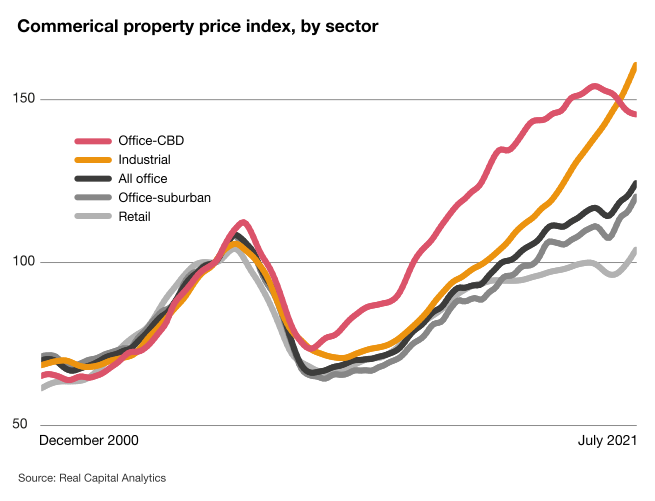
A 22 years old now that saved 10% of his salary toward an index fund with 4-5% expected returns over a decade is disadvantaged versus someone who just spending his money for material rewards now (in 7%+ inflation long-term environment.)
It infects everything in society and absolutely not some benign monetary problem that the markets will adjust too.
"Low time preference generations produce prosperity, which produces high time preference generations, who bring ruin, which produces low time preference generations."