Firewall are useless if you don't run badly coded daemons? And no need to put a strong password on a database if there is a firewall anyway?
Security measures are not all or nothing. It's about reducing the risk.
Even with a testing mandate some infections might not be detected. And wearing the mask, even 50% of the time, might reduce the risk of contracting or transmitting germs during the flight. It's a minor inconvenience that helps keeping the risks somehow under control
You need actual cost and benefit analysis. The situation can actually be different if some measures prevent spread by 1%, 10%, 50% etc.
Cost and benefit analysis can be ineffective or unwanted in beginning stages of a pandemic.. but for COVID-19 it's been few years already and we can do such analysis.
Multiple studies agree that mask wearing is highly effective, and even moreso in confined spaces/close quarters. In a study done onboard Navy ships it reduced transmission by 70%.
Do these studies replicate the idiotic process of giving everyone a drink so 90% of the people in the confined space take of their mask to snack and drink?
And many studies say the opposite, unfortunately studies are more or less junk. Non-profit research just isn't usefully reliable.
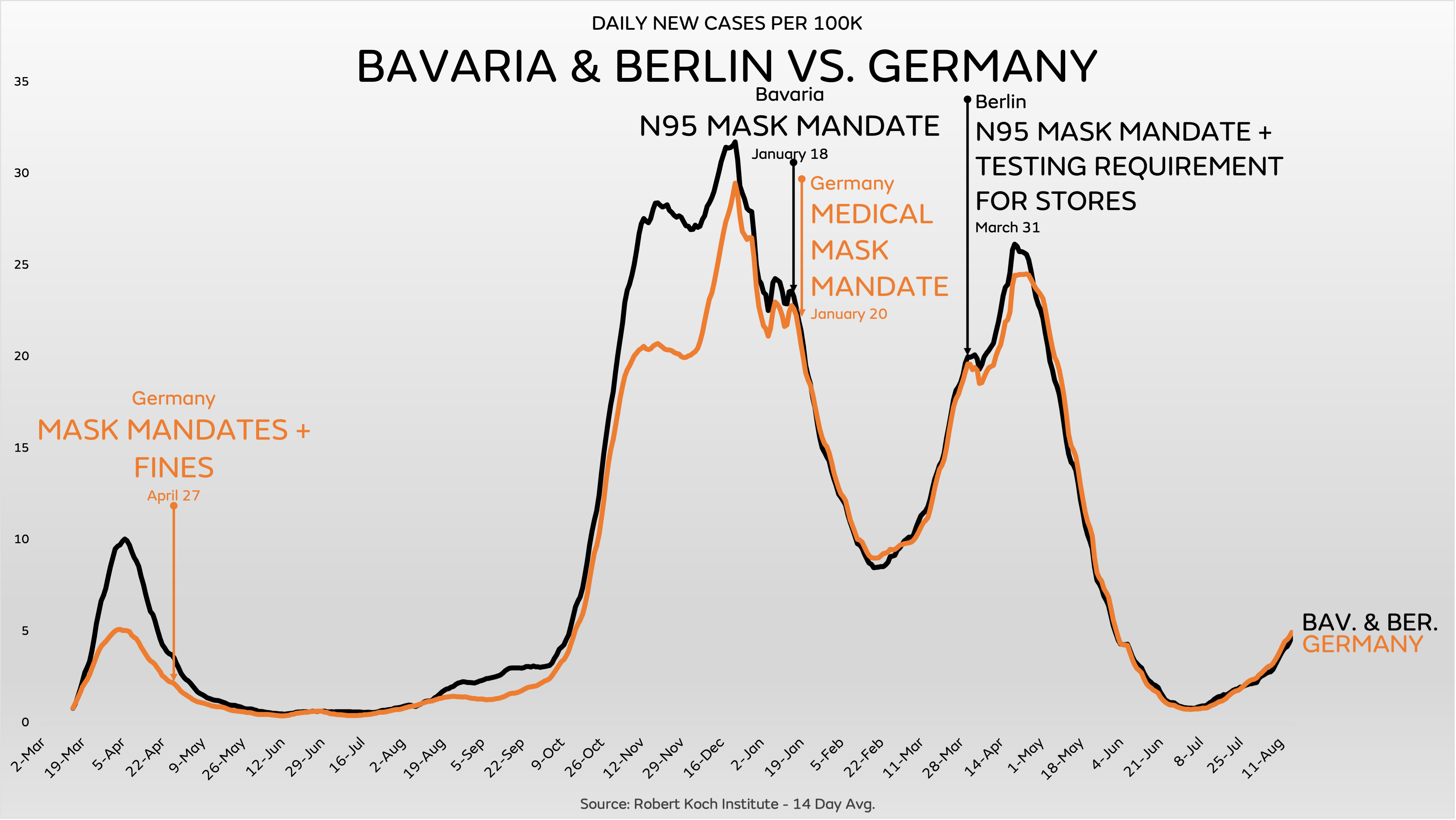
Fortunately we don't really need studies here. A study is an attempt to figure out what would happen if everyone were forced to wear masks, but we did that already. Mask mandates get added, removed and changed at different times even in places that are physically next to each other, allowing us to see what it means in reality - which is nothing. States, counties, cities next to each other that differed only in mask mandates have identical case curves.
If masks actually worked, this data shouldn't be possible. There'd have to be a clear difference in outcomes. For instance this debate doesn't come up with vaccines except in the form "the real world stats appear to show some effectiveness against hospitalization and death, but are they reliable/interprted correctly?". Whereas here there are no real world stats showing effectiveness, only a handful of worthless studies that invariably seem to have major methodological errors when examined.
I'm sure actual gas masks would work, hopefully, but if you come up with a definition of "mask" that nobody actually uses and then claim mask mandates work, or even that masks work, then it's the same as admitting they don't really work.
> There is ample evidence that masking and social distancing are effective in reducing severe acute respiratory syndrome coronavirus 2 (SARS-CoV-2) transmission. However, due to the complexity of airborne disease transmission, it is difficult to quantify their effectiveness, especially in the case of one-to-one exposure. Here, we introduce the concept of an upper bound for one-to-one exposure to infectious human respiratory particles and apply it to SARS-CoV-2. To calculate exposure and infection risk, we use a comprehensive database on respiratory particle size distribution; exhalation flow physics; leakage from face masks of various types and fits measured on human subjects; consideration of ambient particle shrinkage due to evaporation; and rehydration, inhalability, and deposition in the susceptible airways. We find, for a typical SARS-CoV-2 viral load and infectious dose, that social distancing alone, even at 3.0 m between two speaking individuals, leads to an upper bound of 90% for risk of infection after a few minutes. If only the susceptible wears a face mask with infectious speaking at a distance of 1.5 m, the upper bound drops very significantly; that is, with a surgical mask, the upper bound reaches 90% after 30 min, and, with an FFP2 mask, it remains at about 20% even after 1 h. When both wear a surgical mask, while the infectious is speaking, the very conservative upper bound remains below 30% after 1 h, but, when both wear a well-fitting FFP2 mask, it is 0.4%. We conclude that wearing appropriate masks in the community provides excellent protection for others and oneself, and makes social distancing less important.
In Germany FFP2/N95/KN95 masks are mandated in many places and situations. Only few people wear them with a tight fit though.
Germany provides a good counterpoint, because some very nearby places differ only in the type of mask mandate. Some places mandate N95 and others don't. This is the result:
A better analogy of letting people eat and drink on a flight, so not wearing a mask at all time, would be to completely disable filtering on the firewall for a few minutes every hour.
Some people do dry fast, neither drink nor eat, for 24 hours straight with no negative effect. Can people who care so much about COVID they are ready to ban people from flying for the rest of their life, BUT they cannot not bear the inconvenience of not eat nor drink for a few hours?
If it is sufficiently necessary for people to wear a mask then it makes absolutely zero sense to make an exception for eating. Most flights are short enough that you do not actually need to eat during the flight unless for example you have a medical reason for which obviously an exception ought to be made. The obvious example being diabetes.
pretty sure they're breathing during the flight thou, otherwise masks wouldn't be required.
please note: no one gives a shit if your antivax on a flight. its you're fucking behavior that's the problem. Thats what puts the scarlet letter on your forehead not your moronic views on vaccinations.
Its effectiveness at preventing the person who receives it from dying doesn't prove it also substantially reduces the probability of transmission, which is what the parent is talking about.
It makes it less likely for you to catch it in the first place a necessary prerequisite for transmission. Also your bodies ability to fight the virus is liable to reduce your viral load and ergo chance of transmission.
It beggars belief to imagine that your body is both more adept at fighting it and also somehow just as good at transmitting it.
COVID-19 Cases, Hospitalizations, and Deaths by Vaccination Status
February 02, 2022
> 5 times more likely to be hospitalized with COVID-19 compared with fully vaccinated 12-34 year- olds.
This can mean that the risk of hospitalization goes from 0.01% to 0.05%, which isn't something most people would care about. With statistics like that we need absolute numbers, not relative. Your post is basically an example of "how to scare people with meaningless stats".
Actually great grandparent post was asserting that vaccines didn't decrease transmission. In order to counter that assertion the relative numbers are exactly what is appropriate.
But what do I know, I'm not a guy trained to Trust the Scientific Authority, just a lowly pleb with a degree who does math and statistics for a living.
Hospital ICU COVID patients are almost entirely the unvaccinated. This is not in disupte except by conspiracists. What’s the alternative statistical explanation of why unvaxxed are ~90% of covid ICU?
> What's with all the whiney low-effort replies, dude? You're going to have to put a hell of a lot more effort and evidence into your replies, since you've chosen to put up an ideological defense and carry the water for Anti-Vax Science Deniers.
So what was your scientific argument for mandating vaccines against SARS-CoV-2 in the age of the Omicron variant again?
I think you read much more into this than I wrote, in fact I have no idea what exactly in my comment you find terrifying.
Banning access to airplanes is already being done in cases where the airline decides a passenger isn't worth the trouble, just like a restaurant owner can ban people. Using a no-fly list is too much, and wouldn't do more than that either way.
Anti-vaxxers/Covid deniers have physically assaulted and sometimes even killed bystanders and it's not far-fetched to assume they don't take safety of other community members as seriously. Why would I want to share a plane with such people?
> Anti-vaxxers/Covid deniers have physically assaulted and sometimes even killed bystanders
Some extremists that are also supposedly unvaccinated have done that.
Lumping everyone together under one insulting label and then judging them by the worst apples leaves you with a skewed image.
> and it's not far-fetched to assume they don't take safety of other community members as seriously. Why would I want to share a plane with such people?
I would say it is extremely far-fetched. Of the unvaccinated people that I know, nobody is aggressive or violent or would ever engage in behavior that is risking the safety of other passengers.
Punishing them for what some extremists have done is neither fair nor lawful.
> Why would I want to share a plane with such people?
Would you prefer to share your plane with a psychopath who happens to be vaccinated or a lovely person that happens to be unvaccinated?
The comment above me, which I was replying to, is not about flights but is instead claiming that the vaccine does not help prevent hospitalization, which I pointed out is patently false.
US data simply doesn't match figures reported by other comparable countries around the world and is likely to be distorted in some way. For example, here's a story from the UK in October/November last year saying that the majority
of Covid ICU patients were vaccinated.
But we're not debating whether the stat is misleading or not - I think pretty much every stat about COVID vaccines is misleading in various different subtle ways. The original claim in dispute was a factual statement about particular numbers along with a claim that only "conspiracists" could disagree this. But the claim has been wrong in the UK in the recent past, and this is not a matter of "conspiracies" but of published fact, therefore the claim is wrong and people should stop making it.
Re: out of date. I'll take your word for it on the UK data now, but it hardly matters. Here's one from today showing the same thing for Israel:
"Professor Yaakov Jerris, the Director of a coronavirus ward in an Israeli hospital, has said between 70% and 80% of the serious cases in his hospital are vaccinated and that the vaccine has “no significance regarding severe illness”. Israel National News has the story."
Are Israeli hospitals really overloaded with unvaccinated COVID patients? According to Prof. Yaakov Jerris, director of Ichilov Hospital’s coronavirus ward, the situation is completely opposite.
“Right now, most of our severe cases are vaccinated,” Jerris told Channel 13 News. “They had at least three injections. Between seventy and eighty percent of the serious cases are vaccinated. So, the vaccine has no significance regarding severe illness, which is why just twenty to twenty-five percent of our patients are unvaccinated.”
I am asking what is the alternative explanation why the US covid ICU hospitalizations are dominated (upwards of 90%) by unvaccinated people. If the vaccine were ineffective against hospitalization --as you claimed-- wouldn't the ICU unvaxxed percentage be 50%? I'm legitimately interested to hear if there's an alternative explanation (besides "All the hospitals in the US are lying").
The people doing the research had a foregone conclusion - "vaccines are crucial in our anti-Covid effort" - and then went out of their way to massage the data to prove their point.
Other countries had different foregone conclusions, and demonstrate entirely different results.
So what is it to you then if someone is vaccinated if you are protected? Did you before throw a fit COVID that the person sitting next to you didn't show you a vaccine card?
The post that you replied to is about the spread of the virus.
Your reply is about "hospitalization and severe side effects, including death".
It is common knowledge by now, January 2022, that SARS-CoV-2 vaccines do not prevent transmission of SARS-CoV-2.
A tripple-vaccinated person can infect other people.
I was infected by a tripple-vaccinated person and I was vaccinated as well.
We both still live, so maybe the vaccines did something to prevent hospitalization and severe side effects, including death.
How is preventing hospitalization and severe side effects, including death relevant from an airline perspective?
Obviously they need to do their best to prevent spreading of the virus, but if they start mandating things that have almost no impact on that, such as the vaccines, they are overstepping boundaries.
Vaccines have never "prevented" transmission absolutely, so 100%.
They have always "prevented" transmission in some cases, so reducing transmission. At slightly lower rates than preventing severe outcomes.
Delta was 2x more transmissible than the first strain of Covid. Omicron appears to be around 4x more transmissible than delta, so 8x more transmissible than the original variant.
Even if the vaccines had been 90% effective at reducing transmission and was just as effective against Omicron, we would expect Omicron to spread in a fully vaccinated/boostered population just as quickly as the original variant spread in a completely unvaccinated population.
However, the vaccines were not 90% effective at preventing transmission of the original variant, more like 60-80% IIRC. And Omicron has mutated significantly, so effectiveness is further reduced. And of course there is a significant percentage of unvaccinated (partly due to "the vaccines don't work misinformation, sigh!), and the virus has a much easier time going from unvaccinated → vaccinated or vaccinated → unvaccinated than it does going from vaccinated → vaccinated.
So seeing high(er) transmission rates right now in no way "proves" that the "vaccines don't work at preventing transmission". Neither do anecdotes that do not contradict the actual evidence. Transmission rates would be a lot higher without vaccines.
> However, the vaccines were not 90% effective at preventing transmission of the original variant, more like 60-80% IIRC. And Omicron has mutated significantly, so effectiveness is further reduced. And of course there is a significant percentage of unvaccinated (partly due to "the vaccines don't work misinformation, sigh!), and the virus has a much easier time going from unvaccinated → vaccinated or vaccinated → unvaccinated than it does going from vaccinated → vaccinated.
Now Omicron is dominant and these earlier strains are not relevant anymore.
It is reasonable to expect that the virus will mutate more and faster, maybe even with many different strains that are relevant at the same time.
> And of course there is a significant percentage of unvaccinated (partly due to "the vaccines don't work misinformation, sigh!)
Most of Africa is unvaccinated, because they don't have the vaccine, while some countries are trying to enforce the third injection.
> Transmission rates would be a lot higher without vaccines.
That is not an argument for mandating vaccines when they only prevent the spread of the currently dominant strains with a very low probability or maybe even not at all. Actually I haven't heard of any good argument for that yet.
> Now Omicron is dominant and these earlier strains are not relevant anymore.
Yes they are, when explaining why "it's spreading quickly now" does not imply that the vaccines aren't effective.
They are.
>> It is common knowledge by now, January 2022, that SARS-CoV-2 vaccines do not prevent transmission of SARS-CoV-2.
And when you stop spreading misinformation like this, I will stop correcting you.
> Most of Africa is unvaccinated
What relevance does this have to your false claim that the "vaccines do not prevent transmission"?
> > Transmission rates would be a lot higher without vaccines.
> That is not an argument for mandating vaccines
You are right that it is not. Fortunately, that is not the reasoning for vaccine mandates, but just a rebuttal of your misinformation, such as:
> they only prevent the spread of the currently dominant strains with a very low probability or maybe even not at all.
No, they do not prevent spread at "very low" probability. Omicron is just much, much more contagious, so even with pretty high probability of prevention the rate of spread is high. This is why comparing with older variants is helpful with understanding the current situation.
You are also making the mistake of thinking of the effectiveness as a completely independent variable. But it is not. Overall effectiveness rises as the vaccination rates increase, because vaccinated → vaccinated has a lower probability of transmission than vaccinated → unvaccinated or unvaccinated → vaccinated.
And since Omicron is so much more transmissible than Delta, never mind Alpha, getting to a higher vaccination rate is more important than ever in achieving the desired societal outcomes.
Furthermore, every sick person puts a stress on the health system. With Omicron being so incredibly contagious, the risk of overwhelming the health system rises, meaning that other people suffer when you become sick, even if you don't infect anyone.
> Actually I haven't heard of any good argument for that yet.
Because they still prevent transmission, as they have done since the start and as was known from the start. They still prevent transmission in less than 100% of cases, just like they did from the start and was was known from the start and just like they do with severe outcomes.
Claiming that they do not prevent transmission is misinformation.
Claiming that there has been some sort of change in this knowledge is misinformation.
   CDC Director Rochelle Walensky said that Covid-19 vaccines are no longer effective at preventing transmission of the virus.

   "...what they can’t do anymore is prevent transmission. So if you're going home to somebody who has not been vaccinated, somebody who can't get vaccinated...
   I would suggest you wear a mask in a public indoor setting,"
Claiming that the vaccine prevents spread is misinformation.
b) I doubt that it is true, though Omicron is a tough one.
c) The reason I doubt it is that this is a nonlinear effect, i.e. you cannot easily extrapolate from vaccine effectiveness at 65% vaccination rate to vaccine effectiveness at 91%, 99%, or 100%.
d) The more contagious the virus, the higher your vaccination rate needs to be, for reasons that I hope are obvious.
e) So, seemingly paradoxically, the more the vaccine seems to not be working (it actually still is, the virus is just mostly much more contagious), the better the case for vaccine mandates. We really, really need to starve the virus of hosts, particularly so we don't breed ever more variants.
f) Even if it were true that R would still be > 1 with a 100% vaccination rate, as long as the R rate is lower with the vaccines than it is without the vaccines, the vaccines are preventing (some) transmission.
> e) So, seemingly paradoxically, the more the vaccine seems to not be working (it actually still is, the virus is just mostly much more contagious), the better the case for vaccine mandates. We really, really need to starve the virus of hosts, particularly so we don't breed ever more variants.
This seems so unrealistic when most of the world's population is still unvaccinated and the virus can jump from and to animal hosts such as mice too, which seems to be the case with Omicron. So what is left? Mostly just the tyrannic aspect of vaccine mandates, besides of personal protection against severe diseaes for some of the few people who would not get vaccinated voluntarily and some prevention of transmission that does not provide any meaningful personal protection.
Under the current circumstances a more likely outcome is that everyone will be exposed to the virus, regardless of vaccination status and those who survive that (partially due to being vaccinated) will gain some natural immunity and this is what starves out the virus in the long run.
Especially when the vaccines do not prevent (most) transmission.
Why do you think that R would be below 1 with a 100% vaccination rate? In countries with 80-90% vaccination rate we still see massive spread. Handwaving about "nonlinear effects" doesn't cut it. Vaccine mandates are a very heavy tool, that needs very heavy justification.
There is no magical law of physics that ensures that a 100% vaccination rate gets R<1. It all depends on how transmissible Omicron is in vaccinated people.
The numbers are currently still in flux, but a reasonable current estimate is that two vaccinations are approximately 70% effective against hospitalisation with Omicron.
We also know that it is (much) less effective against transmission than it is against hospitalisation.
Even if it were 70% effective against transmission, that might still not be enough to get R<1 given the ease at which Omicron spreads.
Compare, say, with the measles, which has a natural R of about 10. With a 70% effective vaccine, it would still spread. Luckily we have a vaccine that is 99% effective against transmission, so it can be stopped. COVID vaccines are not nearly as good.
To give some indication from my country (the Netherlands) where 86.3% has been fully vaccinated, of the positive corona tests, approximately 66% fully vaccinated. We can see that this 66% is less than 86.3%, indicating that the vaccination is somewhat effective at stopping transmission, but that's still a heck of a lot of vaccinated people who can catch and transmit covid.
> Even if it were true that R would still be > 1 with a 100% vaccination rate, as long as the R rate is lower with the vaccines than it is without the vaccines, the vaccines are preventing (some) transmission.
Of course, but in the long run it would make little difference, because as long as R>1, then more and more people will continue to catch the disease, just over a longer period of time. Smearing out infections can be important if there is a shortage of hospital beds, but this can hardly be called "stopping transmission".
> The more contagious the virus, the higher your vaccination rate needs to be, for reasons that I hope are obvious.
Absolutely correct! And at a certain point, unless the vaccine is 100% effective against transmission, the vaccination rate would need to go above 100%, which is clearly not possible.
Secondly, many lifestyle choices affect the rate of transmission. The singular focus on the forcing people to inject something into their body against their will is unethical (note: I have personally been vaccinated). It is unethical not just because it violates bodily autonomy, but also because it is an easy way to abdicate from your responsibility to take care of your other lifestyle choices that affect the spread.
> We really, really need to starve the virus of hosts, particularly so we don't breed ever more variants.
Not going to happen. Even at a 100% vaccination rate it would still have many human hosts as the data I quote above show, but also because many wild animals now have COVID too. Unless they develop a new vaccine that is much more effective than the ones we currently have, there is no stopping it any more. We need to learn to live with it, like we do live with the flu. We are lucky that Omicron is so much milder than Delta. If you are fully vaccinated then the chances that you have serious illness are very very low. It for sure is terrible for old people and those with existing health problems, but we cannot realistically do anything about that, except for instituting Chinese level control. The response against COVID is at this point completely irrational and doing more damage than COVID itself. Not just economically (which directly translates into future deaths), but also because it is tearing societies apart.
They do reduce the chance of transmission. Vaccinated people have a lower viral load when infected.
And even if there was no difference it would still make sense to me. There's likely a large overlap between anti-vaxxers and people who don't like adhering to safety measures.
    CDC Director Rochelle Walensky said that Covid-19 vaccines are no longer effective at preventing transmission of the virus.

    "...what they can’t do anymore is prevent transmission. So if you're going home to somebody who has not been vaccinated, somebody who can't get vaccinated... I would suggest you wear a mask in a public indoor setting,"
You are linking to correspondence, not to the study, the study suggests the opposite.
Saying they are completely ineffective is wrong based on what we know, to the best of my knowedge. I read, I talk to friends and family in the medical community, I am not an expert.
My understanding is that the vaccines have some effectiveness in preventing further infection but aren't fully effective, as evidenced by the study in Lancet which you indirectly linked to.
Just because peak viral load is apparently the same doesn't mean infection duration or transmission rates are the same, and the study suggests they aren't, in part because of faster decline in viral load among vaccinated folks.
Of course that data is only about delta. The science may change, and I follow the science.
Getting back to what I said, you know that, in the US, vaccine hesitancy is correlated with both less mask usage and less social distancing, right? https://pubmed.ncbi.nlm.nih.gov/33592035/
If your idea is true, and the vaccine is completely ineffective, that still suggests unvaccinated folks are more likely to get infected with COVID, and to transmit it.
Getting back to the article, "Bastian said Delta has placed nearly 1,900 people on Delta’s “no-fly” list for refusing to comply with masking requirements"
Those aren't people I particularly want to fly with during this pandemic, but I do find the scope creep of the federal no fly list, as opposed to the company's list, disturbing.
You are quoting an opinion letter to the Lancet, not peer reviewed research (see the "CORRESPONDENCE" in the top left corner). Passing opinions/letters off as peer reviewed research can legitimately be classified as "fake news"
The authors of the study that this letter referenced responded to the letter:
"Although our findings support Franco-Peredes’ conclusion that vaccination status should not replace social and physical public health mitigation practices, the above clarifications explain why our findings do not support his assertion that mandatory vaccination of health-care workers would not reduce nosocomial SARS-CoV-2 transmission."
Maybe the source was unfortunate, but how can someone in January 2022 say with a straight face that the existing SARS-CoV-2 vaccines prevent the spread of the virus?
I was vaccinated and I was infected by a tripple-vaccinated person and one of my best friends is in a similar situation.
The idea that the vaccines prevent the spread of the virus is dead since we saw the number of SARS-CoV-2 cases in highly boostered countries.
Not sure what's with this "prevent" straw man, which seems to imply that vaccines need to be 100% effective, otherwise they do not work at all.
This is not true and has never been true.
Vaccines "prevent" the spread in many cases.
Vaccines not not "prevent" the spread in 100% of cases.
Just like they do not "prevent" severe outcomes in 100% of cases. You can be fully vaccinated and boostered and still die of Covid. It's just a lot less likely than if you're not vaccinated. This reduction is the vaccines working as designed and advertised.
Effectiveness at preventing spread was always less than at preventing severe outcomes, even with the original variant the vaccines were designed for (or against). This was in all the literature I read about the vaccines during early 2021 (which also showed that, for example, AZ was significantly less effective at reducing the spread than BionTech, although both were >90% effective [still not 100%!] at preventing severe outcomes).
In the meantime the virus has mutated significantly, and the vaccines are less effective than they were against the original variant, but still effective.
> Not sure what's with this "prevent" straw man, which seems to imply that vaccines need to be 100% effective, otherwise they do not work at all.
They don't need to be 100% effective, but they need to be reasonably effective in order to be mandated as a tool for mitigating the spreading. At the very least reliably above 50%, I would say. Otherwise they can only be a tool for personal risk reduction, because they don't reliably do something against the spread. An airline has no authority to mandate personal risk reduction that is not related to the flight.
OK. So are you now retracting your previous claim that "vaccines do not prevent transmission of SARS-CoV-2"?
> but they need to be reasonably effective in order to be mandated as a tool for mitigating the spreading.
Sure. This is a judgment call probably best made by people who actually know what they are doing?
> At the very least reliably above 50%, I would say.
Since you previously believed that they were not effective at all, which is 100% wrong, maybe you are not the ideal person to make that judgement call?
> Otherwise they can only be a tool for personal risk reduction
This turns out not to be the case, for several reason. First, have you heard of the Swiss Cheese Model?
Lots of individual measures, none of which is perfect, together prevent calamities. And in aviation, all these measures are mandated, despite each individual measure not being super effective by itself.
Second, even a 20% reduction could be thing that suppresses the R value sufficiently to either not go exponential or to flatten the curve sufficiently to not overwhelm hospitals.
Third, even the, according to you, "purely personal" risk reduction of preventing severe outcomes is actually societal in a pandemic situation, because we don't have enough hospital capacity.
Fourth, I have seen no actual evidence from you for either (a) 50% being a reasonable threshold or (b) vaccine efficacy being below 50%.
Fifth, vaccine effectiveness at prevent spread increases markedly with fewer unvaccinated people. Vaccinated are far less likely to spread the disease.
So sixth, an airline is very well within its rights to prevent potential harm from its passengers and employees.
> OK. So are you now retracting your previous claim that "vaccines do not prevent transmission of SARS-CoV-2"?
Why should I? It is true, because I was infected after getting vaccinated by someone who was vaccinated as well. There is a lot of data that suggests the same.
> Since you previously believed that they were not effective at all, which is 100% wrong, maybe you are not the ideal person to make that judgement call?
No, I didn't. Don't twist my words. I don't respond to ad hominems and after all you asked me for that answer.
> Fourth, I have seen no actual evidence from you for either (a) 50% being a reasonable threshold
>> > OK. So are you now retracting your previous claim that "vaccines do not prevent transmission of SARS-CoV-2"?
> Why should I?
Because it is false.
> It is true, because I was infected after getting vaccinated by someone who was vaccinated as well.
That does not make your statement true. The vaccines never prevented transmission at 100% effectiveness. Never ever. They were not marketed as doing so, and if anyone did claim they prevent transmission at 100% effectiveness, then that person was spreading misinformation. It was never true.
They didn't even prevent severe outcomes at 100% effectiveness, and they were always much better at preventing severe outcomes than they were at preventing infection. (Initially >90% vs. <~ 80% against Alpha).
The whole idea that one case of transmission proves the vaccines are ineffective at preventing transmission is silly.
> Don't twist my words.
I am not twisting your words. You were making a judgement call, which you are obviously not qualified to make.
> The whole idea that one case of transmission proves the vaccines are ineffective at preventing transmission is silly.
There are many cases. Mine is just the one where I know by 100% that the vaccine was ineffective at preventing transmission. However, the CDC itself says that SARS-CoV-2 vaccines cannot prevent transmission anymore:
   CDC Director Rochelle Walensky said that Covid-19 vaccines are no longer effective at preventing transmission of the virus.

   "...what they can’t do anymore is prevent transmission. So if you're going home to somebody who has not been vaccinated, somebody who can't get vaccinated...
   I would suggest you wear a mask in a public indoor setting,"
Misinformation?
> Seems to be greater than 50% to me. Drops after that, but once again, it was always known that the effectiveness of the vaccine would be temporary.
Guess which efficacy is smaller than the efficacy against symptomatic disease? I am not sure if it was always known that the efficacy was temporary. In the initial phase some scientists speculated about decades. Actually we can only now know how temporary they are after testing them on millions of people.
> By saying who they allow to fly or not. You don't have to get vaccinated. United does not have to fly you.
Sure anyone is free to avoid business, but if you want to put people on nationwide blocklists, then that may be illegal.
>> I am sure we will see such questions being clarified in courts soon.
> Will probably be very short court cases...
Sure, if the pro-mandaters still don't have any good arguments and have to resort to ad hominems instead, I am sure it will be quick.
Again: this is 100% expected. Why is it surprising to you? Even if the vaccines were 90% effective at preventing transmission, which they aren't, you should expect millions of such cases when you have tens of millions taking the vaccines. And tens of millions of such cases when you have hundreds of millions of people taking the vaccines.
You seem to be genuinely surprised (horrified?) by the fact that there are such cases. Why is this so?
The CDC director's comments are not misinformation, but your misrepresentation of those comments could probably be classified as such, similar to the way Carlos Franco-Paredes (the Lancet letter writer) misrepresented the findings of the study: vaccines are no longer sufficient by themselves, so you need to do other things as well.
Or as the authors of the study wrote: "Although our findings support Franco-Peredes’ conclusion that vaccination status should not replace social and physical public health mitigation practices, the above clarifications explain why our findings do not support his assertion that mandatory vaccination of health-care workers would not reduce nosocomial SARS-CoV-2 transmission."
In the same vein, the CDC recommends vaccination as the #1 measure to help "stop the spread", despite your misrepresentations of the director's statement:
"Get Vaccinated and stay up to date on your COVID-19 vaccines
- COVID-19 vaccines are effective at preventing you from getting sick. COVID-19 vaccines are highly effective at preventing severe illness, hospitalizations, and death.
- Getting vaccinated is the best way to slow the spread of SARS-CoV-2, the virus that causes COVID-19.
CDC recommends that everyone who is eligible stay up to date on their COVID-19 vaccines, including people with weakened immune systems."
> You seem to be genuinely surprised (horrified?) by the fact that there are such cases. Why is this so?
I am not horrified by the fact that vaccines do not prevent (and only slow) the spread of the virus, because as you said, that was always to be expected, but by the fact that people are trying to implement mandates on such a weak basis, while ignoring all the social fallout that comes with such mandates.
> The CDC director's comments are not misinformation, but your misrepresentation of those comments could probably be classified as such
"could probably be classified". So you acknowledge that you falsely accused me of spreading misinformation. Thank you for the discussion.
> [..] vaccines do not prevent (and only slow) the spread of the virus, because as you said, that was always to be expected
They "slow" the spread of the virus by preventing infections. A breakthrough infection is not a slower infection, it is an infection that happens at the same speed (in fact, a little faster overall because it subsides more quickly). All the slowdown is via infections that do not happen, and were thus prevented.
> So you acknowledge that you falsely accused me of spreading misinformation.
Not in the least bit. You were definitely spreading misinformation earlier, all over this thread to be precise. Your misrepresentation of the CDC director's comments is a slightly less clear cut case, because you might reasonably claim to have just misunderstood her, but the other cases are pretty crystal.
> They "slow" the spread of the virus by preventing infections. A breakthrough infection is not a slower infection, it is an infection that happens at the same speed (in fact, a little faster overall because it subsides more quickly). All the slowdown is via infections that do not happen, and were thus prevented.
Slowdown != prevention. You will just be exposed a bit later on average, but the spread still happens, just slower.
SARS-CoV-2 vaccines prevent the spread of SARS-CoV-2.
Is a lie.
SARS-CoV-2 vaccines do not prevent the spread of SARS-CoV-2.
Is a true statement. The one that you chose to attack for some reason that only you know.
Feel free to move the goalpost again. Or, you know... just accept the truth.
You have acknowledged that the vaccines prevent transmission, because that is how they slow the overall spread. You have acknowledged that it was always known that they do not prevent infections at 100% efficacy.
Your word games in constantly switching around individual and global definitions of "prevent", "spread" etc. are of no interest to me.
As a counterpoint my unvaxxed housemate got covid a couple of weeks ago, I(boosted two weeks to the day at the time he showed symptoms) took no precautions and never developed symptoms. I also had close contact with someone who got omicron(PCR verified) the day after we hung out(asymptomatic then) and have yet to develop symptoms, that was this past Sunday so I'm pretty sure I'm good now. Vaccines work to prevent spread even now.
I had symptoms and a multiple negative rapid tests at the same time. Only a PCR test confirmed that I was indeed positive.
On the other hand, having no symptoms is no reliable test for being SARS-CoV-2-negative, since many Covid cases are asymptomatic and even asymptomatic people can infect other people. So there is a chance that you unknowingly gave Covid to someone else if you did not self-isolate.
However, even the CDC says that vaccines don't prevent transmission anymore:
   CDC Director Rochelle Walensky said that Covid-19 vaccines are no longer effective at preventing transmission of the virus.

   "...what they can’t do anymore is prevent transmission. So if you're going home to somebody who has not been vaccinated, somebody who can't get vaccinated...
   I would suggest you wear a mask in a public indoor setting,"
You're moving the goalposts on what I'm saying, which is that I never developed symptoms. I followed CDC guidelines while in public(which had just been updated, yet again), so I don't really care if I was covid positive or not. More anecdata, very few people I'm around are vaccinated but nobody that I was in close contact with got sick, so it's doubtful that even if I was positive that I was shedding viral particles in large quantities. This is called ending the pandemic, where this virus becomes just part of the background since there's no point wasting tests on otherwise asymptomatic individuals and it doesn't affect society as a whole. These vaccines (still) work(for now).
> You're moving the goalposts on what I'm saying, which is that I never developed symptoms.
Maybe I misunderstood you and I apologize for that, but I think you got my point - being asymptomatic says nothing about the efficacy of the vaccine against transmission and hence spread. There are asymptomatic Covid cases in vaccinated and in unvaccinated people. It has been found that there is no difference in viral loads between vaccinated and unvaccinated people who PCR test positive.
    A recent investigation by the US Centers for Disease Control and Prevention of an outbreak of COVID-19 in a prison in Texas showed the equal presence of infectious virus in the nasopharynx of vaccinated and unvaccinated individuals.6
    Similarly, researchers in California observed no major differences between vaccinated and unvaccinated individuals in terms of SARS-CoV-2 viral loads in the nasopharynx, even in those with proven asymptomatic infection.7
    Thus, the current evidence suggests that current mandatory vaccination policies might need to be reconsidered, and that vaccination status should not replace mitigation practices such as mask wearing, physical distancing, and contact-tracing investigations, even within highly vaccinated populations.
> This is called ending the pandemic, where this virus becomes just part of the background since there's no point wasting tests on otherwise asymptomatic individuals and it doesn't affect society as a whole.
Fully agree. People also need to accept the virus as part of their lifes and stop throwing a fit, because someone else is unvaccinated, because it is obvious (and not misinformation) that the vaccines do not prevent that almost everyone will be exposed to the virus.
> People also need to accept the virus as part of their lifes and stop throwing a fit, because someone else is unvaccinated, because it is obvious (and not misinformation) that the vaccines do not prevent that almost everyone will be exposed to the virus.
I'm glad my parents' and grandparents' generations didn't share this attitude, for the obvious reasons of smallpox, polio, and MMR being practically nonexistent in my time, and with comparatively little fuss about mass societal uptake. [n.b. I am aware of the various efficacy rates of the vaccinations above, I'm just bookending this reasonable conversation we're having]
> I'm glad my parents' and grandparents' generations didn't share this attitude
That's not an attitude, but a conclusion that is based on what we know about the virus and the vaccines.
Smallpox, polio and measles can practically be eradicated with vaccines, while SARS-CoV-2 cannot, at least not with the existing vaccines. It is also important to look at the fatality rates and other risk factors. Denmark has decided that SARS-CoV-2 is not a threat for the society anymore and lifted all mandates. Not because they don't value life, but because they value life.