That is simply not true.
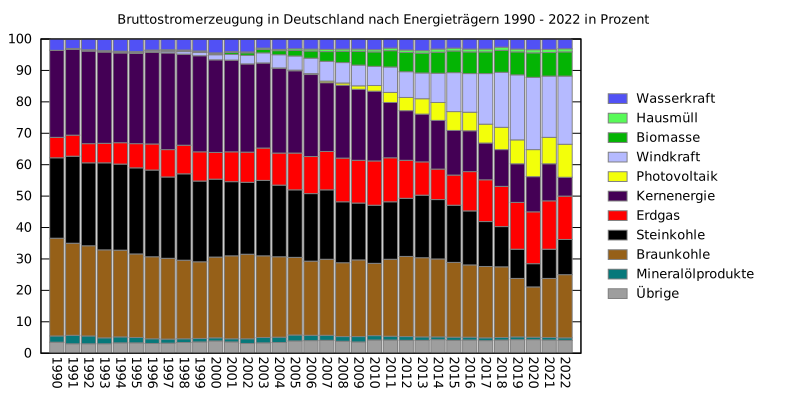
Right this moment, coal is the single largest source of electricity production in Germany (33.66% of the total)
They're emitting nearly 400gCO2eq/kWh, compared to nuclear-first France's 70.
That is an abysmal result.
https://www.electricitymap.org/
That's simply wrong. Renewable energy for electricity is at 46% last year. Up from 6% in 2000. Coal has been declining a lot from 2000 (when the Energiewende startet) to today.
btw. this map is bullshit.
french basically netted zero co2 emissions for their nuclear power plant. I mean 90% of their uranium ore comes from nigeria. it's not like that stuff gets teleported to the reactors. the uraniums needs to be mined, refined, transported.
etc... of course it's way less than coal. but it's stupid to let some countries "export" their emission to third world countries. the map bases their nuclear plants with 12gCO2eq/kwh. which is basically just insanly low and is only the median and does not factor everything in (no build, decomission of the plant (because that is unknown and different for each reactor) and basically the icc does in fact not factors in mining with all their transport routes, mostly it's just a nuclear energy favored estimate)
Yes, it does need to get mined refined and transported. But the fissile energy density of uranium is, literally, a million times greater than gasoline or coal. It doesn't take much uranium to generate a lot of power.
Nope sorry, it takes all of this into account. From their FAQ :
"We use a life cycle analysis (LCA) approach, meaning that we take into account emissions arising from the whole life cycle of power plants (construction, fuel production, operational emissions, and decommissioning)."
yeah, but their approach was to basically cut the emission of construction, fuel production and opertional emissions and decomissioning basically to zero or at least extremly misleading numbers: https://euranetplus-inside.eu/deep/wp-content/uploads/2016/0...
Well, they didn't shut down all nuclear plants either. The last ones are planned to go offline in 2022. It would probably have been possible to extend nuclear use a bit and reduce coal consumption faster instead.
But it doesn't matter, because their CO2 emissions are still catastrophically worse than they could have been with nuclear (compare and contrast with neighbouring France).
It just demonstrates that even a strong and "remarkable" drive towards renewables alone such as what Germany did, just isn't enough to sustain a developed economy, unless you're lucky like Sweden and have a geography that allows a lot of hydro.
we would sit on a bunch of nuclear waste we would not know what to do with. France does not scale with nuclear to the rest of Europe. Basically France is bound to nuclear because it needs the technology for their nuclear weapons and nuclear powered submarines ... otherwise it would phase out this costly technology.
Germany helps the world more, since renewable energy scales much easier and is cost effective, low-danger, ... that's why exporting energy efficient systems and renewable energy production technology is the way to go. Whether we use coal for a decade longer or not does not matter much in the larger picture. We need to develop scalable renewable technology and deploy it, for billions of people. Nuclear is too slow and too risky. If we look at the world-wide numbers for electricity production from nuclear, its mostly stagnating and it will be tough in the coming years when aging reactors will be taken off grid to sustain the level of production, enhance the life of existing reactors by upgrading them, build storage, have money for both decommision of old reactors and money to build new ones. France will need to invest upwards 100 billion Euro just for their aging fleet ... good luck with that. There is a single new EPR in the works and its expensive and late. With an old design from decades ago. The real battle for emission reductions will not be with 80 mill Germans, but with billions of people in Africa and Asia - where the growth is. We need to develop together with them fast scalable electricity production.
Let me quote the World Nuclear Report (!) from 2019:
* Non-Nuclear Options Save More Carbon Per Dollar. In many nuclear countries, new renewables can now compete economically with existing nuclear power plants. The closure of uneconomic reactors will not directly save CO2 emissions but can indirectly save more CO2 than closing a coal-fired plant, if the nuclear plant’s larger saved operating costs are rein- vested in efficiency or cheap modern renewables that in turn displace more fossil-fueled generation.
* Non-Nuclear Options Save More Carbon Per Year. While current nuclear programs are particularly slow, current renewables programs are particularly fast. New nuclear plants take 5–17 years longer to build than utility-scale solar or onshore wind power, so existing fossil-fueled plants emit far more CO2 while awaiting substitution by the nuclear option. Stabilizing the climate is urgent, nuclear power is slow.
Let's put the myth of nuclear waste to rest by putting things in perspective :
The amount of energy required to run France's trains for one whole year is 9 TWh. In terms of waste you can take your pick between :
* assuming 100% nuclear energy : 200kg of nuclear waste
* assuming 100% coal : 700.000 tons of solid ash (usually stored in the open air), plus 1.000 tons of soot and fine particles, including tons / dozens of tons of arsenic, lead, thallium, mercury, even uranium and thorium.
Option 2 is what German coal plants are pumping into the European air right now (34% of total electricity production as I write), for years, contributing to dozens of thousands of premature deaths.
That is the clear and present danger. And there is no credible plan to get out of this, because no matter which way you put it (and as much as I'd like the opposite to be true) you can't solve the renewables intermittence problem without a major breakthrough in battery storage.
All of your arguments will be valid when and if that happens. In the meantime, this stance is betting on a future that may or may exist, whilst causing immense and certain harm right now, in the middle of the climate emergency.
That's all irrelevant. The world production of nuclear power is basically flat for the last 30 years. Renewable energy is expanding rapidly. That's currently the only viable option. The best is to phase out all costly nuclear reactors and invest the money into renewable energy expansion.
Storage of electricity can be done in multiple ways and we will see larger new installations in ten years from now. Models for running countries like the US with electricity from 100% renewable are looking feasible.
Since there has been almost no expansion of nuclear in the past 30 years on a global scale and everything looks like we will see a long and slow decline for nuclear, it's easy to see that it's the wrong technology and its further contribution to reduce carbon emissions will be likely zero or less.
> The world production of nuclear power is basically flat for the last 30 years.
I'm glad that China proves you wrong. If they had gone all in with coal+renewables like Germany, climate change would be an even bigger issue than it already is.
> Renewable energy is expanding rapidly. That's currently the only viable option. The best is to phase out all costly nuclear reactors and invest the money into renewable energy expansion.
No, again Germany has tried that. It. doesn't. work.
20 years later, even now at 46% from renewables, the country still has one of the worst carbon intensity figures of all European countries.
Besides, there's an upper limit to the expansion. Wind farms require 360 times (!) as much land area as nuclear, solar 75 times as much for the same output.
It's a beautiful idealistic dream that I hope will work one day, but causes us all terrible harm in the meantime.
> Storage of electricity can be done in multiple ways and we will see larger new installations in ten years from now. Models for running countries with like the US with electricity from 100% renewable are looking feasible.
This is hot air, nothing more than wishful thinking.
And you can't build a power grid on wishful thinking. Also we can't afford "hopefully, one day" to tackle the climate emergency. Another commenter put it best : https://news.ycombinator.com/item?id=21996271
Nuclear is 4% in China for electricity production. Tiny.
Renewable production & investments in China are much higher that the ones for nuclear. Wind power already is larger in China and fast growing.
It's clear where this is going. Nuclear's contribution to reduce CO2 emissions will be minor - the large share of reduction will come from large scale deployment of renewable energy. The numbers are clear, just read the World Nuclear Report from above...
> This is hot air, nothing more than wishful thinking
It's not. For example I live in North Germany. There is a large power line under construction to Norway and more can be build (some are already under planning). These will combine electricity from on/offshore windfarms with Hydro-Electric storage.
We also have very large storage facilities for gas, which can be generated from surplus electricity. The areas here will have huge amount of surplus electricity.
This will all get more important in a decade or so.
There are various other technologies for storing electricity either existing or under development.