"Nuclear energy, to start with, is ultimately not safe, and the Germans have always been particularly uneasy with it. After the nuclear accident at the Fukushima nuclear plant in Japan in 2011, Chancellor Angela Merkel ordered the “Atomausstieg,” the exit from nuclear energy once and for all. Why? Because, as Ms. Merkel put it back then: “The residual risk of nuclear energy can be accepted only if one is convinced that — as far as it is humanly possible to judge — it won’t come to pass.” After Fukushima, Ms. Merkel, a trained physicist, was no longer able to believe that a nuclear disaster would not occur. That there was a catastrophe even in a high-tech country like Japan made her change her mind."
This article dismisses nuclear power as "not safe" with nothing more than the decision of Merkel to justify it. Yes, Merkel has a background in physics, but she made that decision as a politician. It's an unfortunate truth that science is rarely the first consideration in political decisions.
Merkel's decision ignored the truly extraordinary circumstances of the Fukushima disaster, which was triggered by an earthquake and tsunami that, each individually, exceeded the design parameters of the reactor, which was 40 years old at the time of the disaster. Updated studies indicated the reactor was vulnerable to tsunami, but were ignored. Repeatedly.
The reactors of 40-50 years ago can indeed be unsafe if operated poorly (e.g. Chernobyl) or if necessary threat mitigation is totally ignored. Newer designs are safer, and older designs can be made safer if people don't bury their heads in the sand about necessary updates.
Ultimately, nuclear reactors are designed and operated by humans, and mistakes do happen. However, the fact is that the Fukushima disaster has killed fewer people in total than coal power kills every year under normal operating conditions.
But this is exactly the point. Catastrophes like Fukushima are practically always a combination of individual deficiencies in design, process, and operator errors. Designs can be improved, processes adapted, and people trained better, but that will not prevent accidents from happening. This is mostly because human imagination is limited and humans are fallible, and what‘s not covered by the previous two is lack of knowledge & understanding.
Said in other words, if you wait long enough, a catastrophe is inevitable. And history, both old and recent, has told us that the time you‘ll have to wait is much shorter that you‘d think.
I work in aerospace operations and every freakin‘ day things go different than planned and anomalies happen. In „my“ „industry“, we try to prepare for off-nominal situations and that buffers the effects, but you can only do so much and you end up in contingencies very often. You can also easily see when a new player enters the stage as they very quickly (should) learn that you‘ll have to react and adapt your plans very often and tone down any promises …
Long story short, whatever means you put up to prevent catastrophic events, they will never be enough. Then the question of cost arises, which is undoubtedly extremely high for nuclear events, especially in such a densely populated and small country like Germany, and you’ll quickly realise that you probably do not want to take that risk even if probability is very low.
And finally, we have yet to find a working way to handle our nuclear waste for the next 10k-100k years. (I am aware of the options but obviously we are not there yet and it‘s unclear if we ever reach the state of „acceptable solution“ instead of pushing the issue to generations to come.)
> Said in other words, if you wait long enough, a catastrophe is inevitable.
But the catastrophe in nuclear is substantially less damaging than business as usual in coal. I've lived in a coal mining region, I'd have better health outcomes if I'd lived next to Fukushima when it was melting down. And I don't feel threatened by the risk of either.
The damage done by solar/wind is also flying under the radar, but they are being scaled up to industrial levels of production. Nothing done at industrial scales doesn't produce a lot of waste and environmental damage. It is likely that nuclear is still safer and more environmentally friendly than the renewables.
Nuclear is safer than a hydroelectric dam, for example.
These risks are so firmly within the tolerable zone it isn't funny. And the negative exampels are all talking about 50 year old technology which is obsolete. Even Japan is re-opening their nuclear plants, presumably bowing to the reality that their Fukushima response was overly paranoid.
And it is a tired argument I always make, but "handle our nuclear waste for the next 10k-100k year" - be serious. We have waste that lasts forever and we have plans to store it for 30 years. There is nothing there that matters and the people getting worked up about it are mistaking opportunity for cost. We have the potential to manage waste from an industrial nuclear process. That makes it unique, most other processes we dump dangerous waste, forget & hope. We produce much scarier waste than nuclear byproducts and the volumes involved are tiny.
I don‘t get why you‘d bring up any other means of power generation while my reply solely discussed nuclear, but I‘ll take the bait …
> substantially less damaging than business as usual in coal.
Never doubted that and never will. Though here we are talking two different scenarios (as you said): Accident vs. nominal operations. Strictly statistically speaking, nuclear „wins“ because of that, I‘ll gladly agree to that. That still does not mean nuclear is to be preferred, it‘s just the less worse option of the two in terms of one (of many) measure.
> Nothing done at industrial scales doesn't produce a lot of waste and environmental damage.
While I agree to that statement, there is more to be considered than just waste and environmental damage, e.g. for nuclear (and fossil power) esp. health risks.
> nuclear is still safer and more environmentally friendly than the renewables.
Source? Can you at least state how you would define „safer and more environmentally friendly“? That‘s a bold statement you make …
> Nuclear is safer than a hydroelectric dam
In what measure? Maybe if you look at Risk * probability (I‘d need a source, though) but unlikely if you look at Risk * probability * cost (except maybe the 3-gorges-dam but that‘s due to a number of unique factors).
> These risks are so firmly within the tolerable zone
Maybe for you but not the next person. Or insurer. Or government.
> negative exampels are all talking about 50 year old technology which is obsolete
Power generation from water is much older, even thousands of years (if you are willing to accept a slight redefinition). Saying the technology is obsolete doesn‘t fly if said technology is still heavily used every day and not being replaced (i.e. decommissioning of all old nuclear plants).
> Japan is re-opening their nuclear plants, presumably bowing to the reality that their Fukushima response was overly paranoid
It‘s a political decision by the Abe government. They were always very pro-nuclear.
> be serious. We have waste that lasts forever and we have plans to store it for 30 years.
Which is bad enough. (BTW: This is handled much better in the better part of Europe / Germany than the USA.) The unique problem with nuclear waste is that it requires special handling for 10k-100k years unless you want to die. While this may be true for other, highly toxic waste, this does not apply to the vast majority of waste.
> We have the potential to manage waste from an industrial nuclear process. That makes it unique, most other processes we dump dangerous waste, forget & hope.
Having the potential does not equal using it, rendering your argument void. (BTW: While I agree we should be doing this for all nuclear waste no matter the cost, reprocessing nuclear waste (like burnt fuel) consumes a significant amount of the energy that has been produced by the plant, rendering the process uneconomical.) Even then, it‘s not unique, for most other waste we know how to manage it but it‘s too often not done due to economic reasoning. (BTW: This is also an issue of externalized cost that we‘d have to solve. And again: This is handled much better in the better part of Europe / Germany than the USA.)
> the volumes involved are tiny
… but very deadly and toxic, rendering it a much bigger problem than most other waste. And we‘re not yet talking decommissioning a nuclear …
Presumably in the measure of "lives lost" if you look at the Banqiao Dam failure. In 2017, the Oroville Dam in California was also at imminent risk of collapse and prompted the evacuation of 180,000 people.
That puts hydro at one catastrophe with lives lost at the worst estimates of Chernobyl, and one mass-evacuation on the order of the evacuation of Fukushima
> I rather have 10 Fukushima nuclear accidents than one big dam break
You say that, but Fukushima didn't even come close to reaching it's catastrophic potential. Japan was facing the possibility of having to immediately evacuate 50 million people[0], or roughly 15% of the US population. An evacuation on that scale would almost certainly top any other emergency evacuation in human history.
Japan got pretty lucky with the weather conditions during that episode, and if you flip that coin 9 more times, you'd find out pretty quick that they got pretty darn lucky the first time.
I got curious about the largest evacuations in history and a cursory google search says that the largest sea evacuation took place in NYC during 9/11, when 500,000 were ferried out of the city, beating Dunkirk in WWII (319k).
So the prime minister of Japan was facing the possibility of an evacuation 100x this size. That is truly insane.
Coal has already killed far more beings than the highly rare nuclear power station disaster. If you care about wellbeing and human lives, swapping nuclear for coal is downright stupid.
Germany swapped nuclear (and coal) for renewables. While I wholeheartedly agree that it would have been better to extend nuclear in favor of decommissioning coal earlier, that‘ll still not make your argument valid.
Radioactive contamination of soil has very long tail, so we should wait until radioactivity will be lower than background level to count total number of victims. I.e. 1 victim per year x 100 years = 100 victims, while 1 victim per year x 1000 years = 1000 victims, order of magnitude more victims.
Designs can be improved, processes adapted, and people trained better, but that will not prevent accidents from happening
That premise requires more convincing evidence for me. Nuclear reactors have an incredible safety record, given that most current reactors have their design roots in the 60s, and have been operated for longer than initially anticipated, on MBA-style shoestring budgets. Given that scenario, yes, accidents are bound to happen. But where are the improved designs you mention? What processes have been adapted to improve reactor safety since the 60s? Which reactors have been safely decommissioned at the end of their planned lifetime instead of running beyond their age?
What we have now is the result of thirty years of political (and economic) languishing: no firm decision had been made either way. I applaud Angela Merkel for finally making a firm decision on that subject, but I also think the decision was the wrong one. I applaud India's decision to actually develop and build 90s-era reactor designs.
whatever means you put up to prevent catastrophic events, they will never be enough
As evidenced by the impending climate catastrophe, you are correct. But even ten Tsjernobyl meltdowns will be less impactful than what we are facing now.
we have yet to find a working way to handle our nuclear waste for the next 10k-100k years
No, we already have that solution: Gen-4 breeder reactors, another 90s-era reactor design. We just never had the political will to build them, thereby perpetuating our 10k-100k year problem.
Take a look at history if you need more evidence. At some point, someone always said „now we know better and we can build XXXX to be perfect“, and now we are laughing about them (to give a bad but simple example: Titanic). You are naïve if you think today is any different than yesterday, even with all that superior technology and knowledge that we have – but that was also true for any other point in time.
And your „waste solution“ will not help one bit with the waste we already have. Hence my argument remains.
And your „waste solution“ will not help one bit with the waste we already have.
Why not? Breeder reactors can use spent fuel as (part of) their power source, and that spent fuel is the cause of our 10-100k year problem. From wikipedia [1]:
Since breeder reactors on a closed fuel cycle would use nearly all of the actinides fed into them as fuel, their fuel requirements would be reduced by a factor of about 100. The volume of waste they generate would be reduced by a factor of about 100 as well
[..]
In principle, breeder fuel cycles can recycle and consume all actinides, leaving only fission products [having] a peculiar 'gap' in their aggregate half-lives, such that no fission products have a half-life between 91 years and two hundred thousand years. As a result of this physical oddity, after several hundred years in storage, the activity of the radioactive waste from a Fast Breeder Reactor would quickly drop to the low level of the long-lived fission products
So, not only would fast breeder reactors reduce our waste volume by 99%, they would also reduce our waste storage lifetime from 10k-100k years to a few hundred years (a more than 99% reduction).
>But this is exactly the point. Catastrophes like Fukushima are practically always a combination of individual deficiencies in design, process, and operator errors. Designs can be improved, processes adapted, and people trained better, but that will not prevent accidents from happening. This is mostly because human imagination is limited and humans are fallible, and what‘s not covered by the previous two is lack of knowledge & understanding.
>I work in aerospace operations
It's odd you say this, since the entire aerospace industry exists because people at the time were willing to put up with the risks until we got where we are today.
If you talk space, the difference is that all relevant people were and are aware of the risks and do their job despite them. And they do their job in such a way that the risk is always minimized (through extensive preparation, Monitoring, …), you can handle a situation immediately or even recover from it (e.g. redundancy; failure detection, isolation, & recovery mechanisms; etc) and learn from it (post-mortem processes). Everything and everyone breathes risk awareness.
If you are talking aeronautics, the situation is fundamentally similar but also the scales are very different (also in terms of operating personnel vs. throughput). But more importantly, society in the majority seemed to have accepted a level of risk even though we know for sure that the next catastrophic event could happen any moment.
Fun fact: if the Fukushima exclusion zone was entirely covered with solar panels, it wouldn't even match the nuclear plant annual energy production (note to downvoters: that's actual fact, a 10 km2 plant in India has only 650MW of power, and hits this power only 1 to 2 hours per day).
> But this is exactly the point. Catastrophes like Fukushima are practically always a combination of individual deficiencies in design, process, and operator errors. Designs can be improved, processes adapted, and people trained better, but that will not prevent accidents from happening.
Agreed. The consequences of Nuclear energy last millions of years, not Human lifetimes, to this day we still have not felt the true impact of Fukushima's contaminated water run off into the Pacific, nor the contamination of the food and soil the epidemiology of Nuclear fallout was abysmal in 2011, and was done by Soviet's. Sudden heart failures as well as birth defects, and other maladies of children are stauncly being hidden from the Media as they were ramping up the efforts for the Olympics, not to mention the People have not been able to return Home to their and remian in a make-shift refugee camp, and seen as 'less than' in Japanese society: look up the Hibakusha from WWII, and the same stigma applies now. I think TEPCO/Nuclear Village and the Abe cabinet are just waiting from them to die to make it all go away so they can get back to how things were.
> Merkel's decision ignored the truly extraordinary circumstances of the Fukushima disaster, which was triggered by an earthquake and tsunami that, each individually, exceeded the design parameters of the reactor, which was 40 years old at the time of the disaster. Updated studies indicated the reactor was vulnerable to tsunami, but were ignored. Repeatedly.
First, if you are going to pull out her education in physics and then discount it, have a basis for doing so. And at least make the obvious correlation to the political decision that France is right next door and produces 379.1 TWh/71.6% of their entire energy production, so they will continue to just buy just buy it from them--I lived in S. Germany near the French Border and it that was common practice. With that said, I have a Biology background and just looking at how it devastated one of the most abundant Ag lands in Japan I'd say Humans are too fallible to have access to this tech to be able to use it on this planet. For Mars, sure, that makes total sense, but not here. We have way more, and better options.
Sidenote: I lived near SONGS in S. OC, which had a leak happen around the same time as 3/11.
> And this is why nuclear power is fundamentally unsafe: the operators have conclusively proven that they just cannot be trusted. Repeatedly.
So let's just keep reliably killing people with coal around the year like we do now...?
The fact is that nuclear power kills the least amount of people per unit of energy produced, with all accidents taken into account. If that's "unsafe" then you cannot consider any electricity production method safe.
I hate when people talk about solar or wind "saving the planet".
Solar in particular (and wind to a lesser extent) requires digging up then melting down literal mountains worth of ore to get the rare-earth elements to create them. Creating the space-age materials used for solar and wind installations is hyper-toxic for the environment and creates its own waste-storage problem.
You talk about deaths, but companies seem to be very tight-lipped about wind fatalities. Bucket truck electricians have a serious injury and fatality rate per-capita an order of magnitude higher than normal electricians. Tower workers have rates an order of magnitude higher than that.
Wind towers aren't like normal towers. They are smooth, aerodynamic surfaces. They are much taller than an average cell tower which adds complications. They have hundred-foot blades with all the lack of strength usually associated with airplanes travelling at up to 180mph. Unlike normal towers, you are definitely working on live systems (dead systems are even more dangerous as they are be at the whim of the winds). There's a huge, high-voltage motor in there exerting tons of torque (plus other motors for things like wing rotation). These extra hazards are standard. They don't account for the bonus hazards like fires, mid-air disintegrations, or even a bird (or something more exotic) getting struck and flying your direction. Even ground crews are at much higher risks.
I know several people who have worked at coal or nuclear plants. They wouldn't get anywhere near a wind plant because it's just too dangerous.
Germany is heavily investing in solar and wind. Why do you bring up coal?
Also - even if the nuclear power plant is 100% safe, it still produces nuclear waste that nobody wants to keep anywhere near their city and will be dangerous for hundreds of thousands of years, that's longer than humanity has been around - it's just the same trap as burning fossil fuels. Why would we want to make the same mistake again?
> Germany is heavily investing in solar and wind. Why do you bring up coal?
Because coal is what Germany really relies on in practice, making it one the worst industrialised nations when it comes to CO2 emissions per kWh. Check for yourself, right this minute : http://electricitymap.org/
> it's just the same trap as burning fossil fuels. Why would we want to make the same mistake again?
Because it's not the same mistake at all.
Nuclear waste is stored in highly stable geological layers, and the volumes are orders of magnitude lower.
As I wrote here (https://news.ycombinator.com/item?id=21996751), a year's worth of nuclear energy for running France's whole fleet of trains produces just 200kg of nuclear waste. Since the beginning of the nuclear programme, the cumulated volume is 3650m3, or an olympic swimming pool's worth of it.
Don't get me wrong, renewables are a worthy long term goal, but we might never get there in the first place if we don't tackle the climate change and emissions emergency first.
Phasing out coal in Germany is a political battle against a large entrenched century old industry.
The phase-out looks to be gaining traction in recent years. Deals are being made to retrain coal miners and fund economic redevelopment of heavily coal dependent regions. All players including the power companies, network operators, miners unions, green NGOs, central and regional governments have been in discussion about how to manage the phase-out. A schedule for when plants will be turned off is being written into law.
Where Germany has a bad record on emissions reductions is in other sectors such as transport and heat. Germany has had a centre-right political party running the show for 15 years, progress has been slow. The next election will likely be a CDU-Green coalition which will likely increase ambitions on emissions reductions.
The incontrovertible problem remains : wind/solar are intermittent, peak load sources (Germany doesn't have the geography for hydro)
No matter how you spin this, you NEED to pick one of either nuclear, gas or coal in your mix to complement renewables.
Of these 3, only one of them is low carbon.
Of the other two, one makes your energy grid depend on Putin's whims, while the other causes tremendous fine particles pollution causing thousands of premature deaths today, in addition to carbon emissions.
> Coal powered electricity generation is dropping and renewable generation is increasing.
But won't ever replace a base load source of electricity.
Even after a 300 billion investment and spectacular share increase of renewables from 6 to 46%, Germany's emissions per kWh are 5-10 times worst than the best.
> The next election will likely be a CDU-Green coalition which will likely increase ambitions on emissions reductions.
Increased ambition is great but the facts above are unescapable.
Are Die Grüne willing to drop ideology and face them ? That seems highly improbable.
Wind and solar, plus the already existing 6gw of pumped storage and increased curtailment gets you to 80 percent. The remaining 20 percent requires more storage.
Batteries can help to some extent for shifting day to day peaks.
Seasonal storage is more tricky. Germany has about 3 months worth of natgas stored in underground caverns. One approach would be to use this to store syntheticly produced gases from electrolysis.
Note so far everyone here is talking about electricity which only makes up a third of Germany's emissions.
Synthetic gases (non-fossil) will be required for high temperature heat, and chemical feedstocks for industry. For example some steel smelters in Germany are transitioning from coal to hydrogen.
Nuclear is a poor fit to an electrical grid which is mostly renewable for both economic and technical reasons. However it may be a good fit for running synthetic gas plants which can use both the heat and electricity and require 24/7 energy.
Regarding the Greens. They will be more willing to push back against the German car industry which should lead to increased reductions in transport emissions. Other sectors are likely similar.
"Nuclear waste is stored in highly stable geological layers"
That is just factually wrong. "Despite advanced schemes in Finland, not a single country worldwide has an operational underground repository." [1]
That was 2014 and plans have stalled or have been abandoned altogether due to local opposition and technical problems. The reality is that in nearly all cases storage is onsite or in other above ground locations.
France still has a plan to build and operate an underground storage facility in Bure [2], but costs have exploded due to not just very rose colored estimates at the start, but also due to running into problems such as water seepage and not being able to handle certain failure scenarios such as a transport catching fire.
So on the one hand with nuclear, we're talking about one swimming pool's worth of waste since the beginning of the French nuclear programme. Currently stored safely enough, long term solution identified and implementation in progress.
You find this unacceptable.
On the other hand, we have renewables with no solution in sight (let alone implemented) for the intermittence problem (awaiting an hypothetical scientific breakthrough in batteries).
In practice, you rely on coal for the day-to-day base load. Coal, for only a year's worth of running a country's trains generates "700.000 tons of solid ash (usually stored in the open air), plus 1.000 tons of soot and fine particles, including tons / dozens of tons of arsenic, lead, thallium, mercury, even uranium and thorium".
You call this the reasonable option.
And in another comment, you even feel entitled to lecture the Belgians and French about their nuclear plants near the border that might hypothetically fail one day, when 7 of the 10 worst polluters in Europe are Germany's lignite plants (https://www.cleanenergywire.org/news/german-lignite-plants-e...), with coal killing 23.300 people in Europe every year (https://endcoal.org/health/) right now, with certainty
You're being disingenuous now. It feels like arguing about aviation being the safest means of transportation and having someone answer "but it's scary and deadly when it happens!" This will be my last answer.
It's obviously not a swimming pool of plutonium ! Plutonium is less than 1% of the waste in the first place, and it's removed and recycled.
In any case, nuclear waste is vitrified into glass with an estimated 10.000 years lifespan.
Fukushima casualties : 1 confirmed from radiation, 2202 from evacuation, over 15000 from the tsunami itself.
"These numbers are very low compared to the estimated 20,000 casualties caused by the tsunami itself, and it has been estimated that if Japan had never adopted nuclear power, accidents and pollution from coal or gas plants would have caused more lost years of life"
Again, coal causes 35.000 deaths per year across Europe. Every, year. Right now. Coal or gas are currently mandatory in the renewables + nuclear-free mix that Germany has chosen as the future.
I'm sure you mean wel, and as I said before, like you, I want to believe. The difference between us seems to be you live in a fictional world where nuclear waste was stored in very safe places underground, vitrified into glass with a 10k lifespan, and dealt with very responsibly throughout the lifecyle.
I live in a country where power-plants were built by typical contract builders using sub-spec concrete that is cracking, where all nuclear waste is stored above ground near densly populated areas, where young activists (luckily without malafide intentions) find to their surprise they could just walk into supposedly military protected nuclear plants, where first 55.000 barrels nuclear waste were just dumped of the coast, where the rest of the stuff is in corroding barrels filled not with 10Ky Glass but with tar and concrete, where this deterioration was kept secret for years, and once it came to light resealing it in inox barrels is considered too expensive, where nuclear plants that have failures several times a year because of malpractice during construction and aging installations are kept open with permits issued by administrations and politicians in charge that pass though the revolving doors of the plant's exploiter right into plushy 'consulting' seats, ...
I wish my country was the exception. A rogue state in the very heart of Western Europe. Sadly, it is not. Humans will be humans, with all their vices and fallacies. Humans as a species just can not handle the responsibilities of this type of systems (significant and high short exploitation benefits resulting in extreme long term very costly mitigation commitments, low probability failure modes but with extreme potential impacts).
You imply that there is no alternative. That it is either nuclear or browncoal. This is not true. Germany is the largest net exporter of electric energy in the European grid. Net export amounted to 45.6 TWh in 2018. In that year 72.1 TWh was produced from nuclear power, so almost two thirds of nuclear power was exported). The advances in and deployment of Solar and Wind power have lead to a significant reduction in the use of coal especially starting the second half of 2019. There is no impact on nuclear because nuclear plants unlike coal and gas can not be easily shut down and restarted at will.
Energy is just too cheap by far, so we just continue to waste it like there is no tomorrow. Any gains we make in efficiency, we just take as a bonus and immediatly compensate for by consuming more (cfr. Jevons paradox). Sadly, a neoliberal market economy can never discover the solution of moderation or abstinence, as it is purely driven by privatized marginal profit. It is systemically outside of its potential.
Because solar and wind leads to continued dependency on coal and gas. The reality is, nuclear is the only geographically independent method of providing carbon free energy around the clock. The closure of nuclear plants leads to increased usage of coal and gas: https://www.economist.com/europe/2017/11/09/germany-is-missi...
We can discover efficient ways to re-refine those materials and provide even more energy for the future (actually, such techniques exist for a lot of waste, but mining is still cheaper, so we don't do it). By the time this process is done, the waste simply won't exist anymore.
Maybe it wiser to spend some profits of nuclear industry on problem of nuclear waste first. We already has tons of waste. Chornobyl and other sites are still waiting for a solution.
> The fact is that nuclear power kills the least amount of people per unit of energy produced, with all accidents taken into account. If that's "unsafe" then you cannot consider any electricity production method safe.
This is such a horrible stat, especially when taken in this context; I'm not for coal, I think its filthy and and obsolete form of energy, but do you realize the affects of Chernobyl, 3 mile island, Fukushima et al will be felt for millions of years AFTER you are gone?
With so many other forms of renewable energy, you'd think it were possible to create another model.
> do you realize the affects of Chernobyl, 3 mile island, Fukushima et al will be felt for millions of years AFTER you are gone?
No, because that's simply not true. At least not in terms of radiation. Perhaps politically, or in the general feeling of fear among people who do not understand nuclear energy, the effects might be long-lasting but the no-go area around Chernobyl is very small, Fukushima is basically liveable today and I don't think 3 mile island affected any area to such extent that radiation levels would be above the safety limits.
This is absurd, are you aware that people in Croatia had a mass epidemic of thyroid failures in children? That is a massive endocrine disruption at a very young age, these people then had children themselves and the affects to them have yet to be discovered, I worked with a woman in Istria that voiced these concerns, her child had to be hospitalized several times for weight loss and and heart beat iregularities. She was a proponent of entering the EU solely because her child may have a chance to have access to more promising medical technology.
Fukushima is habitable? Are you seriously insane? This is Abe's solution to get people to move back:
Chernobyl devastated large swaths of Ag land in Germany when it happened that still haven't entirely recovered...
Listen, maybe these things didn't have a direct impact on YOU so you honestly believe this, but I've seen it and lived with the affects of Nuclear Energy accident first hand, and they are costly environmentally and devastating psychologically. Its what turned me into a staunch environmental activist, but the toll of it is something I have to bear alone, and PTSD is only one of the things I have to live with, and I was an adult when it happened.
I cannot even bring myself to look at what has happened in the near 9 years since Fukushima's children were exposed in masse anymore for fear of inducing panic attacks. I can't even go to my friend's wedding this Spring in Japan because of the fear and panic I feel inside. They were already having a very significant spike in thyroid disruptions in 2012, heart problems soon followed, and the cover up began for pregnancies from that time--just as they were during Hiroshima and Nagasaki.
I'd say that the biggest proponent(s) of Nuclear should have to live next to the plants themselves, which incidentally are being phased out in California due to our collective efforts, and see what those 'safe levels' really mean. But go ahead, get a remote job and live next to some of the most grossest offenders in the US for a decade and then we can re-evaluate your position:
Until then, you're just mis-informed entirely about the reality of Nuclear Energy Production and its consequences, and have at best a very glib understanding of it. Hell, to this day I cannot find a proper study done on them monitoring the radiation effluence from San Onofre and its surrounding areas from before then event and leading up to the massive leak. Let alone the epidemiological impacts of it, my old landlord just died in December from heart-failure and he was a lobster fisherman from the San Onofre region.
So, your rationalization is because you're already doomed you would have the rest of us die off just so to satisfy your poorly informed bias for Nuclear energy?
I think this is a much bigger dilemma than you think, and you should rethink your Life in general. The alternatives (renewables) that exist may not be perfect, but they are worthy candidates to at least be able to comprise of most of our energy needs.
But, if I'm honest, this is probably the same selfish mentality that can rationalize having a Humanitarian crisis ongoing while simultaneously being able to vie for the 2020 Olympics in Tokyo. How the Human mind can rationalize such a tragic fate, is beyond me.
The Fukushima accident had more to do with the culture in Japan than the industry globally[1]. The government and the regulator were basically in bed with TEPCO.
Do you think that this is somehow unique to Japan? How close do you think regulators and operators are in the US? Is there any industry that even remotely seems like it has a healthy relationship with its oversight bodies?
> Do you think that this is somehow unique to Japan? How close do you think regulators and operators are in the US? Is there any industry that even remotely seems like it has a healthy relationship with its oversight bodies?
Yes, and no. TEPCO, and The Nuclear Village are strong powerful entities and lobbyists in Japanese Society. But it was the 'Japanese' way of not asking the global community for help that ultimately ensured that the Abe Government and its subsequent action would take the act of secrecy in the face of one of Man's biggest ecological disasters.
Very, look at how much influence Edison and SONGS have over the Judicial system, and I will remind you San Onofre is home to some of the most expensive real estate in all of the US:
Perhaps, but business interests are always messy things within centralized governance models and I can go on my tirade for the imperative need for Anarcho-Capitalism, but to be honest if someone like Trump hasn't already made it clear to you that these imbeciles (they're all the same) in power will march us off to extinction for yourself, then my arguments will fall on deaf ears.
If the US inspections of offshore oil rigs are any indication of our lack of ability to fix things obviously broken, I can't imagine nuclear power plants would be any different, except the risk in a nuclear scenario would be amplified.
* Constructed by companies like Halliburton and Bechtel
* Operated by utilities like PG&E, collaborating with traders like Enron.
I don't know about you, but to me, the whole setup does not scream competence, good judgment, incorruptibility, and adherence to the highest ethical standards.
Indeed I am (that's why I wrote "like"), but they were the household name in the field. Frankly, I don't know who plays that role now, but how confident are you that they behave fundamentally different, as opposed to just not having been caught yet?
The lesson of Fukushima and Chernobyl is that an unexpected failure with nuclear power can become a massively damaging, insanely expensive, generational cleanup effort.
Sure, you can say newer designs are safer, but you can't say that the underlying technology behind nuclear power is inherently safe. Even a well-run, accident-free nuclear plant uses dangerously radioactive material and generates dangerously radioactive waste that must be dealt with. But if anything goes wrong with any of the processes surrounding all of that, the consequences can be dire. Why lean on dangerous, expensive, and risky tech when we have better solutions?
Removing the radioactive material from Fukushima is going to take forty years. Parts of the area around Chernobyl will be unsafe for the next 20,000. It doesn't matter how frequently something succeeds if failure is too costly to bear.
That isn't too costly to bear. There are already huge swathes of earth that are uninhabitable wastelands.
The change in evacuating a region is painful, but the length of time it stays evacuated isn't important. In the long term it is like the existence of the Sahara - just a fact.
Because the fossil fuel industries aren't bearing the burden of the cost of climate change (or geopolitical warfare) and that's what they have to be competitive with
The US Navy currently has 83 (known) active watercraft that are nuclear powered. Across all the reactors the Navy use and have used, they have amassed over 5300 “reactor years” without reactor incident.
With adequate processes and training, Nuclear is incredibly safe and green.
You make the common mistake of assuming one can scientifically prove a given nuclear plant is safe like one can prove that the square root of 2 is irrational or that carbon emissions cause warming. That is not the case and it boggles my mind how many people think it is.
If you know so sure what causes these accidents, then you can predict what plant(s) will have them next. Can you? Can anyone? Saying after the fact: it can easily be explained why that happened... that isn't science.
>After the nuclear accident at the Fukushima nuclear plant in Japan in 2011, Chancellor Angela Merkel ordered the “Atomausstieg,” the exit from nuclear energy once and for all.Why? Because, as Ms. Merkel put it back then: “The residual risk of nuclear energy can be accepted only if one is convinced that — as far as it is humanly possible to judge — it won’t come to pass.” After Fukushima, Ms. Merkel, a trained physicist, was no longer able to believe that a nuclear disaster would not occur. That there was a catastrophe even in a high-tech country like Japan made her change her mind."
With this reasoning, any form of transportation should be "exited" (austeigt) too, because there were airplane, car... crashes in the past. And it is also highly unlikely that it wouldn't happen again.
one addition to the story:
Exit from nuclear power in germany was already decreed by law several years before, by the then government of social democrats and greens.
This decision was reverted by the first (I believe) Merkel government, only to be reverted again few years later due to Fukushima.
Merkel is known for being quite pragmatic and following the path of least political resistance in most cases.
While the exit of the exit was very popular at that moment, I do believe that in this case she was sincere when telling that seeing the Fukushima disaster changed her mind. I guess it was humbling even for world leaders to see how helpless everybody up to the PM were in Japan in the face of what was happening.
>Merkel's decision ignored the truly extraordinary circumstances of the Fukushima disaster, which was triggered by an earthquake and tsunami that, each individually, exceeded the design parameters of the reactor, which was 40 years old at the time of the disaster. Updated studies indicated the reactor was vulnerable to tsunami, but were ignored.
And that wasn't the only case, there were evidence it was the maintenance wasn't done properly. But no one was willing to admit it. Better to let the public think Nuclear is not safe rather than admitting to our own mistakes.
I kept thinking, had that reactor withstand that tsunami, would the world have turn around and built newer, better Nuclear Reactor.
I think nuclear power is a quick win, for the amount of CO2 discharged and the 'amount' of materials gained. The lasting legacy will always be the cost of maintenance, both in knowledge (in 100 years from now will people be able to operate the reactors and remember where all of the crud was left) and environmental impact. Certainly in the north sea area of europe, there is a drive for wind power, which I fully back. Nuclear power plants don't run themselves, which is why it's a highly skilled area, kill the skill, welcome to long periods of radiated land masses which are not obvious (unless you have a geiger counter)
I followed the Fukushima disaster very closely when it was happening. And I remember that during the crucial hours, when emissions of radioactive material was highest, the wind was luckily going to the east, out onto the pacific ocean, with thousands of miles of buffer.
Given that, it seems to me that Fukushima could have gone much, much worse.
I have a pragmatic proposal: lets use nuclear power if it's competitive including insurance and including the long term cost of handling its waste. If it's not or if nobody can insure it, we should probably not.
If a safety system requires that its operators are doing the right thing all the time it is an inherently unsafe system. It's as simple as that. Germany has understood this.
I'm pro-nuclear, but I find these articles about Germany's anti-nuclear stance extremely frustrating.
Blaming the current situation on Fukushima is historically inaccurate. Imo, there are 2 major reasons for the current stance:
1. Chernobyl: After the disaster in 1986 the anti-nuclear movement gained massive traction. The radioactive cloud spread all the way to West Germany and warnings had to be issued (mushrooms, venison, crops, ...). It was a real turning point, since everyone was made aware of the concerns. [1]
2. "Endlager"-discussion: The search for a permanent nuclear waste deposit was/is a political shitshow. The trial run at Asse (in the 70s) failed: We are currently getting all canisters out of there, after they found contaminated sludge and flooded areas. [2] Further, the decision to select Gorleben as one possible locations was mostly political. The whole process is politically loaded, expensive and devoid of any scientific reasoning. [3]
The anti-nuclear decision has been made years before Fukushima for imo valid concerns. The "latest" reactor in Germany went online in 1989, and the decision to phase-out was made in 2002. So the reactors being phased out now are all 30+ years old.
Nowadays, I don't think any energy provider in Germany would be willing to invest in NEW fission plants. By the time they will be online, renewables might be way cheaper per kWh.
> 1. Chernobyl: After the disaster in 1986 the anti-nuclear movement gained massive traction. The radioactive cloud spread all the way to West Germany and warnings had to be issued (mushrooms, venison, crops, ...). It was a real turning point, since everyone was made aware of the concerns.
That is true. And also, still today, when in our forests a boar gets killed by a hunter it has to be brought to the administration to meter the radioactivity (due to Cesium 137). A lot of boar gets discarded instead of being eaten because it exceeds the threshold (600 Bq/kg). I don't know what they are doing with it though.
To put that figure into perspective, it is said that eating 6 kg of boar meat with 3000 Bq/kg is equivalent to 240 micro Sievert which equates 12 x-rays of the lung.
I grew up in the town with the only uranium enrichment facility in Germany (operated by URENCO). That is where they feed gaseous UF6 (Uranium hexafluoride) into gas centrifuges to split it into a gas higher in U-238 and a gas higher in U-235 concentration. The process is repeated for the enriched U-235 containing gas. I got to tour this facility and visit the centrifuges with my high school class at age 16. (I joke that since then I glow in the dark)
Not far away (20km) is the temporary nuclear waste storage Ahaus (pretty similar to Gorleben).
About 60km away is Lingen where the company Advanced Nuclear Fuels converts the UF6 enriched in U-235 to Uraniumdioxide UO2 for direct use as nuclear fuel.
The nuclear power plant in Lingen uses this type of fuel among other power plants.
At this point URENCO is still operating in Gronau, however it appears that Advanced Nuclear Fuels now primarily exports nuclear fuel to other countries.
None of the raw uranium ore used in this process comes from Germany. There is plenty of controversy around the sourcing of uranium by URENCO and others.
I absolutely hate this narrative of the demise of nuclear energy largely being politically motivated because nuclear energy is not just falling in Germany, it's diminishing virtually across the entire world (with very few exceptions).
It's true that Germany has a historical anti-nuclear and green sentiment but other countries are no different. Nuclear energy may be clean, but it is also exceedingly expensive and unable to compete in price in most countries including the US.[1] Even China, the large last country to buckle the trend as of late seems to have reduced the role of its nuclear energy policy and seems to be missing targets [2].
Expensive compared to what? Are you comparing the full costs of coal plants to nuclear, or are you just externalizing the costs as most comparisons do? The costs of coal need to include all the effects of coal emissions into the atmosphere, which may very well be incalculable.
Solar and wind of course are great, but has anyone figured out how to make those supply 100% of a nation's power needs, 24/7? I don't believe so: we don't have the storage technology yet.
Compared to renewables. One of the unanticipated side effects of our current focus on solar/wind is that being decentralized technologies compared to a single complex for coal/gas/hydro/nuclear/whatever mandated a focus on unit reliability since you can't have someone babysit each unit when those units are smeared across a 10 square miles or mounted on an entire suburbs' rooflines. This focus is in direct contrast to nuclear's greatest weakness that no one talks about; it's maintenance and manpower costs. Turns out using a power source that works by restructuring everything around it on the atomic level is a bit hard on the surrounding infrastructure.
> This focus is in direct contrast to nuclear's greatest weakness that no one talks about; it's maintenance and manpower costs.
You say weakness - and I say that more people die from falls, from installing rooftop solar panels, than do in nuclear accidents.
Power generation is inherentantly dangerous. Just because you distribute the danger around, instead of centralizing it, does not mean that you've reduced the danger.
As for the economics of nuclear, as time goes on we are finding that the actual alternative to nuclear is not renewables. It's natural gas, sourced from either fracking, or Russia.
Compared to the uptick in natural gas, renewables are a rounding error.
Manpower salary weakness, not literal life/death weakness. Paying the population of Rhode Island to use exercise bikes connected to generators all day would also be a way to generate pollution-free safe power (in fact considering the obesity rate it would probably end up saving lives), yet there's still an obvious economic reason why such an idea would be completely stupid.
The economics of non-nuclear are terrible, though. All roads that don't include it as a major generator of electricity rely on burning carbon, in the form of natural gas.
If you think I'm wrong - would you mind explaining why natural gas deployment last two years (~20% increase, so about ~5% of global energy generation) was as much as the deployment of renewables, for the last decade? (also ~5% of global generation)
If you are right - could you give me your best guess for when you expect gas plant deployment to go net negative? 2020? 2025? 2050? 20-never? What mechanism (political, economic, etc) do you expect to drive that inflection point?
Renewables aren't a rounding error, unless you consider multiple percentage points of growth in every power market in the 2010s as rounding errors. Yes LNG has accounted for 3 or 4X the coal closures, however renewables don't incur methane leakage. Overall, both renewables and LNG are greening the grid by killing coal.
Nuclear costs are heavily externalized ($12 billion liability cap, rest paid by governement and there are plausible >$1trillion accident scenarios). It is as if they only have to pay insurance on a deductible.
Actually there have been numerous studies how wind and solar could provide 100% power for a country like the US. The thing is you need significant upgrades to your power grid, this will become easier and easier with improving battery and storage tech. The myth of base load is essentially nuclear propaganda that keeps getting debunked. Power plants that can't easily be adjusted are pretty much the worst for operators.
Citation much needed, because that sounds like unsubstantiated wind/solar kool aid that's not worth much more than "nuclear propaganda".
My impression is that battery storage tech and infrastructure is nowhere near able to provide 100% of US power when it's night and the wind doesn't blow (which is surprisingly often)
It's absolutely not. These calls for relying on renewables are pure fantasy; the storage technology doesn't exist yet, so you can't build a reliable power grid based on something that isn't in existence.
It's just like the calls to rely on fusion power instead of building fission plants. Fusion doesn't exist (as a usable power generation method), so calling for it to be planned for now is ridiculous. It's the same with storage systems; we don't have any that can supply the entire grid yet. We're having a hard enough time just getting enough lithium to make batteries for the relatively small number of electric vehicles on the road now. There are things like pumped-hydro, but those only work in some places, and we already have them (i.e., we can't make more of them, because we've already exhausted all the available hydropower sites), and they're not enough.
Don't get me wrong: renewables are great for what they're good at: supplying variable power, especially on sunny days, and the US in particular could definitely stand to deploy much more, particularly in the sunny states where a lot of power is used for A/C. But it's not a solution yet for baseload power.
That is simply not true.
Right this moment, coal is the single largest source of electricity production in Germany (33.66% of the total)
They're emitting nearly 400gCO2eq/kWh, compared to nuclear-first France's 70.
That is an abysmal result.
https://www.electricitymap.org/
That's simply wrong. Renewable energy for electricity is at 46% last year. Up from 6% in 2000. Coal has been declining a lot from 2000 (when the Energiewende startet) to today.
btw. this map is bullshit.
french basically netted zero co2 emissions for their nuclear power plant. I mean 90% of their uranium ore comes from nigeria. it's not like that stuff gets teleported to the reactors. the uraniums needs to be mined, refined, transported.
etc... of course it's way less than coal. but it's stupid to let some countries "export" their emission to third world countries. the map bases their nuclear plants with 12gCO2eq/kwh. which is basically just insanly low and is only the median and does not factor everything in (no build, decomission of the plant (because that is unknown and different for each reactor) and basically the icc does in fact not factors in mining with all their transport routes, mostly it's just a nuclear energy favored estimate)
Yes, it does need to get mined refined and transported. But the fissile energy density of uranium is, literally, a million times greater than gasoline or coal. It doesn't take much uranium to generate a lot of power.
Nope sorry, it takes all of this into account. From their FAQ :
"We use a life cycle analysis (LCA) approach, meaning that we take into account emissions arising from the whole life cycle of power plants (construction, fuel production, operational emissions, and decommissioning)."
yeah, but their approach was to basically cut the emission of construction, fuel production and opertional emissions and decomissioning basically to zero or at least extremly misleading numbers: https://euranetplus-inside.eu/deep/wp-content/uploads/2016/0...
Well, they didn't shut down all nuclear plants either. The last ones are planned to go offline in 2022. It would probably have been possible to extend nuclear use a bit and reduce coal consumption faster instead.
But it doesn't matter, because their CO2 emissions are still catastrophically worse than they could have been with nuclear (compare and contrast with neighbouring France).
It just demonstrates that even a strong and "remarkable" drive towards renewables alone such as what Germany did, just isn't enough to sustain a developed economy, unless you're lucky like Sweden and have a geography that allows a lot of hydro.
we would sit on a bunch of nuclear waste we would not know what to do with. France does not scale with nuclear to the rest of Europe. Basically France is bound to nuclear because it needs the technology for their nuclear weapons and nuclear powered submarines ... otherwise it would phase out this costly technology.
Germany helps the world more, since renewable energy scales much easier and is cost effective, low-danger, ... that's why exporting energy efficient systems and renewable energy production technology is the way to go. Whether we use coal for a decade longer or not does not matter much in the larger picture. We need to develop scalable renewable technology and deploy it, for billions of people. Nuclear is too slow and too risky. If we look at the world-wide numbers for electricity production from nuclear, its mostly stagnating and it will be tough in the coming years when aging reactors will be taken off grid to sustain the level of production, enhance the life of existing reactors by upgrading them, build storage, have money for both decommision of old reactors and money to build new ones. France will need to invest upwards 100 billion Euro just for their aging fleet ... good luck with that. There is a single new EPR in the works and its expensive and late. With an old design from decades ago. The real battle for emission reductions will not be with 80 mill Germans, but with billions of people in Africa and Asia - where the growth is. We need to develop together with them fast scalable electricity production.
Let me quote the World Nuclear Report (!) from 2019:
* Non-Nuclear Options Save More Carbon Per Dollar. In many nuclear countries, new renewables can now compete economically with existing nuclear power plants. The closure of uneconomic reactors will not directly save CO2 emissions but can indirectly save more CO2 than closing a coal-fired plant, if the nuclear plant’s larger saved operating costs are rein- vested in efficiency or cheap modern renewables that in turn displace more fossil-fueled generation.
* Non-Nuclear Options Save More Carbon Per Year. While current nuclear programs are particularly slow, current renewables programs are particularly fast. New nuclear plants take 5–17 years longer to build than utility-scale solar or onshore wind power, so existing fossil-fueled plants emit far more CO2 while awaiting substitution by the nuclear option. Stabilizing the climate is urgent, nuclear power is slow.
Let's put the myth of nuclear waste to rest by putting things in perspective :
The amount of energy required to run France's trains for one whole year is 9 TWh. In terms of waste you can take your pick between :
* assuming 100% nuclear energy : 200kg of nuclear waste
* assuming 100% coal : 700.000 tons of solid ash (usually stored in the open air), plus 1.000 tons of soot and fine particles, including tons / dozens of tons of arsenic, lead, thallium, mercury, even uranium and thorium.
Option 2 is what German coal plants are pumping into the European air right now (34% of total electricity production as I write), for years, contributing to dozens of thousands of premature deaths.
That is the clear and present danger. And there is no credible plan to get out of this, because no matter which way you put it (and as much as I'd like the opposite to be true) you can't solve the renewables intermittence problem without a major breakthrough in battery storage.
All of your arguments will be valid when and if that happens. In the meantime, this stance is betting on a future that may or may exist, whilst causing immense and certain harm right now, in the middle of the climate emergency.
That's all irrelevant. The world production of nuclear power is basically flat for the last 30 years. Renewable energy is expanding rapidly. That's currently the only viable option. The best is to phase out all costly nuclear reactors and invest the money into renewable energy expansion.
Storage of electricity can be done in multiple ways and we will see larger new installations in ten years from now. Models for running countries like the US with electricity from 100% renewable are looking feasible.
Since there has been almost no expansion of nuclear in the past 30 years on a global scale and everything looks like we will see a long and slow decline for nuclear, it's easy to see that it's the wrong technology and its further contribution to reduce carbon emissions will be likely zero or less.
> The world production of nuclear power is basically flat for the last 30 years.
I'm glad that China proves you wrong. If they had gone all in with coal+renewables like Germany, climate change would be an even bigger issue than it already is.
> Renewable energy is expanding rapidly. That's currently the only viable option. The best is to phase out all costly nuclear reactors and invest the money into renewable energy expansion.
No, again Germany has tried that. It. doesn't. work.
20 years later, even now at 46% from renewables, the country still has one of the worst carbon intensity figures of all European countries.
Besides, there's an upper limit to the expansion. Wind farms require 360 times (!) as much land area as nuclear, solar 75 times as much for the same output.
It's a beautiful idealistic dream that I hope will work one day, but causes us all terrible harm in the meantime.
> Storage of electricity can be done in multiple ways and we will see larger new installations in ten years from now. Models for running countries with like the US with electricity from 100% renewable are looking feasible.
This is hot air, nothing more than wishful thinking.
And you can't build a power grid on wishful thinking. Also we can't afford "hopefully, one day" to tackle the climate emergency. Another commenter put it best : https://news.ycombinator.com/item?id=21996271
Nuclear is 4% in China for electricity production. Tiny.
Renewable production & investments in China are much higher that the ones for nuclear. Wind power already is larger in China and fast growing.
It's clear where this is going. Nuclear's contribution to reduce CO2 emissions will be minor - the large share of reduction will come from large scale deployment of renewable energy. The numbers are clear, just read the World Nuclear Report from above...
> This is hot air, nothing more than wishful thinking
It's not. For example I live in North Germany. There is a large power line under construction to Norway and more can be build (some are already under planning). These will combine electricity from on/offshore windfarms with Hydro-Electric storage.
We also have very large storage facilities for gas, which can be generated from surplus electricity. The areas here will have huge amount of surplus electricity.
This will all get more important in a decade or so.
There are various other technologies for storing electricity either existing or under development.
> this narrative of the demise of nuclear energy largely being politically motivated
It's politically motivated to the extent that people are scared of nuclear and any political move to support it or finance research could be career suicide. Without any attempt to research improvements we are stuck using old technology and anyone advocating against nuclear power has good reason to keep doing so. It's a bit of a vicious cycle where the only way to break it is to hope for some unexpected breakthrough.
It's exactly a problem with Nuclear, because it thrives only in centralized, monopolistic, authoritarian, non-market situations and actually supports those structures.
It's such in many countries. That's why Nuclear is on the way out in the West. The struggle will be to build new ones and even keep the current level. The French EPR is way over budget&time in France and Finland.
Basically Nuclear is also not insurable. That's why all risks are state owned. Building them is only possible with large amount of state money and protected markets (see the new EPR for the UK).
> In “Der Atomstaat” (“The Nuclear State”) Jungk quotes the Austrian scientist Helga Novotny, who back in the day worked at the IIASA (International Institute für Applied Systems Analysis) in Vienna/Laxenburg. She said that “the opposition against nuclear energy roots in the resistance against those who profit from the increasing economical and scientific focus. The opposition is directed against large-scale industry that makes common cause with big states and big science. It is the resistance of those who feel powerless and small in the face of the developments” (Der Atomstaat, 1977, zit. n. Ausgabe 1979 p. 77ff). This finding is still relevant today and still undermines democracy.
Democracy works great when people know what they're talking about. But sometimes they're "educated" by mass media and "scarecrows". They bring arguments like "we shouldn't even try, it definitely can't work" (without real knowledge and proof) or "we can't invest in this because we already invest in that" (as if investments in parallel research is unheard of). It's when you get to see the downsides of democracy and it's how democratic systems elect populist leaders not because they are better.
In the mean time (tens of) billions of Euros are spent on projects where some still have no end in sight (Stuttgart 21; Berlin Brandenburg Airport; Elbphilarmonie) but that's an easier sell because they look fancy.
Nuclear research of any kind has a massive stigma associated to the label. Since most people's "education" related to nuclear power is "Chernobyl and Fukushima" politicians will become populists and won't risk their cozy seat. If all your education about flying machines was "Hindenburg" you'd walk.
> Democracy works great when people know what they're talking about.
Energy policy has been widely discussed in Germany for three decades. There was even a party founded which had this as one of their main political topics. That party has been relatively stable and has been in the federal government for a few years.
> Stuttgart 21; Berlin Brandenburg Airport; Elbphilarmonie ... that's an easier sell because they look fancy
None of these decisions were particular popular.
> Nuclear research of any kind has a massive stigma associated to the label
Rightly so. But worse is nuclear deployment in the form of large scale nuclear power plants in densely populated countries.
The battle for finding cancer cures had so many dead ends but it's the worthiness of the cause that keeps you going. The promise of single power plants able to produce an almost endless supply of cheap, clean(ish?) energy still tickles the imagination more than vast swaths of land covered by PV panels or wind turbines.
> Nuclear is simply not cost effective in a democratic society.
Democracy is about picking your aim, not making the target more cost effective. And the more complex the topic, the less qualified regular people are at even guessing if something is cost effective or not. Also absence of evidence is not evidence of absence. Just because we failed to make the tech cost effective until now doesn't mean it cannot be and never will be.
You suggest anything that we've failed at for a few decades (even if some attempts are half-hearted) should just be halted because that's proof it cannot be done. Some of our greatest achievements came from people who wouldn't give up. Some are yet to come. Or we can just stop it all because democracy and cost effectiveness.
This is exactly why the move away from nuclear is politically motivated. Not because it's a foregone conclusion that it cannot be solved but rather because a politician will find it easier to convince "the democracy" that spending tens of billions on a stealth democracy dispatcher is more cost effective than spending the same on trying to improve nuclear to the point of eliminating the key downsides.
You haven't addressed the core of my comment that we usually don't stop just because we failed a few times. Are you arguing we should stop all research that hasn't produced results after a certain time or budget? The argumentation you're basing your opinion on is circular: we couldn't do it > so we shouldn't do it > so we couldn't do it. It also relies on the assumption that investing in nuclear research prevents us from investing in solar and wind power, which it shouldn't. There's no reason to stop research into better alternatives just because we have something that "works".
> It's already happening. In scale.
Again, you are evading the fact that (the as of yet unfulfilled promise of) better nuclear power would actually deliver more than that. In the mean time our energy needs are increasing faster than the efficiency of PV cells and generators is. There's nothing wrong with researching even better alternatives.
Just over a decade ago so many were insisting EVs were dead in the water. We had tried and failed and ICE tech was delivering and constantly improving. You're not arguing that nuclear is bad, you're arguing that we should not even attempt to make it better or good. Why build cars when we can already do it with horses and horses scale...
You could be correct but not based on the arguments you brought so far.
I feel like you are being intentionally obtuse by avoiding all direct answers and just replying with platitudes. Some of them plain wrong since the "horse" argument was based on a well known quote by Henry Ford [0] also implying that just because you have a working solution doesn't mean you have to stop searching for a better one, and that "the market" is not an oracle.
The market was wrong so many times that using it as a source of ultimate truth sounds like a last ditch argument. The same market that still goes for oil and coal and would have barely touched EVs or clean energy if it wasn't for subsidies.
You either didn't understand the problem or are just like anyone who ever said "why invest in clean energy when we have perfectly good coal and oil today, and it scales". We did and now we reap the benefits of clean energy. There is no reason to not invest in getting even better, even if this requires research. But I think you just see the label "nuclear" and any reasonable argument based discussion flies out the window.
In the mean time Germany is closing nuclear plants to burn coal. Lungs rejoice.
Looking at the list of nuclear reactors in Germany Wikipedia has, while there are quite a few they don't seem to be very "good". There are disparate classes with little commonality and nothing in operation that has been built after ~1990.
A far cry for the massive french nuclear power program, which managed to achieve large cost benefits by deciding on a single reactor type and then deploying at a large scale, with only incremental updates in later generations.
In this light their decision to shutdown seems a little less insane, still could be bad to loose all the related knowledge and industry as a result, which might make deployment of new reactors in the future hard.
I think France made one of the few smart moves with nuclear in the day, but today even France is closely studying tradeoffs between reinvesting in the next gen of nuclear fission plans vs renewable. In publicised studies renewable is looking like the better option.
"France will save 39 billion euros ($44.5 billion) if it refrains from building 15 new nuclear plants by 2060, and bets instead on renewable energy sources to replace its all its aging atomic facilities, a government agency said."
If France with it's experience with last gen, and one of the most built next gen designs is thinking this, then it doesn't really bode well for fission plants. I think the world should go hard for renewable and storage as imperfect as they are, while increasing research for fusion plants.
The basic tech/economic balance point is that fission plant tech is highly matured to a high-cost point that is unlikely to shift downwards anytime soon, while renewables and even more so storage tech is on a rapid cost decrease in the manufacturing s-curve - with quite a bit more to run, and they're at pretty close to parity with nuclear in price/watt. Renewables + storage are faster to put up at watt/time - which factors into even more reduced project costs - and more importantly a much wider range of financing options and players who have or can rapidly develop capability to put up renewable plants, leading to even more cost reductions.
Someone from EDF's US division came to our department (this was late 2016) to give a colloquium and try to recruit undergrads to work in their renewables research division. He and I got into a massive fight about what would happen if they had any revenue bonds out on peaker plants (or nuclear) and something like this happened.
Given that they sit on a massive number of aging reactors, extremely costly new ones, very few renewables deployed and a state-owned centralized energy production I can't see how they are in a much better position.
I see a few people in this thread making the mistake of thinking France went nuclear for cost or environmental reasons.
The main motivation was geopolitical. You don't need a lot of uranium (less than 10,000 tonnes a year), you can stockpile it, and you can buy it from many countries around the world and indeed across the political spectrum.
Think about how much the US spends to secure its energy supply, which until recently mostly came from the Middle East...
"...and are now in a much better position to decide what to do next."
...if you deliberately ignore the small "issue" of accumulated nuclear waste, that somehow has to be handled for the next couple of hundred years. For many people, this seems to be neglectable compared to the ugly sights of wind turbines.
So you think it's better to have massive quantities of CO2 and various pollutants (including radioactive ones) pumped into the atmosphere? How exactly is that better than a few buckets of nuclear waste?
Why is that a problem? We can still understand all the writings on ancient Roman buildings without any trouble. And it isn't too hard to make pictograms showing that something is dangerous and radioactive. We put some effort into universal pictograms understandable by actual aliens for the Voyager probes; making pictographs understandable by humans is much simpler.
Finally, why are you so determined to believe that no one will have a solution for radioactive waste in a few hundred years? How hard will it be to launch it off the planet if necessary? With the cost/kg of rocket launches coming down, it shouldn't be too hard to dispose of it that way. But for some reason, people like you just insist on sticking with coal power and breathing in all the pollution that creates. I will never understand it.
that was pretty clearly a joke you responded to. (because you can't put a sign on a gas distributed throughout the upper atmosphere even if you wanted to.)
That's a consideration that makes sense though, since France's reliance on fossil fuels is very low and they can rely on nuclear for base load. Germany, instead, has decided to replace nuclear with renewables where something like 40-50% of our energy comes from coal. If that's not insanity, I don't know what is.
German subsidies in the 2000-2010 decade almost single-handedly financed the improvements in solar cells that sees them competitive with even coal today.
And because the environmental goals had higher rank than economic and selfish ones, they did not enact trade barriers, or lobby for them on an EU Level, even when it became clear it would be Chinese manufacturers reaping the profits of mass production.
A Brussels committee [in 2017] agreed to set minimum import duties for Chinese solar modules and cells that could price them up to 30% above market levels with “huge negative effects” for the industry, according to trade groups.
Sadly, the anti-nuclear movement in Germany is very strong. Germany also has a declining Coal industry. So after Fukushima shrewd politicians moved to shutter nuclear plants and return to coal. The worst part? German coal is some of the worst in terms of sulfur and pollutants.
> So after Fukushima shrewd politicians moved to shutter nuclear plants and return to coal.
That's not true. The phasing out of nuclear energy was decided in the late 90s after the Social Democrats and Greens had taken over the government. This was part of a larger green energy package. This had been a major issue for the Greens since at least the 80s when the party was founded.
The Merkel government attempted to roll some of that back in 2010, but was blindsided by the Fukushima accident that caused public opinion to become much more polarised again w.r.t. nuclear energy.
Please stop spreading this misinformation that the end of nuclear energy in Germany was caused by Fukushima.
Yeah, well, the phasing out of coal has been decided long time even before that - and still nothing happened. So “was decided long time ago by the Green party” is more a “who cares - I believe it when I see it”. Merkel made it happen for real (unfortunately).
The decision to end nuclear power has been one of the “Merkel just decides without really caring” decisions. Germans are not entirely stupid. We have lived through Chernobyl, we know what a Tsunami is - the French and Belgians run much more unreliable reactors in direct vicinity of large densely populated areas. It was not “the will of the people” - but Merkel. Just like the end of the compulsory military service, the bailouts for southern Europe, the refugee crisis... Nothing democratic about that. The German public has nothing to say in these decisions and I don’t recall that ANY of these topics were actually discussed agenda points by any party. The stock prices of publicly traded energy companies folded - keep in mind: they PURCHASED the power plants from the government and were then told to shut them down. The stock price development is an economic reflection how fair the “compensation payment” was.
Electricity prices are now about 30 Ct/kWh in Germany. That is 50% higher than the UK and 100% higher than France. And they keep rising.
I would not infer that Bild headlines (aka the German Sun) are “public opinion”. Of course nuclear power was discussed quite heavily - but ever rising electricity prices, coal’s contribution to electricity remaining flat and the increasing resistance against wind farms certainly paint a more differentiated picture.
> 2002 wurde der Vertrag („Atomkonsens“) durch Novellierung des Atomgesetzes rechtlich abgesichert.[100] In der Folge wurden am 14. November 2003 das Kernkraftwerk Stade (640 MW)[101] und am 11. Mai 2005 das Kernkraftwerk Obrigheim (340 MW)[102] endgültig abgeschaltet. Für alle anderen Atomkraftwerke wurden Reststrommengen vereinbart, nach deren Erzeugung die Kraftwerke abgeschaltet werden sollten. Feste Abschalttermine wurden nicht vereinbart, die Strommengen waren so bemessen, dass ein Betrieb der letzten Kraftwerke etwa bis in die Jahre 2015–2020 möglich gewesen wäre.
The phase-out was decided in 2002, with precise amounts of energy allowed to be generated until shutoff. That was not a hand-wavy "we'll do it sometime in the future" thing. The "grace period" was then extended by Merkel's government in 2010 under heavy pressure from energy providers. Only to be reversed in 2011. I and you are pro-nuclear, but the decision was made by the German public: 77% were against the 15 year extensions in 2010 (https://www.zeit.de/2010/30/Atomausstieg). After Fukushima 79% were for a phase-out until 2022 or earlier. (https://de.statista.com/statistik/daten/studie/190403/umfrag...)
Thanks for the links - I appreciate you digging into things further.
I may just be a bit “disillusioned” by any political decisions as they are just amended changed and reversed so in my own subjective feeling everything always kind a is possible if political parties want it at the time.
A poll is a poll and not a vote. I personally don’t trust any of these to reflect public opinion. A question can be asked and interpreted in many ways. You can always get the opinion you want.
As for “that’s democracy”: well, it’s kind a the chancellor/government deciding. Not the people per se. I would be careful concluding that a poll stating 77% and Merkel “rushing” the nuclear exit (not extending as most believed certainly) is just a reflection if a thorough public thought and decision making process.
well merkel basically ruined our energy marekt.
not because the shutdown of nuclear. (btw. I hate nuclear)
but because the market did bid for a merkel win, where he extended the nuclear energy marekt (or she wanted to).
so our energy industry betted that they save money if they do not be active by going renewables. their bid was good because now we subsidize our renewables heavily.
the eeg started way diffently than the 2014 eeg version and it got worse overtime, with all the newer versions.
also the csu (bayern party) actually dismisses on-shore wind power completly 10-H-law, besides no sane reason. merkal and the cdu/csu are not PRO renewables they just want to keep their power, which they would quickly loose by making turns. also merkel mostly did "rushing" things in the past because things that should've been done 10 years prior, weren't done. see our car industy. (which will be rushed by going all in electric, because we lost 10 years on the run)
These percentages are largely irrelevant because coal remains the only non-intermittent source that Germany can rely on (in the absence of nuclear), and it's so much more carbon-intensive than the rest that the average figures are still terrible.
Because of the intermittence problem, there is simply no chance that Germany can catch up with the best gCO2/kWh results (France and Nordic countries) without an hypothetical breakthrough in battery storage for renewables. Its electricity's carbon intensity is currently 5-10 times higher. Pretty much only Poland is doing worse.
It's worth noting that none of Germany's reactors were ever run in load following mode (1). So the nuclear reactors also didn't/don't contribute to stabilising the German grid. Also note a 1GW nuclear plant also needs to be backed up to a certain degree by load following plants in-case it trips.
The unflexibility of the nuclear reactors is also a problem to network operators, as is the intermittency of wind and solar.
1) Brokdorf was run in loading following mode as an experiment, but the reactor failed, and begun decommissioning early.
Coal is on the move out. Most coal production in Germany has been closed or will be closed. Last year coal use for electricity production was on an all time low at 28%.
> 100% higher than France
The electricity price is political in France and electricity production is basically state owned. The losses are paid by the tax payer.
There is a lot of protest around Hambacher Forst. It may take some time, but then these things will be history. Like the hard-coal mines in Germany, which have been closed. But the production in Germany of coal is actually useful to remind people, that a lot of coal is imported from much larger coal producers and it's not a great idea to close coal mines in Germany and keep buying coal from elsewhere.
Checkout how many mines have been closed by now for 'Braunkohle' / lignite.
> Electricity prices are now about 30 Ct/kWh in Germany.
That's insane - I thought California was bad at ~$0.15/kWh residential, but that's on par with Hawaii. At least Hawaii has the excuse of being an island...
I'm not sure, but you might want to compare the median monthly electricity costs per household between Germany and California. I suspect that would give you a more accurate picture of the true electricity costs. My hunch stems from the fact that almost no one has air conditioning in Germany, which should be a significant factor in Californians' electrify bills...
> The Merkel government attempted to roll some of that back in 2010, but was blindsided by the Fukushima accident that caused public opinion to become much more polarised again w.r.t. nuclear energy.
In a democratic society, the will of the people is relevant. Fukushima caused the end of nuclear energy in Germany.
> Fukushima caused the end of nuclear energy in Germany
The end of nuclear was decided by the red/green government a few years earlier. The conservative successor government (Merkel) tried to reverse that decision and after Fukushima they joined the German mainstream position to end nuclear and to invest further money into a new type of distributed electricity production with the focus on renewable energy.
> The end of nuclear was decided by the red/green government a few years earlier. The conservative successor government (Merkel) tried to reverse that decision and after Fukushima they joined the German mainstream position to end nuclear and to invest further money into a new type of distributed electricity production with the focus on renewable energy.
The entire nuclear saga showed how even an educated country can become very irrational over technology. In the future, especially in democratic countries, these things are going to become worse.
That's not true, coal did not replace nuclear, renewables did [0]. What's true is that coal plants could have been shut down instead of nuclear ones, which sucks. But note that anthracite coal is decreasing since ~5 years ago (dark grey bar in [0]).
The sad part is that the results of Fukushima ... might generally be a example of how safe / what the risks of modern nuclear might be as I understand it.
Fukushima was not updated like modern plants, and it did not experience a 'China Syndrome' type meltdown where the core melted and then kept breaking through all the containment material, rather it fused to the material (sand I belive) of its container and stopped indicating that even an old model nuclear plant might not ever experience a 'China Syndrome' type event.
Granted probabbly a really hard sell that a disaster might indicate safety.
The article misses to mention that Germany is actually quite active in fusion reactor research (eg. Wendelstein 7x the world's largest stellerator was just opened a few years ago). Its yet to be seen if fusion power will ever reach production level. But stating that Germany cut itself off of nuclear energy research is not exactly right.
Nuclear Fusion should be treated completely differently though.
It shares nuclear in the name and the similarities pretty much end there (the 'waste' from neutron activation of plasma facing components is negligible).
Fusion seems to be doing well these days with good progress on ITER, nice results from MAST and the approval of STEP. I remember Chen liked the idea of the Stellarator as it removed the need for the plasma current so perhaps we can expect good results from W7x as well.
The last thing I want is for fusion to have political issues due to being linked with fission power just because of the name.
That's pretty irrelevant. Fission and fusion are two totally separate processes. Fission is a process used in nuclear power plants to provide many gigawatts of power to electric grids. Fusion is something that's only used for science experiments and cannot generate useful power. Maybe it can in the future, and maybe in the future we'll also have holodecks and warp drive, but that isn't useful today.
Matthew J Moynihan's response to a Quora question [1] points out there are general fusion physics and engineering problems regardless of the reactor design that remain open questions starved for data points. If anything going by his response, it isn't the type of reactor that matters now as much as getting more research data. We don't have a spare trillion to throw into fusion research, but we certainly do have enough tens of trillions to prop up all the central banks in the world [2].
In common parlance nuclear tends to mean nuclear fission, not nuclear fusion.
Though the "technically correct" aspect is that they're both nuclear reactions. I'd say its important to say that they're not cutting themselves off of nuclear fusion research.
Every time this topic comes up, I find it useful to share this fascinating real time map of electricity production and its carbon intensity around the world :
I think it helps frame the debate and put things in perspective. Needless to say that Germany's mediocre figures here are not worthy of the country's reputation for pragmatism and engineering excellence.
That reputation has suffered anyway quite significantly in the recent past: BER (Berlin's hilariously failed "new" airport) VW et al. cheating on emissions tests...
Rainer Moormann's [0] recent statement concerning current nuclear costs Germany is facing in a single case:
"
Here an info about #NuclearWaste. A particularly bad kind are the 900,000 HTR-balls from Hamm and Jülich. It is being considered to export them to the USA against the resistance of the ecosystem. Would cost about 1 billion €, including transportation. From the globes, 4.4 TWh, i.e. 0.15% of the German
nuclear power was produced. If disposal would be generally so expensive, we would have 700 billion €, but even with LWR=factor 5 cheaper (more realistic) we would end up with 6 times what is available (24 billion €)
Addendum: In the USA the graphite of the spheres is to be gasified and the CO2 is to be released into the atmosphere together with the radioactive C14. It's a military facility, they're allowed to do that. In the EU this would be excluded in the civilian sector. But it makes disposal cheaper.
Here detailed information on the Jülich spherical castors
radientelex.com/Stx_18_748-749...
There are a total of 453 Castors with balls. The castors are however smaller than LWR castors (25 t instead of 120 t)
One more addendum: The acquisition costs of the 455 castors alone were almost as high as the value of the electricity generated with the balls.
And one more thing: The transport is to be carried out by an armed special ship, some dozens of trips would be necessary
" [1]
Germany invested 300 billions euros in windmills and solar, and achieved 0% emission reduction, thanks to its abandonment of nuclear power. Worse, they now realise that windmills last only about 20 years, while nuclear plants last at the very least 40 to 60 years. With similar amounts invested in nuclear they would be coal free by now.
Why do we still talk about "safety" when discussing nuclear even though this has been handled over 30 years ago. Or in other words I haven't seen any arguments presented in this paper "debunked".
http://www.phyast.pitt.edu/~blc/book/
In short a few points:
- nuclear power is the safest form of energy production by far
- storing the waste is an easy problem (store on site and reuse later with better technologies), or just make glass cubes of it and dump in the ocean (yes really)!
- the high price of building nuclear power plants is in many ways the result of "nucular paranoia"
- non-military reactors (ie. all "western reactors") can't have the same failure modes as chernobyl had
Germans do not have to decide between Nuclear Energy or Climate Catastrophe. They have to decide between the potential risks of radioactive pollution or the impairment of landscape by wind turbines and power lines. There is not much tragedy in this decision.
In France and Belgium, which are West of Germany, there are plenty of nuclear reactors. This is in a region with prevailing west winds.
If Germany would want to minimize the risk of radioactive pollution, it would have to build plenty nuclear reactors at its eastern border and sell that energy to France below market value.
Then, as long as France doesn't cut Germany off, the French nuclear reactors would be shut down and the risk of nuclear pollution for Germany would be reduced.
And adding to that: the public DOES understand this. People in Western Germany (especially in NRW where they have to suffer from coal and are close to French and Belgium reactors) just shake heads in disbelief while having to swallow the highest electricity prices in Europe...
Germany has by far the dirtiest energy produciton in Western Europe. On average, every German citizen produces almost twice as much CO2 than the average French or Brit:
Here is a by the minute diagram of the german energy consumption. Germany would be fine with all the nuclear power plants switched off. They invest heavily in renewable energy which shows off.
#1: coal, 34%
#2: wind, 18%
#3: gas, 13%
#4: nuclear, 12%
(Solar is zero of course, it's night right now : inconveniently, this tends to happen rather regularly)
for a whopping average of 400gCO2/kW, compared to France 68, Sweden's 42, or Iceland's 28.
to add some geopolitics - shutting down nuclear&coal and relying on renewables Germany would need more and more of natural gas plants - the cleanest option and most convenient one due to high speed of bringing up/down among the "dirty" ones - with more and more of the natural gas coming from Russia (https://en.wikipedia.org/wiki/Nord_Stream#Controversies_of_N...). While Germans seem to be ok with it (Stockholm syndrome?:), other countries, like US and various Germany neighbors, are naturally either don't like it or actively against it, and as result i think a lot of anti- German anti-nuclear PR and renewables scaremongering is coming from here.
people are using the words 'nuclear power' like the word 'disease'. There multiple different kinds of nuc power. I disagree with our use of fast breeders and other reactions that also keep our supply of weapons grade fissile material 'fresh'. However there are other much safer reactions that are much safer and aimed more at energy generation like molten salt reactors - thorium, fluoride?
Just like there are diseases with which we can cope(chickenpox) and others which are horrible(smallpox), we should not use the words 'nuclear power' in planning or discussion among educated people. 'Nuclear power' is only useful in third grade science class.
Well, let's see: wind parks are a tough sell to the public, will new nuclear plants be an easier sell? I doubt it. So they seem to be on the right path.
And yeah, proportion of renewables in total net energy consumption has been 46% in 2019 already.
Try pointing this out in Germany. Most people have no idea what kind of electricity they are actually buying, apart from choosing a greenwashed energy provider and paying through the nose.
Climate change is much in the news these days, but one important reason for it is never even mentioned: the “nuclear industry”.
A radioactive gas, Krypton 85, is released into the atmosphere by the reprocessing of nuclear reactor fuel rods. It is considered harmless because it rises to the upper atmosphere and will not come into contact with any life. There is now several million times as much KR85 as in 1945, at the start of the Atomic Age.
KR85 is a radioactive gas, and radioactive gases consist of charged particles. When charged particles enter a magnetic field, they migrate to the poles. The earth is a giant magnet, so the KR85 ends up equally at the North and South poles. There it interacts with the charged stream entering the earth's atmosphere from space, known to astronomers as the Wilson Current, a part of the Wilson Circuit, which keeps the earth charged up.
The discharge portion of the Wilson Circuit is lightning, most of which is in the belt of constant thunderstorm activity that circles the earth at the Equator. As the inflow of charge at the poles weakens, so does the amount of lightning decrease everywhere on earth.
And lightning is essential to plants. Plant life cannot use the nitrogen in the atmosphere unless it is "fixed" into compounds, which can be done by two processes: certain types of bacteria, and lightning strikes.
There are some plants that have a symbiotic relationship with nitrogen-fixing bacteria on their roots and do not need lightning, but many plants, especially in tropical forest areas where there is normally a lot of lightning, are lightning-dependent, and cannot get enough nitrogen to thrive without lightning.
So the widespread use of nuclear power is decreasing the amount of lightning all over this planet, and causing deterioration of forests, especially in the tropics, from nitrogen starvation.
And that is the worst form of climate breakdown currently happening. The mass extinction of countless species of plant life all over the world is much more significant than all other effects of climate destabilization combined.
The increase in both frequency and severity of storms in the temperate and polar zones is also being augmented by the build-up of charge at the poles from KR85.
The strong tropical storms that form along the Equator are highly-charged systems. How far they travel from their birthplace along the Equator toward the poles is determined by two factors: The strength of the charge of the storm itself, and that of the pole that is attracting it. As KR85 builds up at the poles, these strong tropical storms are drawn farther from their normal home in the tropics and sub-tropics toward the poles, bringing with them tropical heat, as well as more frequent and stronger storm activity to areas not formerly accustomed to such weather.
The observations of decrease of ice in the polar zones and more frequent and severe storms in the polar and temperate regions is only one more symptom of the build-up of charge at the poles caused by radioactivity from the nuclear industry.
Another side-effect of particular consequence in the Arctic is the damaging ultra-violet radiation that has been observed reaching the surface of the earth from above. It seems to be from beyond the atmosphere, and is conventionally thought to be from outer space, and reaching the surface because of a thinning of a filtering layer of ozone, but is actually being produced in the upper atmosphere by the interaction between the influx of charge of the Wilson Current, and the layer of KR85 that now exists there.
The conventional explanations being thought up to explain what is happening in the atmosphere fall far short of the mark. So far, none of the mainstream scientific community has dared to mention the possible role of radioactivity in causing the breakdown of the climatic regime that has prevailed for the last 5,000 years or so. A large part of the reason for this glaring omission is the lack of any mechanism understood by orthodox meteorology that could account for the observations.
There IS a well-worked out theory that explains all the manifold observations, and is supported by enough solid evidence to be convincing to anyone who examines it objectively. But the history of this theory, along with the personal reputation of it's originator, ensures that it will not be examined at all. That, however, is a defect in the education of the scientific community, not a defect in the theory.
This is wild, can you please point to the literature that links Kr85 release into the environment leads definitively to decreasing the atmospheric charge? I was able to source descriptions of how nitrogen fixing is performed by lightning [1], and that Kr85 is released in nuclear fuel re-processing [2], but that Wikipedia article leads to a study [3] that says the release increases conductivity with uncertain meteorologic effects, so I'm stymied trying to look up more detailed explanations of the mechanism behind your fascinating description.
The killings that nuclear may make are difficult to pin down (did that cancer come from nuclear exposure, or a chemical, or just a chance cosmic ray?) and so may be unattributed.
A well-developed statistical model should be able to take that into account. My understanding is that the academic consensus is fairly strongly leaning towards nuclear being the safest energy option, based on robust statistical models. Would be interested in hearing the opinions on this from someone actually in this academic field though...
A model could provide an estimate there, but nuclear deaths are not estimated that way from the posted source. They are only directly attributable deaths. e.g. cherynobyl was attributed from the posted source as 7 deaths while statistical modeling puts it in at least the tens of thousands range. Even the 7 of the link is questionable as reports of firefighter deaths during the accident as 27.
Skin cancer can also come from exposure to material on the skin or ingested... chemical or nuclear, it could come from strong enough exposure to EM radiation. at the point you have cancer, it's very difficult to say exactly what the cause was.
Let's assume for a moment there would be no opposition to nuclear in Germany. How does nuclear energy help with climate change?
Looking back to 2000, nuclear energy at peak was responsible for 32.1% of electricity production[1].
We'd need to at least double that. That would take a huge amount of money. More importantly it would take time. We can barely manage to build a single fucking airport in 1-2 decades. Building this many nuclear reactors would easily take this long, if not longer.
It seems to me that nuclear energy as a solution to climate change might look good on paper. Sci-fi also looks good on paper though and it's just as realistic.
There were great strides in increasing the overall percentage of renewable power. If the proportion of nuclear power had stayed constant, that would mean usage of coal could have been reduced even further than it already has been, which helps fight climate change.
That's not how it works. Energy production is a huge market with lots of political corruption and huge amounts of money involved.
Nuclear AND coal is both owned by a few monopolistic companies. In Germany there were four regions for electricity production and these four companies each owned one: basically all production and distribution of electricity.
None of these companies had any interest to invest in renewable energy or to open up their markets for competition. Politicians were given jobs in these companies after their political career.
It took literally decades to break up this system and the Energiewende was the first movement towards open energy markets, competition and renewable energy production. It's a system which takes decades to reform and rebuild. Whether nuclear or coal is first to go out is a minor issue over that time scale.
The money invested into renewable created a lot of effects which will drive down electricity prices in many other countries much faster than nuclear will do. Germany served as a first example how to build up technology, increase efficiency, etc. For example, the real benefit for solar will not be in Germany, but in many other countries which have lots of sunshine and lots of ways to deploy that kind of lower tech - compared to extremely complex nuclear technology.
It’s not at all a minor issue. These are real emissions that will continue to exist which didn’t need to. You’ve made zero argument to refute that fact.
> These are real emissions that will continue to exist which didn’t need to
They won't continue. Renewable will replace them much faster than nuclear could. Nuclear simply does scale much slower and much more expensive than nuclear.
While the statements you made might coincide with reality, you don't support any of them with an actual credible source. And you ignore the fact that you keep comparing bleeding edge tech to 50 year old tech to prove that the old one shouldn't be researched and improved, a line of argumentation that makes no sense. You insist nuclear should be gimped by not doing any research and then use that as an argument for it not performing well enough now. The tech is old because politicians are weary of promoting research into improving nuclear tech (not talking about "holy grails" like cold fusion) due to the stigma associated with the "nuclear" label and losing their average Joe constituents.
By your own line of argumentation research in renewables should stop because coal and oil are cheaper and scale much better than them. If you can't keep your reasoning consistent it's not much of a reasoning. 20 years ago people like you insisted that electric tech in cars doesn't make sense because it was tried around the 1900s and didn't take off, proof that it should not be researched further.
In the meantime in 2013 the BARD Offshore 1 400MW wind turbine farm cost 3bn Euros and for a long time it cost ratepayers 2m Euros per day by not supplying most of the planned energy. So you see, anything can be disastrous if you don't do it right. If you don't invest in technology don't complain that it's not up to date. You don't blame technology for the blunders of mega-project management unless you're doing it in bad faith or truly have little understanding of the topic.
> * A record 165 GW of renewables were added to the world’s power grids in 2018, up from 157 GW added the previous year. The nuclear operating capacity increased by 9 GW6 to reach 370 GW (excluding 25 GW in LTO), a new historic maxi- mum, slightly exceeding the previous peak of 368 GW in 2006.
> * Globally, wind power output grew by 29% in 2018, solar by 13%, nuclear by 2.4%. Compared to a decade ago, non-hydro renewables generate over 1,900 TWh more power, exceeding coal and natural gas, while nuclear produces less.
> * Over the past decade, levelized cost estimates for utility-scale solar dropped by 88%, wind by 69%, while nuclear increased by 23%. Renewables now come in below the cost of coal and natural gas.
That's today.
If you want more research into Nuclear (which has research in the range of hundreds of billions since the 50s) then you need to say: where, what for and with what goal.
Currently it's clear that the investing even more money into nuclear won't bring any breakthrough with visible effects in the next 20 years.
> it's clear that the investing even more money into nuclear won't bring any breakthrough with visible effects in the next 20 years
The world will never become carbon neutral with PV and wind turbines. Our needs grow much faster than this tech will, short of an unexpected breakthrough, much like the one nuclear is still looking for and might actually be closer. It's just a great stopgap solution.
Your assumption (mind you, not a fact) that it will never happen does not preclude the investment in nuclear tech. We invested in PV for decades before they became anything near economically feasible. And they're not great for places that don't have the land to spare and/or are far away from the places that do. Not great when you are at the mercy of (ever changing) weather and climate.
But as usual your quotes have nothing to do with my point - that renewables projects can be astonishingly expensive too (nuclear level expensive for some wind turbines) and underdeliver, or that the reason there's no nuclear research has nothing to do with lack of potential but with preconceptions that it must be dangerous. So it's a self inflicted wound where you oppose improving nuclear tech and then you blame it for being old and inefficient. You are part of the reason we don't have good nuclear.
And to highlight the dissonance of your point you insist that there should be no investment in new nuclear tech because old tech is expensive and doesn't scale compared to renewables. And then insist we should invest in new renewables even if they are more expensive and don't scale as well as fossil. How is that? You either invest in the tech that scales and is cheap, or you don't. Or perhaps you invest in the technology that shows promise. And scary-nuclear-label aside, nuclear tech always showed a lot of promise, if only people like you didn't shoot it in the foot and then whined that it's limping.
Just google for "breakthrough in nuclear power" and see what advancements have been made even with a strong opposition of the uneducated. Now imagine what could be achieved if it actually received some solid support. In the meantime we're burning coal.
> The world will never become carbon neutral with PV and wind turbines.
That's your assumption. Fact is: currently only renewable has a chance to make an actual impact for the next 30 years.
> that renewables projects can be astonishingly expensive
That was long ago and in the case of German offshore the reason was that the technology was challenging (because of deep and rough water in the North Sea) and needed to be developed and deployed. Today scaling it is a bit easier and more cost effective. Solar (PV) was also expensive in the first years, but it was always clear that mass-production would bring prices down.
> the reason there's no nuclear research has nothing
There is nuclear research.
> you insist that there should be no investment in new nuclear tech because old tech
No, I insist that there is no need to invest in DEPLOYMENT of nuclear, because the current nuclear has been proven to be a dead end.
> insist we should invest in new renewables even if they are more expensive and don't scale as well as fossil
No I insist to invest in renewables, because they are the cheapest and fastest way to REPLACE fossil.
> And scary-nuclear-label aside, nuclear tech always showed a lot of promise, if only people like you didn't shoot it in the foot and then whined that it's limping.
Nuclear has totally shown its own failure: remember Russia? Worst security. Remember Japan? Fully nuclear. One event took out ALL reactors. Remember the US? No expansion of Nuclear despite having all the technology in the last 30 years. Remember France? A single reactor under construction in last 20 years. Late and cost explosion. 70 years and no storage solution. 70 years and the cost building them is increasing. In the US, in France, ... in core nuclear power countries.
> Now imagine what could be achieved if it actually received some solid support
You believe in Santa Claus. Look around. Read the 'Nuclear World Report' and it paints a bleak picture.
The problem here is that you seem to be arguing a point I’m not making. I’m speaking only to the decisions regarding prioritizing decommissioning nuclear over coal. Let’s ignore the future and deal only with what has already happened, because it requires no suppositions. The German public and politicians have decided to prioritize the phase out of nuclear over coal, both before and after the accident in Japan. This is a fact, it’s not up for debate. It’s supported both by public policy positions, public sentiment, and by looking at the percentage of energy coming from each production method. This has negative consequences for climate change.
That’s all that I’m saying here. I’m an overall supporter of the Energiewende, I’d be happy for renewables to replace both coal and nuclear. The issue is as renewables become a bigger share you can shutter coal or you can shutter nuclear capacity that renewables are replacing. Germans chose to prioritize shuttering nuclear, and that’s the wrong choice.
> Germans chose to prioritize shuttering nuclear, and that’s the wrong choice.
Actually it was not. There was no choice.
The problem is that you neglect the context. There are a bunch of actual problems which made getting rid of nuclear faster than coal the only way.
1) there was no choice. No one asked what should we replace with renewable. The renewable energy movement developed out of the opposition to a full Atomstaat (a nuclear state) and the risk of nuclear accidents in a densely populated country/europe.
2) there was no way it could have been decided to replace coal first. Coal is the only large primary energy source in Germany. By far. Hard coal and lignite. The whole industrialization of Germany was based largely on coal. Thus whole regions were living from that. And some still are. There is much larger opposition to replace coal than nuclear because people earn(ed) their living from it and there was (and still is) a large political lobby for it. This lobby is not from the greens. it took decades to close hard-coal mines and it takes decades to close lignite mines. Basically when the workers retire. Not because renewable energy fans like that, but because the opposition from some political parties and the industry is strong. Remember when environmentalists were recently protesting against lignite mining in Germany? Political impact: not much. In the current federal government are conservatives and social-democrats - both with large coal lobby groups.
3) Technically fossil fuel plants are slightly more flexible than nuclear power plants and mix better with renewable energy.
4) since coal is the only large domestic primary energy source at that time (very little natural gas, very little oil, uranium mining was dirty and on the way out, not much hydro, very little renewable deployed, ...) it was seen helping with energy independence.
5) France went in into nuclear technology early because that was a side effect of the creation of nuclear technology for the military. Germany didn't have military nuclear infrastructure, was late to the nuclear build-up and does have no ambitions for its own production of nuclear weapons - though that was featured when conservative politicians and technology fans decided to build up nuclear technology. Thus nuclear power was also an easier target to break up the grip of the four big electricity companies on their monopolistic market (each exclusively owned distribution and production in a large area of Germany). If you look at France, they haven't build-up similar large amounts of non-hydro renewables.
So the claim that Germany did make the wrong choice is completely neglecting the actual history: there simply was no choice and we are lucky that we were able to start the replacement of at least one of the problematic technologies and that this gave us an idea of the path to further reduce coal. There are still areas where we have even less progress: traffic and heating.
1.) of course there was a choice. That’s what all of this was, a concrete plan, none of this was organic. A choice was made to be nuclear-free, and not coal free. This is what set the stage for larger reductions of nuclear than coal as renewables grew. This was absolutely a choice.
2.) this absolutely may be what’s underpinning the preference. I’ve never really made a claim about why the choice was made, only pointed out it was the wrong choice from an environmental perspective. But let’s not pretend this was some nefarious lobbyists, the German people were behind prioritization of closing nuclear as well.
3.) Sure, although we both know this doesn’t justify the decision as it’s not a big enough issue to really matter.
4.) Right but we aren’t talking about plans to build new nuclear plants, we are talking about what that already exists gets decommissioned, coal or nuclear. So this is irrelevant.
5.) Again, not relevant to which of existing power generation capabilities you phase out.
You really seem unwilling to engage on the point being made here.
There was no choice. There was no question at that time what to phase out and there would have been no political majority to exit coal. The most important goal of the environmental movement (and which lead to the red/greens government and to the exit decision) was to exit nuclear and to find an alternative to that.
> You really seem unwilling to engage on the point being made here.
Same. You are trying to rewrite history.
2) + 4) + 5) are not irrelevant: these were jobs, industry, tradition, political influence, etc.
You seem to think that decisions on energy politics exists in a vacuum, independent of reality and historic context.
The political discussion to exit coal in Germany only started to get traction a few years after 2010.
It's like asking why the US didn't fly to the more interesting Mars instead of the Moon. There simply was no choice when that decision was made. Constructing a choice in hindsight is just rewriting history.
This isn't really going anywhere, so I'll say my last bit on this and you can feel free to have the last word on the subject if you'd like.
You seem to be identifying the constituencies that exist for the outcome that happened, and seem to be saying that because they existed it simply couldn't have been any other way. This is sort of tautological - in a sense yes, it couldn't have been any other way because it happened the way it did. Nobody made an arbitrary decision on this, nobody flipped a coin. But of course those constituencies weighed various factors, and made choices. That they made a choice does not mean it couldn't have been any other way or was correct. That's a bizarre way to look at history. It would essentially render all analysis and criticism of past decision-making moot. "Well it had to be that way, because the people who made the decisions made the decisions because factors existed that influenced them to do so!" I mean yeah, welcome to every subject in the history of the world.
But the specific question being replied to here was, "how does nuclear energy help with climate change?" from OP, obviously specifically in the context of the article. In that context, it's completely fair and correct to critique the decisions made as I and others have done, and it's frankly completely irrelevant what other constraints there were politically or practically.
And even if we do take those into account, it's fine to be critical of the decisions. You are right, there wasn't a huge appetite to take on coal in Germany until well after there was one to take on Nuclear. And that's something that's rightly criticized. Nobody forced people to embrace their goofy "Atomkraft, Nein Danke" crap.
> how does nuclear energy help with climate change?
and the answer is: it doesn't. Simply because it does not scale to make anywhere near of the needed impact in the next 50 years. Nuclear production will struggle to keep it's current levels for the next two decades. Renewable does expand rapidly.
Draw the trend curves for energy consumption, deployment of production and you'll see that nuclear is a costly mistake. That's just basic mathematics.
"Atomkraft, Nein Danke" was the rational reaction to investing billions into the wrong energy landscape.
The pro-nuclear lobby likes to pretend it offers a clean solution. I really want to believe, as it would make things easy. Sadly, not only is nuclear not clean, the worst part is humans can't handle the required responsibility for this technology.
If by "handling well" you mean examples like buying the Belgian energy sector and then buying the Belgian politicians with generous revolving doors to keep open extremely dated and deteriorating reactors in Wallonia (Thiange) and Flanders (Doel) and playing deaf to the objections of neighboring states scared shitless of having these things operating in a dilapidated state so close to their borders, then yes, I guess they are doing a-ok.
Part of the German public and political class can be "scared shitless" until they're blue in the face, they have no leg to stand on.
If I were Belgian, I sure would remain deaf to a lecture about energy and the environment, by one of the worst European contributors to CO2 emissions and emitter of deadly fine coal particles causing dozens of thousands of deaths now
Germany, this is so out of character for you. You have the resources and smarts to be leading this effort instead of clinging to one terribly misguided populist decision 20 years ago. Until you do though, I would keep a low profile on these matters.
Whatever you say, the hard inconvenient facts remain and as I write this around midnight CET, coal is the #1 source of electricity in Germany, and their CO2 emissions per kWh are 5.71 times those of France.
You simply cannot solve this problem (the most urgent in our times) today by getting out of both nuclear and coal, because battery storage technology isn't ready, the sun doesn't shine at night, the wind isn't always blowing, and Germany doesn't have the geography for hydro like Sweden or geothermal sources like Iceland. It really is as simple as that, in the current state of technology.


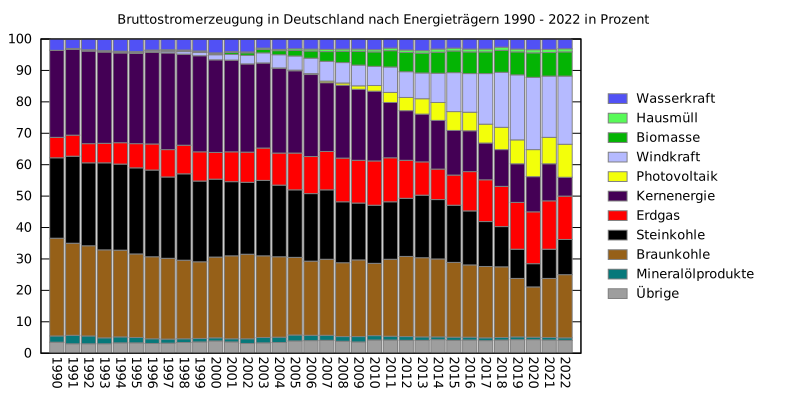


This article dismisses nuclear power as "not safe" with nothing more than the decision of Merkel to justify it. Yes, Merkel has a background in physics, but she made that decision as a politician. It's an unfortunate truth that science is rarely the first consideration in political decisions.
Merkel's decision ignored the truly extraordinary circumstances of the Fukushima disaster, which was triggered by an earthquake and tsunami that, each individually, exceeded the design parameters of the reactor, which was 40 years old at the time of the disaster. Updated studies indicated the reactor was vulnerable to tsunami, but were ignored. Repeatedly.
The reactors of 40-50 years ago can indeed be unsafe if operated poorly (e.g. Chernobyl) or if necessary threat mitigation is totally ignored. Newer designs are safer, and older designs can be made safer if people don't bury their heads in the sand about necessary updates.
Ultimately, nuclear reactors are designed and operated by humans, and mistakes do happen. However, the fact is that the Fukushima disaster has killed fewer people in total than coal power kills every year under normal operating conditions.
Is Germany paranoid about nuclear power? Yes.