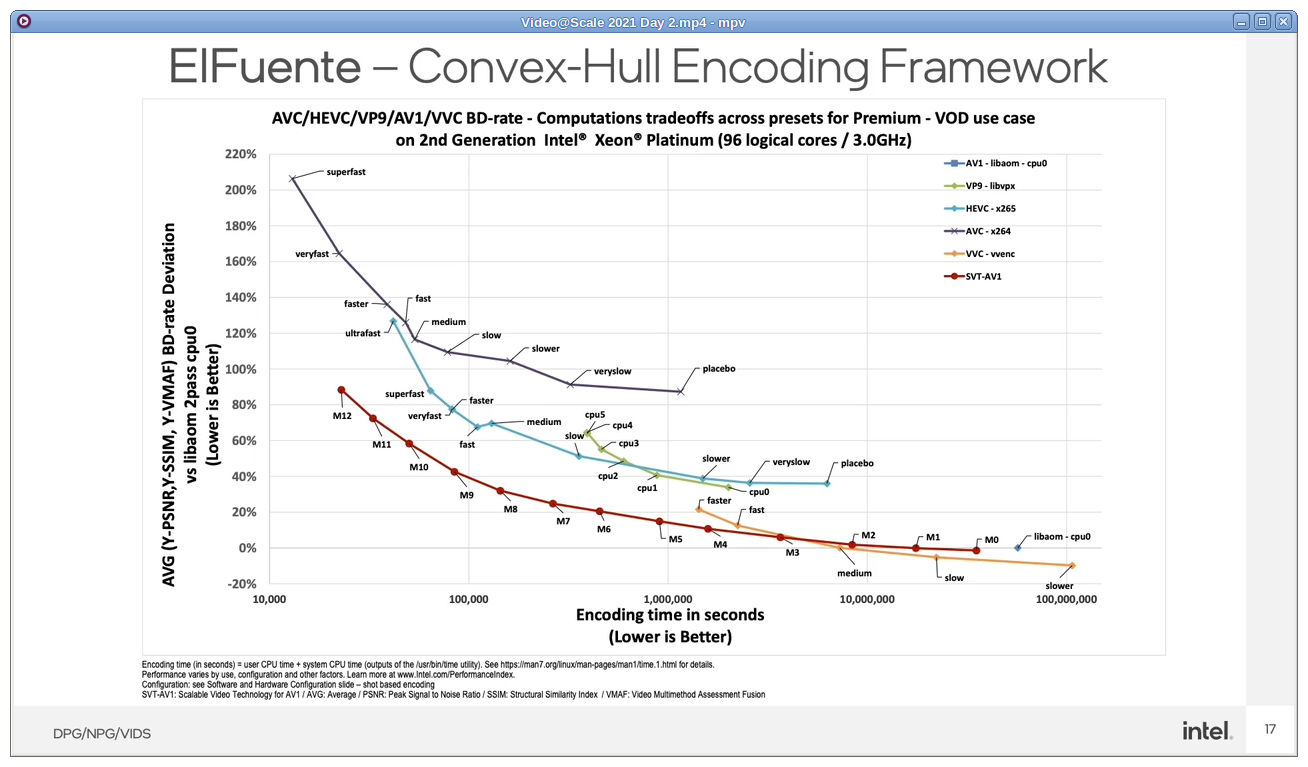
Does AV1 need a successor right now? At least as of some years ago SVT-AV1 was stronger than x265 on both software encoding speed and quality/bitrate[1], and a successor would reset the timer on getting hardware decoders rolled out.
It looks like VVC (H.266) will be significantly better compared to HVEC and AV1.
But due to the patent issues it'll bound to have, I suspect common usage will practically be nonexistent, just like HVEC.
> I suspect common usage will practically be nonexistent, just like HVEC
HEVC is used in all TV broadcast station. FaceTime and other Cameras, Netflix, Amazon Prime, Disney+ and many other large streaming services outside US. The only one that doesn't have any usage of HEVC is Youtube.
The problem with the patents are largely misunderstood. Most importantly the patents do not directly apply to the individual consumer downloading and decoding such audio/video content. The patents only apply to commercial settings - the sales of software that can encode or decode audio and video in the MPEG formats, and sales of audio and video content encoded in those formats. This is why Mozilla made a big fuss over not wanting to include H.264 decoding in Firefox years ago, because they feared they'd have to spend a bit of their money since they are after all a commercial endeavour. No, really, it was never about wanting to "protect" users, it was always about their earnings. You can happily encode AAC audio and H.264 video and share it free of charge with everyone, and they can always listen to and watch that content, without any worries.
And pardon the nitpick but it's H.264 and H.265, not x264 and x265.
Seems like the last h264 patents expires in about 5 months, silly to start moving around to options that might have submarine patents when we'll have something functional that's patent free in quite a short time.
Can you be more specific? I can't really tell what you mean by "normal" here.
And while I do like smaller files, if I compare with a few years ago my connection is faster and my drives are bigger so presumably the limit for "normal" has gone up...
H.264 does just fine with 4K. If you know what you're doing you really don't need to throw 10 Mbit/s at it to get crisp quality.
(p.s. I'm fully onboard with H.265 being fantastic, it's amazing to see what e.g. x265 can do for it, being able to provide practically identical output at 30-50% lower bitrate. I'm just saying that H.264 isn't in any way incapable.)
H.264 may allow 2160p video, but the 4K UHD standard is more than just 2160p. For example, HDR is absolutely critical to 4K, and the only way to do that in H.264 is to use Hi10P which isn't supported by most devices.
In fact, I'd say HDR is more important than 2160p resolution in that I'd rather watch 1080p HDR video than 2160p SDR video.
The trick is knowing what the optimum settings are to use.. with h.265 as you lower the bitrate it smooths more and more and you lose detail. h.264 does blocking instead, so there is an image quality difference.
At the lower end of useful bitrate there's absolutely a difference. Video encoding is complex territory and there's no way around knowing and understanding "optimum settings" when wanting to keep bitrate down, no matter MPEG-4 ASP, H.264, H.265, AV1, what-have-you.
Compared to other modes of operation, CRF doesn't work better or worse at any arbitrary bitrate. In itself it doesn't do anything fundamentally different about how changes between frames are analyzed or how the changes are encoded. It's a "constant quality" mode of operation, and it will use as much data as it deems necessary in order to meet the quality target. That is, CRF produces a varying bitrate product and you have no actual control over the final bitrate requirement.
I know it's not doing anything very different. But that's my point, that you don't need fancy tuning features.
As for final bitrate, maybe we need to talk more about use case here. Because for very small encodes (often around 250kbps), I never cared about moment to moment bitrate, just the final file size. And if that's too far off I change the factor and run it again.
For things I intend to stream I usually have a bitrate limit on top of the CRF setting, but that's the only optional flag and it doesn't kick in very often. The result is quite high quality out of 2-3Mbps AV1, without any flags that affect the details of the video encoder, so I don't see a need for knowing and understanding optimum settings. And the same setup worked with h.264 at a moderately higher bitrate.
The best thing you can do for the encoder is give it time to work.
They've been working on it for years but I'm not sure there's any great need for it right now. The various MPEG alternatives seem to be eating themselves with patent infighting and fragmentation.
It says AV1 is open source and royalty free, and all modern hardware seems to have hardware decode for it. It doesn't seem any of the big players are realistically worried about bogus patent claims.
The official investigation report is of course going to take a bit, but the ATC audio is public, and the helicopter was warned twice about the plane, and said they had a visual of the plane.
Besides never missing an opportunity to 'slam' the opposition, I have no idea why this is being construed as an ATC failure.
That's a system failure if there's no way to verify just what plane the helicopter had in its sights. If continuing with visual separation in the same place, ATC may very well adjust their language. It would help to identify where in the sky the plane is. Or, if there's a potential for cutting it close, just getting the helicopter to hold back until the plane lands? We wouldn't let a plant fly 200ft above another plane in any other situation
That's part of the problem here, everyone is just taking political potshots. Which is to be expected. But the danger is you lose sight of the real issue. As you mentioned, the helo pilot's loss of situational awareness. (Did they ever even have situational awareness?)
We can't be getting into these situations where every crisis is met by this typical American emotional reactionism. We can't be blaming the "left", or the "right", or the most ridiculous one which was "it was the black guys somehow". We gotta stop letting that crap distract us.
I think the underlying problem was the irresponsible amount of air traffic that has been allowed in that space. It sounds like the pilot made a mistake any pilot might've made and truly it was just a matter of time until something like this happened given the overcrowded nature of the air traffic in the area.
Operator error is only the first 'why' in the 5 whys for this incident.
> Besides never missing an opportunity to 'slam' the opposition, I have no idea why this is being construed as an ATC failure.
Just saying what I've heard. One issue is that the controller allowed visual separation, to begin with. They say he should have known that it was difficult, especially at night, and shouldn't have allowed it.
Congress keeps approving more flights into DCA over the in hindsight, clear objections by those in charge of safety at DCA, the FAA and several congress people in the minority. Congress people use it as their personal transit hub.
https://www.nytimes.com/2025/01/30/us/reagan-airport-flights...
Kinda. Collective bargaining rights are great for employees but they do not automatically lead to better outcomes for customers/citizens/etc.
A good counter-example of ATC would be police. Police have strong collective bargaining rights, but mostly came at the expense of accountability and citizen oversight. (And also police departments are still chronically understaffed).
Okay, if not police, then teacher's unions: there's not a lot of available studies, but most point to a non-existent or negative relationship between CBAs and student performance.
Or in the private sectors, non-unionized manufacturers like Toyota and Honda always outperform legacy manufacturers in the US on quality.
I'm not saying there's not a strong argument for unionization, but an improvement in quality is not one backed by any sort of evidence and it's a really weak argument. To put it another way, it would be hard for a unionized employee to outperform a Foxconn employee with no human rights on output quality - but it's not at all the kind of argument we should be making.
> Okay, if not police, then teacher's unions: there's not a lot of available studies, but most point to a non-existent or negative relationship between CBAs and student performance.
I'm going to guess that there are far stronger correlations with household wealth when it comes to student performance than there are whether the students are taught by teachers who are employed under a CBA.
> Or in the private sectors, non-unionized manufacturers like Toyota and Honda always outperform legacy manufacturers in the US on quality.
That could very well be because of how the cars are engineered and made versus the union representation for the people who make them.
GM, for example, tends to build cars in a way as to make them as cheap as possible to build. That lets them compete on price versus quality. You need the car now, after all; what happens in 40k miles isn't as important to you now. Of course, that comes with the risk, like when some essential component on my college girlfriend's Pontiac's shat the bed, and they'd had to take the entire front of the car apart to replace it because it was cheaper to build that way. They've just taken the price of having a functioning vehicle and charged you for it at the mechanic, not the dealership.
Toyota and Honda used to do the opposite, of course. You were going to pay more (depending on exchange rate) upon purchase of the vehicle but the result was that the car wouldn't need as many trips to the mechanic. They've since started doing more value engineering.
There's also a cultural difference between Japanese and American businesses, but that's far more nebulous.
> There's also a cultural difference between Japanese and American businesses, but that's far more nebulous.
The abstract cultural differences might be difficult to articulate, but many of the effects are concrete: Toyota still maintains lifetime employment for Japanese factory employees. And Toyota factory workers in Japan are represented by a union, AFAIU, though like Germany the relationship between unions and management is less adversarial in Japan.
Interestingly, the change in union employment in Japan seems to have tracked the US, from a high of over 50% mid-century to 16% today versus ~35% and ~10%, respectively, in the U.S.
Citation needed, because just a cursory check is showing me plenty of powertrain manufacturing happening in Mexico. Meanwhile if by critical components you mean chips, I don't think there's a big semiconductor manufacturing union that's kneecapping GM. Design is also an apples to apples comparison, it's not a union job.
It was 44 years ago. We have had 6 presidents since then. Every single ATC controller from 1981 is retired, most for over a decade. You probably should be looking at a more proximate cause.
which was a substantial improvement for millions of people. It's worth pointing out that the one (and probably only) good thing I can think of that Reagan did would get him tossed out of today's republican party.
The idea was actually that employers would start to bear some responsibility for knowingly hiring illegal immigrants and thus creating an economic incentive for the migration.
That didn't really happen. You see plenty of roundups of illegal immigrants, many/most are employed. What you don't see ever are roundups of their employers.
If you want to actually see this problem solved immediately all you need to do is show a daily perp walk of the employers on the evening news for a few months.
Several years ago, there was a big immigration raid on a bunch of Tyson Chicken facilities.
They found about 900 undocumented workers.
Many of them gave evidence to officials, including written instructions from Tyson that advised them how to fill out employment, banking, taxation paperwork if they "didn't have documentation" and how to stay under the radar, i.e. Tyson didn't just know they might have undocumented workers, they were facilitating and actively enabling it.
In press conferences, when journalists asked "Are there any plans to investigate the company or issue fines or charges?", the response? "We are not considering that at this time." (And they never did.)
What it ended up looking like was that Tyson had been getting in some trouble, getting bad press for OSHA safety issues and perhaps had decided their undocumented workers were getting a little too angry about poor safety standards, making waves.
It would be entirely unsurprising to me if Tyson made a sweetheart deal with ICE that said "Hey, if you come to these plants, you'll get to make this big stink about undocumented workers" (and this was during the Trump administration), "but in return, can you leave us out of it?", very much shades of "Won't someone rid me of these meddlesome workers?"
True, and I’m sorry for the snarky reply even though I knew what you meant.
But regardless of if this was the fault of Reagan or the largely Democratic-controlled Congress, Republicans in government since then have soured on any idea giving an ounce of amnesty because of it.
Nominated the first female to the Supreme Court, Sandra Day O'Connor, and using his bully pulpit to pressure the Soviet Union about East Germany and the eventual dissolution of the USSR.
He became very popular to hate on in the past midterms because his position that "government IS the problem" is more popular than ever given the last administration. It was a vain effort to preempt what they knew was coming.
Seriously, why else would the name of a president who hasn't served in 40 years suddenly be brought up all the time?
Israeli enabled money to go in to pay government salaries to prevent Gaza from descending in chaos. That said I think it's a matter of fact that maintaining Hamas as a counter to the PA was part of strategy of the Netanyahu government.
I think pretty much any money going into Gaza should be considered funding Hamas. It either went directly to Hamas or it was taxed or it allowed Hamas not to spent that money. This means Europe and the US also funded Hamas.
The reason for funding was to create chaos, not to remove it. Why else do you fund a group that destabilises the area. Basically Israel wanted Gaza to be more chaotic as they felt it gave them more control.
The decision to pursue power and chaos as opposed to seeking resolution and a path to peace has had obvious consequences.
It’s so interesting that you’ve taken away all agency from the Palestinians, or you believe as an absolute rule that giving someone money automatically makes them do chaotic evil things. And that the encourager of the monetary transaction (not the giver or recipient) is solely responsible for any harm or chaos that ensues.
This whole thread is so strange, people keep claiming Palestinians cannot be trusted to rule themselves, while at the same time accusing Israel of genocide for not giving them the ability to rule themselves.
Hmmm. I don't think I agree with that. It's such a polarized and emotional debate. It could really benefit from being precise with words.
Making everything sound just slightly worse than it is will help rile up the side that feels slighted and it will let the other side just pass the speaker off as a liar. The result is fewer shared facts, more polarization and a more emotional debate.
The truth of war is bad enough. It doesn't need to be stretched.
Almost every FDO member is an employee of a corporation. Some are required to use their corporate email for upstream contributions. This is all very normal.
Have you read the email conversation in question? Surely it made you concerned at least a little in regards to the state of FDO and RedHat?
Thinly and not so thinly veiled threats to another person to police their own, not related to FDO in any way, shape or form, community because it does not adhere to your political ideology sounds like a severe abuse of power to me.
FDO is a community, and having people be treated with respect is crucial for maintaining this community. Letting people with a history of not respecting others be a part of that community is a problem, even if that behavior was displayed elsewhere.
It doesn't address the contents of this particular incident, rather it alludes to vague and nice-sounding moral principles thereby brushing off the whole specific issue. It is interesting, because by staying general the author gets to shrink from taking the responsibility of giving their actual opinion on the specific incident itself.
I don't remember since when "bowing down to threats" is adhering to CoC and "openly threatening someone over resolved conflicts under the suspicion of wrongthink" was "respectful behavior from community representatives".
Either way, it is always "we're just policing the bad people" until the bad person is you.