In the US, the government has control over the content too, it just so happens that it mostly concerns itself with combatting certain moral vices (from prostitution to bootleg fireworks) - although to be fair, it also lightly pressured big tech into combatting political "misinformation".
In China, the same mechanisms exist, except the controls on speech are much tighter and the punishments more severe. Every other tech company operating there has a story of officials showing up with demands or threatening employees. I worked at two places where this happened. In addition, most businesses operate as formal or quasi-formal public-private partnership, where the CCP has officials within the corporate management structure. Again, ask anyone who tried to start a foreign-owned business in China.
You can make a reasonable argument that having an oppressive and geopolitically adversarial foreign government effectively in control of the most popular youth social media platform in the country is not great. Or you can make a reasonable free-trade argument. Free trade works only if all participants follow the rules; if Western social media can't operate on their market, they don't get to operate on ours.
There are things to dislike about the US government, but I really don't get the contrarian takes on TikTok. China is objectively worse and its government's legitimacy and lasting power is built in the bodies of tens of millions of victims. We're not getting along right now. This doesn't require cynicism to explain.
I'm guessing you're talking about taxing businesses or products / services instead. That strikes me as a weird argument. Ultimately, all taxes are taxes on the labor of individual humans. "Corporate money" mostly isn't: if you tax it, you either pay as an employee or as a consumer. There are some populist arguments about executive compensation, but if nothing else, executives are still "individual taxpayers", right?
Businesses have to pay for a lot of things that consumers don't - business licenses, permits, etc. Any of those things can be a source of revenue to make up the shortfall.
By that logic should corporations get a tax break because a corporation isn't going to be using the public library given that it's a legal fiction?
I think it's mostly messing up viewport and movement calculations, which is why you have textures popping into view when already in the viewport, and shifting too much in the periphery.
In essence, you're just mildly glitching the display. It doesn't really alter the map or the spatial relationship of items. You'd need more fundamental game engine changes to really implement a different geometry.
> The irony is that this is a good reminder of the harsh realities that Oppenheimer himself clearly grappled with - if you refuse to build it, someone with less scruples will.
The dilemma was quite different: if you don't do it, your enemy will beat you to it and will kill you and the people you love. It was a very utilitarian, wartime calculation.
The soft variant you're quoting is just a license to misbehave because others also misbehave - and I don't think that was Oppenheimer's qualm.
In the general case, I mostly agree, but it cracks me up that this is the prevailing attitude when it comes to our industry; but when we see police departments or government agencies trying to follow the same playbook, we immediately point out how that's laughable and doesn't result in real accountability.
In this specific case, though, Sam Altman's narrative is that they created an existential risk to humanity and that the access to it needs to be restricted for others. So which is it?
Neither. It was pure hype to get free column inches.
Anyone who's used their AI and discovered how it ignores instructions and makes things up isn't going to honestly believe it poses an existential threat any time soon. Now they're big enough they can end that charade.
They're very cool until it's your apartment or commercial building, and you have to clean it up - because let's face it, for every clever graffiti, there are fifty that are just tags, swear words, or worse.
And your framing is odd - can you only dislike one of these things? Graffiti or ads? There are successful movements to rid cities and scenic areas of ads, or to tone them down.
in toronto it's embraced to the extent that in areas where it's common, there's funding by businesses and even residences or local gov commission it or permit it and nice work by local artists is less likely to get tagged or covered. there's at least some upside to cooperating when there's a culture to it (to some extent)
Right. That’s the point. In public spaces, the public has chosen what it believes to be beautiful. Illegal graffiti is one person forcing their aesthetics on everyone.
Plenty of cities have surfaces that are open to being grafitti’d. In those cases, the artists bothered to think about others before taking unilateral action.
Have you chosen what you think is beautiful for your city? Most city decorations are decided by direct action from the council without consultation from the public. Sometimes involving as little as one or two people.
For private property I agree with you, the owners have it how they want to have it.
> Have you chosen what you think is beautiful? Most city decorations are decided by direct action from the council without consultation from the public.
When it’s mattered, I’ve showed up. Or signed petitions saying something is ugly and would benefit from being replaced by just about anything else.
Plenty of communities embrace their mural and graffiti culture. Plenty don’t. Imagine if someone who doesn’t like murals went around whitewashing painted walls.
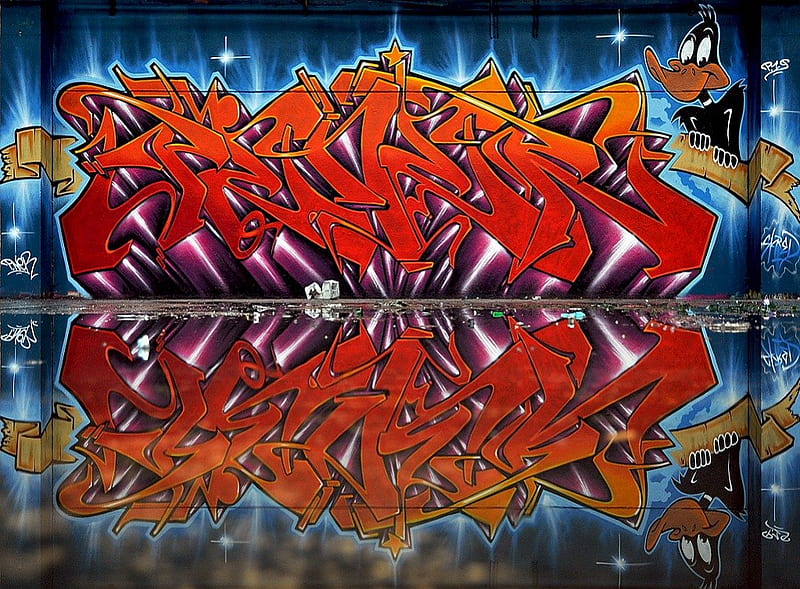
While I find this specific beautiful, retouched and over-saturated picture beautiful. I'm pretty sure it would look much better without the graffiti, trash and huge puddle in front of it.
I've normalized it all my life and will keep doing it, art should be around us and bring interestingness to public spaces. People like you would rather walk around in the equivalent of a hospital 24/7 and you currently have the law on your side but it doesn't mean you're right.
I hope this made you feel better. Good luck finding a new place to live or growing out of being upset from paint or it seems like you're going to be mad every couple of months until the rest of your days.
It's actually one of the perks of centralized platforms like Reddit: if they want to, they have the technology and the resources to investigate bad actors like that. I don't just mean just finding and blocking their IPs, but untangling their ownership, corporate structure, tooling, and so on. Hiring actual PIs if necessary. It's the bread-and-butter for many spam and abuse teams at Big Tech.
That said, just because they can doesn't mean they will. It's possible that they've grown complacent and underfunded these capabilities (instead relying on community moderators to weed out bad actors). Or it's possible that they're too focused on the short term to see the existential risks. If I recall correctly, they couldn't resist the temptation of selling user content for LLM training, same as Stack Overflow.
But in an internet overrun by spam LLMs, the future are curated, walled-garden communities, and Reddit could be the basis for that.
Anything which diminishes their usage numbers won't look good for investors, so one should assume no action will be taken by the company which diminishes their usage numbers.
I really want to be impressed, but I've been reading papers about breakthroughs in deblurring and upscaling for two decades now, and the state of the art in commercial and open-source tools is still pretty underwhelming. Chances are, if you have a low-res keepsake photo, or take a blurry nature shot, you're gonna be stuck with that.
Video, where the result needs to be temporally coherent and make sense in 3D, can't be the easier one.
At this stage there's really only a couple of options. More than there used to be, but still.
When you want to stay faithful to the actual data then your options are limited, for quite a large part of the image a simple convolution is about as good as it gets, except for the edges. Basically the only problem we couldn't solve 20 years ago was excessive ringing (which is why softer scaling algorithms were preferred). You can put quite a lot of effort into getting clearer edges, especially for thin lines, but for most content you can't expect too much more sharpness than what the basic methods get you.
And then there is the generative approach where you just make stuff up. It's quite effective but a bit iffy. It's fine for entertainment but it's debatable if the result is actually a true rescale of the image (and if you average over the distribution of possible images the result is too soft again).
In theory video can do better by merging several frames of the same content.
Video is absolutely the easier case - there's a lot more information to go on. A single blurry photo has lost information compared to the original, but you can theoretically recover that information in a video where you get to see the subject with a variety of different blurs/distortions applied.
Note that a limitation of this result is that it assumes a static scene, but that's already a typical limitation of most gaussian splat applications anyway, so it kind of doesn't matter?
I'm trying to make an opensource NN camera pipeline (objective is to be able to run on smartphones but offline, not real-time), and I'm still barely managing the demosaicing part... would you be open to discussing with me?
Yeah, it's a weird metaphor, especially since plywood is a premium, structural material. I wish my Ikea furniture used plywood. Instead, you get fiberboard.
It's also a good example of how the metaphor this blog post is predicated on can fall apart. Your customers care about durability, but they make purchasing decisions based on cost and outward appearance. In a world like that, where you can't satisfy all requirements at once, you inevitably end up cutting corners on the things the customer cares about but can't measure. But is that right? That's how you end up with $200 furniture that lasts a year or two in a home with children or pets.
It's also easy to neglect cumulative costs. Back to software: does it matter if your app uses 100 MB of memory when it could be using 1 MB? On an individual basis, no, because RAM is cheap. Cumulatively, when every other app developer thinks the same, and when you multiply it by billions of devices, your decision might have actually cost lives if you consider the increased emissions and countless other distant externalities.
A milder version of the blog's claim is definitely true. You should pick your battles. But it's all about trade-offs, there are few problems that truly don't matter to anyone.
It's easy to lash out against the VC culture, but the problem is us. We're the ones who dream of building a billion-dollar unicorn in two years - and that means entirely unsustainable efforts to build products and grow by burning heaps of VC money while constantly pitching for more.
How many founders move to the Bay Area thinking "you know, what I really want to build is a small business?" And how many HN techies would enthusiastically join a project like that?
I don't get it. My experience is that techies in the original sensor of the word have always enthusiastically joined companies where they thought the technology was profoundly cool. Business size or profits have little to do with it as it is how interesting or transformational the tech is. Most of us just want to get paid to do the thing we're passionate about, and have no particular interest in entering the world of personal yachts.
In fact the desire of people to "just work on really neat tech" and have some creative influence and work outside of a big boring company is exactly what has allowed many startups to underpay and play carrot-on-stick with stock options for years.
Almost nobody is getting rich inside these "tech" startups, the options agreements are written to prevent it. Maybe the founding engineers, but nobody after that.
I feel like what has happened is that the words "startup" and "tech" have been redefined by a small segment of the population who are interested in one particular thing being described here in this thread.
But I've been around long enough to remember when it meant "a group of people getting together to make some really neat tech."
Honestly the motivations of people who started a bunch of the foundational SV ecosystem were exactly that and not "let's be billionaires" That is very much a post-Y2k mentality.


In the US, the government has control over the content too, it just so happens that it mostly concerns itself with combatting certain moral vices (from prostitution to bootleg fireworks) - although to be fair, it also lightly pressured big tech into combatting political "misinformation".
In China, the same mechanisms exist, except the controls on speech are much tighter and the punishments more severe. Every other tech company operating there has a story of officials showing up with demands or threatening employees. I worked at two places where this happened. In addition, most businesses operate as formal or quasi-formal public-private partnership, where the CCP has officials within the corporate management structure. Again, ask anyone who tried to start a foreign-owned business in China.
You can make a reasonable argument that having an oppressive and geopolitically adversarial foreign government effectively in control of the most popular youth social media platform in the country is not great. Or you can make a reasonable free-trade argument. Free trade works only if all participants follow the rules; if Western social media can't operate on their market, they don't get to operate on ours.
There are things to dislike about the US government, but I really don't get the contrarian takes on TikTok. China is objectively worse and its government's legitimacy and lasting power is built in the bodies of tens of millions of victims. We're not getting along right now. This doesn't require cynicism to explain.