A lot of people are very uncomfortable with the notion that not every product is targeted at them. It's an ego thing. If I was Freud I'm sure I could explain it better.
I remember discussions after the iPad came about how it was useless on construction sites, wouldn't last a month etc. If this is durable enough it could sell nicely. Also, having synchronized 'digital' data might help avoiding some issues like outdated underground blueprints (college machine room suffered network and power shutdowns because of wrong digging location.. how crass)
ps: https://news.ycombinator.com/item?id=6705169 says the specs aren't as impressive as panasonic toughbooks, someone needs to test this in real life. Slow mo guys maybe ? www.youtube.com/watch?v=8OH1CKIQdpw :p
And video editors.... except that video editors spend a lot of money to buy controllers for video editing, because video editing is about frames. It's about maintaining some illusion of continuity by messing with video by the frame. They need to controllers because they sit in a dim or dark room all day. And they won't want to touch the screen and get it dirty.
6k for a 4K 20" tablet with a 2 hour battery that weighs over 5 lbs with only an i5 and 2GB vram? This isn't going to be the ultimate Civ 5 machine that I've been hoping for.
I keep wondering why tablet manufacturers are all focused on the smaller form factor when they could be producing all in one screens upwards of 32" to replace clunky desktop units. Such screen sizes wouldn't necessarily need the generosity of a long lasting battery because of their sizes but could pack enough punch for compete with desktop units.
Hopefully manufacturers delve into that market more and drive the price down.
How exactly would one hold a 32" tablet, or situate it at a desk? Arms grow very tired operating horizontal touch screens, and if the screen is on a table, angled, it's awkward to sit and look at.
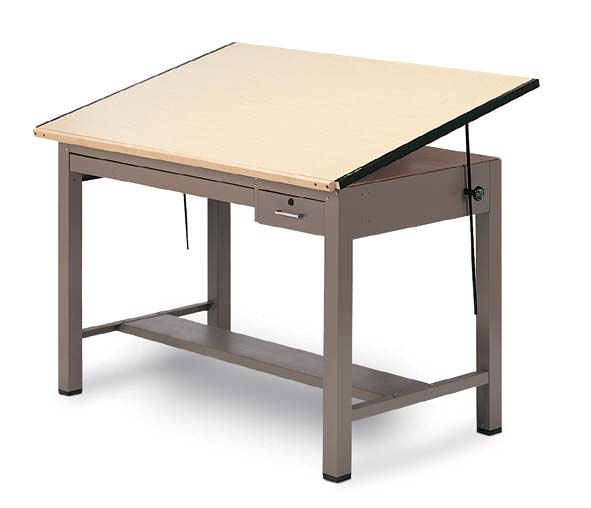
There should be a stand that holds such a tablet at an angle comparable to a drafter's table [1]. That especially combined with a Wacom digitizer would be perfect for a lot of creative professionals.
Ha ha. Ridiculous. The reason why smartphones and some tablets are popular has less to do with touch than with size. It's pleasant to hold a small screen a foot from your face for reading and watching videos.
Let me quietly wish that we will see a model with a DisplayPort input so it could be used as an external monitor for a laptop. I would love me a 4K 20" 5.5lbs transportable monitor. Given then weight is pretty much the same as the AOC e2351F I have anyways, the only question would be -- four times as many pixels, fourty times the price. Is pixel density and hardiness worth a magnitude of price difference?
A little off-topic, but I like how marketers trying to sell Win8 have to use fake application screenshots. Where are the actual apps that let you share blueprints? Oh, right. They're not sexy at all, and wouldn't benefit from a 4K display.
Dimensions/Weight: 18.7”(L) x 13.1”(W) x 0.5”(D), 5.3 lbs.
Weighs more than a MacBook Pro 13 (4.5 lbs). This should be marketed as a body-building tool. In fact, I'm not sure the models in the "Solutions" page are actual users, because they don't have gigantic forearm muscles required to hold a 20" 5.3lbs screen from one corner:
I was going to comment on the same thing -- I'd tried the same positions holding a 17 & 15 inch MBPs to get an idea of how heavy that would be. It was tolerable for a minute or so, and I'm a rock climber blessed with gigantic forearm muscles.
If they can make a 20" 4K display and put it in a tablet, then why can't they just mount it in a desktop display and I'd be interested in buying it (though whether I have the money is a completely different question). I'm sure it would be easier to manufacture if they didn't care about weight/power consumption and there might be a bigger market.
I think it's meant to be used more like a desktop. Except it's going to lay flat on your drafting table, offer a touchscreen and high resolution 4K screen.
Having a battery means you can move it around without having to shut it down. You can also take it to meetings and present stuff.
i think the best part of it is that you can take it outside, or take it to a client. 2 hours isn't a lot, but it is enough for a meeting with someone at a starbucks or at their home.
Just imagine playing mine craft with so many pixels! I don't care about the price or battery life, we are finally in the age of overpowered 'gaming tablets'
Panasonic is dying... I've been following this company for my whole life. Their concepts are bad and their focus is wrong. Typical Japanese company with board full of elder chairmans, who are afraid of big change. I don't see light in this tunnel....
I have to think this has been designed, built, and priced to sell to the sorts of law enforcement organizations that already have the latest armored personnel carriers, and have just a bit more budget to dump.
  "While one could increase the resolution to make up some of
   the difference, it is meaningless unless your tablet also
   includes sandpaper, so that the user can sand down their
   fingers to around one-quarter of their present size."
                           -- Steve Jobs (on 7 inch tablets)
I've been using a Samsung note ii for a while now -- and the combination of regular touch input combined with a precise stylus (with the option to disable "regular" touch input while using the stylus) is really nice.
This isn't for anyone. _Anyone_. Beyond the 300-350 pixels per inch, the 'sharpness' and the 'detail' is not perceivable by human eyes. It's a wastage of power, memory and CPU/GPU resources. This is what happens when Marketing dictates Engineering.
Is that really true in general? I'd say the difference in print start to disappear around 600dpi (dpi/clarity isn't really discernibly different between a 600 dpi print and a 1200dpi print. But up to 600 dpi, I'd say there definitively is a difference)?
Granted, with current technology we have single-coloured pixels, so 300 ppi is really 3-900 dpi (or pixel-parts) -- that might have something to do with it?
The dots in your basic 300dpi monochrome laser printer's output are black or white, but on a 300ppi screen you could antialias with grey pixels (or even subpixels as you note), which can boost perceived smoothness/quality a lot. Figure here conveys a difference between PPI and DPI pretty well: http://en.wikipedia.org/wiki/Dots_per_inch#DPI_or_PPI_in_dig...
Oh, just saw a post about this on another site and noticed it's 231PPI because of the large size. That's a good bit less than the 300PPI on the Nexus 10 that they compare it to in the image on the product page, interestingly. Also south of 1080p and 720p phones, the new Nexus 7 or Kindle Fire, or any of Apple's iPhone/iPad Retina displays.
It's maybe most comparable to the 15" Retina MBP--roughly similar density (220 vs 231), and both are bigger panels you use at a distance.
Just interesting that from a pure spec-wars perspective, raw density isn't one of the dimensions on which the Toughpad is pushing the envelope. Density in its size class, maybe, but not density full-stop.
Depends on how close the page is to your face, and how well you see. The type's size also matters. 7pt type at 300 dpi is not that attractive due to pixelation. However, to even see that, I need my face at 10 inches from the page.



This isn't for you. This is for doctors, and architects (which is pretty obviously indicated in their marketing material).