Thanks for the reply, Taylor. Perhaps you can explain this to me:
What niche are you guys trying to fill with this? I guess I'm just not seeing it yet. You talk about "piping TCP/IP" over the data link but how is this superior that using any of of the dozens of other powerful, low-cost, mesh solutions purposely designed for TCP/IP routing?
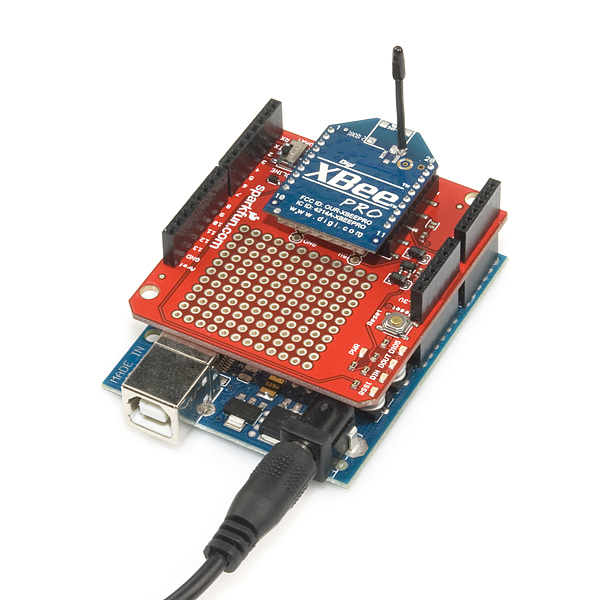
Maybe you're trying to fill the "talk to my kegerator" niche. OK, but how is this superior to the Xbee shield [0]? That shield interfaces with a number of different Xbee products that offer a wide variety of power outputs and ranges. These Xbees do mesh networking out of the box. How does Flutter do it better? Help me understand. :)
TCP/IP is a fun idea and I think people will get some use out of it for mesh and darknet purposes, but the target is Arduino users (aka "regular people"). That said, I'm designing the protocol so professionals can use it too. We may end up forking it, and doing what Raspberry Pi did, giving people Rasbian for regular folk and other distros (featured in the same place) for hardcore users.
That is a $25 shield, $23 radio, and a $29 arduino all stacked on top of eachother, and you get 100m range max. Wouldn't you rather have a single board for $20 or $30 that meets those needs and lets you reach out up to a kilometer or more?
Yeah, exactly this. Used to be, you buy an Arduino Fio and an xbee module[1], and for $50 you get max 100m range? Two nodes then cost $100, which is enough for one project and one device to route traffic to mobile, lets say.
With Flutter, for $100 you can have 5 nodes, so you can have the beer brew monitoring, control some lights, measure the humidity of your greenhouse, and build a robotic car you can drive with your phone.
We're trying to hit commodity pricing for consumer mesh hardware so people can just toss it in whatever they want to make and easily handle the communications they need.
And not relying on another radio module manufacturer means we can design the product to be everything we need and nothing we don't, and only pay for board manufacture once, instead of paying for a module (which is a manufactured board) that you then put on your own manufactured board.
The radio and cpu should be on the same board and should be very useful (hence open and arduino). Then we can really build a network of things.
You seem proud of the fact that with your $20 pricing you are turning your module into a commodity.
Although I'm sure consumers will cheer you on, I think the typical entrepreneurial thought is that having your product turn into a commodity is a bad thing because there is no money in it.


What niche are you guys trying to fill with this? I guess I'm just not seeing it yet. You talk about "piping TCP/IP" over the data link but how is this superior that using any of of the dozens of other powerful, low-cost, mesh solutions purposely designed for TCP/IP routing?
Maybe you're trying to fill the "talk to my kegerator" niche. OK, but how is this superior to the Xbee shield [0]? That shield interfaces with a number of different Xbee products that offer a wide variety of power outputs and ranges. These Xbees do mesh networking out of the box. How does Flutter do it better? Help me understand. :)
[0] https://www.sparkfun.com/products/10854