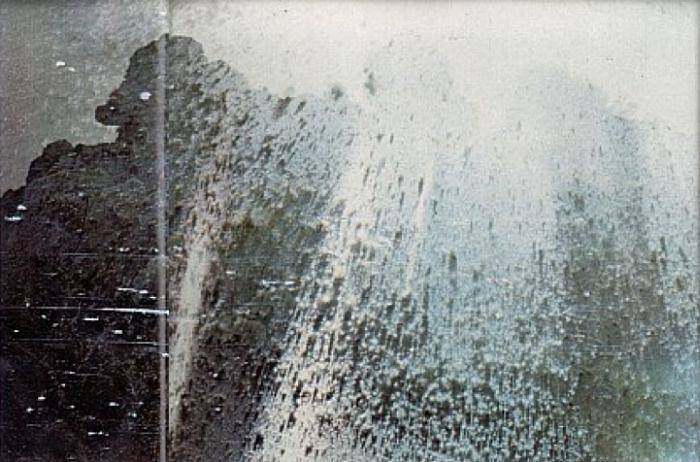
It's wild to see this footage safely behind a monitor. Kind of macabre to ponder but I wonder if the victims of Pompeii had a similar experience. The last we see is a hailstorm of ash and molten lava raining down then signal lost.
there is a poignant set of images taken by a photographer Robert Landsburg who chose to post himself too close to the blow up of the top of Mount Saint Helens in 1980.
the last picture from his salvaged camera is similar to what we see for this topic: https://allthatsinteresting.com/wordpress/wp-content/uploads... his camera was found under this body, with speculation that he was protecting it, which doesn't seem unlikely, but it also would not be surprising for him not to have had that presence of mind, things were happening very quickly.
After taking his final photograph, Landsburg removed the roll of film from his camera and placed it in a canister. He buried the camera and the film canister deep in his backpack. Then, he placed the backpack on the seat next to him and covered it with his body.
It was more than just jumping on top of his camera. Sounds like there’s some confidence about his intention.
iirc, Pompeii was a pyroclastic flow [0], a fast-moving current of hot gas and volcanic matter with speeds between 100-700 km/hr and temperatures up to 1000°C. So, probably something like that, but a lot bigger, faster, and arriving faster from further away.
I was surprised how long the camera lasted getting buried. It'd be a not good end.
Just to add, there are two main categories of volcanism, shield volcanoes (hot spots, mid ocean ridges) and stratovolcanoes (continental and subduction zone volcanoes). Hawaii is the first kind ("tourist friendly"), Vesuvius at Pompeii is the latter kind (not friendly). The main difference is the silica content, the stratovolcano lava is sticky and viscous; it gets stuck and things get explosive and nasty.
We have a lot of stratovolcanoes around the pacific rim so it's eruptions like those that we should compare with Pompeii, and not really Hawaii.
The two categories also produce, in general, different kinds of rock.
Here is a pyroclastic flow from two weeks ago. In the first minute you can watch it boil a rainforest to tree trunks. That is an insane amount of heat to do that, green stuff is full of water and doesnt like to burn.
i just posted a sister comment to yours about the Mt St Helens explosion, with a picture from 1980, and then i noticed that they are calling (it's a non technical article) what rained down in the photograph onto the camera and photographer "pyroclastic flow" and it looks very similar to what happened here.
This is not a pyroclastic flow and doesn’t look even remotely similar. The problem is that you’re comparing a very close up image of some lava falling on a camera to videos taken from tens of miles away from Mt St Helens. The scale and nature of the event are completely different.
Weirdly if you are going to be hit by a pyroclastic flow then it won’t be moving across your field of view at all. It’ll just be getting bigger and angrier–looking for the minute or two that you have left in your life.