[I am not a current Google Employee so my understanding of this is based on externally written articles and “leap of faith” guestimation]
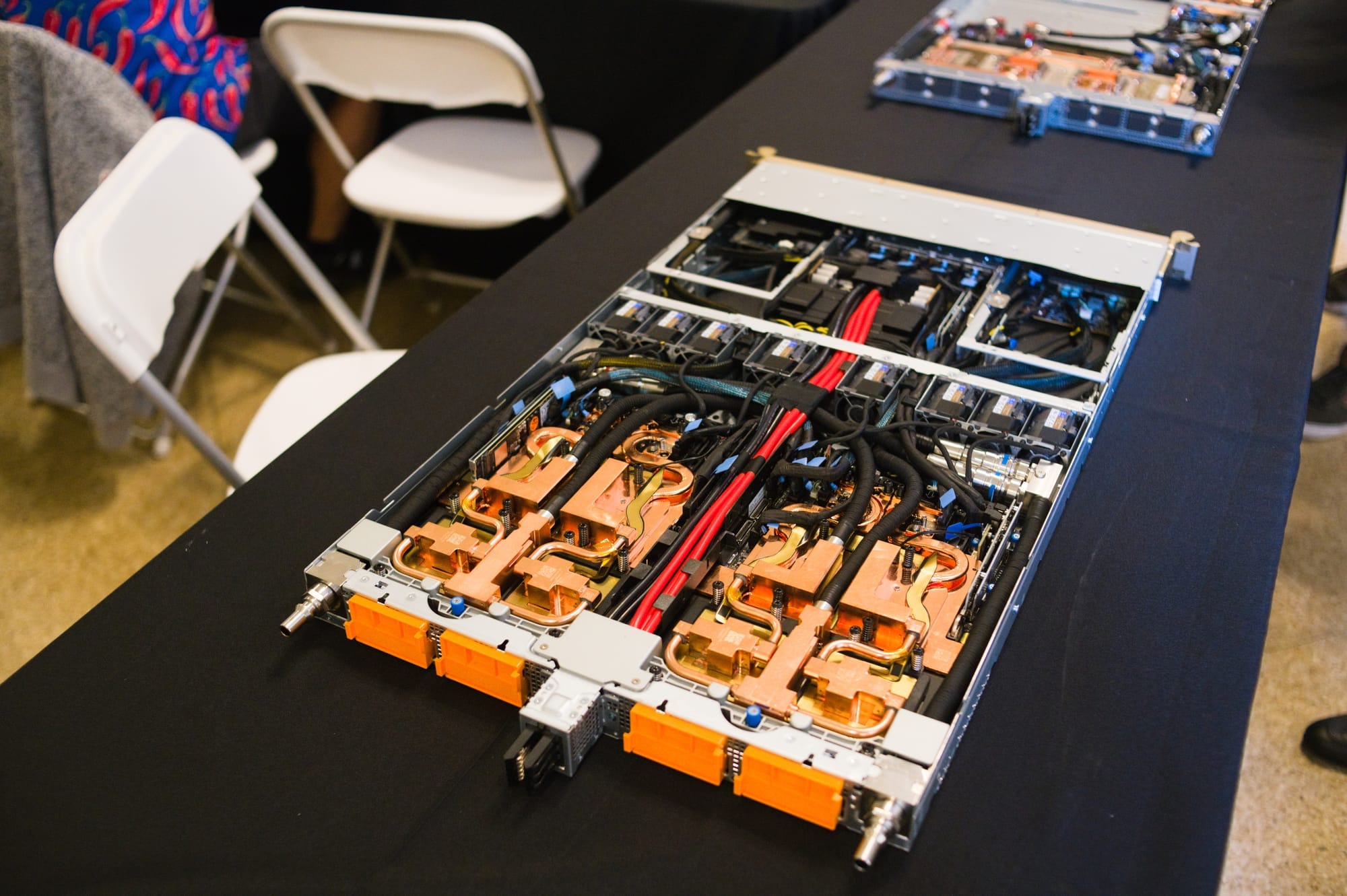
Yes. A supply and return line along with power. Though if I had to guess how its setup this would be done with some super slick “it just works” kind of mount that lets them just slide the case in and lock it in place. When I was there almost all hardware replacement was made downright trivial so it could just be more or less slide in place and walk away.
Non-spill fluid quick disconnects are established tech in industries like medical, chemical processing, beverage dispensing, and hydraulic power, so there are plenty of design concepts to draw on.
Related, I vaguely recall a concept from a Tesla charger for semis that proposed a charging cable with active coolant flowing through it as well to keep the wire cooled.
I remember reading somewhere that they don't operate at the level of servers; if one dies they leave it in place until they're ready to replace the whole rack. Don't know if that's true now, though.
It does sound like connections do involve water lines though. As they are isolating different water circuits, in theory they could have a dry connection between heat exchanger plates, or one made through thermal paste. It doesn't sound like they're doing that though.
It has not been true for a LONG time. That was part of Google early “compute unit” strategy that involved things like sealed containers and such. Turns out that’s not super efficient or useful because you leave large swaths of hardware idle.
In my day we had software that would “drain” a machine and release it to hardware ops to swap the hardware on. This could be a drive, memory, CPU or a motherboard. If it was even slightly complicated they would ship it to Mountain View for diagnostic and repair. But every machine was expected to be cycled to get it working as fast as possible.
We did a disk upgrade on a whole datacenter that involved switching from 1TB to 2TB disks or something like that (I am dating myself) and total downtime was so important they hired temporary workers to work nights to get the swap done as quickly as possible. If I remember correctly that was part of the “holy cow gmail is out of space!” chaos though, so added urgency.
I'd love to work in a datacenter at that scale sometime, it sounds like it's like working in a warehouse where you get a list of orders, servers to remove and pick up, but at the scales of the Googles et al, that's hundreds of server replacements a day, and production lines of new servers being built and existing ones being repaired or decommissioned.
It's a fascinating industry, but only in my head as the only info you get about it is carefully polished articles and the occasional anecdote on HN, which is also carefully polished due to NDAs.