I am pretty sure, diamonds would make awful eyeglasses. While their index of refraction is high, which makes glasses thin, their chromatic dispersion is high. That is the very thing which makes their glitter so colorful. For good optical systems you want to try to reduce the dispersion, to 0, if possible.
Another story is the scratch-resistance. For that it would be sufficient to coat the surface of the lens with a thin layer of diamond. Which is done in several applications.
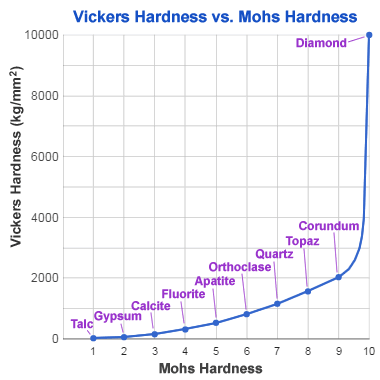
It’s definitely price performant at 6.5 on the mohs scale, sapphire panels are 2-4x more expensive to produce but 9 on the mohs scales so they’re typically only found in watches I bet. At a 10 on the mohs scale diamond is still best for hardness. Maybe the same effect of the prince Rupert’s drop could be induced on a round diamond with an alpha particle beam treatment where you add these ions primarily on the surface of the stone.
I'm not exactly a watch nerd, so don't know how true this is, but I hear that sapphire shatters on impact. Or maybe that's just an excuse for people peddling "alternative" materials for their watches?
But if it is true, then I'd say that sapphire is a poor choice for mobile phones. IME I'm far more likely to drop the phone, preferably on some form of hard surface, that to scratch it. Phones are nowadays so ridiculously big, that there's zero chance I'll have anything else in my pocket.
Diamonds also shatter. It's got roughly the same toughness as sapphire but the cleavage planes are more annoying (in that it has them, while sapphire doesn't).
They did however manage to get Sapphire on the watch display (at least on the stainless steel LTE edition of the apple watch series 4 and 8, which I'm aware of).
The difference between my watch (which was 4 years old at the time) and a colleagues almost brand new apple watch (without the sapphire) was really telling, is his was lightly scratched on the edges despite him being quite careful, and I was exceedingly reckless with mine as I considered it old- yet there was not a single defect.
That was a major reason for me to upgrade to the LTE of the next version of apple watch that I bought.
I have now had watches for 10 years without issue and my phone displays seem to scratch.
I’m not doubting you’re correct, I never boight it for this reason, it was just an interesting retrospective observation. Clearly its working for me, and I’m not sure I have anything with gorilla glass.
Unless the Pixel 7 has it.
EDIT: My Pixel 7 does have gorilla glass indeed and it has two scratches on the display despite being extremely rarely used. (its my work phone and sits on my desk mostly)
I have a Series 5 with the Saphire glass but my clumsy ass dropped it in the kitchen onto a stone floor. The edge of the glass shattered and while I still use it to this day, it's an ugly reminder of my clumsiness. The repair offer from Apple was to get a new one with a very slight discount.
Long story short, it is more scratch resistant but also more prone to break. So be careful.
I wonder if they could put in tiny reaction wheel gyroscopes (to make it land in a safe orientation) or tiny linear reaction masses, or perhaps tiny replacable airbags or tiny sodium azide NaN3 charges/nozzles to blow air just before landing, to make for a gentler landing, replacable of course.
Tiny replacable airbags, on the corners. Preferably it should somehow detect the elasticity of the surface its falling to or going to hit.
There was a prototype design that a German student, Philip Frenzel, produced in 2018 that used the accelerometers to detect freefall and push out little spring claws to protect the device. It was supposed to be in production circa 2019 I think but I can't see evidence that it made it. YouTube has videos.
I suspect the edges are more at risk than the face, as I've struck the face very hard against the edge of a scaffolding pole and there was no damage - which, actually shocked me a lot based on the force.
The threat isn't so much scratching it in your pocket (but that is possible, I typically have my sunglass clip in the same pocket--it's supposed to be in it's own case but in theory something could happen) as scratching it against things.
No, it's substantially more expensive. At least for anything too large to just cut out of HPHT chunks, just due to CVD at optical grade being pretty slow.
So scratching definitely still happens, both on sapphire camera lenses and new scratch-resistant screen technology. I’ve mainly had it happen with concrete. I think concrete sometimes just has some rocks in it that have a very high hardness because I’ve gotten pretty thick scratches in new iPhones when they’ve taken a slide over a rough concrete sidewalk due to a drop while walking.
Your keys are by no means hardened steel. If they are steel at all (most are brass or silver/zinc), they would be mild steel. If they were hardened they would be really difficult to cut. The harder you make a steel the more brittle it gets. Think about what happens when you slam a file with a hammer vs a large nail.
What kind of material are your keys and locks made from? Over here nickelsilver or nickel plated hardened steel is common for keys and a combination of brass, steel and titanium for locks.
This should not be possible with any type of modern phone screen. Do you perhaps have a plastic screen cover that is scratched? Or key metal could be deposited on the screen and just need to be scraped off
Depending on your location and lifestyle, your keys and other possessions can easily collect a dusting of tiny sand particles. Quartz in the sand can scratch most types of glass.
I believe you, but there is some other explanation here- it warrants further investigation. You can scrape a regular glass window (about MOHS 6.5) clean with a razor blade (about MOHS 6.0) and it is impossible to scratch it, just from that tiny difference in hardness. I do this all the time, e.g. recently to get paint that my kid painted on the house windows off.
Your brass keys should only be about 3.0, and gorilla glass a 9.0- you should be able to rub keys into brass dust all day long and not mark the screen.
I store my keys right in my pocket with my glass iPhone SE, and it doesn't have a mark on it.
I suppose it is possible you have keys with some weird material or coating, or as another poster suggested- maybe something like an abrasive dust got stuck on your key.
Typical keys are made from nickel plated hardened steel and nickelsilver. Considering the shiny coating is long gone and the keys are ferromagnetic, I assume it's the first. The keys are certainly hard enough to scrape my glass ceramic stove.
And reports online say that gorilla glass victus is the mist scratch prone gorilla glass, scratching at or around 6 already :/
I think you may be onto something here. Taking apart old machinery I have often observed that the hardened part of a shaft is worn and has a noticable groove detectable with a fingernail. However the part that rubbed on it is often much, much softer eg a rubber oil seal. My theory is that the much softer material is so soft that microscopic inclusions of something much harder (grit?) are caught in the material and then abrade the harder shaft. Something similar may be occurring in the keys on glass case?
And it's a tradeoff. I found out the hard way that newer Pixels have incredibly soft screens to avoid cracks and shattering. Unfortunately, they're so soft that a fingernail (a 2.5 on the Mohs scale) will leave huge gouges quickly. Fortunately, there's third-party covers that use an adhesive that fills in the scratches well.
Think about it; you couldn't put a fingernail scratch into a cheap soda glass beer bottle. Why would Google make a phone with glass that could be scratched by a nail, let alone easily? Does that even exist? Perhaps there is some coating on the glass you didn't remove and that's what you're scratching?
I'm sorry if you don't believe it, but it really happens. The "coating" would have to be pretty thick, this gouge was something you could easily feel with your fingertip. I was very careful to not let my keys or anything else get near it, and the gouge (which was essentially the only scratch on the otherwise flawless screen) was exactly where my thumb hits the screen.
My Pixel 4a, meanwhile, was in my pocket all the time and never got a scratch.
It's possible, and I remember seeing a very expensive prototype for it, but sapphire is already Good Enough for almost any cause of scratching you're likely to find.
Before I got to the end of your comment, I was just about to ask if it's possible to make a diamond coating. The scratch resistance would be very valuable, and I'm guessing if it's very thin, the chromatic dispersion wouldn't be an issue. This would probably be valuable for other applications too. However, I don't see how this would work on today's predominantly plastic (polycarbonate) eyeglass lenses, and switching back to glass lenses would make eyeglasses much heavier. It'd be great for smartphone screens though.
> While their index of refraction is high, which makes glasses thin, their chromatic dispersion is high
Isn’t the layer caused by the former? For a given required refraction, isn’t the chromatic dispersion the same?
In complex lenses corrections can be made, but for a simple single eyeglass lens, how is chromatic dispersion affected by anything apart from simple refraction?
Unlikely. Same as under low-light conditions where everything is grayscale. The light is still colored and just not perceived in color, so it should be blurred grayscale.
No, because eye surgery can't take the place of corrective lenses in all cases: it's not a full replacement for glasses or contacts. For people the farther ends of the spectrum (either needing very light correction, or extremely heavy), surgery doesn't work, or for very high prescriptions it only helps but it's not enough by itself. (Ophthalmologists please feel free to chime in.) And there's other reasons people aren't eligible for surgery, such as being too young.
Laser eye surgery cannot fix the problem of the lens having become inflexible and losing its focusing range. In such a case, surgery can only change where the focal distance lies.
Laser eye surgery won't do that, but intraocular lens implantation could. I think those lenses still don't work that great for reading, but I imagine they will eventually.
I know of these as side effects but I don't know if they are ubiquitous and people prefer them to glasses or of they don't happen to everyone. Do you happen to know amd know about what the rate of regret is?
I don't have the data. I think it depends on the severity of the correction. Also, age factors in, if you get it too young your eyes can go blurry again by middle age.