Yes, but actually no. If the DEA or local LEOs actually wanted to crack down, there is plenty enough wiggle room in the scheduled substances act and all the related add-on laws (esp. Federal Analogue Act), there is enough molecular similarity between the various cannabinoids, and insufficient sensitivity in most chemical tests, plus the tendency of THC-A to decarb (eject a carbon dioxide molecule to give THC) under heating, that these agencies could absolutely give you a hard time and make your life hell for a while. Even if charges didn't stick, you'd still have a bad time and be out thousands in legal feels.
What's actually happened is de facto, not de jure, legalization (in effect, but not in law), because of the unpopularity of cannabis prohibition. It's just not worth it in most situations to go after these products at this point.
There's still a strong need for actual legalization at this point.
Totally depends on the product. The federal farm bill states that hemp products need to be under 0.3% THC to be considered hemp. How high you get depends on the milligrams. So, edibles (gummies, etc) can remain under a 0.3% THC by volume in the product while still having more than 5-10 mg per edible.
You're not wrong about people being able to make your life hell, but the edibles absolutely fall under the letter of the law. (The one exception being the concentrate used to name the edible with have a large percent THC until it becomes diluted again)
I'm not sure if there was a specific article your trying to link me to - that's just a list of all FDA cannabis regulation articles.
I'll admit that I didn't read much of the article. My knowledge comes mostly from working in hemp from 2017-2019. I was asking back then went people weren't doing this since, based on my reading of the law, it seemed perfectly legal (if not very sketchy). I'm not sure if the regulations have been updated since then, but it seems like 'no' based on current behavior
Initially I was thinking it was 0.3% by weight, which would be no big deal -- a gummy worm under 3.5g would be legal for 10mg of THC. But it's 0.3% by volume! What volume does 10mg of THC take up? Quick search didn't make it clear... but I think you'd need probably a little over a liter of liquid to get 10mg of THC at a concentration of no more than 0.3%. Not terrible, but I could see a silly product called "hemp water" that's just a 1.5L bottle of water with hemp-derived THC in it.
For an edible it'd probably be a bit painful.. a whole bag of gummies (and then some) like you suggest...
The supreme court recently curtailed the latitude of federal agencies have in making rules - they were aiming for the EPA, but the blast radius is huge. The effects of that ruling wil reverberate for years to come.
That assumes US of A still operates under rule of law and there will be “no actually “ at some point resulting in Federal agencies that bother corporations to be gutted, but drug enforcement will keep going on as it was.
I'm a fan of decriminalization rather than legalization, mainly because I believe that people should be able to engage with it, but I don't want companies marketing it. Marketing in the US is too effective, and I don't want to load that gun with anything that makes people less well, because it'll find a way to maximize consumption.
To paraphrase Schneier: law is a process, not a product. The raw text of statutes and regulations is just one component in the overall system, and there is no amount of contemplating the One True Meaning of the text that will lead to a functional understanding of how that system operates in reality.
Wish they delved further into legal Delta 9 THC. The Farm Bill limits how much of the activated Delta 9 products may contain.
Essentially, they grow hemp like regular marijuana, except it's grown in the shade and plucked early. This prevents the sunlight from activating the THC-A in the plant and keeps the federally regulated Delta 9 under the legal limit.
Now breed the plants so that they have a higher level of THC-A, and you get to where we are today where THC-A bud you can buy in a smoke shop will be about as potent as recreational/medical marijuana.
This is also increasing the potency of recreational/medical marijuana across the board as places will use the same plants harvested for THC-A; just grown in the sun instead.
What are you basing this off of? My state is one of the largest producers of hemp and has extremely strict regulations.
You need to a have a license to grow, license to transport, license to sell, etc.. Seeds must be registered with the state and there will be periodic compliance inspections with steep punishment if violated.
THC-A is the acid form of Delta 9 THC. Marijuana has mostly THC-A that doesn’t turn into d9 thc until it is decarboxylated. Look at any test result COAs of marijuana to see what I am talking about.
THC-A hemp is just marijuana that isn’t considered marijuana until it is burnt. Hemp is just cannabis. It is all cannabis. The same cultivars are being used for THC-A hemp as medicinal and recreational. In fact, there is genetic bottlenecking going on.
As you said though, cutting early generally ensures that any cultivar doesn’t “test hot” for d9 THC. Besides sufficient heat, THC-A turns into d9THC through oxidation as well as UV exposure so the sun isn’t necessary. There is plenty of THC-A hemp flower being grown indoors too.
You are mostly correct. But there are definitely common instances where hemp that is strain specific to be low in THC is sprayed with outside sourced thca. I have found this to be the case for most brands I see in texas, unfortunately. That and added synthetic terpenes imo bastardize the legal hemp industry as it is.
It's this exactly that turned me off, especially after a sales person misinformed me that their products where definitely not sprayed with anything, when the flower brand website itself told me otherwise.
Good point! The “THCa hemp flower” that is hemp flower sprayed with THCa distillate isomerized from CBDa distillate processed from hemp flowers is a distinct product from drug type cannabis flower being sold under the label of THCa hemp flower which is generally just the same old black market stuff with a new outlook on life and a note from a lawyer in the USPS box. Add in the botanically or synthetically derived terpenes and you have a recipe for a headache in my experience.
The thing is, those fake terps are being added to both types of THCa flower and regular products on actual legal markets.
Thanks, that's why I wish they delved into the topic further as I'm certainly no expert in chemistry or growing cannabis. When I meant "activated" delta 9, I meant decarb'd as you said. Not sure where I'm giving misinformation apart from that.
Would you say that vapes and edibles in this loophole inherently have to be sprayed with chemicals, due to how these inherently must be decarb'd, and due to the very low yield of other cannabinoids like Delta 8 in cannabis?
I would not say they inherently have to be sprayed. There are plenty of regenerative farmers - think the type of hippies that dont spray anything that isn’t organically derived - that take advantage of this loophole.
Spraying of chemicals could happen during the growth of the flower, or it could be spraying of flavorants and terpenes on a finished product, you’ll have to be more specific for me to answer further.
I think I get part of your question though. For vapes the loophole is that it can remain in acid form all the way up to the point it is shipped across the country and up til it is decarbed by the consumer hitting the vape.
Edibles would need to be decarbed but because of the loophole, you could have 10mg of straight decarbed d9THC in a regular sized cookie and per total weight of the product, it has less than .3% d9THC.
D8 distillate production is largely from a supply glut of cbd distillate which can be converted to d8 distillate OR d9 distillate with a process which has been widely publicized since 1971.
It's psychoactive when it's decarboxylated (smoked, prepared as an edible). From what I can tell that turns it from Delta 9 THC-A to Delta 9 THC. I first went down this rabbit hole because I found what looked like normal flower in a smoke shop, and it does indeed get you high.
I've looked at the lab results for various medical/recreational products and even they tend to have a lot of THC-A, with THC hovering around or higher than the federal limit of 0.3%.
Not psychoactive until you heat it (vape or smoking it), then it decarbolyzes (sp?) to THC D9. That’s true even in dispensary grade and the reason you can just eat it directly and get high.
>THC-A bud you can buy in a smoke shop will be about as potent as recreational/medical marijuana.
Except it tastes like dog farts, on account of its growing irregularities (e.g. lack of sunshine, as you pointed out).
As a personal annecdote, test-sample size of only a few ounces (of "legal weed" [THC-A]), my Volcano vaporizer filter/screen looks entirely different when running illegal/legal products through it:
For THC-A, the screens cake-up quickly with a dense, black, tar-like substance; no green is left within the plant even after fewer runs/hits; the vapoo (depleted marijuana, thrown out) is left lifeless, stunk.
For full-grown marijuana, the vaporizer screen is still dirtied brown, but it's fluffier (cottonlike) and accumulates much. more. slowly. The vapoo still has flecks of green, and nothing appears charred. It smells like popcorn instead of shit-stained bedsheets. "Trim" & "ditch weed" sublimate similarly, albeit for not as long/strong (but tastes better than legal weed, still).
Perhaps the temperature needs to be lowered for THC-A? I don't know, but I ask the few friends I know that buy local (legal THC-A) weed to "bring me a gram of the next `good ounce` you buy from that store, and we'll see what Volcano can do." I have yet to see much deviation from my above-observations.
----
Combusting THC-A ("legal weed") has never been an enjoyable experience [no sunshine == no terpines/flavanoids], but vaping it does still deliver some "high" so I know there must be some weed in there.
Anecdotally, some of the THC-A flower I’ve tried wasn’t anything like what you’re describing in terms of taste/aftermath, but does seem to stress the particle filter on my Storz & Bickel Mighty.
I suspect this has a lot to do with the particular strain and grower. I was experimenting with products from Wildflower Hemp based out of Bend, OR.
I’m in a legal state and prefer the predictability and quality of the “real” stuff, but was surprised by how decent the pure hemp experience was since I’ve heard people describe a range of experiences/results.
I think it depends on the grower. Fairly certain some take some liberties like growing one of the plants under insane conditions to make this happen and then get their lab sample from it. My experience has been that the THC-A stuff I've gotten from high quality sellers (WNC for example) is substantially richer in terps than the stuff I can currently buy legally in my state, largely because that THC-A bud is grown in organic living soil, while the legal stuff is grown under insane regulations (common to medical-first states) that renders most of it dry, straw smelling, and leaving next to nothing in the kief collector. I would avoid buying from gas stations and similar outlets and look at user feedback online (r/CultOfTheFranklin on reddit is a good source)
And since I'm replying here, I'll point out that the parent comment calls it "Delta 9", which is misleading because "Delta 9" is the common phrase used when people extract Δ9 THC from "hemp" plants and then distribute it in edibles, which makes it legal because the bill specified "less than 0.3% Delta 9 THC on a dry-weight basis", and 10mg of THC is well below that for any gummy (or similar product like can of seltzer) that is > ~3g. The "THC-A" stuff makes use of a similar loophole in a very different way.
I was wondering if the Supreme Court had legalized all drugs recently when they discovered that the executive branch agencies lack the power to create detailed regulations. Surely that would include the DEA’s power to schedule drugs, wouldn’t it?
No; the ruling mostly moves adjudication of disputes over regulations from the administrative agency into the courts. From one set of unelected bureaucrats to another.
It's likely to result in a DDoS of the court system, but all existing regulations remain in effect until someone brings it to that one-judge jurisdiction in Texas with the judge that loves issuing nationwide injunctions.
It's darkly funny to me that the Court, in this power grab, managed to illustrate how insane this is probably going to get directly in the opinion; it repeatedly mixed up nitrogen oxides with nitrous oxide. https://newrepublic.com/article/183285/supreme-court-chevron...
> No; the ruling mostly moves adjudication of disputes over regulations from the administrative agency into the courts.
Not quite. Chevron deference (what was struck down) says that if the statute is ambiguous, courts are required to accept the agency's interpretation of the statute. In practice, striking down Chevron deference is unlikely to make much of a difference--it now means courts don't have to find a statute to be unambiguous to ignore the agency's interpretation, and many courts have already been willing to do that.
The bigger issue is that another case this term effectively guts the concept of statute of limitations for regulations, saying that the clock starts from when someone is injured by the regulation, even if the regulation predates their legal existence by decades. All you have to do to challenge a decades-old ruling is form a new corporation, congratulations, you are now newly injured by regulations that predate the founders' births. That's more likely to DDoS the court system.
>It's likely to result in a DDoS of the court system, but all existing regulations remain in effect until someone brings it to that one-judge jurisdiction in Texas with the judge that loves issuing nationwide injunctions.
But also SCOTUS shot down stare decisis, so another court at the same level can make the opposite ruling and that ruling also holds.
Someone is going to eventually take this ruling to it's logical conclusion: using "scientific mumbo-jumbo" to get a compound legalized/illegal. Hopefully it's something like, "SCOTUS bans all sales of all forms of dihydrogen monoxide", but there's the very real possibility of something far more sinister.
Whether or not they shot down stare decisis is purely a matter of opinion.
They have issued no formal ruling on the principle, and I am sure if challenged would insist that it still holds. It doesn't matter than you or I think that their actual rulings this term (not to mention Dobbs) bring stare decisis at least into question, at most into the abyss.
Yeah, you can buy thc-a hemp legally in most places, as it's federally legal, and few states restrict it specifically.
But.. just a couple notes to keep in mind:
This is indeed a grey area, even if it seems explicitly legal. Thc-a, through time, heat, oxygen, etc, WILL degrade into federal illegal THC. So if you buy a jar of thca hemp, the thca will turn into THC over time, and potentially rise above the legal limit of THC percentage.
This could mean, in the worse case scenario, that if they confiscate your legally purchased hemp, and test it, then they could charge you for illegal cannabis possession because it has more than the allowed thc, and therefore is not legal hemp.
Also, I've asked at hemp stores, and was told no.. But indeed, some growers spray thca liquid crystal and even non-cannabis derived terpenes on their bud. Pretty shady imo..
This market, although a legal victory, is actually a detriment to the industry and legalization as a whole, IMHO.
It feels like the US needs to just make some really basic decisions that would vastly improve the quality of life for hundreds of millions of it's citizens so it can get on with actual important stuff.
Legalize weed. Legalize abortion. Fix the severely broken healthcare system. Make education affordable.
Bring the quality of life up to par with other OECD countries, then start actually making stuff better - renewable power, cheap and good public transit, fix crumbling infrastructure.
So many arguments about petty stuff that should have just been decided and moved on from two decades ago.
Marijuana could even catalyze such initiatives, especially if used strategically. Strategic cultural initiatives aren't exactly our thing here in the west (at the public level anyways), but marijuana could also catalyze changing that!
Plenty of states have legal weed and abortion, but certainly not the rest. Health care is broken at the federal level, and I don’t think individual states could fix it even if they wanted to.
> It feels like the US needs to just make some really basic decisions that would vastly improve the quality of life for hundreds of millions of it's citizens
It already did. If you are of the citizens that have hundreds of millions, you have a quality life.
>This could mean, in the worse case scenario, that if they confiscate your legally purchased hemp, and test it, then they could charge you for illegal cannabis possession because it has more than the allowed thc, and therefore is not legal hemp.
My attitude towards it when I lived in a non-legal state was to treat the THC-A the same as illegal stuff when it came to storage and use because cops aren't going to listen to some nerdy rant about the difference. They wouldn't even likely test it. Just charge you like they otherwise would.
I lived in a decriminalized area, so it wasn't a big risk. But I'm not sure I would take that risk in some place where they still do nasty felony charges for THC possession.
Indeed. The state health department tried to stop it a few years ago. The $8 billion hemp product industry in Texas ended that in about 3 days. The state was found to have no jurisdiction.
Recently, there was an "alternative hemp products" expo here in Houston (that's the new word for this stuff). Just like the marijuana expos in Colorado when that first became legal, Texas is a dry state for pot with no legal states within an easy drive. This, combined with our huge population, makes it a natural market "alt hemp." I don't think it will be going away here anytime soon.
I know politicians can justify laws coinciding with their belief system, but this strikes me as hilarious rationale. I thought the state was supposed to be the final authority. Does anyone have the ability to regulate the sale of plants?
The constitution (Texas' and/or USA's) is (theoretically) the final authority. It's possible that many things don't have constitutional authorization for state regulation.
Regulating sale of crops (via taxes, quality control standards, defining a vegetable, or even the standardized size of a bushel) seem government rights with exceedingly long precedent. The constitution was signed when the economy was predominantly agricultural.
I appreciate the outcome, even though I detest the, “I’ll use it when it benefits my beliefs” kind of execution.
That was supposed to only affect interstate commerce according to the constitution, but a supreme court case in 1942 gave the federal government way more power than originally intended.
The original intent of the 5th amendment was that even your stuff couldn't be used against you in a court of law. The Founders were all wealthy businessmen committing treason; surely they'd have been in support of a very weak government when they later framed the Constitution.
The USDA is 1862 and some of the more famous events like "The Jungle" [1] leading to food safety laws are well after the Constitution. Getting sick an dieing was just a fact of the old times and I don't think people were like "lets band together and use government to make use get less sick".
They were in support of a weak government when they wrote the Articles of Confederation. They wrote the Constitution a decade later because that turned out to be such a disaster.
I've been very much enjoying these loopholes, as someone who lacks any personal connections in my state. I've been keeping an eye on these proposed reforms. It might be time to buy some up to keep for a rainy day.
They've known from the start. There are d8/d9 shops everywhere now. It's kind of annoying actually. I think the articles have been slow to roll out because of the line at the very end of the article. They've been waiting until it's too late.
The same loophole is used to sell THC products in stores here, but any plant material used is usually hemp.
There also used to (there still might be) be guys selling fake weed (as in no high) products to tourists on Broadway downtown where the "loophole" was that the product wasn't illegal and they only gave you an implication of what it was. As in it was the equivalent of a guy walking up to you to sell a bag of ground up leaves he says will blow your mind and it's just basil.
There are solvent extracts and there are CO2 extracts. State testing regulations in other states tests for solvents: the -anes; propane, butane, hexane,.
Some fire extinguishers are tanks of CO2.
Compared to a double-boiler reduction with flammable alcohol and oil on a stove,
quality-controlled extracts are in the interest of public safety.
There are much safer desktop infusion units with electronic temperature control, and then an ISO factory might have more consistent doses than sketch gummies.
I don't think the sky is falling due to the lesser-regulated hemp consumable products. Quality control and banking would probably further reduce the cost to society.
If the 'sin tax' on recreational isn't enough, then raise it to pay for substance abuse treatment and prevention.
Practically, retail strain availability differs in states with only Farm Bill hemp products, in that the strains being selected for by the regulation don't have same or sufficient levels of the unscheduled cannabinoids which may also be as or more therapeutic than the terpene essential oils in fresh flower without preservative.
> Minnesota state Sen. Jim Abeler, a Republican from Anoka, told the Minneapolis Star-Tribune he did not realize this law would allow THC-infused edibles of any kind and thought it would only apply to delta-8 THC products.
It's almost as though people who are experts in a field should be in charge of making the specific regulations, with Congress tasking them with high-level objectives.
Expect more of this with the Chevron deference ruling. Now we will have judges making these decisions using only technical input from the party in favor of looser restrictions.
> It's almost as though people who are experts in a field should be in charge of making the specific regulations, with Congress tasking them with high-level objectives.
You're literally advocating for a technocracy, which most people don't want. We don't need a overclass of technical elites running our lives, we just need competent law makers. Legislators can and do consult with experts when writing their legislation. We don't need to do away with democracy just because some of them don't do a good job. Even if they are useless, we do at least have the lawmakers that we want to have.
> You're literally advocating for a technocracy, which most people don't want.
I remember taking sociology in college, and the professor went around the room asking us what we thought the ideal form of government was. I said I thought it should be the best and brightest running the government in their areas of expertise, and not these circuses where corrupt demagogues win popularity contests.
That's when I learned that I'm a technocrat.
Fun fact, the EU is basically a technocracy. The European Commission authors all European law, and the legislature is reduced to being a vetoing and amending body. They came up with this system after a couple hundred years of people experimenting with republican forms of government, and it seems to be doing pretty well.
> the EU is basically a technocracy. The European Commission authors all European law, and the legislature is reduced to being a vetoing and amending body. They came up with this system after a couple hundred years of people experimenting with republican forms of government, and it seems to be doing pretty well
For whom? The EU is almost completely unaccountable and used to launder unpopular legislation that favours monied interests; the European populace only tolerate it because it's been stapled onto what was originally a politically neutral trade bloc, and have voted against giving it expanded powers in every chance they've had (for all the good it's done them).
> You're literally advocating for a technocracy, which most people don't want.
No. They're advocating for what we've had since at least 1984 in the US. (Longer, really, as Chevron just established SCOTUS precedent for what was already the setup for decades.)
> We don't need a overclass of technical elites running our lives, we just need competent law makers.
And unicorns! And cotton candy clouds! And a river of chocolate!
Even the smartest and most well-intentioned lawmakers still have to function at a high level. They are not capable of getting down into the weeds on the breadth of issues applicable to an entire country of 350M people. Some will absolutely have pet issues they do a lot of research on, but understanding even the basics of everything is... tough.
> No. They're advocating for what we've had since at least 1984 in the US.
Are you suggesting this element of our governance has been well received by the population? Have you been satisfied with the government during that period?
Just because a system managed to become the status quo for a period of time doesn’t mean it wasn’t technocratic. Because that is absolutely a technocratic way to legislate.
The system described in the patent comment is also far more technocratic than chevron deference ever was. Allowing regulators some room to interpret legislation is completely different from giving them some high level objectives and carte blanch to implement them however they see fit.
> Even the smartest and most well-intentioned lawmakers still have to function at a high level. They are not capable of getting down into the weeds on the breadth of issues applicable to an entire country of 350M people.
They have never had to be, because that’s not how laws are written. Laws are written by teams of lawyers and subject matter experts, and then voted on by legislators. If you want to remove the legislators from this process, or distance them from it to some degree, then you’re removing/distancing the democracy from it.
> You’ve forgotten “industry lobbyists writing the whole thing and giving to a pet lawmaker”.
Lobbyists are made up of teams of lawyers and subject matter experts too. If you don’t like the people your law makers are consulting with, then change your law makers. In a democracy you’re allowed to do that, in the technocratic system described above you wouldn’t be.
> Lobbyists are made up of teams of lawyers and subject matter experts too.
With very different goals.
> In a democracy you’re allowed to do that, in the technocratic system described above you wouldn’t be.
No; in the partially technocratic system I describe - regulatory agency writing regulations based on the goals and authorities the legislature assigns them - the people can vote for lawmakers who a) confirm the President's nominees to run those agencies and b) write new laws adjusting any edge cases where they feel the regulator has conflicted with their intent.
That's the Chevron setup, that has worked quite well in a lot of realms. It's now being disassembled in favor of less democratic setup, where similarly unelected bureaucrats (Federal judges - with lifetime tenure!) and usually zero domain knowledge make the calls.
I am happy with a many of "the government" initiatives in my lifetime (which spans beyond your 84 threshold) that were enacted by one party (the one always cleaning up deficit messes), yes.
I'm willing to bet the FDA, SEC and other "technocratic" oversight agencies have higher approval ratings than congress. HN is not the entirety of the American Landscape indeed
Edit: I just checked - Gallup has the lowest ranked government agency/department (the IRS as one might guess) at 30% approval rating. As of June 2024, Congress has a 16% approval rating. To be clear - The public has greater confidence in EVERY government agencies asked in the poll than it has in congress.
Low congressional approval is a great reason to do many different things. It is a terrible reason to remove democracy. Which is what you’re arguing for.
Is that your most charitable take on my position? FWIW, I'm describing the status quo - how does that "remove democracy", and from where? That said...
> It is a terrible reason to remove democracy.
I'm speculating onto your meaning a bit here, but I don't want a congress-critter with no college education in science (or their lobbyists) writing guidance on allowable ppm of carcinogenic material I can be exposed to. I'd rather have PhD nerds at the FDA do it: if that's what you'd call "removing democracy" - then we irreconcilably disagree on a fundamental level. Logistically, how many laws would Congress have to pass each year to have a functional society just to keep up with research and industry developments?
Congress is elected by and serve at the pleasure of the American people.
Public servants in Executive agencies are appointed at the pleasure of the President and his Cabinet as applicable, with some appointments requiring Senate confirmation.
It is therefore "removing democracy" to task unelected public servants with writing laws and regulations. The task of legislating is the duty of the legislature, Congress. The Executive Branch's job is to execute the laws as legislated by Congress, hence their name.
>Logistically, how many laws would Congress have to pass each year to have a functional society just to keep up with research and industry developments?
More than now but less than what would be humanly impossible. Make those fucking Congresscritters earn their pay and votes.
As a co-equal branch of government, the legislature has the right to delegate its rule-making authority as it deems fit and provide oversight to whatever individual or body they delegate to - or create said body through passage of a new law.
Indeed, but there are limits to that delegated authority as has been ruled by SCOTUS and particularly when the laws governing that delegation of authority are badly written.
When such laws/doctrine have been widely accepted as settled for many decades, it becomes arguable that it's an instance of judicial activism by SCOTUS, and possibly a power grab to pick and choose on a case-by-case basis which laws (and rule-making bodies) SCOTUS likes for non-legal, partisan reasons. Such an arrangement would make the legislature subservient to the judiciary, rather than co-equal.
> I speculate that congress gets negative approval ratings as they are the proxy for the federal government agencies
This is not consistent with the data (over time). Congress approval used to be much higher that of agencies, with more people approving than disapproving of congress.
My take: disapproval of congress ties directly to political polarization, and the effect is attenuated for agencies as they are seen by most of the public as apolitical.
I'm sorry to inform you that technocracy is widely supported outside of Hacker News and Silicon Valley.
Specifically, 51.1% of americans surveyed indicate "Having experts, not government, make decisions according to what they think is best for the country" is fairly good or very good.[0] This is up from 34% 20 years prior.
> "Having experts, not government, make decisions according to what they think is best for the country"
That's a poorly phrased question (for this discussion at least). A technocracy is when experts replace elected representatives and become the government. I'm still quite surprised by those answers, and thank you for posting that. But if you wanted to measure attitudes on replacing democracy with technocracy, I think it would be better to have some more directly phrased questions.
>> It's almost as though people who are experts in a field should be in charge of making the specific regulations, with Congress tasking them with high-level objectives.
>You're literally advocating for a technocracy, which most people don't want.
You are the one equating experts making decisions with technocracy. No one here is calling for the replacement of elected representatives, just for those elected representatives to focus on the big picture while domain experts deal with the technical details. If that's technocracy, then it's widely popular, if it's not technocracy then complaints about technocracy are a non-sequitur.
I'd personally call this a meritocracy -- people should earn their positions by being well suited for the role. But technocracy is a type of meritocracy.
Considering the groups looking to close the loophole, I can believe it was unintentional. Especially since this started as a project from Mitch McConnell to support his home industry. The end of the article notes how Florida is continuing to fight marijuana.
…legislative battles at the state level. In early June, Florida Governor Ron DeSantis launched a political-action committee to fight a state ballot initiative that would legalize recreational marijuana. The very same week, he vetoed a bill that would have restricted hemp cannabinoids in the state.
Thailand managed something similar, an attempt to reform the law to be slightly more cannabis friendly, and ended up in some kind of legal limbo where it’s become unregulated in practice:
Have you been to Thailand recently? Lower Sukhumvit is full of head shops. The “old laws” meant prison or worse for anyone selling it. There is indeed a new ban being suggested, to take place in 2025:
https://www.euronews.com/travel/2024/07/09/is-weed-still-leg...
My problem with this whole phenomenon is that the explosion of smoke/vape/candy shops has become something of a commercial nuisance in places. It has a tendency to degrade the character of a business district when seemingly every other shop is selling basically the same set of products. It can feel a lot like that Lewis Black standup bit about finding a Starbucks across the street from another Starbucks.
Yeah, I don't know what the correct number of car washes is to have, but I swear my city has enough for every car to wash every day with capacity left over.
A lot of it has to do with taxes. These carwashes are basically just real-estate parking. The formula is simple, buy a plot of land in an area you think will be high demand, plop a carwash on it to reduce taxes for owning that land (maybe pull in a few bucks here and there), wait for the land value to appreciate significantly, sell it for a profit to future development (or another person who thinks the land will further appreciate).
End result loads of carwashes doing nothing. Pretty sure it was the same reason mattress stores were everywhere at one point. You just need like 1 person to operate the store so paying their salary is nothing compared to the future appreciation of the land value.
Except in my town they are forcing useful businesses out and tearing down the buildings to build car washes. There probably is some advantage to holding land with something that produces some amount of money, but the fact that they are willing to tear down existing infrastructure to build them implies they are at least fairly profitable.
I have the same gut feeling. But I also realize it's because these types of shops are one of the few types of small retail businesses you can open these days and possibly be successful, with everything else having had its margins thoroughly squeezed by the highly centralized megacorps.
That is a solid take. Until you can buy it at Amazon/Walmart/CVS the tiny corner shop is the only entity willing to handle the legal gray zone. You will get crushed once it is fully commercialized, but not impossible to imagine you can make a good business for a decade.
You could just sell it like cigarettes/booze at convenience stores and eliminate the whole need for weed shops on every corner, and just have specialty weed shops for higher stuff, like liquor stores.
If the gov required a full store to exclusively sell candy there'd be one on every block too.
As sleazy looking as the shops often look, they're usually locally owned. I don't vape or use any THC products but I'd rather suffer a bit of an eye sore and have money stay somewhat local instead of it going to CVS and 7-Eleven.
Are you aware that there are many specialty shops that will sell you alcohol, many of them operating 24 hours a day? Many people find bars and liquor shops to be a nuisance; they also sell basically the same set of products!
Its just indicative of customer desires. These shops wouldn't exist for very long if they couldn't bring in enough money from the local community to pay for their overhead and rent.
Well it's not just indicative of that. It's also indicative of the lack of regulation for something that didn't exist previously. The shops could exist in a less-unpleasant way... just, nobody has forced them to yet. It's coming, though. Everyone is pissed.
(Also I remember reading an article somewhere about how smoke shops are an ideal "short-term tenant" for landlords. Basically they cost very little to set up and close, so they can get short-term leases while a landlord e.g. waits for a higher-rent client or for some macroeconomic winds to shift. No idea how true that is but it's floating around in my head from somewhere.)
> Well it's not just indicative of that. It's also indicative of the lack of regulation for something that didn't exist previously. The shops could exist in a less-unpleasant way... just, nobody has forced them to yet. It's coming, though. Everyone is pissed.
I suppose people could also just get used to them.
Live and let live? But yeah of course people can also try to get these "unpleasant" things banned, if they don't have anything better to do with themselves.
Live and let live is for things that don't affect you.
You seem to not be aware that people care about what the world around them is like? Or in denial? Or you think it's unjust? I don't get it. It seems like a good thing to me.
Oh, you misunderstand. I/most people don't care at all about people buying THC products. We are irritated by the loud, neon-light colored storefronts in otherwise residential areas.
I said I was leaving, but maybe I'll just pop back into to clarify that I did _not_ misunderstand you. When I initially responded and later said "live and let live", I definitely included living with "loud, neon-light colored storefronts in otherwise residential areas". If someone complained about e.g. about a house's color or Christmas lights I would tell them the same thing. Personally (I don't mean this as an attack, I just honestly am telling you my opinion) I find busybodies like you to be the worst kinds of neighbors.
As an aside, if you don't want loud, neon-lighted signs, you should just push for a ban on loud, neon-lighted signs. I'm not sure what it has to do with THC products.
It’s a deliberate tactic. Saturate the market, lose money while your smaller competitors can’t, then return to normal when your competitors are gone. Whomever is left standing gets an unchallenged monopoly. It’s why Starbucks will open stores beside competitors.
That's part of it, especially when it is a national chain coming in that can afford to subsidize a loss to compete. The other side of the coin is that there are areas with non-chain liquor stores on every corner and they've been like that for decades. Maybe the customer base for these sort of stores is simply larger than you might have figured.
Recently USSC killed the Chevron Doctrine, I wonder how that impacts the powers of DEA to keep scheduling substances w/o court legal battle. I think its time for some big marijuana corporate to pool resources and challenge DEA for their deference in enforcement.
And now all the soccer moms in illegal states are buying delta 9 gummies at CBD stores (and there isn't mass hysteria in the streets) so those states are reluctant to outright ban it. We'll see how long that lasts.
These edibles are even spreading over here to Europe. I was very conventional in the thinking about their potency potential but now I understand better how it works.
It will make you very high. Not necessarily in the same manner or experience that "normal cannabis" does but most of those products do contain synthetic terpenes and isomers of delta-9 or what they market as "delta-10" or other product names. Paired with CBD in the admixture they can approximate the natural cannabis experience
Can somebody else confirm this? This stuff was and sometimes still is freely available in Europe, and so is CBD in various forms.
At the end I don't care what chemicals do get mixed but trips from THC substitutes are not the same and not only for me subpar to the point of ignoring it (closer to being dizzy from alcohol than fun creative weed, also tolerance seems to be built much faster).
delta-8 tends to be more mild than delta-9, but it definitely does the job. the bigger issue with delta-8 is you can only find it in extract form (i.e. vape pens), and it's hard to find a quality brand that doesn't taste like shit.
another issue the article doesn't mention is the thca loophole.
the farm bill only concerns itself with straight delta-9 thc, and as it turns out most weed has very little delta-9.
most weed is high in thca and fairly low in delta-9 thc. the thc-a is converted to delta-9 thc through decarboxylation by heat -- when you smoke, vape, or cook the flower, the thc-a become delta-9 thc.
because of this, i can visit a hemp shop here in indiana where i buy what seems to just be plain old weed of pretty decent quality. it's labeled as thc-a and costs about $250/oz.
There's tons of delta 8, 10 and 11 vapes flooding gas stations and smoke shops, my feeling is that they only provide about 30-60% of the intensity and duration as 9 does. If it's named "Chapo" it has to be good, right?
i mean, it's a 9 minute round-trip to the hemp shop, vs just shy of 9 hours round-trip to the nearest weed shop in michigan. the thc-a super silver haze i'm smoking now is indistinguishable from a solid mid-tier sativa found in any recreational state weed shop. the prices here are on-par with washington and way less than california.
As TFA points out, you can also buy edibles and drinks with chemical extractions of delta-9 THC too. They are widely available, accept major credit cards, and ship to all states.
>Hemp-based intoxicants aren’t limited to delta-8 THC. The Farm Bill also appears to authorize the creation of hemp-based delta-9 THC products as long as the total delta-9 content is 0.3 percent or less of the product’s dry weight. This turns out to be easy to do. Carolindica, for instance, sells a 10-gram gummy that contains 30 milligrams of hemp-derived delta-9 THC, which is exactly 0.3 percent of the gummy’s total weight. The Florida-based company Crispy Blunts sells a cookie that weighs 22 grams and contains 50 milligrams of delta-9 THC. At 0.23 percent by weight, that’s well under the Farm Bill’s threshold, but the total THC content is five to 10 times as high as the legal per-serving limit in many of the states that have legalized recreational-marijuana edibles.
And for size reference, 1g is pretty close to the weight of a single M&M. My homemade caramels, which I consider to be plenty strong, are definitely weaker than .3%, judging by the effects.
Respectfully, you do not seem well informed on this matter.
THCA, when decarbed, will convert into regular THC. A good chunk of what you are smoking with "regular" marijuana was likely THCA when on the flower, particularly if it is relatively fresh.
I've been smoking for decades. The THCA products will get you just as high as a similarly potent strain of recreational stuff in a legal state.
no mention in the article of "Type I", "Type II", or "Type III" cannabis indicates that the research wasn't exhaustive
the story here is that there was a hemp strain called Franklin that was getting cbd consumers high. it was considered a hot batch of hemp. growers cultivated additional Franklin derivatives and brought out higher THC-A strains. eventually, growers said to hell with Franklin, let's just sell high THC-A, low THC strains. this categories includes a wide variety of retail strains sold for recreational use today
so, yeah. you can get real cannabis, no weird stuff, that will get you absolutely lifted and delivered to your house in most of the states where recreational remains illegal.
if you're asking why you haven't heard about this, it's because loose lips sink ships. why am i talking about it now? it doesn't matter anymore!
I’m dumbfounded that this seems to have gone completely under the radar. Does being passed by Trump make it immune to the culture war? Does it just feel right to people that weed is loophole-legal, such that it seems totally unremarkable?
People vote with their wallets. It's clear that Americans either want weed or don't care if other people do. This law -- a complete Federal law, tested numerous times and not a loophole -- survives because the public wants the product and this is the way to get it.
Sigh, it's probably because, for cannabis-naive people, it's far harder to tell if someone is super high than if someone is super drunk. There's not a lot of difference between a high person who's trying not to let on, and someone who's just rather tired or a bit dumb. It's not like with alcohol where past a few drinks it's pretty easy to tell. But that doesn't mean the effects are harmless.
Legalization was one thing, but valorization is another.
THC potency levels are going through the roof and availability of analogues is too. I feel like there will eventually be problematic societal consequences and a pushback a generation from now, much as happened a few decades after cheap hard liquor distillation was invented, or a few decades after we hit peak tobacco.
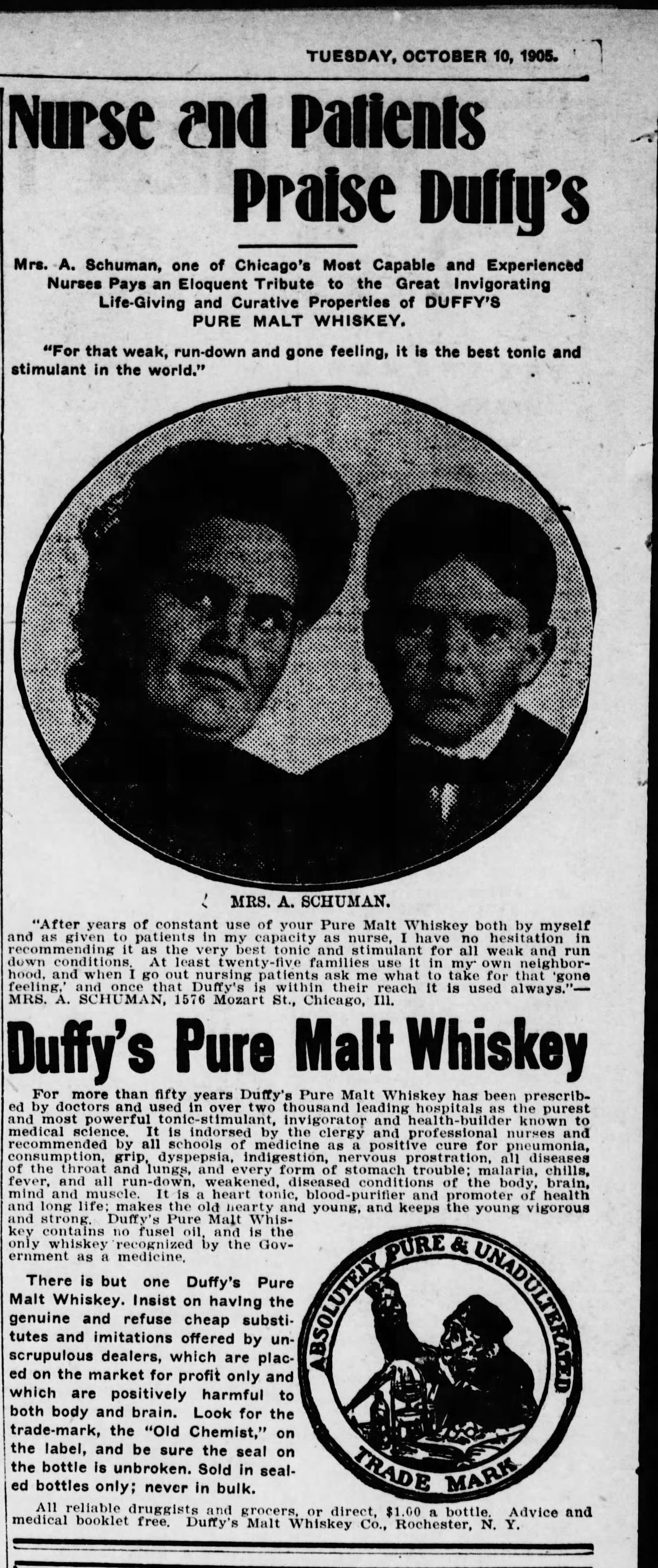
Also, here's an ad from a century ago selling whiskey, claiming it is a medicinal cure all for any and every condition, much as is common today with cannabis
I belive your statement, "... claiming it is a medicinal cure all for any and every condition, much as is common today with cannabis" is really off base. Nobody who is serious thinks medical marijuana can cure any specific disease.
In any medical state, there is a list of specific conditions for which you must have a medical diagnosis in order to get medical cannabis. No doctor will tell you it is a "cure" for anything and nobody is permitted to advertise this either.
People tell each other that everything from homeopathy, to crystals, to keto diets to meditation can cure specific diseases all of the time. I do not believe that you could lump probiotics, to make another example, in with the absurd patent medicines of the 1920s.
Additionally, there plenty of promising peer review regarding cannabis. We've had high potencey weed for decades.
It's odd that neither recent administration has embraced this, especially during a pandemic when we funded farmers and needed people to stay at home;
but also in the midst of opioid deaths, alcoholism (of older Americans) - with a seemingly well regulated, American grown, not physically addictive, impossible to overdose to death - for a muscle relaxer and/or mild hallucinogenic effects.
My cynical and informed-only-by-observation take is that it is a win win for lawmakers of both parties. It allows people who want to buy weed to get it, without those local politicians seeming overly radical or permissive by decriminalizing fully.
I've never met a weed gatekeeper, this is kind of exciting. I wish I had some simple heuristics for determining whether I was authentically high or just fake high.
It's probably a lot like wine, where blindfolded critics struggle to determine between red and white or $5 and $5000 wine but can claim to tell you which particular hillside of a vineyard in France the bottle came from if they can see the bottle.
If you never felt any difference between 5 euro and 50 euro red wine, you are buying wrong wines and probably at wrong place. I only once had wine over 100 euros, but that was something else altogether. I put prices in euros as they are in France, where we often shop although not coming from there (and having no idea about prices across the pond), nor having kind of 'wine tradition' in family/region/country I come from.
I can't judge price from taste, but for sure I can appreciate massive variations and types of taste experience in good red wines, bigger than any other drink I've experienced including whiskeys (again, never tried expensive ones but say up to 100 euro per bottle). Initial hit, body, aftertaste, how it changes when in your mouth. The higher ones are (near) flawless experience every sip, rich, smooth tastes I couldn't previously imagine a simple wine can hold.
Not saying every wine deserves its price, most probably not, but there are gems even in mid tier category, at least for me (+ my wife who feels the same).
Also, one of best red wine experiences was a random buy for 12 euros from some local bodega in Puglia, south Italy. Explosion of fruits and nuts, very very long and varied aftertaste that felt like a small symphony. I tried desperately after vacation there to buy it online, and its simply not out there... one of those local, (still) highly under-appreciated gems.
> In the course of their routine duties, he would sometimes present the judges with samples from the same bottle three times without their knowledge. The judges were among the top experts in the American wine industry: winemakers, sommeliers, critics and buyers as well as wine consultants and academics. The results were "disturbing"... "Over the years he has shown again and again that even trained, professional palates are terrible at judging wine."
You fully and completely misunderstood what I wrote, I am well aware of those double-blind tests (which can have their own flaws), but real life experience of me, my wife and plenty of our friends consistently says what it says.
We are not yet in time where I trust internet or anonymous commenters more than my/our own taste buds.
But look, if you enjoy those 5 euro wines in same way as others do with 5000 euro bottles, good for you. Or at least illusion of equality there, at the end it doesn't matter that much, does it. I'll stick with our selection of 8-50 euro range of french and italian ones (mostly at the bottom part), so everybody is happy.
> real life experience of me, my wife and plenty of our friends consistently says what it says...
Real-life experience fairly consistently shows vaccines cause autism, angels are real, and my cousin's brother's sister-in-law went to school with a kid named "Shithead" but pronounced "shu-theed".
>blindfolded critics struggle to determine between red and white
This never happened.
The source of this myth is typically a 2001 experiment (G Morrot, F Brochet, D Dubourdieu), in which they took oenology undergraduate students and had them (not blindly) taste wine and write down tasting notes. A week later they repeated it, but with a white wine and another white wine that they dyed red, given a list of their "red wine notes" and "white wine notes" from the prior trial, and asked to label the two wines using them. They found that the students were more likely to pick from their "red wine notes" to describe the dyed red wine.
There are a couple of problems here. First is that a small (50) sample of undergraduate students were used, not "critics", and there was no requirement for them to have any wine drinking experience. I have met very few college kids with developed wine palates, most (even in France where the study was done) I've known drank whatever booze was cheap and available. Second is that the trial was testing visual biases to tasting notes by examining faked visual cues, which is not the same as "determining between red and white" wines blindfolded for example. It's a very specific thing and no one who brings this study up seems to understand that. They were neither neither "blindfolded" nor "critics".
In my experience, for common varieties and wine regions, wine professionals can typically place it to the given region of a country and sometimes a given year based off a tasting. I've seen them practice for CSM exams doing this, and you would be pretty surprised at how often they're very close to correct (if not entirely so). Your average non-professional who drinks a lot of wine and pays attention to common notes can also usually place the grape and/or region pretty well, they'll just get thrown off by outliers like Eastern Europe orange wine or Tasmanian pinots or whatever.
As far as $5 vs $5000, $5 is a price point that is impossible to meet without extensive use of additives and tricks like adding wine concentrate to a thinned out (read: cut) and deacidified wine, and then correcting its color with an additive like Mega Purple. I've never tasted a good $5 bottle. $20 and up is where you have the chance of getting great bottles, and then it is true that (imo outside of a few types like champagne) the only difference between high and low cost wine is the price tag.
Of course, "critics" will tell you that one wine or another is good for all sorts of reasons. Maybe it is good, maybe they are afraid of offending a large producer, maybe their parent company has a stake in the wine being reviewed, maybe (in the case of Robert Parker) they are a lush that likes overly boozy and juicy reds. Either way, don't take wine critics too seriously, it is not an honest industry, and be especially skeptical of Parker-style numerical ratings.
Only surveyed 20 people, subjective rating of effects, no word on existing tolerance in this cohort. Also double blind is pretty impossible to actually do when it is in terms of a psychoactive drug. Imagine testing drunkenness and having a cohort drink water, how useless that would be as a placebo, as people would know immediately they have not been given the drug and are still feeling quite sober.
Double blind means the researcher doesn't know what they are giving to the subject. They still ran a placebo.
"Methods: Twenty healthy adults completed nine, double-blind outpatient sessions in which they inhaled vaporized THC alone (15mg or 30mg), d-limonene alone (1mg or 5mg), the same doses of THC and d-limonene together, or placebo; a subset of participants (n=12) completed a tenth session in which 30mg THC+15mg d-limonene was administered. Outcomes included subjective drug effects, cognitive/psychomotor performance, vital signs, and plasma THC and d-limonene concentrations."


What's actually happened is de facto, not de jure, legalization (in effect, but not in law), because of the unpopularity of cannabis prohibition. It's just not worth it in most situations to go after these products at this point.
There's still a strong need for actual legalization at this point.