It's (edit: $3230, thanks for pointing that out), but AFAIK this is the first publicly available gallery plus display and it's half the price of the ACeP demo display kits from a couple years ago.
I still have no comprehension of EInk's branding, so I'm not sure if ACeP is the high color thing or gallery plus is, but gallery plus is ACeP and this is gallery plus.
I'd love a color e-ink art frame, but I hope maybe I can find one in a store to see first.
Ah, here's Deepl's translation of the product description:
Rewritable color e-paper with paper-like visibility is born!
Digital signage that can rewrite and distribute contents, and the installability of paper posters that can be placed anywhere, are realized at the same time. The new ePoster, an environmentally friendly product that can be displayed with 0W power consumption, will change the way information is transmitted.
Constant display with zero power consumption*1
Once displayed, the display is maintained even when the power is turned off. Since no power is used except for rewriting the display, overwhelmingly low power consumption can be achieved. 1 Power connection is required for display rewriting, auto mode, and eSibnage S (sold separately) operation.
Paper-like easy-to-read screen
Reflective display with no backlight and a viewing angle of almost 180°. Just like paper, it is easy on the eyes even after long hours of continuous viewing and offers excellent visibility in bright locations.
Thin, lightweight, and free installation
The thin, lightweight design allows for easy and free installation in a variety of locations. No power cable wiring is required, so it can be installed in places where a power source is not available.
Contributes to environmental friendliness
About 30% of the plastic material used for the main cabinet is recycled. Recycled paper is also used for the packaging cushioning material, contributing to environmental friendliness. Replacing paper posters and POP can contribute to cost reduction and CO2 reduction in printing, sorting, distribution, and repositioning work.
Not sure on that, but I am in favor of replacing the horrible current billboards utilizing LEDs. So much light pollution, and a imo adds another distraction from focusing on the road.
When you see these things switch especially at night in your peripheral vision, it can be a bit jarring, especially if you suffer from vision issues.
Some states set limits on how frequently the image on a billboard can change, which eliminates animations, but still can be jarring, especially at night, if the switch between ads creates a large difference in light intensity.
I probably should have been clear. I count "show a different ad every 30 seconds" as animation. Basically anything that isn't a static image. Only allowance I would make is "one and done" updates, like a gas station sign with prices on it.
Grocery stores here use eink for prices. It appears sharp, need to look closely to observe. It kind of did not occur to me this could lead to dishonest behavior. Not sure why they use them even. Those Waveshare ones are cheap esp in bulk.
Oh yeah, when I first encountered them, my mind went to a Black Mirror-esque future where security cameras identify me as a high spender or stressed buyer and jack up listed prices according to what some neural net figures I'm willing to pay. It already happens online, now it can happen offline too.
I think it's baaaarely in the realm of science fiction right now, but I'm sure someone is working on it.
E-ink color is nowhere near vibrant or saturated or high-contrast enough, not in its current form.
Maybe it will be someday -- I'm not entirely sure if it's fundamentally constrained by the physics of it, or how much further engineering progress can improve it. Curious if anyone here knows.
I'd say the Posters in the display actually look very very close to it. I did a bit of hunting around on YouTube because I never trust marketing shots and I was actually impressed. First time I've seen a colour E-Ink display that doesn't look like someone had left it out in the sun for 15 years.
LED's are a good comparison point. They once were hyper expensive. The thought that we'd have billboards bedazzled with them would have seemed impossible.
It's not patents, it's literally artisanal handcrafting prices - they produce these giant e-ink screens by fusing together 4 smaller screens, and they do so by hand because there's almost no demand for $1000 1Hz screens, so they haven't automated the process.
>just about every other display tech came down in price by a factor of 10 a few years after it was invented.
No, the successful display techs came down in price. The commercial flops that nobody hears about are the same price as always (i.e. astronomical), because they have no economy of scale.
That is so much more than just patents. Vast engineering effort and process investment back up every "economy of scale". Unfortunately there is something about most e-ink designs so far that doesn't scale up in size very well. Really small ones are already cheap.
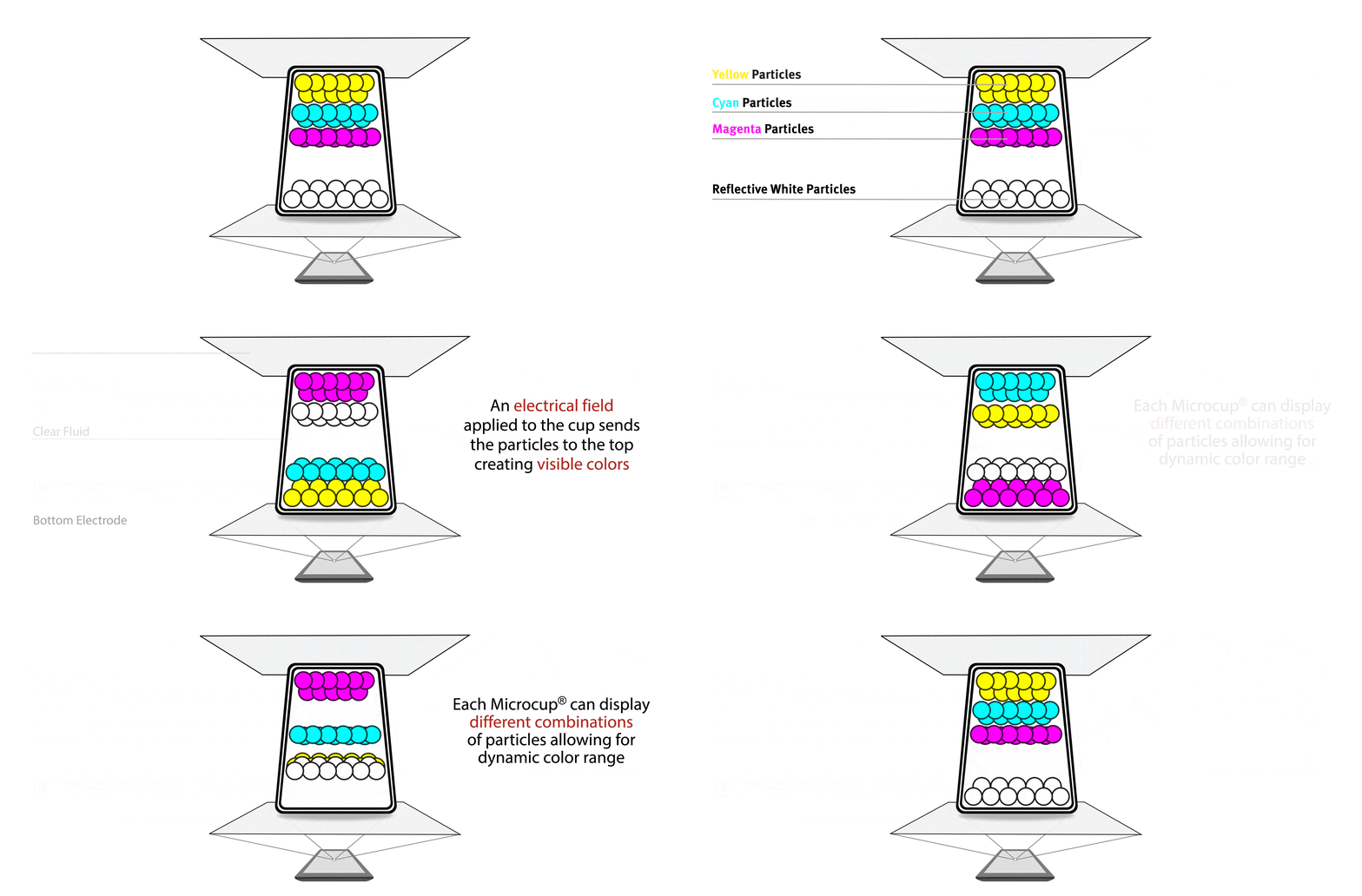
ACeP is the multi-dye tech. Basically, there are two ways of getting color one-ink: you either get a normal monochromatic e-ink screen and place a stained-glass checkerboard over it (which sucks, and is called CFA/Color Filter Array), or you make it so every pixel has black dye, red dye, yellow dye, purple dye, etc.
CFA tech is what E-ink's "Kaleido" line uses, whereas ACeP is used in the "Gallery" line.
Gallery Plus means, IIRC, they have 7 different dyes in each pixel (and takes 10ish(?) seconds to refresh, with the latest model). There's also the Gallery 3, which is an 8" screen that has ~4 dyes and can actually update the screen in a reasonable timeframe for interactive use.
10 years ago that was fairly accurate, and I've been using that conversion ever since visiting around that time. Surprising to see the conversion rate move so much.
Huh, I was using that rate in my head too. The yen was hovering around 9/10 of a cent from 2017 until the beginning of 2022. I only noticed the drop recently.
Philips Professional Display has a Signage Screen probably based on the same panel available for some time. I have seen it the first time at ISE last January and it looks pretty good, considering it is ePaper. About half the price.
>I'd love a color e-ink art frame, but I hope maybe I can find one in a store to see first.
Me too. I see them used at small scale, like price tags at the local grocery stores (I'm told Aldi's in the US as switched to these), and I fanboy a bit when I see them used in the wild.
I am not sure, at minimum it seems to be standard practice. It stands for network information center, and there is a lot of variation when it comes to information provided and tools they offer.
I can't wait for e-paper to get cheaper for consumers, but I'm not looking forward to the inevitable increase in advertising displays this will accommodate when it does.
Advertising is one of those area where energy costs and needs don't seem to be a problem. It we could replace all "active" advertising display by e-ink, we would save an insane amount of energy. It feels like every bus stops now has one of those lcd ad screen, because good old recycled paper is not good enough anymore.
I guess that changing the paper displays cost a lot more than people imagine when you include all the backend jobs for distribution.
Being able to change the sign quickly/often for new advertisers might also bring in more money. E.g. you can now sell different advertisements on Friday versus other weekdays, and more specialized Christmas advertisement.
For BART in the Bay Area, it’s a shockingly small amount of money - $1.7M in revenue out of $255M total. I’d happily pay half a percent more to not have that crap put in my face. Hell, I’ll pay your half percent too.
Advertising is a negative-sum game. If we replace all "active" advertising displays with e-ink, we won't be saving energy - that energy will be immediately put to use in making even more of even more obnoxious ads.
> I'm not looking forward to the inevitable increase in advertising displays this will accommodate when it does.
Counterpoint - a large e-ink advert market means (likely) cheaper e-ink products for consumers. E-ink isn't likely to replace cheap paper, it's more likely to replace LCDs and OLED screens which are already more obvious/intrusive as they're self-emitting.
Does anyone know what the long-term price of these is likely to trend towards? Like, is there some fundamental reason (materials, proess) that they'll always be 10x the cost of an LCD screen, or can we expect them to eventually get to similar prices?
The big e-ink screens are handmade, because there's basically no demand for $3k 1Hz screens so they haven't invested in automating the process.
In theory, the big screens could be roughly comparable to LCD screen prices, like the 6" e-ink screens already are.
They key cause of cost in e-ink is lack of demand, and more specifically lack of demand compared to LCDs. LCDs are produced at a rate of billions per quarter, they're so stupidly cheap it's almost unfair to compare them with e-ink. Point is, LCDs will always be cheaper unless demand changes.
i don't know your experience with polarizing filters, but in photography, they are adjustable by rotating them so that you can align them to achieve the effect you are looking for. this is what was meant my orientation.
I wanted an e-ink photo frame. Because these are so expensive, I’ve been thinking about hacking up a rolling box frame where high quality photos can be made into a “roll” and have motors on the top and bottom to roll up to see the next pictures. Perhaps a little diffuseD backlight would even make the printed photo pop a little.
Something like this.
https://m.made-in-china.com/product/Outdoor-Custom-City-Adve...
Don’t know what it is called in English properly to search for such things..
Just been to Taiwan and Japan before. This form factor of e-ink display is super new. I believe it may well be made by one of the Taiwanese shops but badged by Sharp.
e-ink is a big deal in Taiwan right now. The prices should come down fairly steeply in the next year or two.
I saw bus stops with eink posters showing upcoming arrival times in some cities in Taiwan. Not the best choice because refresh is very slow and they are hard to see at night.
> I’ve been thinking about hacking up a rolling box frame where high quality photos can be made into a “roll” and have motors on the top and bottom to roll up to see the next pictures.
This sounds similar to signs I've seen in some malls. I'm not sure what they're called though.
Contrast on color eInk displays isn't great I have one 7 color one and every photo looks a bit washed out and desaturated even when I crank up the contrast. Back in the 90s and early 00s there were frames you could stack a pile of prints into that had a manual mechanism that would advance through the stack.
I got a nice photo printer on Craigslist for $150 that can print 13x19” borderless. I guess you could just print a bunch of flat sheets and make a little stack and just manually swap them from time to time. I am a photographer and I have more photos than wall space so rotating a featured photo sounds kinda nice actually.
3k... I don't know what the manufacturing cost is. Add profit to it.
If it would cost 30 dollars, I'd buy many of them, hang them on walls, take them down every few months or years to change the picture. If it cost 300 maybe I'd buy one of them. At 3k, zero. Of course I'm not the target at that price point.
The manufacturing cost is astronomical, these things are typically handmade from 4 smaller screens (which are already expensive) because there's not enough demand to automate the production process.
Everyone wants a giant $30 e-ink screen, but realistically they'll never be as cheap as an LCD of the same size and nobody's willing to pay even that price.
I wonder if these thingies can be powered by NFC sensor. Hang frame on the wall, choose the image in the app, bring phone close to frame, boom, the frame has new image.
Not by your standard NFC, those cap out at ~50mW [0] while eInk screens consume 750-1800mW during an active update. [1] That number is probably out of date but it's tough to find good numbers quickly, maybe if you accept EXTREMELY slow updates you could do that but the display drivers probably consume a fair amount themselves. [2] It's low enough you could pair a Qi charger with the updater to power the screen temporarily. Most solutions that use eInk like adjustable price labels just put a low self discharge battery in them to allow standard devices to do the updating and those last several years before they need to be replaced depending on update frequency.
[2] People's/site's answer defaults to the "eink uses no power to maintain an image" even when the question asked is specifically about power use during updates.
I'm confused (and an electricity layman, so please excuse), but why would that power requirement of NFC matter in conjunction with the eInk power usage? Why can't the NFC reader be isolated from the display's power usage?
Because the person I was replying to specifically asked if you could pair the two and power/update a stand alone display with just NFC delivered power?
The devices for updatable price labels based on eInk already exists and I mention it in my post, it's powered by a low self discharge battery. Those IIRC use a special radio fob that connects to your phone instead of using NFC but you could probably do a largely drop in replacement for the radio circuit with NFC but that still doesn't solve the issue of updating the eInk screen. That's an order of magnitude more power required.
YEs, but their description of what they were imagining made clear they were using the word 'powered' to mean 'controlled by', not in the literal sense of delivering electrical power. I blame advertising for this, 'powered by [software product]' has become ubiquitous and exploits the relatively low literacy level of the public.
I really think they actually meant literally powered by here. Being on HN I make the presumption that commenters are a bit more savvy than the average Joe Public.
"Hang frame on the wall, choose the image in the app, bring phone close to frame, boom, the frame has new image."
It's extremely obvious the person you replied to was talking about controlling the tablet, not supplying electricity to it. Their subsequent remarks are beside the point, this is what led to the confusion in this thread.
Beside the point? It's pretty on point if you're trying to say they weren't talking about powering the device too... Also there are only two people here confused about GP's meaning. Can it be controlled by NFC is a trivial question.
The original poster in the thread was suggesting that if power usage were low enough, it could be powered by the power provided by the NFC in the phone; where the phone provides power for an NFC circuit that is entirely unpowered. If you could power an eink display that way, you could have a completely unpowered frame, which you could set via NFC.
So yes, of course NFC can be isolated from the displays power usage, the originator of this thread was just suggesting it would be neat if you could power it via NFC.
But NFC doesn't provide nearly enough power, nor likely enough bandwidth to do that in a reasonable amount of time.
In theory you could maybe charge a supercapacitor over time with the power from NFC and then perform the update but you're looking at at least 15x (50mW vs 750mW average update draw) the update time standing there holding the phone to the display while you trickle power over that connection. In reality with losses and extra draws to manage the screen you might not break net positive on the energy from the phone or you'd be looking at a 30-50x multiple instead of /just/ 15x.
Thanks for the informative answer. It just occured to me that modern phones like iPhone or Motorola/Samsung/etc phones often have Qi charging capabilities for powering accessories, so powering a display wirelessly shouldn't be a problem.
Qi wireless charging isn't by default bidirectional but yes more things are moving that way so you could, on supporting devices, in theory have them powered by a Qi pad only for the duration of the refresh.
The only issues I can think of there are I'm not sure if the Qi process can start up without power on the receiving end, the source device isn't always broadcasting power afaik so I don't know what the trigger is and if it requires some communication with the receiver device. The last is the NFC has a pitiful data rate of ~424 kbits/s but if we're powering it through Qi we can use more power hungry transfer methods to speed it up.
Can the Qi process bootstrap if the receiving device has no power to begin with? My limited understanding of the process is that there's a communication step between the sending device (a phone in this case) and the recipient before the source begins transmitting.
edit: A quick skim of the massive Qi specs makes it seem like maybe it can boot strap but I'll be honest I don't have the time to really dig in super deep into it. Bing Chat also seems to think it can but its sourcing is a bit spotty and the link it provided for that isn't actually saying anything about unpowered bootstrapping on the Power Receiver side.
I dreamt about eink boardgame components. Put new graphics on tiles and small tokens to change to a new game, or to upgrade or expand a game. Maybe a deck of eink playing cards, if that is ever feasible. I never thought of having an entire eink board to play on, but now I want that as well.
But it would also require a good supply of games to download. Unfortunately there has never been a successful standard file format to download boardgame graphics, so all virtual tabletops use their own (usually closed) formats.
I wish more billboards switched to color eink, but who am I kidding. Sticking blinking bright screens in people's faces is better for ad views and who cares about energy consumption.
I don't see any mention of refresh rate there. Since it's signage, I could imagine lower refresh rates, but if it's commercial maybe they do have high refresh rate requirements?
For personal use as a photo frame I couldn't care less about refresh rate, even if it was 5 minutes to replace the image. As long as the resolution and color space are good enough to display photos.
I'd love to have a few of these in my home and then have them change the photo each night. Much easier than changing out prints of my photos.
You know, that almost sounds like a printer. Like what if a print head could hide in a frame. Move up/down and across whole printing, and if it weren't on some sort of reusable surface, like a dry erase board.
Higher power requirement of course but would be really cool for art.
Maybe like cafes that have an artist (sometimes doubling as a barista) do their interior signage by hand, sometimes in chalk on blackboard, or in neon marker... one could rig up something like an X-Y flatbed pen plotter, with additional axes for chalk/pen angle.
That's great for a one-off enthusiast project, and make a blog post and video about it.
Or, if it's instead tech industry SOP: Tie it into a subscription cloud service for updating the signs (initially free), with a tablet UI for the independent cafe manager, and enterprise management dashboard for chains of cafes with mass-produced homey feel, and also run display ads for whatever revenue, and spy on all the business's data that goes through it, to sell the surveillance data to whomever will pay.
Back to the original inspiration: maybe the artist enjoys drawing the signs, and can do it in a more appealing, humanized, genuine way, so automating it would be counterproductive, at least for independent cafes.
> Like what if a print head could hide in a frame. Move up/down and across whole printing, and if it weren't on some sort of reusable surface, like a dry erase board.
And for me, dreaming of lo-fi paper-like (no animation, no unnecessary display elements, humble palette, no light emission) working and studying experience, the refresh time has to fit under 1 second (ideally somewhat higher, at least for partial updates, but 10Hz will be more than enough) and the colour space is irrelevant. I'd love either a palletre of 4-8 slightly-grayish (like I've seen on some eBooks) colours or just a good grayscale. Even a simple black-white would do.
I've owned an Onyx BOOX Max Lumi (13.3" e-ink Android tablet) for nearly 3 years now. Monochrome 16-shade greyscale (with dithering for better presentation of images). It's excellent for reading straight text, line drawings, and most webpages, though a pagination-based navigation is much preferable to scrolling.
Refresh is ~8--16 Hz, though that varies by display mode. It's possible to view video on the device, though you'd generally prefer not to. Animations are generally annoying A.F.
What you describe already exists in multiple ereaders and eink tablets. Check out Bigme or Onyx Boox tablets or displays, they come in all sizes, some with color some bw, and their tablets run pretty much standard Android. Great for studying, etc.
I don't want Android, I want a real desktop OS and at least 15″ display. As for e-books, of course I have one and use it to read books. But I also want to use e-ink for everything else I normally do on a computer (I mostly do it slowly so low refresh rate is Ok), including full-featured window management.
The ACeP signage displays usually have a 30s refresh rate. There are Gallery 3 ebook devices which promise ~1s color refresh, but so far only one has come out (and it wasn't very good).
That being said, if you don't need a lot of color, the Kaleido 3 eink devices are very good and very fast. I've had a color Boox device for the past year (with their GPU-driven refresh technology) and it's quite zippy on the refreshes. The color is filter-based, so not so vibrant, but it's great for highlighting (looks sort of like newsprint in terms of color and sharpness) and for me, is "enough" color w/o giving up anything.
There's good reason to believe that the technology is simply expensive and hard to manufacture, not that there's some giant conspiracy of patent trolls. And the use of "troll" here, when there's actually a product that's being made, is inaccurate. "Trolls" are companies that buy up dubious patents, don't actually make or invent anything, and sue everyone and hope that they settle instead of challenging the patent in court.
Every new generation of LCD and OLED has plenty of patents, and there are affordable products eventually. OLED in particular started out very expensive and now is everywhere.
Calling companies that hold a patent you find valuable and aren't distributing it's use how you personally see fit a "patent troll" isn't just inaccurate, it's an intentional mischaracterization for the purpose of eliciting a negative emotional response solely to spread your narrative. It cheapens the meaning and lowers any engagement to fight for the same cause when you realize it's a facade driven entirely by sour grapes and a lack of understanding of the patent system being criticized.
I guess it's okay here though, because [passionate story about side project idea using eink that could be tinkered on but never actually idealized into something].
That's bullshit though. People always make this claim but never with evidence or a source, or they provide a source that has either been retracted or simply states the same claim without evidence or citation.
That is essentially the entire idea behind patents. They get a limited time of control, the public benefits later. Like it or not, this is how the system is supposed to work.
"I don't like how the system works" and "I blame this company for working in the system" aren't really the same point though.
If the real problem is the first one, then implicitly there is a need to propose something that works better. And that is no obvious (but it's obviously not simple).
The original patents expired years ago (2016/2017?) and even before them EInk had some legal setbacks (Trekstor/OED). I remember buying a Plastic Logic device that used a different tech w/ similar output (OTFT substrate), and we've seen waves of technologies/companies come and go (Liquivista, Clearink, Mirasol, QR-LPD, DES, RLCD, etc.) so there isn't any shortage of competing technologies, it just turns out development/productization of new display technologies is massively expensive (EInk worked w/ Philips to get started and had to spend hundreds of millions ramping up production) and pretty thankless - Mary Lou Jepson had some interesting public discussions on the economics of new display tech when launching/running Pixel Qi.
I've heard that Eink is notoriously hard to work with and as an outsider looking in, their product development is frustratingly slow, but it's a public company (acquired by a Taiwanese company a long while back), and looking at their financials over recent years, their operating margins seem to be 10-15%, which I guess beats a lot of other display companies, but still doesn't seem so impressive vs other semi/tech companies. That no one's disrupted them over the past few decades I think speaks to how it's more than just an IP moat at play.
> I've heard that Eink is notoriously hard to work with
From whom? I asked someone who commented this on HN and the person replied saying that they had refused to help him debug his 3 display project. So yes, any display company is notoriously hard to work with if you're not buying a reasonable quantity of their product. It is like saying Samsung Displays is notoriously hard to work with as they're not helping my startup debug our problems where we've bought a grand total of 3 displays this year.
They seem to be pretty much the opposite of a patent troll, no? I mean, you and I may not like how aggressively they are approaching it, but they did develop the technology.
Overall you can argue they as a company would have done better to allow the tech to broaden and reap licensing fees, but you can't argue that it isn't their decision to make. Or, you can, but you aren't arguing against these guys but the system of IP laws in general.
I would be interested a display with limited/semantic UI coloring (two pixel colors, not necessarily saturated). That would be enough for syntax highlighting and similar features. But it seems like the designers expect true color to be close enough on the horizon that partial solutions are not worth it.


I still have no comprehension of EInk's branding, so I'm not sure if ACeP is the high color thing or gallery plus is, but gallery plus is ACeP and this is gallery plus.
I'd love a color e-ink art frame, but I hope maybe I can find one in a store to see first.