I drink diet sodas. I have received many emails/calls/texts from friends and family telling me about the "news" of them being a possible carcinogen. To every such person I say: Alcohol is a KNOWN carcinogen. Drinking alcohol causes cancer. So don't lecture me about drinking diet coke until you have given up on beer.
So it’s obvious how a study would support the notion that X causes cancer, but how would a study support that X prevents cancer? Too many confounding variables methinks.
I'm not sure I see how one is easier than the other. In studies where they find that wine, say, causes cancer, they aren't looking at some molecular chain of events, they're simply doing a large (hopefully) study and looking for correlations, while attempting (hopefully) to factor out confounding variables and incorrect direction of causation.
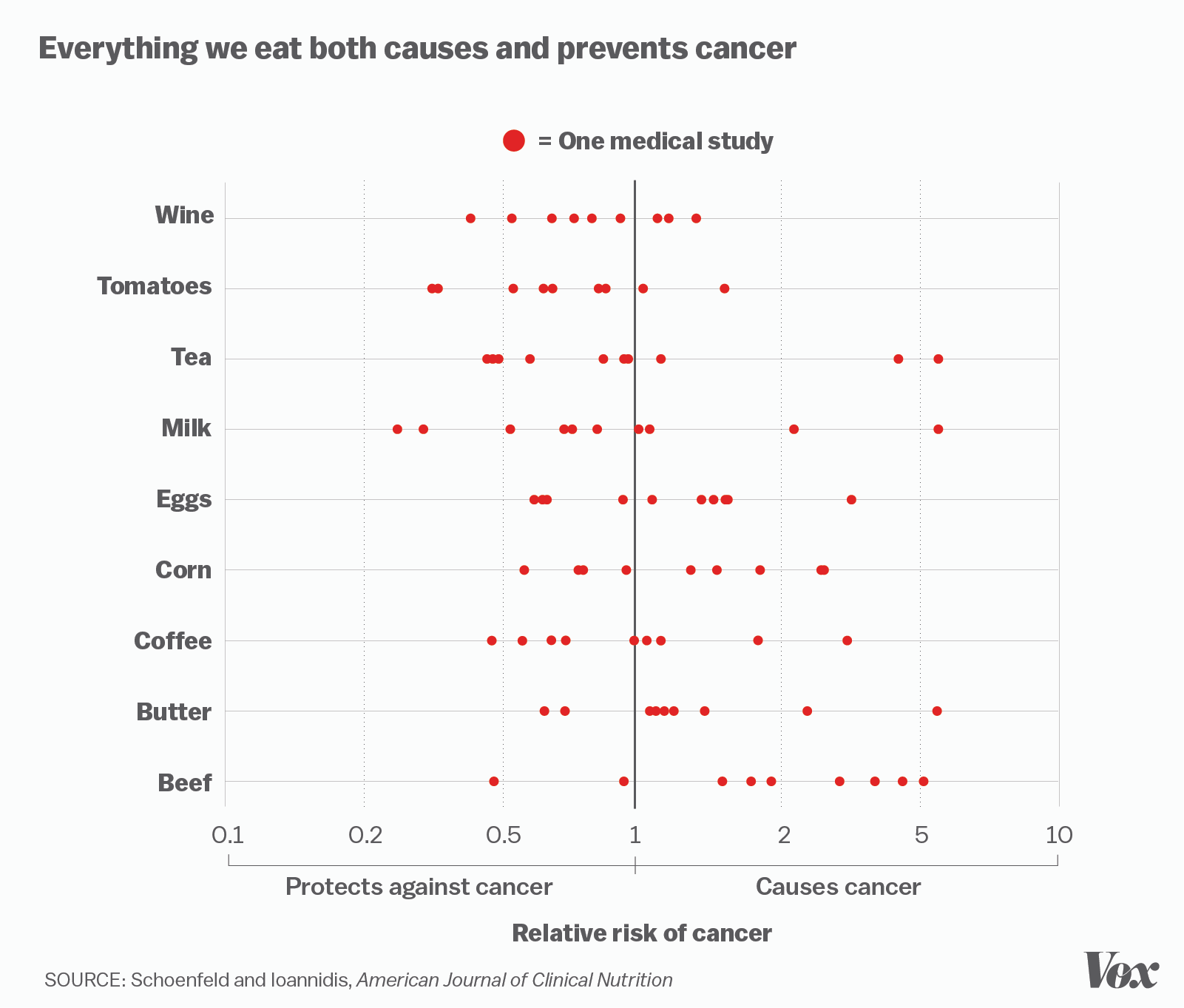
In some of those studies, the wine drinkers get more cancer. Red dot to the right. In some they get less. Red dot to the left.
I would think the effects of confounding variables are reduced the larger the sample size, so you can say "everyone in group A does not drink wine, and everyone in group B does drink wine". Some from both groups will get cancer because of some confounding variable, but they would cancel each other out- a non-related cancer case in Group A would be cancelled out by a non-related cancer case in Group B.
Conversely, if you have a similar study aiming to prove that wine prevents cancer, how do you prove that wine is the reason a person did not get cancer? It seems much more difficult, because now you are saying X did NOT happen because of Y rather than Y caused X. I'm struggling to articulate this. Maybe you're right.
First, a confounding variable doesn't work like that. It's a hidden variable that's linking that independent and dependent variables that you didn't account for. So, for instance, if you look at the correlation between ice cream and sunburns, you might see a strong correlation, and you might naively think that one causes the other if you don't account for the confounding variable of hot summer days.
In the case of population-wide studies on food, there is always the danger of confounding variables: if you are just comparing the wine drinkers vs non, who are these non-wine drinkers? What makes them non-wine drinkers? As a whole, do they tend to be more heath-conscious? Is that why they're less likely to get cancer? Etc etc.
Second, my point is that in both studies that show foods causing cancer vs those protecting against cancer, it's almost always populations studies. So in an ideal experiment, they have two identical populations, one of whom just happens to eat more chocolate. If that group gets more cancer they say they the chocolate is causing cancer. Similarly, if they get less cancer, they say it's protecting them from cancer.
You don't have to prove that individual X would have gotten cancer if it weren't for the chocolate. All you have to show is that the standard, base-line amount of cancer you'd see in any population is reduced in this group.
What makes you think there are tweaks that would improve "this"? You might be startled to learn "this" (the scientific method) is the best possible way of discovery that humans know of.
You may be even more startled to learn the scientific method is clear as an abstract concept, you know, those circle diagrams with "observation -> research -> hypothesis -> experiment -> analysis -> conclusions", but the details are always in flux and vary between countries, universities, publications and in time.
And the details are absolutely crucial for the end result. You come in here acting like a religious defender of the scientific method against the evil of rejecting science, but I'm not that guy. I'm not rejecting science, I'm just pointing out the obvious: modern science is producing literally noise, as seen in this chart, because of misaligned incentives and a broken peer review process, among others.
Do you even know what the "replication crisis" is? Hints of it in this very chart. And if you do, it's completely disingenuous to come attacking me for even mentioning we have a problem. And if you don't, you're not informed well enough to speak about the scientific method.
The "scientific method" should be applied to the "scientific method". Meaning when you see evidence that falsifies it, seek the causes and correct them, don't dig in your heels and go religious.
Everyone knows about the replication crisis, and everyone knows the flaws in the incentive structures around publishing research, but none of that is what you referenced.
What we need are people with level heads making calm decisions, not bombastic polemics demanding the system get blown up.
What did I reference? It was a very short message, so probably you saw what you wanted to see, or what you could see. But all I said is that a lot of modern studies are noise like that, and it's actively harmful, and the process which produces these studies should be modified.
Modern researchers have insane incentives to churn out papers based on superficial or questionable data, without isolating variables. The result is predictably noise. Or even worse, noise shaped by cultural bias and prejudice, which has been a long term problem with the scientific method, because in the end, we can talk about facts and evidence and data, but the judge jury and executioner on what is a fact, evidence and data are people, and people are always subjective by definition. The best we can hope is to all be subjective in the same way, hoping our shared subjectivity is more objective taken together. That doesn't always hold up.
None of these studies are produced via the scientific method. They are looking at statistical correlation and plucking them out of thousands of complex, confounding, dynamic variables in a very chaotic environment.
relative risk in terms of a ratio: <1.0 means less, >1 means increased risk compared to the control group. E.g., one study showed that beef reduced risk of cancer by 50%, another showed that it increased risk by 500%
The question is the problem. The answer is not a yes/no, but a point on a scale of multiple dimensions. Most of these studies don’t answer the question asked here, but a completely different question. And also most of these studies don’t answer the same question. Heck, it’s even a good guess that none of these studies answers the question asked here, because it’s rather difficult to make a double blind test about such questions.
I mean, wood dust is no joke. Because of its size, you can end up with micro wounds all throughout the respitory system, and those in turn act as something like a nucleation site for infections and cancer. If you're doing a lot of sanding or running a lathe or mill, you can lose decades of your life by not using proper dust control schemes.
It's actually not that black and white. Wood dust is linked to a statistically significant increase in the occurrence of a very rare nasal cancer. But the thing is, in woodworkers and in the general population alike, it's still a very rare cancer. You're orders of magnitude more likely to die of other cancers, whether you work with wood or not. This should be way, way down your list of risks.
There is a simpler reason to avoid wood dust: it causes allergies, asthma, and other non-cancer respiratory issues in a fair number of people.
Yes. IPF and friends are more of a death sentence than nasal cancer. Nasal cancer at least has a meaningful treatment outside of "double lung transplant" (which itself only has like 50-60% 5 year survival rate, and is essentially unavailable to most people with IPF due to age).
I'm aware of the stage 3 pipeline for IPF. I would still rather have cancer in most cases.
I don't know why people so much care about cancer than other illness/injury. Why is a dedicated cancer insurance a thing? Is there any historical reason?
Asbestos is like that. It's not inherently carcinogenic, but there is some kind of mechanical process associated with asbestos fibers that activates cancer.
Wood dust is absolutely not something to mess with. Chips - what most people think of as "sawdust" - aren't the scary part. The scary part is the too-small-to-see stuff that has a physical structure remarkably similar to a number of things that are extremely Not Good To Breathe.
Also, as a sibling notes, the stuff (chips and dust alike) can contribute to some really memorable conflagratory experiences.
There used to be a site that listed everything that the Daily Mail (a low-quality British newspaper) had claimed could cause or prevent cancer (and often both): http://wordpress.mrreid.org/2009/09/07/kill-or-cure/
Fine point: that is the list of substances that cause cancer, which is a more narrow set than "things" that cause cancer. The number one thing that increases a person's risk of cancer is age. After age, physical and genetic dispositions (aka family history) are also "things" that elevate cancer risks.
You don't have much to worry about from wall paint as long as you aren't sanding or eating it.
OTOH, it is a very economical colorant, so it is in a ton of foods (FDA still has it approved under 1% by weight of the food item), toothpaste, makeup, skin creams, white tattoo ink, and so on.
I quit sugar sweetened drinks in my early 20s. All sweet drinks in my late 20s.
In my 30s I have cut my alcohol consumption down hugely but for my little rat brain the risk reward vs sweetness is a different balance.
I think one of the most valuable things through my quest to eat right was people challenging my behaviour vs my knowledge. I made a lot about the fact I quit sugary drinks after writing a lit review on their health effects. My friends pointed out that I had deliberately excluded artificial sweeteners from my lit review and my knowledge.
Then I was challenged about my love of dessert.
I think being called a hypocrite and told I was stupid and coming to agree with the underlying criticism has been a big part of my growth as a person.
But if drinking drinks sweetened with aspartame is your only vice then you're doing pretty well.
On my property I have both a well and a spring so that's what I generally use. Recent outing in the city reminded me of the chlorine they use. It was kind of an amusing episode as drinking the water at the restaurant I had sworn maybe the glasses weren't fully rinsed so the waitress brought out another and made sure it was clean.. still tasted of chlorine. So I had her fill my canister up thinking it was just a detergent they were using.. still tasted of chlorine so I presumed it must be the water and remembered that indeed chlorine/chloramine is added to public supplies. I don't know if that will prove to be a problem in the future and most things that claim to be are a bit on the tin foil hat tent that said a recent study does seem to show minimal impact on gut biome (https://doi.org/10.1038/s41564-022-01101-3) .. whether there is a compounding effect down line who knows.. but could explain some of the issues that differentiate between farm communities and urban dwellings (https://www.reuters.com/article/us-kidsallergies/amish-farm-...)
Monochloramine, on the other hand, is barely perceptible at a couple ppm.
(It also produces less in the way of disinfection byproducts, which is good if the water contains anything that might react nastily with chlorine. And it’s much more persistent, which is good or bad depending on your perspective. You need to take special measures to remove it if you want to water a fish and potentially if you want to brew beer. As far as I can tell, it has no meaningful effect on an established sourdough starter. I assume that the large population of microbes in established starter is able to neutralize the small amounts of chloramine in tap water.)
Most wells these days go with uv, not sure if that handles that. Personally I don't bother, but I also pull from creeks and rivers nearby for more tainted water with the intention of exposure. Been doing it for decades now. Wouldn't recommend it. That said, uv might be a plausible answer (I know a few public wells where you pay to fill up which is treated with uv and is all they use).
UV works well but the problem is bacteria can build up in water lines. So you'd have to UV sterilize it at every tap point or at least every house. Chlorine is easier for this.
Well, it is a gas at room temperature. Might be a good science project for a student to confirm what we think we know. The taste of chlorine does dissipate and that was good enough for me.
Plain water bores me. It just doesn’t satisfy cravings. I know it’s arguably the best beverage to consume, but I find it really hard to choose water over nearly any other kind of beverage.
I know I’m not alone.
Sparkling water has become my go-to. It does satisfy my cravings, and I’m sure it’s immeasurably better for health than my previous go-to Diet Coke.
It's probably better for your teeth, and, if you're drinking caffeinated soda in large volumes, that's not great. So: the sense in which it's better for health is pretty measurable.
It's just what the human palate does. It adapts to circumstance. Skip sugar and sweet stuff for a few months and when you try it again everything tastes much sweeter than before. Same with salt. Same with acidity. And surely other things I haven't tried and corroborated with peers.
I dunno about a week, but it only took me about three weeks to switch from regular soda to diet soda, back in the mid-nineties, and I really didn't like the taste of diet soda when I started. After 2-3L a day of diet for several weeks regular Mountain Dew tasted sickeningly sweet and I no longer wanted it. ¯\_(ツ)_/¯
I felt the same way until I took up regular exercise and my body's hydration preferences changed almost overnight. Now I guzzle the stuff like, well, you know.
>I know it’s arguably the best beverage to consume
Not arguably, it factually is.
I've also never understood the concept of being "bored" with water. Not everything in life has to be a sensual experience. Why not drink it because its good for you and save the flavoured beverages as treats?
> I've also never understood the concept of being "bored" with water.
some of us are really bad at doing things, even good/healthy things, unless we get a dopamine response. so 99% of my "water intake" is really coffee, tea, or artificially sweetened soda.
I’ve been using True flavor packs (2 per refrigerated gallon of water), alternating between lemon and lime. It’s just natural crystallized juice. Will likely never go back to just drinking unflavored water.
But yeah, I’ve been drinking water for years, and this has made it much more enjoyable. (I occasionally “splurge” and drink tea or soda, but it probably amounts to less than 1% of the fluids I consume.)
Citric acid isn’t great for teeth, but 2 packs per gallon should have a negligible impact (could possibly do more, but 2 is perfectly fine).
Artificial sweeteners contribute to obesity. It seems that they trigger carbohydrate cravings and cause sugar crashes in the body, albeit with an absence of sugar. The body receives that sweet taste and expects calories and carbs, but what to do when they don't materialize? We weren't designed for artificial sweeteners, carcinogen or not.
I drink alcohol to get plastered in social settings. I know it's unhealthy and the risks associated with it. I don't drink every day, mostly on social settings which happen like once or twice every couple of weeks.
I drink soft drinks more often than alcohol. I hate artificial sweeteners not just because of the taste, but all my life I've heard the fact that those sweeteners are carcinogenic, especially the cheapest ones (like aspartame).
Honestly, it doesn't help that most studies that say artificial sweeteners are safe were funded by the drinks companies themselves and obviously they will be biased towards what makes them have most profit from it. I think adding the sweeteners to this list of potentially carcinogenic and asking for more neutral, unbiased studies is a step on the right direction.
If a soft drink contains sweeteners, I simply refuse to drink it. Honestly, I'd rather have a beer which tastes worse than a coca-cola, for example, than to have to drink diet cola.
There's nothing healthy about sugars and alcohol. If you want healthier, science indicates you should skip those along with whatever else you are skipping for whatever reason.
Well, it is known to change one's gut biome, which is not good either since gut bacteria control your mood, appetite, digestion capabilities. Nothing beats clean, non-tap water at room temperature.
True, my granddad is 96, worked at a coal coking factory, recently overcome COVID, and is still a totally capable person. Like his body doesn't give a damn about challenges.
The goal here isn't to convince them, but to get them to go away. The message is "If you want to convince me to drop diet coke, you have to be prepared to discuss your alcohol consumption."
It's not an academic conversation, nor is it meant to be one.
I don't think this is whataboutism, really. Part of it is frustration, but more it's an attempt to get them to recalibrate their idea of "carcinogen". Carcinogens are not some list of ultra dangers to strictly avoid. We're too good at detecting them.
The point is relative risk, in particular the poster's friends are warning them about Aspartame, while drinking alcohol, which has significantly larger confirmed health risks. If they believe drinking alcohol is safe in the quantities that they do (and given that most health authorities now point out there is no safe level of alcohol to drink), then it's irrational to worry about Aspartame.
The comment doesn't make any point about relative risk. They're only mocking their friend for telling them about something unhealthy when their friend also does unhealthy things. As if it somehow cancels out.
> I drink diet sodas. I have received many emails/calls/texts from friends and family telling me about the "news" of them being a possible carcinogen. To every such person I say: Alcohol is a KNOWN carcinogen. Drinking alcohol causes cancer. So don't lecture me about drinking diet coke until you have given up on beer
The poster compares the risk of aspartame being a « possible carcinogen » to Alcohol, which is a « KNOWN carcinogen », specifically comparing the different classifications.
But relative risk is irrelevant. They still don't somehow cancel out. My aspartame consumption poses some risk to me, and that risk doesn't depend on the habits of the person telling me about the risks of aspartame.
That’s not the point, there’s no claim it cancels out. The point is about the risk tolerance. We all take risks in our life, and the risks posed by aspartame are lower than that of alcohol.
I hope next time my friends or family point me to something I do that's potentially harmful I won't justify it by pointing to something that they're doing that's harmful.
I hope the next time my friends watch a fear piece about something unproven to be harmful, they'll understand my frustration about their hypocrisy when they continue to participate in activities that are proven to be harmful.
There’s a pretty big gap between alcohol which we highly regulate and keep away from minors due to the pretty obvious harm, and aspartame which is pretty commonly cited as the “most studied food additive”. [0]
One is really clearly signalled as “bad for you”, even if it is extremely common. The other one is basically seen as an inert implementation detail. I can totally see why people put more fear behind the evil they didn’t even know existed vs the evil they choose to ignore.
> One is really clearly signalled as “bad for you”
I cannot easily express in words how stunningly false this is. Alcohol is signaled over and over and over and over across all forms of information as fun, relaxing, sexy, festive, appealing, exciting, luxurious, and sometimes even healthful in moderation. Any notion of it being bad for you is relegated to small print messages specifically about pregnancy and driving.
Yeah of course, there’s advertising. There’s also advertising for cigarettes.
Stunningly false is a bit strong.
What I mean is: no one thinks consuming alcohol is good for them. At worst they might think it’s health-neutral in the amount that they drink, but the majority of people know it’s bad for them.
It’s been effectively communicated, by laws and culture around booze, that it’s a thing for adults to choose to do, and accept consequences from. (Hangovers, drunk driving, abuse, and many other societal ills that are pretty cliche and well known) Just because the people making it, leave off the consequences, doesn’t mean everyone is brainwashed.
Notably there's a LOT LESS advertising for cigarettes than for alcohol in the US. Cigarette ads are banned in most media here. But sexy night club intrigue alcohol TV spots still abound.
> it’s a thing for adults to choose to do, and accept consequences from. (Hangovers, drunk driving, abuse, and many other societal ills that are pretty cliche and well known)
This is true, but I think the strongest statement we can make is that everyone believes that the good vastly outweighs the bad, otherwise we'd all stop.
> What I mean is: no one thinks consuming alcohol is good for them.
Even with very specific and reductionist notions of "good for" we have decades of "red wine is good for you" reports. Beyond that, relaxation and fun are good for you. We know this because we also have a lot of media telling us.
> the majority of people know it’s bad for them
Like a billion people out there think that God actually talks to them and tells them what to do on a daily basis, so I bet you're significantly overestimating.
We're talking about in comparison to aspartame though. I'm sure there's people who have the same reverence for booze as their choice of god, but:
My point in the GP post is that someone isn't going to be convinced to stop drinking because drinking is bad for them, they know it's bad for them. They had to wait till they were old enough to buy it, and maybe they've had a few hang overs, they know what liver cirrhosis is, and have seen a TV show featuring an alcoholic. They ignore those things, because they like drinking. They'll hand wave away why their drinking isn't a problem. Even with bunk click-bait articles like "red wine is good for you". We're on the same page there!
Sugarfree gum, feels pretty inert. There's no laws around the sale or packaging. There's no health warnings. There's no TV shows where someone's life is irreparably destroyed because of their gum habit.
So the root comment's family, I think were just being concerned.
"Inert thing you don't think about gives your family member cancer" is a scary thought! Of course I'm going to talk to ${familyMember}!
"Alcohol gives you cancer, along with a lot of other bad diseases" is a "well I still like a cheeky glass of red winkwinkwink" sort of thought.
> My point in the GP post is that someone isn't going to be convinced to stop drinking because drinking is bad for them, they know it's bad for them.
You're taking an extremely niche information set and generalizing it broadly to the public. Have you actually met the public? The average person knows approximately nothing and gets along fine because in practice knowing nothing doesn't significantly affect outcomes.
> "Alcohol gives you cancer, along with a lot of other bad diseases" is a
I bet you most people do not know or believe that alcohol causes cancer or any other disease, especially not when consumed in the amounts that they personally consume. At worst they believe that nonspecific "too much" alcohol will damage your liver in ways they don't understand but that not too much alcohol is fine because your liver heals itself and the amount that is "too much" is abstract and far off in the distance.
Don't you just feel like you're getting nothing in return from diet soda?
It just tastes wrong and you're ingesting chemicals you probably don't need.
A relative of mine who drank diet coke daily just had her bladder out due to cancer and she never really drank alcohol and took awesome care of herself. She suspected her diet-coke habit and in light of this news, she might be right. I get it, this is HN, I need numbers, not anecdotes, but it sure is curious.
> I get it ... I need numbers, not anecdotes, but it sure is curious.
No, it is not curious. The IARC finding found limited evidence linking aspartame to liver cancer alone[0], no other types. You have a 1/28 (male) or 1/91 (female) chance of developing bladder cancer in your lifetime[1].
Please do not post comments that sound like Tucker Carlson rhetoric.
Please do not post comments that sound like Tucker Carlson rhetoric.
Please do not be so fragile. It is curious to me, so what?
There are many, many things we've been told are ok for us and it turned out they weren't the most striking example for me recently has been PFOAs. In our area, firefighters used to spray down kids with "harmless fire retardant foam" and choppers would dump it into the forest by the ton. Now rivers near us are completely forbidden to go near because of the contamination.
I dislike TC as much as anyone else, but he is successful because some of these "conspiracies" can turn out to be true or partially true. Sorry but it is just a fact.
> Don't you just feel like you're getting nothing in return from diet soda?
That’s how I describe water. Unless I’m really thirsty, water is just … nothing. Diet Coke has crisp, light flavor. And the aspartame only tasted weird way way back when I switched from sugar soda.
On just taste alone I prefer Diet Coke to the regular kind and to Coke Zero.
I probably should reduce or eliminate it, but it’s just so good.
I think about this too. I can drink a cup or two of water over a couple hours... unless I squeeze a little bit of lemon into it, in which case I can drink myself hyponatremic. It's the same, to an extent, with things like Diet 7-Up. If being super well hydrated is a good thing, then I guess what I get out of flavored drinks is ultrahydration?
I don't know why this is. Seltzer doesn't do it. I assumed it had something to do with sodium, but, then, the lemon works too.