So when we say that a star is N light years away and therefore it would take N years to reach at the speed of light, is that not true? If the speed of light is changed by gravitational waves.
How does this play into our understanding of the size and expansion of the universe?
As others have noted, the speed of light (in a vacuum) will always constant. To be nice and pedantic, you can always slow it down by making that light go through a medium, where it will go slower (e.g. any prism that makes a pretty rainbow). It’s a cheat of sorts, but the speed of light isn’t some special property of light: it’s a property of spacetime. There is a maximum speed of anything at all, and unimpeded light goes this speed. For most astrophysics purposes this doesn’t worry us much, as space is essentially empty.
You can also “slow light down” by just making it go further: a few clever mirrors will do this easily. This is even more of a cheat, as the light itself isn’t any slower, it just gets where it was going a little later because it went further.
In a sense that’s what’s happening here: the spacetime is being stretched on one axis and squeezed on another, as gravitational waves pass through it. It isn’t by much, which is why we need a whole galaxy to measure it.
We don't need a whole galaxy; pulsar timing arrays (PTAs) would be happier if there were stable millisecond pulsars much closer than the ones they're using, as it would control for some uncertainties particularly in "red noise" which arises from the interstellar medium (ISM) as well as the configuration of the neutron star itself. Closer pulsars would have less of an ISM contribution to the red noise (and thus less red noise).
The nearest millisecond pulsar is about 500 light years away. There are closer "classical" pulsars. Most of the millisecond pulsars used by PTA collaborations are a few thousand light years away.
Maybe a better way of thinking about the gravitational wave is that it alters a form of gravitational potential along a fraction of the worldline of an element representing a pulse, causing light to run a little uphill (redshifting) or downhill (blueshifting). cf. the Harvard tower experiment (Pound-Rebka). This doesn't seem very geleneral-relativistic but hey looking for a Poisson equation in the Newtonian approximation goes back to Einstein. The Earth and the array pulsars are moving sufficiently slowly with respect to each other, and low-redshift SMBHBs are OK where (handwave handwave) linearized gravity is OK, so we could work likek Einstein in the Newtonian limit with some care. A more modern approach to calculating a Poisson-equation gravity potential analogue is a technically annoying trip through the spacetime decomposition formalism, but once it's there it's conceptually useful, and for gravitation physicists it can be related to the g-induction and g-field in gravitoelectromagnetism.
There are other ways to describe the elephant <https://en.wikipedia.org/wiki/Blind_men_and_an_elephant> though; an equivalence to acceleration (one can change the direction component of the velocity vector for electromagnetic waves); calculating time-dependent (and here that means depends on the orbital phase of the supermassive black hole binary) null geodesics; and so forth. This is the gift of general covariance: we can choose practically whatever coordinates we want, which highlights different components of the covariant tensors used in relativistic theories (e.g. the electromagnetic field tensor F_{\mu\nu} or the Einstein curvature tensor G_{\mu\nu}).
Finally, the concept of https://en.wikipedia.org/wiki/Retarded_time would probably be useful in this thread and others like it that try to understand how what we see here-and-now arose in the past there-and-then. "Perhaps surprisingly - electromagnetic fields and forces acting on charges depend on their history, not their mutual separation" -- the same is true for gravitational fields and forces acting on masses, and this is what drives some of the above Poisson-equation thinking and the GEM formal analogy to the electromagnetic Heaviside-Maxwell equations.
It's not that the speed of light is changing, but the size of space and therefore the distance between things. (Edit: Since the definition of length is changing as space expands and contracts, then I guess our measured speed of light does in fact change and that presumably is what you meant)
The way to really think about this is that there really isn't any objective thing except proper time and the manifold of the spacetime you're interested in. The idea of things taking an objective amount of time as seen by all observers is only an approximation valid at low speeds and low curvature in a small area. The only objective thing is the causal structure.
There's an awful lot of matter which seems pretty objective, at least to me.
There's also a lot of electromagnetic radiation around, and you can't calculate a proper time for that. Likewise gravitational waves and gluons.
Surely the causal structure depends in part on matter? Future null cones of time-orientable flat Minkowski spacetime narrow in the presence of mass; matter is also relevant in null cones on general curved Lorentzian spacetimes.
I only mean with respect to the coordinates we use to talk about the world. It is tempting to believe you can give an objective description of the state of the universe using a 4d vector space but this isn't true - the universe fundamentally has less structure than a vector space description suggests. And in GR it has structure which the vector space simply cannot capture.
In addition to multiple sibling comments answering your actual question, I'd like to point out the following:
> when we say that a star is N light years away and therefore it would take N years to reach at the speed of light, is that not true?
That is not what "N light years away" means. It means that the light we're right now seeing from that star was emitted N years ago. But stars don't stay put. If you point a rocket at the star and fly N light years of distance, you won't end up inside the star -- it'll have moved on.
This seems pedantic (and it is), but consider the expansion of the universe. You're seeing light from N years ago - when the universe was smaller. Suppose expansion is more or less uniform, i.e. something like "every 1000 years, each meter becomes 0.1% longer" (it isn't, but reasonable approximation). Then: the greater the original distance was, the faster the star is moving away due to expansion of the universe. After all, each meter in between expands x% per second, so more meters in between is greater increase in distance every second.
If the distance is great enough, then each year, the universe expands that distance so much, it increases by more than 1 light year. That means that light from that star can nerve reach us again (unless the universe starts contracting). This phenomenon is called the Cosmological Horizon.
The millisecond pulsars in the international pulsar timing arrays https://ipta4gw.org/ are all within the Milky way. There is no metric expansion of space within the Milky way. The pulsars (and our solar system) are all on ~Keplerian orbits through the galaxy, and relative motion between us and them is small.
> If the distance is great enough
It's not, in this context.
> Stars don't stay put
Close enough, in this context. The uncertainties ("red noise") in PTA timing residuals from scattering in the interstellar medium and local properties (mostly internal structure) of the pulsars dwarf the uncertainties in relative motion.
PTAs also care about the pulse timing not the carrier of the pulse. That is, the beam points at us with a predictable period and that period evolves (in parts per million) in the presence of nanohertz gravitational waves. The beam itself is broadband (radio to gamma rays) and any spectral line structure could be anything (most likely the interstellar medium).
Detailed redshift studies look at the spread of spectral lines, particulary the Lyman and Balmer series, and pulsars are what you get when there's no hydrogen left to fuse. ("Finally, pulsars have broadband continuum spectra, so if there are gas clouds along our line of sight, pulsars can be used to probe the ISM via absorption by spectral lines of Hi or molecules. Such absorption spectra can be used to estimate pulsar distances" -- end of §6.2 of Condon & Ransom's Essential Radio Astronomy advanced undergraduate one-semester-course textbook (2016 ed.), web version at https://www.cv.nrao.edu/~sransom/web/Ch6.html )
I have a related comment in this thread if you're interested.
The speed of light isn't changed. The distance the light is traveling is what changes. So to:
> So when we say that a star is N light years away and therefore it would take N years to reach at the speed of light, is that not true?
Sort of, sort of not. The distance distortion caused by gravitational waves is way too small to make a difference. You're talking maybe nanoseconds sooner or later you'd arrive compared to prediction. But this is true within gravitationally bound regions of space, that is, regions with sufficient mass density to prevent expansion. It's the regions between galaxies and especially between galactic clusters that is expanding rapidly, because insufficient mass density exists in these regions to slow it or stop it. So if you set out for Proxima Centauri, you'll get there in about the amount of time you'd expect. But if you set out to leave the local supercluster to some destination in a different supercluster that is megaparsecs outside of the Milky Way, you may never get there at all, even at the speed of light, because the best cosmological model we currently have predicts the expansion rate between superclusters will eventually exceed the speed of light.
[Future of an expanding universe](https://en.wikipedia.org/wiki/Future_of_an_expanding_univers...) seems to suggest this will happen in about 150 billion years. Earth won't exist by then, but any signal sent from within any location in the local group outside of it will never arrive anywhere else if its sent past that time.
Note the other comment's point that some astronomical features are actually moving toward us is only true within the local group. All supercluster-sized mass regions are receding from all others.
The thing is that we happen to havw pulsars in our vicinity that have a very predictable frequency with which they change their brightness. Now just like the siren on a police car will move up in pitch when it moves towards you and down when ot moves away (the Doppler effect) if space compacts and expands one would expect the same to happen on a very small scale.
Exactly. Space is not static. Also everything is moving relative to each other. Finally distances are measured using the "distance-ladder" of astronomy which depends on a bunch of model assumptions. Therefore astronomers typically report distances in proportion to the Hubble constant. In case your model prefers a slightly different value you can recalculate your distances easily.
The pulsar timing array pulsars are all in the Milky Way; there's a bright millisecond pulsar only ~500 light years away. What's the "proportion to the Hubble constant" of that? For ~500 ly ~ 150 pc, direct measurement of parallax is totally possible (even Hubble could get most of the IPTA targets in 2009). We can check that with other methods (secular parallax, (supernova remnant nebula-) expansion parallax). Not sure what the "model assumptions" are other than Euclidean trigonometry.
These are good questions, and while I'd take a different approach from most of the other replies to them, I instead want to clear up a misconception about the choice of signal that I notice throughout the thread.
What's being tracked on Earth is not the speed of light or the radial distance to each pulsar (which is in any case not known to good precision) but rather the rotation rate of each pulsar. That's known to very good precision for each of the selection of pulsars by each pulsar timing array (PTA) collaboration. Each collaboration selects a number of pulsars with very stable rotation rates.
The PTA antennae listen to the beam from the pulsar in convenient radio frequencies; they're not especially interested in the spectral structure of the pulsar signal, and are not deliberately looking for a gravitational redshift of the beam's radio frequencies as opposed to a gravitational redshift of the beam's amplitude.
The amplitude modulation of the listened-to frequencies is driven by the very much slower than light rotation of the pulsar which drags a beam around so that we see it very strongly once or twice per rotation.
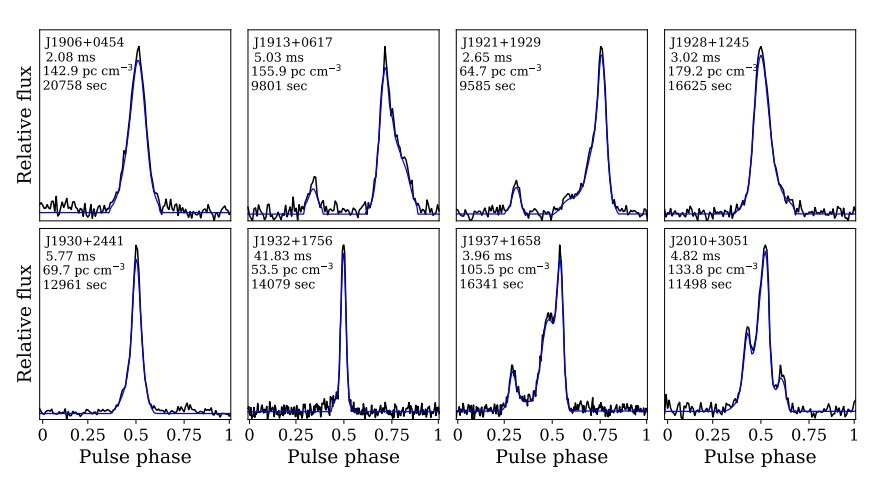
At the top of this page <https://www.astron.nl/pulsars/animations/> there is an animation of a pulsar; we're interested interested in the bright flashes when the beam fills the video window. The evolution of timing of those bright flashes are what PTAs track. Notice that the flash is sharp rather than smeared out, waxing and waning slowly over the course of a rotation. This is a useful property and distinguishes a pulsar from ordinary astronomical radio soruces (and the essentially constant light from ordinary stars). Here's a typical "chirp" from eight different millsecond pulsars observed at Arecibo <https://scx2.b-cdn.net/gfx/news/2019/palfasurveyr.jpg>. The first line in each box is the name of the pulsar; the lines below the names are the rotation rate (the other two lines are details about the observation and processing rather than the pulsar).
Another useful property is that the "chirp" is seen in an enormous range of frequencies, so two immediately adjacent radiotelescopes listening to the pulsar in two very different radio frequencies will notice the pulse essentially simultaneously. Some millisecond pulsars even flash at high frequencies (up to gamma rays) although in practice PTAs aren't particularly interested in that part of the spectrum (although it is certainly watched by other astronomers!).
In many millisecond pulsars the interval between bright flashes is very very very stable (they don't have "starquakes" and don't have significant amounts of matter accreting on them) and thus predictable. That means (with a good frequency standard on our side) we can tell if the gap between a pair of pulses is short or long compared to the long term average.
The gravitational waves the pulsar timing array (PTA) experimentalists are interested in will induce a gradual (over the course of months to years) increase and decrease of the gap between pulses. The change is quite small; if we have a "true" millisecond pulsar where the long term average has us seeing one pulse every millisecond exactly, a nanohertz (say, a cycle time of one year and of moderate amplitude) gravitational wave over the course of the year will stretch the millisecond timing to a maximum of one millisecond plus low tens of nanoseconds and a minimum of one milliecond minus low tens of nanoseconds. Most of the time it's between those outer bounds and close to the long term once-per-millisecond-exactly average.
The hard work for the experimentalists is in signal processing and spotting sources of noise in the pulse timings.


How does this play into our understanding of the size and expansion of the universe?