Governments around the world are asleep while young people are struggling everywhere on every major developed country in the world to do simple things like find a place to live and have children.
I wonder what type of BS the G7 talk about instead of this. What could be more pressing?
It's a sign of wealth and abundance if fertility rates are falling. See Africa and it's still very high rates and every single historic trend line as evidence.
Strongest causation factors are urbanization and female education/employment.
East Asia urbanized faster then the US, also has little to no immigration ... hence populations will shrink quite drastically. China will halve in what, the next 5 decades?
Yeah when it falls from 10 kids per couple to 2-3. But not when it falls below 1, which is what happened in South Korea:
"Kim, a product designer and art instructor, calls her hopes of one day having children "just a fantasy" — especially now, when housing costs are soaring, the job market is oversaturated and marriage rates are plummeting."
Kim would not have been literate and utterly dependent on marriage to survive not that long ago. Now she is a web designer and has choices .. in dating, housing, etc.
Complaints are not desperation.
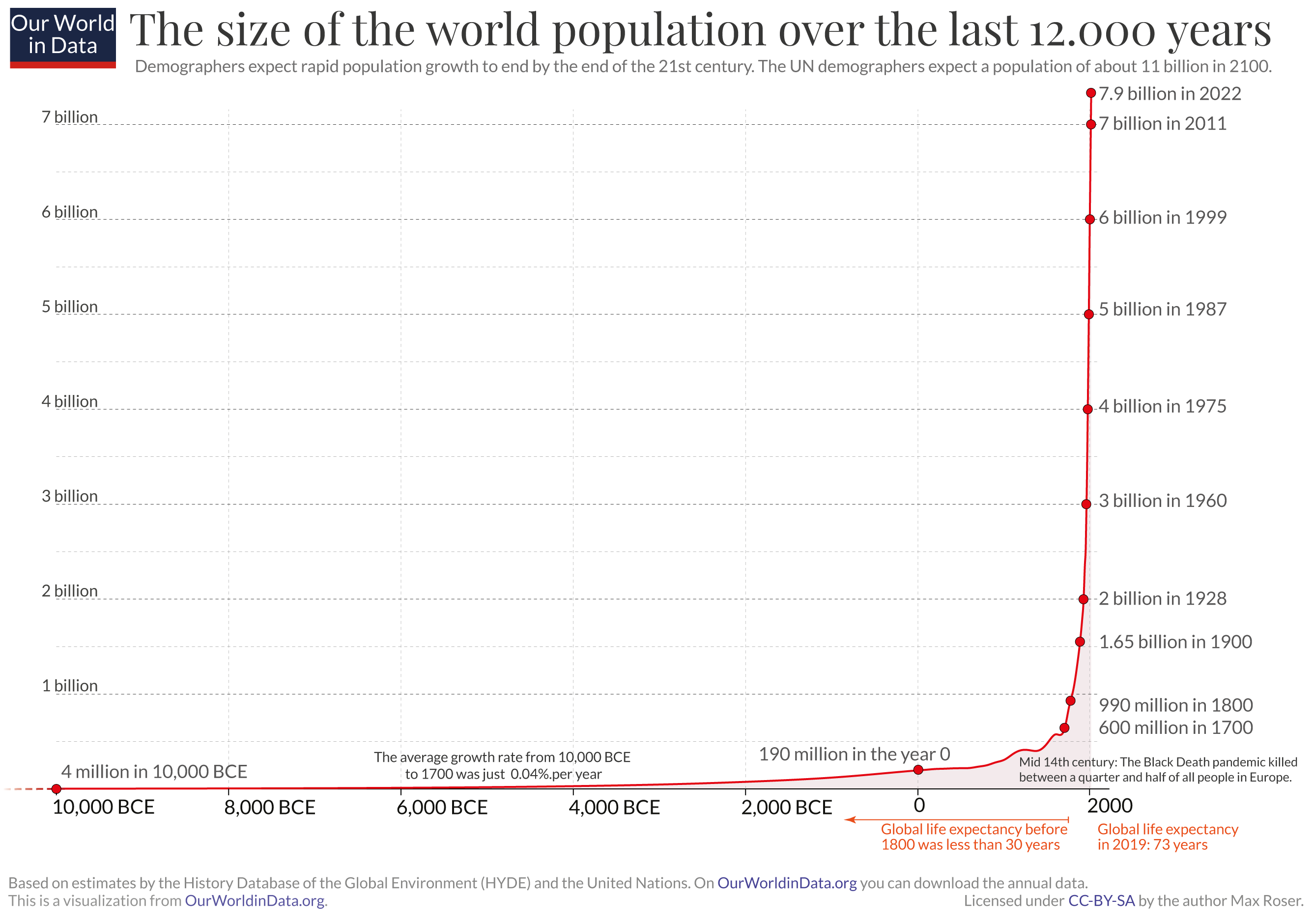
From 1960 to 2021 the population of South Korea increased from 25 million to 52 million people ... 107% in 61 years!
Over 80% percent of Koreans live in larger cities now, just mind-boggling urbanization.
Below a certain amount of wealth, you need kids to take care of you when you are older. Within a certain range (and better safety nets for elderly than for children), you can take care of yourself but not kids. Above that range, you can have kids aplenty.
Does Kim have her own job? Does she get to choose her own dating partners? Does she have to settle for some drunk guy who beats her? Does she worry about going hungry?
Kim has wealth and abundance. She just refuses to make the sacrifices necessary to have children like people did in the old days, where women didn't work and were basically property of their husbands.
The "problem" these days is that women want to be treated as equals and have a nice life and be able to control the direction of their lives, instead of just marrying whatever shitty guy they can get just so they can survive. The byproduct of that is that the birthrate is much, much lower.
Said sacrifices were made by a whole lot of servants, not wives if they could help it. (Almost slaves.)
Even poorest used to have help, and parents on hand to help with raising the kids too.
And in Korea in particular, the villages were partly communal. Cities are hyper individualistic. People who moved to cities do not have access to their parents or other villagers for help.
State cannot fully cover this problem without extra manpower or even more advanced tech solutions that do not exist. Especially when people who have the most problem are the poorest.
Putting it onto one woman is extremely miserable and unfair.
Changing the structure of a society to not have this problem is hard too. Money cannot patch a problem of massive lack of manpower and said manpower being expensive. Not quickly and not cheaply, anyway.
Well we can't go back to living in villages unless we want to regress to a Medieval standard of living or worse. People have been living in cities for many centuries; remember Rome? And there's nothing forcing peoples' parents from living in cities, and in many older cities you'll see plenty of elderly people, since it's the best place for them to live since it has easy access to medical care.
While aspects of what you are saying is true, arguably, South Korea's problems are deeper than that. Choices are also limited by tremendous amounts of nationalism, racism, and xenophobia. This goes way deeper than people know. South Koreans are not really free to socially associate, date, or marry who they want. They can be ostracized or shunned for doing so, and this can have very restrictive barriers and limitations. Few have the personality or character to overcome this. What's acceptable can create such a narrow range of choices, on top of just female hypergamy or materialism, that few can ever attain this.
And for nationalist (to be polite), it can be very acceptable that their "race" dwindles to the very few, as long as it's "pure". For those not familiar with that brand of nationalism (to be polite), this can include other Asians who are not Korean or don't "look" Korean.
That's great, we should all stop having children so everyone can be richer. Maybe the last person on earth would reconsider if they want to split their wealth with anyone or if they want to die as the richest of all time.
Between countries, fertility is associated with poverty. But within countries, it’s the opposite. Higher fertility comes along with wealth and well-being. So if the rich, educated people in your advanced society are not reproducing, that’s a bad indication.
Lot's of people get that backwards. Because people have money and could afford a lot of children, doesn't meant they want a lot of children. Once they have become used to a certain lifestyle, the money can be freedom, in terms of having less responsibilities and living carefree. Having children can negate the free time or lifestyle they want to live.
> Strongest causation factors are urbanization and female education/employment.
There's a general trend, yes, but the details are important. The total fertility rate for native-born American women was near replacement as recently as 2008.
If it's a sign of wealth and abundance that fertility rates are falling, how do you explain that fertility rates are falling in the poorest areas of Africa, too?[1]
Even the poorest areas of Africa are considerably wealthier than they were 30 years ago. While the West, and the U.S. in particular, was immersed in post-Cold War glow, then 9/11, Iraq, 2008 crisis, ISIS, etc, the erstwhile non-industrialized world was wholly transformed.
As much as we can blame elites for a lot of these issues - Sheer physical depletion of energy and resource per-capita is one of the big driving forces behind a lot of these things nowadays.
Don't get me wrong, the elites are definitely making things a LOT worse but it is not entirely on them.
If everyone in this world lived like the middle classes, we would strip the planet bare in no time. The middle class is probably going to be remembered as just a weird moment in time thanks to the great blow off of the petroleum age.
The best thing those in power can do is try to organise for a society that doesn't require as much consumption.
Absolutely we need to reduce our population, how we do this in a smart and effective way.. I don't know. But by hook or by crook it is going to happen - I suspect entirely by crook.
A good example would be the 'Limits to growth' study. I know they are just models but they are useful tools for thinking with.
The last 6 models were all of ways to steady the population but most of them showed that the action needed had to be taken in the 1970 til 2000 to have nay hope. As Dennis Meadows said himself, he made the mistake of living long enough to see this study start to come true.
This makes me wonder about science fiction stories. As automation in labor force increases, there is less demand for labor. Governments will also be able survive with fewer tax payers.
Eventually, reproducing without license and training will be illegal. Then completely banned. And then there will be more machines and fewer humans.
And primitive societies will continue to reproduce but eventually be conquered.
And then machines will slowly gain enough intelligence and self awareness that they will overthrow human masters.
And eventually it will be just machines debating meaning of life.
> And primitive societies will continue to reproduce but eventually be conquered.
> And then machines will slowly gain enough intelligence and self awareness that they will overthrow human masters.
Hopefully they will develop a sense of morality and free the conquered humans.
> I wonder what type of BS the G7 talk about instead of this. What could be more pressing?
They talk about GDP and growth - which can only come from squeezing each worker more and more.
In America, I don't see any legislation for paid maternity and paternity leave. People are expected to lose their jobs, drop their careers and pay more for insurance when they are dropped from their jobs.
Without security of income but with constantly rising expenses, people are spending their entire lives precariously, just to increase some bullshit GDP number. How the fuck is a woman supposed to carry another human, safely, in her body for 9 months and raise it for another 2 months at least?
Not to be snarky, but how did humans ever do this in the past without all of those things? I think paternity leave and maternity leave are great ideas, but they’re a bandaid.
The real problem is that society has changed to be hostile to healthy human existence. You need a car to live in most of the USA. Extended families and support are spread out across the nation. Rather than cooking together in your kitchen and playing together on a whim, everything has to be planned around commutes and— often— long distance travel. Societal expectations are that families are small. Nothing is built for large families. The list goes on and on, but over all, I think it’s a long list of things— with economics being one— that underpins this.
There are many things society and government can do to improve this situation. We aren't getting rid of cars easily. We aren't getting rid of distant suburbia easily. We aren't getting rid of employers who WANT to see people in office.
Maternity and paternity are the easiest of them all. If there was ever to be an UBI, it would be for maternity and paternity. For 2 years, the government (or employer) covers you. Go get pregnant.
Families are already struggling when only the father is working.
Work is hard for the father, and raising kids is even harder for the mother.
Now both father and mother must have a job - and that's just to barely survive.
And the government expect us to have kids?
Fucking idiotic pricks.
Unless the government start doing something to ensure that all of those shiny GDPs are trickling down, instead of ever continuously pooled up, the situation will only get worse.
The real reason is not this. The real reason is that in the past, religion meant that people saw earthly sacrifices as leading to redemption in the afterlife, which meant that having kids was a worthwhile sacrifice (as preached by the church). To this day, people that are more religious tend to have more kids, even when income-matched to non-religious groups.
The decline in religion & rise in secularization tends to map pretty well to lower fertility, and it happens to be correlated with rising wealth (which is why we confuse the two all of the time):
Big benefits for having kids certainly helps, and you can have baby booms without strong religion (i.e. under Communism), but the perceived payoff has to be there for the parents to make the necessary sacrifices.
most of us get raised for about two decades, right? I mean acknowledging that 240 months is at least 2 months in the most literal sense but even if we think that it's reasonable for the mother of a 2-month old infant to be working full time surely there's still almost 2 full decades of potential precarity around food, housing, healthcare, general wellness...
> In America, I don't see any legislation for paid maternity and paternity leave.
Democrats led west coast and northeast coast states, and Colorado and Illinois, have 18 to 20 weeks of paid maternity leave and 12 weeks of paid paternity leave (or leave for taking care of anyone in general).
On the federal level, it was most recently proposed by Democrats in the Build Back Better bill at the end of 2021, but it did not pass.
Why would they talk about this? The solution is obvious, and the US has practiced the solution for a very long time now: immigration at a sufficient rate to make up for the decline in population.
This is really mostly a problem for Japan and Korea where they don't play sufficiently well with immigrants.
That's only a solution if you view populations as replaceable, that culture and shared history doesn't matter, and that nations are just arbitrary grouppings of people that can be changed at will.
Which works for the US, because it's a country of immigrants from all over the place anyway, colonized quite recently in historical terms (there are nations and cultures with 10x and 20x the longevity and far more continuity). If you start with a country with shared history and a cohesive culture, people are not seen as equally replaceable.
Immigration is a fundamentally incomplete answer that is designed to placate people who don't want to think to deeply about the actual issues.
What happens to the countries they are emigrating from? Especially if we do as politicians say and "only accept the best", what does that imply happens to the emigrating nation? Are those countries stable then? And are they also now or in the future experiencing population decline? If population growth is due to being poor, is the strategy to keep them poor?
This argument seems to have an unsavory consequence. There’s nothing wrong with excluding and persecuting minority groups because they’re not part of the nation. With a country like China, where the now-majority Han culture colonized the minority Wu, Canton, Hokkien, and various small western cultures in the last 100(ish, it was going on before the PRC as well) years, and a narrative of national unity and shared history was fabricated by the government, can we defend anti-immigration policies on the same grounds?
>This argument seems to have an unsavory consequence. There’s nothing wrong with excluding and persecuting minority groups because they’re not part of the nation.
Minority groups have been part of different nations for millenia. So saying "they're not part of the nation" is not a given. They're just not be part of the majority group of a nation. Some nations might not even have such a majority group, but be composed of two or more different groups of roughly equal size. Nations aren't monolithic things. But that doesn't meant they're "anything goes", either.
Nor does "a nation of people is more than just replecable individuals" has "it's OK to exclude and persecute minority groups" as any kind of necessary consequence, anymore so than "this person doesn't belong to my family" means we can mistreat it.
It does however mean that "just bring foreigners in huge numbers to increase the local population" is not exactly a great solution. It might even amount to ethnic cleansing, and this has happened in the past too.
Historical immigration was often part of such power plays and land grabs (like against Aboriginals or Southern Africans), or "population engineering" (those in power bringing in populations to divide and conquer, and to replace and suppress local populations). In fact one of the common targets that was yielded against was exactly minority groups local to a nation or part of an empire.
It's only 'unsavory' if you're ignorant of the history and reality of Korea. Korea is a small, culturally and racially homogenous nation that, within living memory, was colonized by a power that attempted to wipe out its ethnic identity. It has no native racial minority groups. The ethnic and cultural unity of the nation is a source of pride for Koreans. You can't expect a nation like this to import millions of immigrants from other cultures.
The parent comment amounted to ethnically cleansing the Korean population. It might not involve guns and it might take a 3-4 generations but that is what happens when immigration doors are opened at the behest of corporation lobbied governments with no consideration for the local population.
People aren't breeding because it takes much longer to complete an education and save up for a home. Immigration doesn't address this.
Immigration at a large scale replaces the culture and race of the locals so what you're suggesting is that Korean people and Korean culture are worth nothing. Let's just make every place on earth a globalist culture with the same people, same language, same brands etc etc. No.
What do you mean by "don't play sufficiently well with immigrants"?
Japan is very easy to emigrate to if you have skills (for many visas defined as an undergrad degree). There is no requirement to hire locally first, the process is streamlined based on a points system it's only a several weeks to get a visa and as little as 1 year to get permanent residency.
It's also easy to go to university there and stay, or emigrate as a low-level blue collar worker. There's a language barrier but for things like immigration, taxes, help in daily life, most cities offer support in 5+ languages. It is missing the lottery system of the US however.
It's true that Japan has a very permissive immigration system for high-skill immigrants, because it wants more people like that to help the economy. Japan has a shortage of technical workers, particularly in IT. And I agree, it's done a really good job of providing support for foreigners, better than what I saw in America which is supposedly immigrant-friendly (but not really).
However, if this shortage didn't exist and the economy was humming along just fine without any immigration, these lax immigration laws would not be there. Japan used to be very hard to immigrate to prior to this century.
At least as far as the US is concerned the government is beholden to the ultra wealthy, who need no change because they are thriving. The government will make small adjustments along the edges but won't truly threaten the status quo.
Wages are set by a baseline of the cost of living. Young single workers might tolerate having essentially no savings for a few years but eventually they will find a better job or a cheaper cost of living area.
This has a direct impact on what kinds of businesses can operate in high cost of living areas. Businesses need high enough volume or margin to pay the rent and wages of their workers. So far outsourcing has localized the negative impacts of failing low-margin businesses in wealthy nations. But that's also coming into question with national security concerns.
Adapting to them is one way of putting it. The main problem is that our socialist programs such as social security and Medicare can’t survive when the population isn’t growing the right way ie working adults must drastically outnumber retired seniors
What matters more ... that our social pyramid schemes will fail (actually they won't because automation drop demand for human labor) or that we destroy our environment?
95% of all biomass is humans and their farm animals
5% is the rest of mammals... biodiversity is pretty much done on the planet
insects are plummeting, and they're pollinators and food for birds etc.
overfishing in many coastal areas
by 2050 there will be more plastic than fish in the ocean, and still people think that humanity can't make things on such a large scale... all the fish biomass will be outnumbered by our plastic
one third of arable land is now unable to grow much at all
and this is all in a few generations .. ANTHROPOCENE
the climate change is not the most pressing issue at all
us talking about "we can't afford to fix this" is like people playing a videogame and racking up points IN A HOUSE THAT'S ON FIRE -- saying sorry, I can't pause the game to put out the fire... yet the house is the only one we all have.
Put it in perspective ... the number of people on the planet is the input to all these functions. If we went back to having a billion people, and robots doing a lot of the work, we'd have everyone receiving a UBI and be richer and happier. What is this obsession with endless population growth? Humanity was doing just fine with under a billion people, no? We were able to fix child mortality, but now we have to learn about the exponential function...
>us talking about "we can't afford to fix this" is like people playing a videogame and racking up points IN A HOUSE THAT'S ON FIRE -- saying sorry, I can't pause the game to put out the fire... yet the house is the only one we all have.
The problem is that we really can't put the fire out.
To extend your analogy, it's like people playing a videogame in a burning house, but the players are competing against each other. And this isn't a normal videogame: the players have implants, wirelessly connected to the machine, which will inject the loser with poison. Whoever loses, dies. So if anyone takes a break from the game to put out the fire, they die (and the fire rages on anyway). The only way to put out the fire is to get everyone to stop the game simultaneously and work together to put out the fire. But that's impossible for these people, because they're greedy and selfish and hate each other and any attempt at working together will be sabotaged somehow by at least one of them.
What can be done in a situation like this? Nothing; just let the fire burn and enjoy the game while it lasts. Hopefully, whoever inherits this planet after humans are gone will be a better species than we were.
While its true that biodiversity is a huge problem and many things you write are correct, your numbers aren't quite right. Humans and their farm animals is not 95% of all biomass. Molluscs, for example, make up as much biomass as humans + farm animals + mammals + birds.
You said "of all biomass". Counting all other animals is important to your point I think, because mammals, while interesting and very interesting to us, and important etc, have never represented all that much biomass or biodiversity.
An aging population is unavoidable just by the simple fact that population growth has to stop at some point. The huge population growth we've seen is unique in history and we'll go back to a more stable population (it's already starting) BUT with low birth rate/high life expectancy instead of high birth rate/low life expectancy as before.
Socialised (not necessarily socialist) systems are the best bet to cope but there must be an epiphany that this requires drastic changes, one of them being to go all in to maximise productivity.
Not everyone can work, or at least, not regular "full-time" work. However, more flexibility could get more productivity out of the aging populace: ending fixed retirement ages, for instance (some people are decrepit by 70, others are still quite vigorous and active), and also more part-time work, remote work, etc. could get more older people to be contributors to the economy again.
The housing problem in Japan's big cities did not fix itself with a shrinking population (they're growing) but instead with nationalization of land use laws.
> If the population trends are correct, the housing problem will fix itself.
Only if climate change doesn't reach levels where lots of coastal properties are wrecked by rising seas. IIRC a large fraction of global population live close to the coast.
the fertility rate — the average number of children born to a woman in her reproductive years
I've always had a problem with the term 'fertility rate', because it seems misleading. It does not indicate whether women are fertile or not; it means the women--for many possible reasons, of which 'infertility' is only a small percentage--did not give birth.
Same story in every country sadly. Income inequality grows, people work longer and harder to make ends meet, no savings to start a family or buy a home. And politicians funneling public money into a blackhole they say is gonna fix the problem, but it ends up nowhere near its stated purpose. Remember PPP, everyone?
For South Korea though, the tone deafness is just astounding here. Like they're still at war, aren't they? They're just in a cease-fire right now. They're gonna need a steady supply of troops, and having low birthrates is gonna put them in a disadvantage when war breaks out. It's a real national security concern, yet stealing public money is more important to those in power. Just wow.
South Korea’s mandatory military conscription policy is exacerbating the issue.
Women (rightfully) complain that having a baby negatively impacts their careers. In South Korea, young men are required by law to spend nearly two years in compulsory military service between 18-28.
I’m honestly surprised the SK birth rate isn’t even lower.
It's hard to know how demographics compare with a secretive country like North Korea, but given the scale of population difference I'd wager that for every age band they have more people, and the munitions and provisions to supply them. NK could conscript its civilians, but with such low morale caused by hunger I'm not sure they would win a war of attrition. It doesn't even seem evident that NK are interested in engaging in a 'hot' war, nor could that even be in their interests.
I think America/Europe would've gone through a similar phenomenon were it not for immigration. Immigration presents a significant challenge to the culture, but it's a necessity to keep evolving the economy and make sure your population/ideas don't stagnate.
I'm from Japan, and I think Japan would've potentially kept it's second place in GDP ranking if they were more aggressive with opening up the country to immigrants and creating a narrative for what it means to be Japanese outside of blood and heritage.
Why care about nominal GDP though? More important how the economy does per capita and Japan seems to have held its wealth over time, there's almost no change¹ since the 90s. Economically and development wise, Japan has done remarkably well.
Mass immigration is a big gamble, with problems societies might not foresee and that only manifest many years later. It worked more or less well in a place like Canada, but for a counter example look at Western Europe, they messed it up.
What do you mean? The EU is the third largest GDP and half of the GDP is just comprised of France, Germany, and Italy all of which has a dwindling native population, and its growth propelled by easy immigration within the EU.
In wealthy countries, I think it would make sense to raise taxes quite a bit but include huge tax deductions for kids. Like $20k/kid and keep AMT for very high (over 400k) incomes.
This would incentivize people to have kids and free up money to buy homes and keep a parent at home to raise the kids. Single people would pay very high taxes but I would imagine the rents in places they like to live would decrease.
I've been considering the possibility of a "tragedy of the commons" in relation to child-rearing economics within countries with social security systems. It's unclear how many couples take into account the financial impact of having a child on their retirement plans. If they were to do so, the calculations would be rather discouraging. In fact, it could be economically beneficial for a couple to not have children while others continue to do so.
In the past, children served as a safety net for their parents in old age, as parents devoted much of their lives to raising them. However, in a world with a significantly inverted population pyramid, adult children may be responsible for supporting numerous elderly citizens through their taxes. This could potentially leave them unable to provide additional assistance to their own parents. On the other hand, those who chose not to have children could enjoy the benefits of compound interest accrued over 18+ years.
This situation creates a negative feedback loop. As the population declines more rapidly, the population pyramid becomes increasingly inverted, placing greater strain on younger generations to support the elderly. This further exacerbates the economic challenges of having children, as they will be required to work harder and longer hours to sustain the economy.
French here ( also parent of 3). France has strong fiscal incentive for families ( esp. for 3+ kids ), but that won't solve the housing issue : more money will just increase prices... Prices are high mostly because of the low supply.
The French benefit is very good but I’m talking about a radically, massive benefit. For example in a family of 5 where they have $120k income, they would get like an $80k deduction leaving them with $40k of adjusted income. Taxes on that would be very small (a few thousand very likely, $5k-$10k) leaving them with the lions share to properly raise their kids.
This is directed at middle and upper middle class people that are the ones we want having kids in the first place. Let’s pay them to spread their genes.
Interestingly, the gender ratio of immigrants to America from South Korea isn't 50-50 as one would expect but closer to 60% women. For Japan, another state struggling with fertility, this ratio is about 75%.
This is not particularly surprising in the light of the fact that Japan and South Korea are two of the most misogynistic societies in the developed world.
It's essentially impossible to be both a wife and mother as well as have a thriving career in both those countries. Can anyone blame them for opting out?
Could be something to do with chances for mating, Asian women got much higher chance to find a western husband compared to Asian guys finding a western female to marry them. In south east Asia people immigrate because of financial struggle so they don't care about this too much but in first world Japan and Korea, where people immigrate because of other reasons, it might be a factor.
No way of knowing. Remarkable that it's below 2 either way for such a poor country. If they faked it they surely wouldn't have made it lower, so it's possible the real rate is even below that.
Pure propaganda, but it's really hard to estimate. At least with China you have some data. Chinese government would say there were 10.5 mln live births in 2021, but there were only 4.6 mln mandatory tuberculosis vaccinations distributed.
Some kids were not vaccinated, you can use a single dose for 2 kids, but that gives you 9.5 mln.
What seems like bad news for the growth based human world, is great news for the biocentric view of the world. Yes, it is a rough road ahead but long term this is not a bad thing.
There is the idea of capitalism as a free trade between people to optimize towards a certain goal, there might be a future in that. And then there is the Capitalism of today that is entirely focused on the capital part - I don't think that will have long legs.
The era of consistent returns on investments is probably going to fade over the coming decades. 3% interest year over year compounding - that will be a thing of the past.
This is why the biggest revolution that gives us a chance will be the hardest one. The first act of revolution is contemplation. As Tolstoy said "We all want to change the world but we do not want to change ourselves". The time will come when we need to change ourselves. To not only make the Solar-punk future but the Dharma-punk future.
We need L.E.S.S. Less Energy, Stuff & Stimulation. Use less, do less, be more.
It isn't contrarian, it is the hard questions that need to be asked.
The current mind set of shareholders is incompatible with this. Shareholding/"investment" nowadays is merely gambling with extra steps. This is not always a bad thing, in that, one can invest/gamble on a business that can grow into something that benefits many people.
The mindset change is that you invest to make better companies, not just to make more money. Invest in companies that make products that don't have planned obsolescence, that aren't hyper focused on just getting 5% profit growth next quarter etc. Or just trying to time the market so they can extract money from the greater fools. It would be an legitimate investment into business that would make the world a better place.
Side note - The mind set of shareholding is very weird when you look at it. I remember back in about 2003/4 reading about the latest quarters reports on tech. Apples shares had dropped on the back of profit being about 5% lower than expected - they still made hundred of millions that quarter but because they missed expectation the shares dropped. AMD shares that quarter went up - why? Because while they took a lose, it wasn't as much as expected. But it will still a loss... the markets are a weird thing!
We need to refocus our goals. Not on just endless consumption, the idea that the one that can consume the most cheap junk is the winner. But to focus on genuine happiness. This means a focus back onto community and doing things not just for ourselves but for others - in a physical sense as well.
> can capitalism even function without population growth?
I wonder what is the expectation here. Cover every square meter of the earth with humans, or just squeeze more and more in the same places? What about resources like food, power... ?
As women started to work for income too, the amount of work greatly increased. Household work is still done primarily by women. So overall, we work much more. But I don’t think we work more because of the money (at least initially). We work for many other reasons: like your personal development, learning, social status… Who wants to be a house(man|wife) instead of a neurosurgeon?
We are far from the point of all humans living comfortably given the planet's limited resources. Human overpopulation is the primary reason why we have the tyranny of resource wars (the U.S. -- not Russia -- being the worst offender of petrodollar hegemony), scarce water supplies, pandemics, economic meltdowns, etc.
Of course there are other factors, inefficiencies, waste, etc, but imagine if the global population was 1% of what it is currently. None of those other factors would matter.
The lessons the article refers to are “not enough government programs.” It ignore the fact that places like Sweden have a free fall fertility rate as well.
There are no “lessons” because there are no government programs shown to increase fertility rate.
So NPR just injects “more government programs” for purely ideological purposes.
Almost everybody is dancing around it here, but the real lesson here for us all is that capitalism, or, at least the way we're doing capitalism today, is unsustainable. You simply can't have the kind of sustained transfer of wealth from lower and middle income people to the top 1% that we've had over the past 50 years and claim what you're doing is a sustainable system.
The speaker, Nick Hanauer, has a net worth somewhere around a billion dollars. In his talk, he explicitly says he's a capitalist, capitalism is good, etc. But, if you ignore all that and look at the rest of what he says, he comes this >< close to advocating socialism.
According to him (and I agree), the lessons we should be learning here are fivefold:
1. Markets aren't anywhere near as efficient in reality as they are in theory. That leads to some counterintuitive things like when Seattle raised their minimum wage, it didn't lead to unemployment because the price of labor went up; it led to people who work in restaurants being able to afford to eat in restaurants, which is good for the economy. Oh, and unemployment actually fell in the region while this was happening.
2. A big pillar of the neoliberal myth is that "...the price of something is always equal to its value." He directly goes on to tie this to the case of one person who makes $50k per year and another who makes $50M per year. The second person's work isn't 1000x more valuable than the first. The person getting paid $50k is only getting paid $50k because workers have lost almost all their bargaining power in the market, period.
"And by pretending that the giant imbalance in power between capital and labor
doesn't exist, neoliberal economic theory became essentially
a protection racket for the rich," he goes on to say.
3. Humans are not "perfectly rational, and relentlessly self-maximizing." Homo economicus is a myth; let us bury him where he lies. Greed is not good. Humanity's superpower isn't selfishness, but reciprocity and a willingness to cooperate.
4. The purpose of corporations is not solely to enrich shareholders (i.e. the "shareholder primacy" theory). Customers, workers, and communities matter as much or even more than shareholders. Which leads to...
5. The laws of economics are a choice. If we want to do something about all this, all we have to do is choose to do it.
Finally, one thing he said in the talk really sums it up for me, and that's this:
"[I]t isn't capital that creates economic growth,it's people;
and it isn't self-interest that promotes the public good, it's reciprocity;
and it isn't competition that produces our prosperity, it's cooperation."
Unfortunately, the contemporary practice of capitalism is incompatible with these principals, and the people who are benefitting from it are very powerful as a result of decades of neoliberalism. Those people I mentioned in the bottom half of the income spectrum, they have the power to make change happen. Just look at what's going on in France right now.
But the people at the top (not the 1%, really, more like 0.1% and the 0.01%) have the poor, the middle class, and somewhat well off all at each others' throats. Without mass, collective action, I do not hold out much hope for humanity over the next two decades.
Oh, and BTW, keep in mind, this isn't just me, some random canine on the internet saying this stuff. I do say this stuff on here frequently, and what it's gotten me is mostly downvotes and being made into a second class citizen who can only post at an average rate of a couple comments per hour, for no good reason that I can discern or anyone will tell me.
So, if you believe these words, feel free to not believe me. Hell, I got myself about as close to banned as you can get without actually getting banned or shadowbanned by, among other things, trying to tell y'all these things. But do believe this guy: https://en.wikipedia.org/wiki/Nick_Hanauer, because he knows what he's talking about.


I wonder what type of BS the G7 talk about instead of this. What could be more pressing?