This is a fun[1] list that highlights how much is going on in Chicago despite how little attention it gets from the broader tech community. It’s the third largest US city, insanely good cost of living compared to Bay Area or NYC, a central hub with easy flights to anywhere, etc but it still isn’t talked about like NYC, Miami, Austin, etc.
[1] however take the numbers and descriptions with a large grain of salt. I’m not sure how they are sourcing their database but there are at least a few very incorrect investment amounts and company descriptions and those are just from the companies I personally know.
Second this! For a such a great, world-class city, Chicago is very affordable compared to other major metropolitan areas. I bought a single-family home in the city within walking distance to the "L" for 350k in 2017. And this was not in some undesirable area.
The tech scene does not get enough love either, but I guess that matters less now that more jobs are fully remote.
Yes, some winters can be absolutely brutal. But like others have mentioned, you don't have to deal with drought, wildfires, hurricanes, etc. And the upper Midwest summer weather is amazing IMO.
The public transit is fine but could be leagues better. Wish the CTA would finally create the Circle Line - going to the Loop and back out to get to disparate parts of the city is so inefficient. The bus system is pretty good tho.
Also they only include startups headquartered within city limits, not in the suburbs and the greater Chicagoland? It's a funny omission, like a list of SF startups eliding the rest of the Bay Area. :)
For anyone interested - BuiltInChicago maintains a different list which is good, it doesn't have funding info but it's more comprehensive:
I disagree here. If I'm looking for companies in San Francisco I want to see companies in the city not in some other area like Oakland or San Jose.
I used to live in Oakland and had to commute to Redwood City for a time so I'm personaly scarred by this lol.
On the Employbl dashboard anyone can add an array of cities they're interested in and query by that. For the Los Angeles post I did include surrounding cities though so I guess personal preference
I imagine you'd disagree, you're the OP and founder :)
But metro areas are important! If I'm looking at SFBA jobs, I wouldn't restrict myself to the 7x7, right? But adding all the little peninsula towns by hand would be a chore.
How about adding a metro area filter, not just plain city?
Data comes from a knowledge graph of the public web made by the good folks at Diffbot: https://www.diffbot.com/. If you send me details of inaccuracies I'll fix: connor at the website where the post is on dot com
Somewhat similar conversation going on in the /r/chicago subreddit. Top comment from that thread[1]:
Anthony Bourdain is a far superior wordsmith than myself, so I will leave this here:
Here are Bourdain’s most memorable quotes about Chicago.
“I’ve done shows in LA, but LA’s a fantastic sprawl. San Francisco? A great town. New Orleans? A state of mind. Chicago? Chicago is a city.” — No Reservations, 2009
“Chicago is big — not just any kind of big — I’m talking major metropolis big. I love this city. In my opinion, it’s the only other real metropolis in America.” — No Reservations, 2009.
“You wake up in Chicago, pull back the curtain, and you KNOW where you are. You could be nowhere else. You are in a big, brash, muscular, broad shouldered motherfuckin’ city. A metropolis, completely non-neurotic, ever-moving, big hearted but cold blooded machine with millions of moving parts — a beast that will, if disrespected or not taken seriously, roll over you without remorse.” — Medium essay for Parts Unknown, 2016.
“It is, also, as I like to point out frequently, one of America’s last great NO BULLSHIT zones. Pomposity, pretentiousness, putting on airs of any kind, douchery and lack of a sense of humor will not get you far in Chicago. It is a trait shared with Glasgow — another city I love with a similar working class ethos and history.” — Medium essay, 2016
“Chicago is a town, a city that doesn’t ever have to measure itself against any other city. Other places have to measure themselves against it. It’s big, it’s outgoing, it’s tough, it’s opinionated, and everybody’s got a story.” — Parts Unknown, 2016
It has always surprised me that Chicago's tech scene never really took off. I recently left (for a tech job), and it saddened me - Chicago is the best city in the world from June-Sep.
I really wonder why tech doesn't thrive there. Common diagnoses (crime, taxes, regulation) all undoubtedly make an impact - but none are as bad as SF/NY. And frankly, crime and taxes aren't really as bad as the news make them seem.
Meanwhile, it has 3 top-20 tech universities, major employers, huge population, low COL, and so many things to do.
June-September is a weird range. We're the best city in the world from April to early June, for sure. Then we're too humid to sustain human life until the end of August. Then we're the best city in the world again until early December. Then we're so cold we have to hibernate with our increasingly vegan bratwurst stashes until April again.
I don't think startup-friendliness has all that much to do with city greatness, or vice versa. San Francisco is smaller than Columbus, Ohio, both by population and by square mileage. Columbus isn't even in the conversation! It's just a network effect thing: SFBA was the right place at the right time, got a critical mass, and it became a received truth that if you're thinking about funding a company, that company should in SFBA, so it can interact with and recruit from other successful companies.
If you're not looking to get funded, being in Chicago can be a big advantage. It was for Matasano, the company I co-ran for a decade in the '00s. The cost of living is low, every major city has a reservoir of talent that's going to stick around for reasons other than career development (family connections, just loving the city, &c), and, maybe most importantly, a diversity of real businesses that aren't part of the tech ecosystem, which is a customer base you need to learn how to support either way.
> We're the best city in the world from April to early June, for sure.
Lol if you hate the sun and love the mud, then yeah that time of year is fine.
> Then we're too humid to sustain human life until the end of August. Then we're the best city in the world again until early December.
Agreed, although I don't mind December if only because things still feel festive in the city, and we don't get properly cold until January anyway. I don't mind bundling up for ~30° days when the city is at its most charming. But when decorations come down after the new year, temperatures plummet, the city becomes collectively depressed, etc then it's a pretty miserable place to live (though surely there are worse places).
Deep winter in Chicago is pretty miserable. I grew up with it and value the changing of the seasons (California has only two seasons: yellow season and wet grey season), but not wanting to gut out February here is a perfectly cromulent reason to avoid the place. If you don't have a pretty healthy social system with indoor stuff to do during the weekend, it can feel a little like living through 2020 did, but for a couple months every year. I'm happy to hang out with the whiskey list at Delilahs, seeing a concert or two, and snagging tables at Publican, Juno, and Duck Inn during those months, but if that's not your thing, I can see how this place would get bleak.
Former Chicagoan here. Grew up in Evanston and lived in Lakeview area for almost 20 years. We moved to a small town in Colorado a few years ago. Chicago is just constantly running against the wind. Violent crime is a game-changer (property crime is one thing, violent crime another), public schools are dysfunctional, taxes are bad and only getting worse, weather is terrible the majority of the year, and there's nothing particularly interesting to visit within a few hundred miles (though I've always loved western Michigan). Chicago has a culture that's gotten progressively uglier and makes a lot of people generally not want to live there. I could go on, and I'm not saying anything unique. It's just running against the wind and prevents Chicago from ever really taking off and reaching escape velocity. It would take a real unicorn to jumpstart things more.
Btw you ask any former Chicagoan and they'll say the same thing: their only regret was not moving sooner.
This is the opinion I always hear - but, after a decade, never really understood. (no shade - you're definitely in the majority with this opinion!)
Crime is bad, but concentrated in some parts of the city. Sure, I can't leave my bike with a cheap lock, but I've also lived in some questionable areas and never had real issues - nor have 95%+ of people I know, about the same rate as friends in other major cities (Philly, DC, etc.)
Public schools are dysfunctional - yea, I guess I'm young, but isn't that similar in most major cities?
Taxes are bad - yes, but so is NY/SF. Getting worse - fair point. Agree there.
Weather - yea, fair. Sucks hard.
Travel - yes, nothing close - but it's also an airline hub for 2/3 major airlines, and it's easy to get $100 tix to cool places.
I guess I may have just been too young much of the time to "get it." But it has so many great things, too - the summers, the restaurants, the colleges, the neighborhood variety & subcultures.
I kinda just wish I could buy long-term Calls on Chicago.
Former Chicago suburbs native. Once you have kids, you’re not willing to take them to the Bean on a weekend and end up in the middle of a shooting. Taxes are higher in NY or SF, but if you have kids, you’re not moving there anyway (I’d pick Des Moines, IA or somewhere safe in the Rust Belt first). The weather might get better with climate change, but probably not enough to make the winters tolerable. It can get very cold, and you might as well live in Canadian latitudes those times of the year. CPS quality is low and likely to not improve in the time my kids would rely on it.
Chicago could be great, but the effort required makes it a deep long dated out of the money call. Some deus ex machina intervention is going to be required to reduce crime, reduce the debt burden, and right size public services so a productive tax base will stay. Ideally, one works remotely for a Chicago firm and visits when the weather is good (between Memorial and Labor Day).
I am not going to wade into the crime chatter all over this thread, people have their own stories and barometers on that stuff.
But I cannot let Bean anecdotes slide without an alternate take. We take our kids (two under 10) down to the Bean/Millennium Park area 4-5 times a summer, without fear. It's a fantastic place for families. Super diverse, good exercise, breeze off the lake. The Bean + the fountains + Maggie Daley Park can be an awesome Saturday/Sunday afternoon.
> Once you have kids, you’re not willing to take them to the Bean on a weekend and end up in the middle of a shooting
A (irresponsible) buddy of mine once drunkenly fell asleep by the bean, and was woken up by a nice homeless fellow who told him “hey man, can’t be sleeping here, the cops will fine you.” Wallet, phone, etc all still in his bag.
I lived across the street from the bean for 3 years. I’m more likely to get injured in a car wreck driving around the suburbs than a shooting by the Bean
Sure, we all have different risk tolerances, but if you're actively avoiding The Bean, I don't think risk tolerance can be the primary factor. What has led you to believe the area surrounding The Bean is so risky?
> Once you have kids, you’re not willing to take them to the Bean on a weekend and end up in the middle of a shooting.
Despicable and shameful FUD. You'd have to win (lose) the statistical lottery for this trope to become true. Good riddance tbh, Chicago needs more people believing in the city than those who spew this tired and fear-machine driven narrative. Hope wherever you ended up is as cultured, cosmopolitan and rich in life as Chicago but I highly doubt it.
As a current (longtime) resident, I see comment threads like this and scratch my head wondering which sensationalized coverage led to the belief that the city is so dangerous "it needs people who believe in it to move there".
May I ask: which neighborhood(s) did you live in, and/or is there specific coverage or a precipitating event that made you lose faith?
Crime has increased in some areas, yes, but the reaction to those increases have been extreme, and do not seem proportional.
It's one thing when people who don't live here are just reacting to the news cycle, but I'm pretty curious to hear your perspective as someone who has lived here.
The crime issue is debatable based on various stats, and I would tie partly into my general comment about the culture having become uglier, but to me it felt like violent crime was a smog cloud constantly over the city. Sure, the odds of something bad happening to me or my family was very low in the absolute, but it was off the charts relative to others places. The reports of shootings and carjackings and armed robberies in my neighborhood were disconcerting and we would alter our lives to help avoid stuff. Eventually, I looked at my wife and said, "You know, we don't have to live like this. This isn't normal. It's only normal here." It's weird when you're surrounded by it every day for decades, like anything else it becomes normalized.
CPS is uniquely dysfunctional with the number of times they strike. I had three kids in Coonley and the mood was constantly adversarial. The teachers see everyone as the enemy. It was pervasive and nasty and it spilled into the classroom. Like many other things it's become self-sorting. The good teachers mostly want to take a pay cut to go to a private school where the culture is different, and same for families that place a high value on education. The public system is the residual, and I'd say this is proven in various grim stats.
I really just think the culture is ugly, I don't know how else to say it. Everything felt negative, everyone was angry. Leaders (and the majority who elect them) de facto support and enable all this dysfunction because for various reasons it's now part of their ethos. It wasn't until we moved that I understood it, and I admit it's very difficult to articulate. I'm not saying Chicago is a hell hole, but the future of Chicago is at best stagnant to me...real estate values partly prove that. Migration stats, especially among high earners, should be deeply concerning to anyone involved. I haven't even touched on how financially screwed Illinois is.
The city just looks checkmated to me. This isn't Rochester but it's clearly in decline. When the companies start leaving is when people should start taking it really seriously, and we just had Caterpillar, Boeing, and now Citadel all bail, Citadel quite publicly. We can debate all sorts of things but the scoreboard here, the ultimate things which we'd use to measure a city's overall health and direction, is deeply and objectively troubling.
I've also lived in Chicago/Chicagoland >20 years. Obviously there are crime issues in certain parts of the city but most of the people I hear loudly complain about it are old white people that don't live here anymore. I have no idea what you mean by uglier culture.
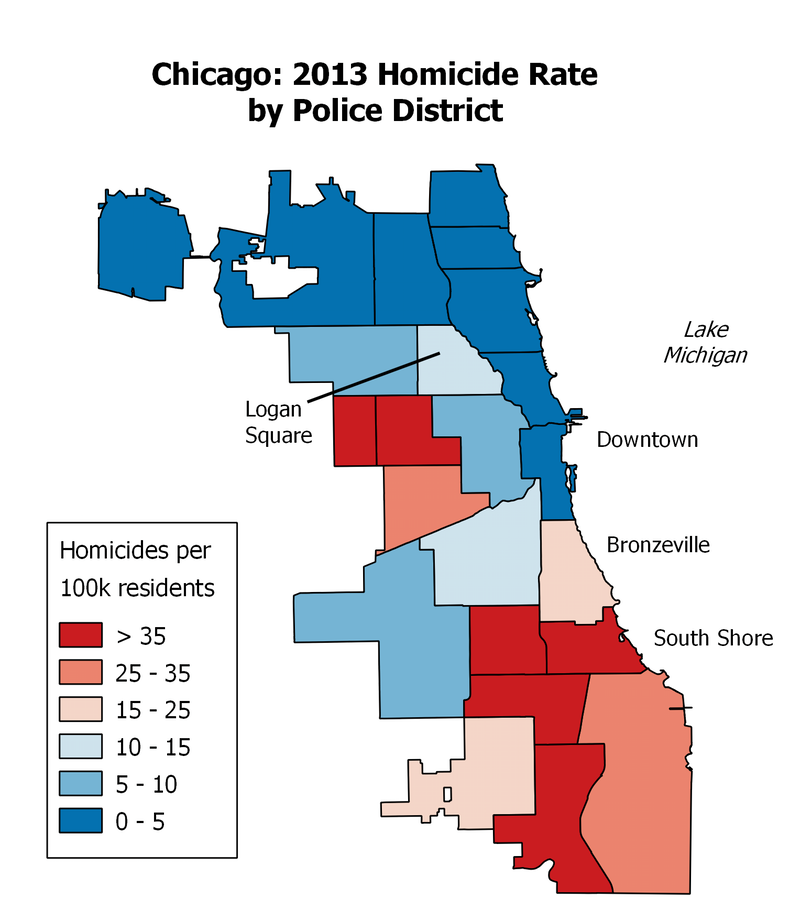
Also, for anyone not from around here, Chicago has a significant crime delta between neighborhoods that, if one were to read about it, can only be thought of in terms of extreme racial injustice.
0: https://upload.wikimedia.org/wikipedia/commons/7/7c/2013_Chi...
>Obviously there are crime issues in certain parts of the city but most of the people I hear loudly complain about it are old white people that don't live here anymore.
So you've spoken to a large number of the hundreds of thousands of African Americans who live in the neighborhoods most plagued by crime and know that they don't complain about it? It just has to be some derogatory classification of subgroup such as "old white people", As if the hundreds of murders per year were little more than something for them to whine about?
>Chicago has a significant crime delta between neighborhoods that, if one were to read about it, can only be thought of in terms of extreme racial injustice.
"Only" in terms of racial injustice? So those violent crime numbers by neighborhood are entirely the fault of the aforementioned white people? The people actually committing them in these neighborhoods have no agency or fault in what they do to their own neighborhoods? This logic just keeps getting more twisted in the absurdities it has to push to sustain itself. Doubtless there is racial injustice in a U.S. city with a famously corrupt police/civil administration like Chicago, but in recent decades Chicago has had multiple black mayors and a large percentage of its government and police are staffed by African Americans or people of color in general. Yet they somehow have had no say or co-responsibility for anything that has remained problematic?
We're talking about quality of living issues for people in the tech industry, not social justice. The issue of crime was raised in the context of why someone would want to move away from Chicago, not as an invitation to reckon with the moral horror of it. This will be an entirely different (and less useful) thread if we embark on the tangent of American crime and its causes and responses.
It is more or less simply the case that people who work in the tech industry, the kinds of people who are choosing whether to live in Chicago or Austin or Portland or San Francisco, are not living in the neighborhoods where it's unsafe to walk to school or to set foot in the park after sundown. Lawndale and Lakeview might as well be different cities.
There is bleed --- increasingly --- from rough neighborhoods to the wealthier ones, especially with respect to property crime, but also with robberies. But there are robberies all over San Francisco, too. If you're choosing between those two cities, violent crime is probably not a meaningful metric for you.
>So you've spoken to a large number of the hundreds of thousands of African Americans who live in the neighborhoods most plagued by crime and know that they don't complain about it? It just has to be some derogatory classification of subgroup such as "old white people", As if the hundreds of murders per year were little more than something for them to whine about?
Basically a strawman but whatever, I pointed out that this person was obviously white(the culture comment, growing up in Evanston) and lived in Lake View, two places I will call light on crime compared to South Side. OP is trying to describe Chicago as crime-ridden - when in actuality they would have never lived anywhere near the actual crime epicenters of Chicago and are only operating on fear-mongering.
>Only" in terms of racial injustice? So those violent crime numbers by neighborhood are entirely the fault of the aforementioned white people? The people actually committing them in these neighborhoods have no agency or fault in what they do to their own neighborhoods?
Again, a strawman, but whatever. If you want to paint the problems of an entire area on someone/some group, then the government that dominates your local area is the best option.
>This logic just keeps getting more twisted in the absurdities it has to push to sustain itself.
When you twist everyone's words to misrepresent them and make them illogical, are you shocked that you get lemonade from lemons?
>Doubtless there is racial injustice in a U.S. city with a famously corrupt police/civil administration like Chicago, but in recent decades Chicago has had multiple black mayors and a large percentage of its government and police are staffed by African Americans or people of color in general
That's right, because there have been three black mayors since 1983 and because there is no more explicit policy of racism in the Chicago PD no policies that were formulated by racism, or economic impacts from racism exist anymore.
>OP is trying to describe Chicago as crime-ridden - when in actuality they would have never lived anywhere near the actual crime epicenters of Chicago and are only operating on fear-mongering.
Besides being a pretty low-quality, racist comment overall (e.g., "I pointed out that this person was obviously white(the culture comment, growing up in Evanston) and lived in Lake View"), this specific bit of reasoning is particularly poorly-reasoned. Two things can be true: north-side Chicago can be crime ridden compared to other places and also it can have less crime than South-Side Chicago. The latter doesn't refute the former.
>Two things can be true: north-side Chicago can be crime ridden compared to other places and also it can have less crime than South-Side Chicago. The latter doesn't refute the former.
This doesn't appear to be responding to anything I said - I said they didn't live near the actual crime epicenters of Chicago and thus couldn't accurately comment on it. Chicago, as an urban area, will have higher crime rates just by population rate - that doesn't actually mean they lived in a high crime area.
>Besides being a pretty low-quality, racist comment overall (e.g., "I pointed out that this person was obviously white(the culture comment, growing up in Evanston) and lived in Lake View"
I am white - if it's racist to point out how resoundingly white OPs bias and POV is then so be it. Go read that comment back, along with the culture comment and now living in rural Colorado - connect the dots or not. I know tons of white people that used to live here that no longer do because they don't feel it's "a nice place to live anymore."
> This doesn't appear to be responding to anything I said - I said they didn't live near the actual crime epicenters of Chicago and thus couldn't accurately comment on it. Chicago, as an urban area, will have higher crime rates just by population rate - that doesn't actually mean they lived in a high crime area.
The parent didn't claim to live near "the epicenter of crime" nor does one need to live near the epicenter to find that crime is too high for their liking. Your comment was a non sequitur (responding to "crime is too high in Chicago" with "you don't live near the epicenter").
> I am white - if it's racist to point out how resoundingly white OPs bias and POV is then so be it. Go read that comment back, along with the culture comment and now living in rural Colorado - connect the dots or not. I know tons of white people that used to live here that no longer do because they don't feel it's "a nice place to live anymore."
Yes, I read the comment correctly the first time. Assuming someone's race and then assuming that the person's race impacts how they see the world is racism. Writing someone off because of their race is racism.
> So you've spoken to a large number of the hundreds of thousands of African Americans who live in the neighborhoods most plagued by crime and know that they don't complain about it?
Chicago is really segregated. It's very easy to forget that one's experience in an expensive, largely-white, progressive, north-side neighborhood isn't representative of the city as a whole. Moreover, if the only "diverse" people you speak with are those who have had good educations, landed well-paying jobs, moved to a nice north-side neighborhood, and so on, you might not realize that they aren't representative of "diverse" communities more broadly (particularly when the portrait painted by the media differs so much from reality). TL;DR--we have to be careful when we generalize about "what life is like in Chicago" because it's easy to extrapolate our own experiences onto tons of people who live in neighborhoods that don't remotely resemble our own (and I strongly suspect that's what's happening when the OP says "most of the people I hear complain about crime are old white people that don't live here any more").
> Obviously there are crime issues in certain parts of the city but most of the people I hear loudly complain about it are old white people that don't live here anymore.
Unless "old" is >29, there are plenty of people who still complain about crime in Chicago including many black people (black communities have been most impacted by the 2014-onward crime wave). But Chicago is a segregated city, so the cushier, largely white, progressive neighborhoods are more insulated from both crime and minority opinion about crime. There are definitely lots of Fox News listeners who complain about Chicago's crime (my father-in-law being among them), but while the Fox caricature might be inaccurate, crime is still very much an issue even to the "old" 30+ crowd of various races and ethnicities.
The Chicago crime narrative is mostly a bad-faith political football.
By the numbers, it's safer to be a professional in Chicago than it was at any point in the 1990s, where this wasn't part of the national conversation.
But a movement towards criminal justice reform (which started out bipartisan, with Koch support!) elected a bunch of high-profile reformist prosecutors and shifted everyone's attention towards police oversight at exactly the least congenial time, on the eve of a bunch of exogenous shocks (the pandemic, the economy, the full flowering of a disastrous anti-gang policing strategy) that juiced violent crime.
There's political hay to be made of the crime numbers (Chicago's are far from the worst of all the metro areas in the US, but we're such a large city that the decontextualized numbers are easy to sell on TV), and easy sides to take --- the defunders on one end, the "tough on crime" conservatives on the other, here to make the case that Chicago (and Philly and San Francisco) fucked up by electing reformist Democrats to prosecutor posts, and so now crime is the first word out of everyone's mouth when it comes to this city.
Notably, none of that attention has anything to do with improving the lot of the people who live in Lawndale or South Shore; the national conversation basically boils down to whether we should create National Guard cordons around these areas, or whether we should instead abolish the police departments in these neighborhoods. It's a joke, not a public policy debate.
We're not going to resolve any of it on this thread. It sounds callous to say this because it is callous, but it is also, non-normatively, the descriptive correct answer for professionals wondering about how crime in Chicago would effect them: if you don't live in the hardest neighborhoods in Chicago, it's unlikely to be meaningfully different from any other comparably dense urban area.
Yes, I fully agree that many people who criticize Chicago's crime are doing so in bad faith, but by the numbers Chicago's violent crime is climbing again after decades of decline. That there are bad faith people among critics of Chicago crime doesn't imply that we should ignore Chicago's very real crime problems, nor that all critics of Chicago crime are acting in bad faith.
> But a movement towards criminal justice reform (which started out bipartisan, with Koch support!) elected a bunch of high-profile reformist prosecutors and shifted everyone's attention towards police oversight at exactly the least congenial time, on the eve of a bunch of exogenous shocks (the pandemic, the economy, the full flowering of a disastrous anti-gang policing strategy) that juiced violent crime
Chicago's crime began surging back in 2014-2015, and I'm pretty sure the likes of Fox News were happy to talk about it back then (certainly I recall my father-in-law ranting about it around that time). The idea that they waited until there were confounding factors like the pandemic to talk about it probably has no bearing in truth, although I'm sure they boosted that topic again in 2020 and 2021 when Chicago homicides soared to ~30-year highs (as they did all over the country).
> Notably, none of that attention has anything to do with improving the lot of the people who live in Lawndale or South Shore;
In fairness, it's not like the conditions of people in those neighborhoods abruptly fell off in 2014 such that it would explain the surge in violent homicides. If you're interested in reversing the surge (which is probably where most of the opportunity lies, assuming that if something can drive crime to surge so dramatically/quickly, that perhaps it can be similarly made to decline dramatically/quickly), you're probably going to look at the causes of the surge rather than investing more in education in those communities in the hopes that it will yield a positive return in ~10 years.
Like most of the rest of the country, property crime and violent crime are on the rise in Chicago. But index crimes in Chicago are far below where they were at any point in the 1990s. The full context isn't just "crime is up", but also "up from where".
And yes, there were changes that have explanatory power over the increase in gang homicides on the south and west sides; a string of them, in fact. The atomization of the large "institutional" Chicago gangs, the disinvestment and flight from the roughest neighborhoods to suburbs in the south and west, and, yes, the way CPD managed the problem, "flooding the zone" in whatever the most recent hot-spot while leaving other problematic areas to fester. A lot of this is Chicago's fault.
But it has not at all much to do with the quality of life for professionals in the city. For most families that live in Portage Park, South Shore might as well be in Indiana.
> But index crimes in Chicago are far below where they were at any point in the 1990s. The full context isn't just "crime is up", but also "up from where".
That context isn't helpful for someone who is considering where to live. I don't care what crime rates were in a city 30 years ago, I care how a given city's crime rates compare to other places today (and possibly in the foreseeable future).
> But it has not at all much to do with the quality of life for professionals in the city.
I take your point that, in a segregated city like Chicago, the north-side crime rates are going to be a lot lower than the city average, but I'm pretty sure rates are rising in virtually all neighborhoods.
Yes, and that's what I'm telling you: that the "rising crime rate" story tells you nothing at all about what it's like to live here, because crime is rising from historic lows, and the headline crimes are gang-related and largely confined to neighborhoods you won't live in --- something you can see pretty clearly from the different rates of increase of homicide (the quintessential gang crime) and violent crime overall (still near all-time lows).
You came to this discussion with a data point that clearly isn't meaningful. You don't even need empirical data to see that; logic is enough to tell you that you can't deduce quality of life from "crime is up". Up from where? But, to be helpful, I've provided that context for you.
It seems like you misunderstood my argument. Based on:
> You came to this discussion with a data point that clearly isn't meaningful. You don't even need empirical data to see that; logic is enough to tell you that you can't deduce quality of life from "crime is up".
... it seems like you think I'm arguing "rates are up over the last decade and thus quality of life must be bad overall". My argument is that crime rates are high overall (tenth worst of the top 100 big cities) and on a worsening trajectory. The near-term trajectory (i.e., the last ~decade) is important because we don't live in a city from moment to moment, but we will likely be in a city for 5 or more years. I also don't purport to claim that crime rates tell you everything about a place's quality of life, in case that wasn't clear. Yes, it is unlikely that a professional will live in the worst neighborhoods in Chicago, but they're also less likely to live in the worst neighborhoods in any other city they might move to.
You could credibly argue that Chicago's more segregated nature means more variation in crime rates between the worst and the best neighborhoods, which I completely believe (and consequently I also consider more qualitative assessments of cities in addition to a strictly numerical approach considering the dearth of data).
"bad faith" yet every relevant stat which you'd measure the health of a city, arguably the largest one being population gain/loss, is going the wrong way. So the whole argument about this being some sort of made-up political narrative is just provably wrong. Crime stats, population loss, budget deficit, credit rating, school strikes, school truancy, school poverty line, property values...I could go on. Take your pick. The scoreboard says Chicago is losing, this isn't some political conspiracy.
I don’t mean to downplay Chicago’s crime problem, which is very bad, but if you’re not a gang member and you don’t live on the south side your odds of getting murdered in lakeview are literally orders of magnitude lower than your chances of dying in a car crash in rural Colorado where you have to drive long distances to get anywhere and everyone has a pointlessly huge truck optimized for inflicting maximum carnage in an accident.
When you go from a dense, transit friendly city where people drive
less to a rural auto-oriented one, your odds of dying an untimely and violent death go up dramatically, even if the latter has much less crime.
I grew up in Beverly, on the south side of Chicago, and moved to Lakeview when I was 18.
I moved from Chicago to San Francisco (I lived at 7th and Folsom), and then back again, regretting only that I hadn't moved back sooner. Then a company I started got funded and I got hauled back to San Francisco (this time in Noe Valley), where I stayed for another couple years, before moving back to the midwest (Ann Arbor), regretting only that I put up with San Francisco for as long as I did. We lived in Ann Arbor for 4 years before moving back to Chicago and putting down roots.
I had vastly bigger problems with crime in San Francisco than I did in Chicago.
I've only heard about the public school problems in San Francisco; my kids public school here has extraordinarily well-compensated teachers who ran a pretty competent college-prep playbook that got both of my kids into hardcore STEM majors (the boy's a biochemist now, the girl is out in Utah doing geology field work).
The weather was literally the first thing I missed about Chicago.
I don't know what "culture" means to you, but one of the first things I noticed about SFBA was that none of the touring bands I followed ever played there (a track record of closing every music venue in the city for like a decade couldn't have helped, a story you'll find well told at Jamie Zawinski's blog), and last call at the bars was, like, 11PM. Does culture mean museums? Check. Public art and architecture? Check. A theater scene? Check.
I'm sure Colorado is lovely and don't begrudge you your preferences. I don't think it's at all true that if you "ask any former Chicagoan" you're going to get agreement on all these points, or even most of them. If you'd said you grew up in Evanston and then lived in Kenwood, or Humboldt Park, the violent crime thing would be easier to take seriously --- but you lived in Evanston and Lakeview, which means that as far as violent crime exposure goes, you might as well have lived in Glenview. Chicago has a violent crime problem, but it's a deeply racist violent crime problem (not just demographically, with crime endemic to regions of the city that were de jure segregated until the 1970s, but literally racially: violent crime will follow you across the city border into the suburbs, but only if you're Black and have Black friends on the other side of the border).
I'm a startup operator in Chicago, and we do not have a good startup scene. Don't let me be taken as saying there's no tradeoffs to being here. You don't come to Chicago because it's going to be a game-changing win for your startup.
Really? You encountered a bunch of violent crime in Lakeview?
The unusable schools and taxation are way bigger issues, and the everyday corruption through which the city rips off citizens is despicable (much of it revolving around their vehicles). The special tax it imposed on Netflix and similar services stands as a particularly egregious embarrassment.
But the complaints about the weather are tired, overblown BS. If you don't want to experience real seasons, don't live in a seasonal area. The "oh it's so cold" one is particularly bogus, since bouts of extreme cold are typically short (and getting shorter) followed by 45-degree F periods all winter long.
Chicago is slowly dying by self imposed policies. Cue in guy shoving stick into bicycle wheel then holding shin meme. Chicago is a great city and everything you mentioned is completely avoidable. But again, its shoving a stick into its own wheel, quite intentfully at that.
Our tech scene has been largely driven by fintech and a few unicorns. And our unicorns tend to be much more bust than boom — Groupon being the highest profile one. Not sure if it's correlation or causation, but VC investment tends to be more conservative, and the ones I do hear about are mostly fintech.
On top of which, Chicago wasn't all that tech friendly. Pay has been rather stagnant, and promotions above senior engineer didn't exist before Covid/remote stretched everything out. The exception to comp has been prop trading firms, which make oodles of money but... trader culture dominates over eng.
I lived in Chicago and, when I was there, there were a lot of good people but the overall technical culture was mediocre--probably not worse than anywhere else, but not befitting what was once (and could be) among the greatest cities in the world.
The presumption, except in high-frequency trading, is that the talented people go to the coasts (which is bullshit, because I've spent a lot of time on the coasts, and it's all socioeconomic) and so a certain fratty culture dominates.
If WFH is permanent, it could be one of the best things for Chicago in a long time. It really is a great place to live--if you can find a good company. I also didn't find the weather to be that bad. April-November is a slightly cooler (nicer, in summer) version of the same thing we have on the east coast, and the winter tends to be mostly fine with only an occasional -20 cold blast.
In my view, Chicago's biggest negative is its 1-2 hour drive radius. The city's beautiful. Northern Illinois, not as much. Starved Rock is nice, and the Indiana Dunes are alright, but most of the cool stuff in the Midwest is 3-5+ hours away. The flat landscape also suffers due to billboards and powerlines; the topography makes the city itself so much more more compelling, but it means the outlying areas get really ugly--because if there's any garbage within a mile radius, you're going to see it. On the other hand, it has one of the cheapest and most connected airports in the world, so that might make up for it.
The venture money in Chicago is too conservative. It’s not a great city during the winter. There aren’t enough large, innovative employers in silicon hardware, or software. The state has latent brain drain due to taxes and a few other things. Source: have spent years trying to make it better.
Edit: want to be clear that the money isn’t conservative in a good way, encouraging small, sustainable businesses. It’s reluctant to support those at a reasonable price as well.
This is a new interesting point to me, which makes total sense. All the big $ in Chicago seem to go to prop trading, not VC.
Combine that with a big industrial base, not tech, and all the STEM talent just becomes mechanical engineers, not software engineers, and half those who do become SWEs end up at trading firms.
Is it really not thriving? Surely it's relative vs SF/NYC, but when I got here in the 90s, it was all just banking & insurance. Also advertising, but very little tech there. It was super frustrating at the time, but the last decade has shown quite a bit of growth of "modern" startups, imo. It may not be those other hubs, but as Mr Bourdain would probably say, Chicago doesn't care.
On the weather...
"A nice day in Chicago is a nicer day than anywhere else in the world." -- Anonymous.
75 degrees with no humidity is heaven here, and _everyone_ you see feels the same way. Outdoor dining, festivals, parks, etc. People grind through January just to see June, and it shows. 75 degrees with no humidity in San Diego is just another Tuesday.
>Common diagnoses (crime, taxes, regulation) all undoubtedly make an impact - but none are as bad as SF/NY.
SF/NY's tech scene gained momentum up before the surge in crime and corruption and is currently mostly coasting on inertia, driven mostly by ambition to tap into that abundant capital from previous cycles.
It is a great city, but the tax rates are outrageous and they're going to get worse. Just look at the funding of the pension plans. Illinois and Chicago have some of the worst funding ratios. They've promised too much to workers and never set enough aside.
There's a reason why companies like Boeing or Citadel are fleeing.
The tax situation is not great, but for tech workers, it ultimately just means that Chicago is not as advantaged over NYC and SFBA as it could be; the cost of living here is so much lower that it's hard for me to think of a scenario where you wouldn't come out substantially ahead. My kid brother is buying a starter home, in a relatively (obnoxiously) expensive part of Chicagoland, and to get the same house within an hour's drive of San Francisco he'd be looking at 4-5x the outlay.
The property tax situation does mean that Chicago houses aren't mortal-lock speculative investments the way SFBA houses are, so there's that to contend with.
This is a fair point. Long term tax issues could def be a factor. Even beyond the abstract potential bankruptcy: who wants to buy a house when 90-110% of appreciation will be eaten by the inevitable tax increases?
Illinois is generally in the bottom three of states for pensions being underfunded, and Chicago is normally the city with the highest or second highest sales tax in the US. As an Illinois resident I'm concerned about the high percentage of taxes over the next several decades that will go to service debt, and therefore not provide other services. I think this causes issues which scare away established employers as well as entrepreneurs (high crime rates, struggling public schools, etc). This will then drive away young people who are looking for good jobs, and therefore Illinois misses out on the taxes those people would pay over their careers and thus the situation spirals down further.
A few years ago the Citadel CEO went through a very public and extremely acrimonious divorce, during which the wife and kids left Chicago for the east coast and refused to come back. So now, he's all alone, and seemingly getting angrier by the day. His politics are increasingly distanced from what people in the area are interested in, etc.
Moving to a location where he might see his kids more often might just make him a lot happier and less angry. If so, that's good for him.
Boeing was barely here to begin with. They consistently missed their job targets, despite being allowed to count contractors towards the anemic targets they were meant to hit. Citadel is a body blow, but Boeing? Who cares.
> Chicago is the best city in the world from June-Sep
I'm a Chicagoan who works for a successful Chicago startup, and I'm planning to leave this year precisely because I strongly disagree with "Chicago is the best city" (at any time of year). There are things that I appreciate about the city (which can be gained from occasional visits rather than residence), but here are some of the things that are driving me out (I'm not sure the extent to which these things have a bearing on its success as a tech hub):
1. There's virtually no nature within a 2 hour drive (you can hardly get past the suburbs in 2 hours after work). There are a few decent state parks (e.g., Starved Rock) that one could do in a day or two, but it's not like Seattle, Denver, or Phoenix where you can be in the mountains in ~40 minutes during rush hour. It seems like Chicago is a great city if you're big into sportsball and clubbing, but for those who want more from life, it leaves a lot to be desired.
2. Chicago has a few charming neighborhoods and the architecture downtown is beautiful, but in general most of the city is kind of ugly (lots of trash blowing around the streets). I particularly hate all of the vomit-yellow brick buildings that plague the north/north-west sides of the city. The more charming neighborhoods are also pretty unaffordable for most Chicagoans.
3. Even with respect to the weather, Chicago is hot and humid from June through August, which makes it pretty unpleasant to be outdoors for most of the day unless you're on the lake (which is invariably crowded). And of course from January through May, Chicago is either cold and bleak or muddy and bleak. If Chicago has a peak time, I would argue that it's September through December.
4. Chicago is deeply politically dysfunctional with respect to fiscal policy, policing, prosecution, etc (and things at the state level aren't much better). I'm happy to pay more in tax to a government that uses that money effectively, but Chicago's taxes are steep and it doesn't seem like that revenue is efficiently used. It's also extremely segregated--when people talk about "Chicago", they're almost always talking about the north side specifically. South and west sides may as well be in different states (if not countries) to most of us north-siders except for the overflow of crime (which admittedly isn't as bad as the news makes it out to be--we're not the worst city in the US for violent crime, we're "merely" the tenth worst of the largest 100 cities).
6. The city lacks any prominent sense of community. Most people don't know their neighbors (although I'm sure there's the odd building or block for which this isn't true). It seems like the overwhelming majority of people are transient and isolated ("alone in a crowded city"). A lot of people seem depressed as a result.
7. Chicago's COL is only low by coastal standards. It's still quite high compared with most of the country. Of course, the present inflation crisis and likely recession are probably going to make these comparisons a bit messier until things reach a steady state.
I think this is mostly fair, though I'd strongly dispute point #6; Chicago is a city of neighborhoods with block parties and tool shares and local meet-ups, and far, far more community spirit than San Francisco has. Wanting to live in a place where you know your neighbors is a reason to move here, not to move away from here.
I also think most of the architecture on the north side is really charming --- every block is a shaded corridor of dense tree cover with a mix of old and new 2-3 storey walk-up buildings and mixed-use on the corners. The north/northeast side is my happy place, and a starter home in Jeff Park or Portage Park will set you back ~275-300k, for neighborhoods where all the lots have back yards and everything's walking distance from the Blue Line.
But it's true, that's as compared to New York or San Francisco. There are certainly better deals elsewhere in the country!
Yeah, I haven't lived in NYC or SF, and I'm certainly not intending to imply that they outperform Chicago in these regards, but I think there are a lot of second and third tier cities in the country that compare more favorably. I agree that there are a few streets in every neighborhood that have charm, but they tend to be the tucked away residential streets rather than the commercial streets. I want more of Chicago to resemble Andersonville, Lincoln Square, etc, I guess.
> There's virtually no nature within a 2 hour drive (you can hardly get past the suburbs in 2 hours after work).
This is often brought up, often by very vocal people on r/chicago, but I've lived in Chicago for years and have never missed nature. The lake is good enough for me. I suspect there are a ton of people like me. I grew up in a big city and I'm energized by the energy of big cities. I like green spaces, but I don't actually feel a compelling need to be in wilderness.
The middlefork Savannah would disagree https://www.lcfpd.org/middlefork-savanna/. In fact there are many forest preserves in Chicago itself. Insofar as neighbors go, when I lived in Bridgeport, all the neighbors knew each other and were quick to respond with help.
> 1. There's virtually no nature within a 2 hour drive
Indiana Dunes National Park is less than an hour away! Don't get me wrong, I wish the region had mountains, but Indiana Dunes has both great forest trails and giant sand dunes you can climb to get a great view of Lake Michigan.
Maybe from the loop or the south side, but from my place it's 1.5 with normal traffic and 2+ with rush hour. You're not going to get out there in an evening, eat a quick meal, and have any daylight left to actually do anything (maybe in the peak of summer you can have enough daylight for a meaningful after-work trip, but most times of the year I doubt it).
The “right” way to do Dunes is to bike camp there. Ride your bike to your nearest train that gets you to the loop and take the southshore train (or do the whole thing by bike).
You can do a similar trip to Zion up north which is even easier from the Northside. You can be sleeping in a hammock walking distance to the water in either direction pretty trivially.
I’m less familiar with the western suburbs version but have friends that do starved rock this way.
I don’t think it invalidates your point and the time it takes to get to somewhere “outdoors” is actually my biggest complaint about the area but both of those parks are definitely doable after work… so long as you stay the night.
Here is a link to a group that does those trips as tours and does advocacy: https://www.oofd.org/
That's fair—driving to Indiana from the north side of Chicago can be surprisingly grueling. And taking the train there isn't ideal if you want to take a cooler and beach gear.
Chicago is incredibly underrated, especially compared to the amount of hype that Austin and Miami receive. Don't get me wrong, Austin is cool, but Chicago beats it in so many dimensions (art & culture, events, scenic views, architecture, even music). No city is perfect, though, and I think the best option is to live in multiple throughout the year to experience the best of each. For example, living in Chicago for most of the year but then flying to Miami or SoCal for the winter would be a good combo.
And don't get me wrong, I also think the views just from Congress Ave bridge are gorgeous. But to me, (and this is completely subjective) I found I was much more captivated by Chicago's views of Lake Michigan, its skyline, and its architecture. I think part of it is that I love beaches, and Chicago has some really great beaches.
Did Uptake pivot, or something else? Flush with filthy Groupon money and trying to surf the IoT wave a few years ago but then they lost Caterpillar and now they're back but doing analytics or something else.
A lot of these companies are great. Some are... doing just okay. The total funding number isnt all that helpful if its been raised over a very long period of time. Would be happy to give more insight into anyone targeting these companies in Chicago. Was a tech recruiter in Chicago for many years before becoming a dev.


[1] however take the numbers and descriptions with a large grain of salt. I’m not sure how they are sourcing their database but there are at least a few very incorrect investment amounts and company descriptions and those are just from the companies I personally know.