Food for thought. In 1964 you could take two silver dimes and purchase ~1 gallon of gas. Gas was ~20 cents per gallon. Dimes were 90% silver.
Fast forward to 2021. You could take two silver dimes to a coin dealer, sell them for fiat currency, and purchase 1 gallon of gas. Gas is ~$3.50 per gallon, silver is ~$23 per oz, and 2 silver dimes from 1964 contain ~5grams of silver.
But using 2021 dimes, you need 35 dimes to purchase a gallon. Precious metals have kept their value. Fiat currency has lost nearly 90% of its value since moving off the gold standard. The government needs more money, they print it. Based on their promise to pay it back later, with cheaper inflated currency.
Paper currency representing a given quantity of gold/silver/etc is a good idea. When you divorce it from that backing value is when governments print money to inflate. We all lose when that happens.
Gas is more expensive because fossil fuels are more difficult to extract, we have some environmental standards instead of none, consumption has skyrocketed, and there's an organization called OPEC that maximizes the price. Pretending that none of that would be true if dimes still had silver in them is ridiculous.
If you had taken those same two 1964 dimes and put them in a DJIA index fund, you'd have $7. That's because storing shiny things in a vault does not contribute to economic activity. It doesn't invent anything, manufacture anything, provide any service, or create any new markets.
No one thinks that their economy would be better off with a huge stockpile of gold instead of a huge stockpile of CPUs. No one thinks that a reduction in mining capacity should restrict the amount of currency available for business loans. Representative currency is a vestigial technology that is no longer useful.
Precious metals are not typically considered as drivers of economic activity. They are used as hedges or backstops. Your $7 in an index fund after 57 yrs doesn't sound that productive being only 2x what the value of the silver is.
As I have said many times on HN, a gold standard protects the wealth of the people from government excess. That is also why the gold standard was ended by government.
The inflexibility of a gold standard is a benefit. More gold or an increase in gold value is required to represent greater wealth. The gold can be traded for or mined. However, the gold standard ensures that the dollar you earn today maintains purchasing power for as long as you care to keep it. Your gold backed dollar can't be made worthless in a generation by the excess of politicians seeking money, power, and control.
Politicians are people subject to all the same emotions as you or I. Money and power are powerful motivations for corruption. There is access to a lot of both in government. The gold standard was a check on greed at the government level and in turn a restriction on the power government had to manipulate the economy for the benefit of a few.
Housing wouldn't cost a million$ if not for inflation. There has always been demand, and people always found ways to meet it. But with inflation, especially high rates, your mortgage was paid back with dollars worth less than when the house was first purchased or built.
How is this a concession to the old? Why is it that someone worked for 30 yrs to pay off their mortgage shouldn't get the same treatment, mainly "appreciation" due to inflation that everything else gets?
Honest question - is this the same argument we hear about "forgiving" student loans, meaning having people who didn't sign up for them, agree to them, utilize them, or even go to college, pay of the debts of those who did?
> More gold or an increase in gold value is required to represent greater wealth.
Not true. A restriction in supply can raise the price, and the discovery of new sources can lower it. Plus wealth is entirely subjective. Would you rather have a warehouse full of food, water, and ammunition during a crisis, or a warehouse full of gold? (Hint: people may not want to trade food for a soft metal that can't be fashioned into anything but decoration.)
> The gold can be traded for or mined.
It can also be lost in a shipwreck[1] contributing to a banking panic[2].
> However, the gold standard ensures that the dollar you earn today maintains purchasing power for as long as you care to keep it. Your gold backed dollar can't be made worthless in a generation by the excess of politicians seeking money, power, and control.
Of course it can. Private banks failed all the time, despite claiming that you could trade their notes for gold/silver. Governments can simply abandon the gold standard (and they did).
It all comes down to the fact that gold backed currency does not solve the primary problem of credibility and corruption at the levels of institutions and governments. It only adds another variable. Your ability to trade your paper for gold is still dependent on the ability and willingness of that bank or government to make the exchange. If they say no, what are you going to do?
The next step you could take is to refuse currency and to use only gold/silver/clam shells/whatever to do your transactions, which simply puts you at a huge disadvantage in any modern economy. Literally no one is going to do business with you if they have to add the burden of authenticating your clam shells to buy your product or rent your time.
In the end, there is no functional difference between "We promise that we will give you a grain of gold for this dollar if you ask" and "We promise to not mismanage this currency into hyperinflation." During an existential crisis, both promises may be broken. Hell, they probably will be broken. But the promise on the paper you're holding isn't going to matter either way.
Before your examples Europe had the Great Bullion Famine during the 15th century that caused deflation across the continent due to the lack of gold. This was ended when the Spanish started flooding Europe with vast amounts of gold from the Americas, which then caused massive inflation instead.
Yes, all of those bad things can happen. A gold standard is not perfect. The goal isn't to be perfect. It is to have a currency that is fair to the greatest number of people. Gold is a currency trusted by all, fiat is a currency of force.
In crisis I would rather have the food, water, and ammunition. What a silly strawman. A warehouse full of survival supplies is incredibly valuable during crisis but it is not durable and must be maintained when not in crisis. For the long term representation of wealth I would rather have a vault of gold just like every nation on the planet. Nearly everything else degrades in a fraction of a lifetime. Gold will be exactly the same after sitting untouched for millennia. For the long life of nations this is extremely important. For the comparatively short life of a human this is less important but still valuable.
A casino is the best analog that I can thing of at the moment. When you want to play in the economy of a casino you are required to change your dollars for chips. You have to trust that the casino is not going to steal your dollars and will actually give them back. They practice full reserve banking where every dollar represented by chips is in their vault. The same is true for a gold standard economy as practiced sans full reserve. Gold is the money, banks do the job of verifying gold and exchanging for easily carried and traded tokens, dollars. You have to trust that banks or governments aren't going to steal your gold. If you don't trust them you change your dollars back to gold. If a lot of people lose trust you get bank runs. With fractional reserve banking there isn't enough gold to pay back every dollar and you get crisis and bank failures.
With any currency its value comes down to trust. A gold standard allowed people a way to keep their wealth in a durable form in times of low trust with no conversion cost. It allowed people to "take their ball and go home" so to speak. No governments needed to trust another country's fiat. The money exchanged in trade had a real, verifiable, persistent value.
Yes, a gold standard has some problems. Barring straight barter with physical gold it is still the fairest most robust currency system humans have come up with. Whatever excuses the US Government gave for ending the gold standard it still acted unconstitutionally. The government was facing a damaged economy and dwindling gold reserves as people and countries redeemed dollars for gold. The government saw their dwindling gold reserves as a problem instead of a function of a gold standard. This is the same as a casino seeing a lot of people cashing chips in and seeing their dwindling cash supply as a problem. In both cases it is a loss of trust in the token issuer that caused their supply to dwindle. It wasn't a problem with the currency it was a lack of trust in the issuer that the issuer saw as a reduction in "their" money that needed to be stopped. It was never "their" money to start with. It always belonged to the people. The people were just taking their ball home.
> Gold is a currency trusted by all, fiat is a currency of force.
> You have to trust that banks or governments aren't going to steal your gold. If you don't trust them you change your dollars back to gold.
> With any currency its value comes down to trust.
Do you see the problem here? The entire argument for the gold standard always goes back to trust of the institution that is promising to exchange paper for gold. There is a long, long history of banks and governments unable to produce lumps of metal when demanded, and that has caused panics and recessions. Even if they were sound but had logistical issues moving gold around and exchanging it.
Again, there is no difference between a piece of paper that promises to be worth some amount of gold and a piece of paper that promises not to mismanage a fiat currency. They both depend on full faith in the institution that made the promise.
> A gold standard allowed people a way to keep their wealth in a durable form in times of low trust with no conversion cost.
If they had the physical gold, there is always a conversion cost. A lot of immigrants use gold as a bank of sorts, and they always lose a few points when they sell and buy back. In a crisis, as we both agree, gold is worthless, or at least worth a lot less as everyone tries to sell theirs for food. Holding paper that should be exchangeable for gold has no more inherent value than a fiat currency.
> It allowed people to "take their ball and go home" so to speak. No governments needed to trust another country's fiat. The money exchanged in trade had a real, verifiable, persistent value.
It allowed people to have a piece of paper with a promise that they could "take their ball and go home" so to speak. No governments needed to trust another country's fiat, they needed to trust they weren't lying about their gold reserves and their management of it. The money exchanged in trade was a promise that it was backed by a real, verifiable, persistent value.
> Whatever excuses the US Government gave for ending the gold standard it still acted unconstitutionally. The government was facing a damaged economy and dwindling gold reserves as people and countries redeemed dollars for gold. The government saw their dwindling gold reserves as a problem instead of a function of a gold standard. This is the same as a casino
The government saw their inability to manage the money supply when it was tied to gold as an existential crisis to the Union. If you were in charge, based on your arguments here, you'd rather let the south secede or win the Civil War than tarnish the reputation of the gold standard. That's a bit more serious than a casino going bankrupt.
> It wasn't a problem with the currency it was a lack of trust in the issuer that the issuer saw as a reduction in "their" money that needed to be stopped. It was never "their" money to start with. It always belonged to the people. The people were just taking their ball home.
And when many of those people tried to take their ball and go home, there was no gold for them to collect. The system failed because the institution was mismanaged, or because there was a panic and they couldn't handle the logistics of moving lumps of metal around. That's the whole reason the world has moved away from the gold standard. I'm not sure how you see the long history of it's repeated failures as evidence that the problem is not the gold standard, but the lack of a perfect implementation of it.
Would you be happy with no paper certificates for gold and just use gold coins? From your earlier argument I suspect the answer is no.
Every single argument you have made is that governments and banks cant be trusted with paper money even when it is backed by gold. So, why do you push for fiat currency?
If government and banks are not to be trusted with paper money then hard currency is the only solution left that doesn't require trust in anybody.
> Would you be happy with no paper certificates for gold and just use gold coins? From your earlier argument I suspect the answer is no.
Everyone's answer is no. Even during the prime of the standard, people made transactions on paper currency promising they represented gold because no one is going to lug around heavy coinage, spend the time to authenticate it (since it's easier to counterfeit than modern paper/plastic currency), or have to decide between making trips to banks or having a pile of it they have to constantly guard.
> Every single argument you have made is that governments and banks cant be trusted with paper money even when it is backed by gold. So, why do you push for fiat currency?
Because for every person who isn't part of the aristocracy close to centers of power, there is no difference. If a currency is mismanaged, it doesn't matter whether it promised gold or low inflation. During all of the previous crises, the first things banks and governments did is suspend specie payments.
> If government and banks are not to be trusted with paper money then hard currency is the only solution left that doesn't require trust in anybody.
If you want to live in a nation state with a credible legal system, and I think everyone does, you have to trust them to some extent. You have to trust that they won't take away your property by force, throw you in jail to take your wealth, allow someone else to do those things without consequences, or mismanage their currency to the point where it hyper inflates.
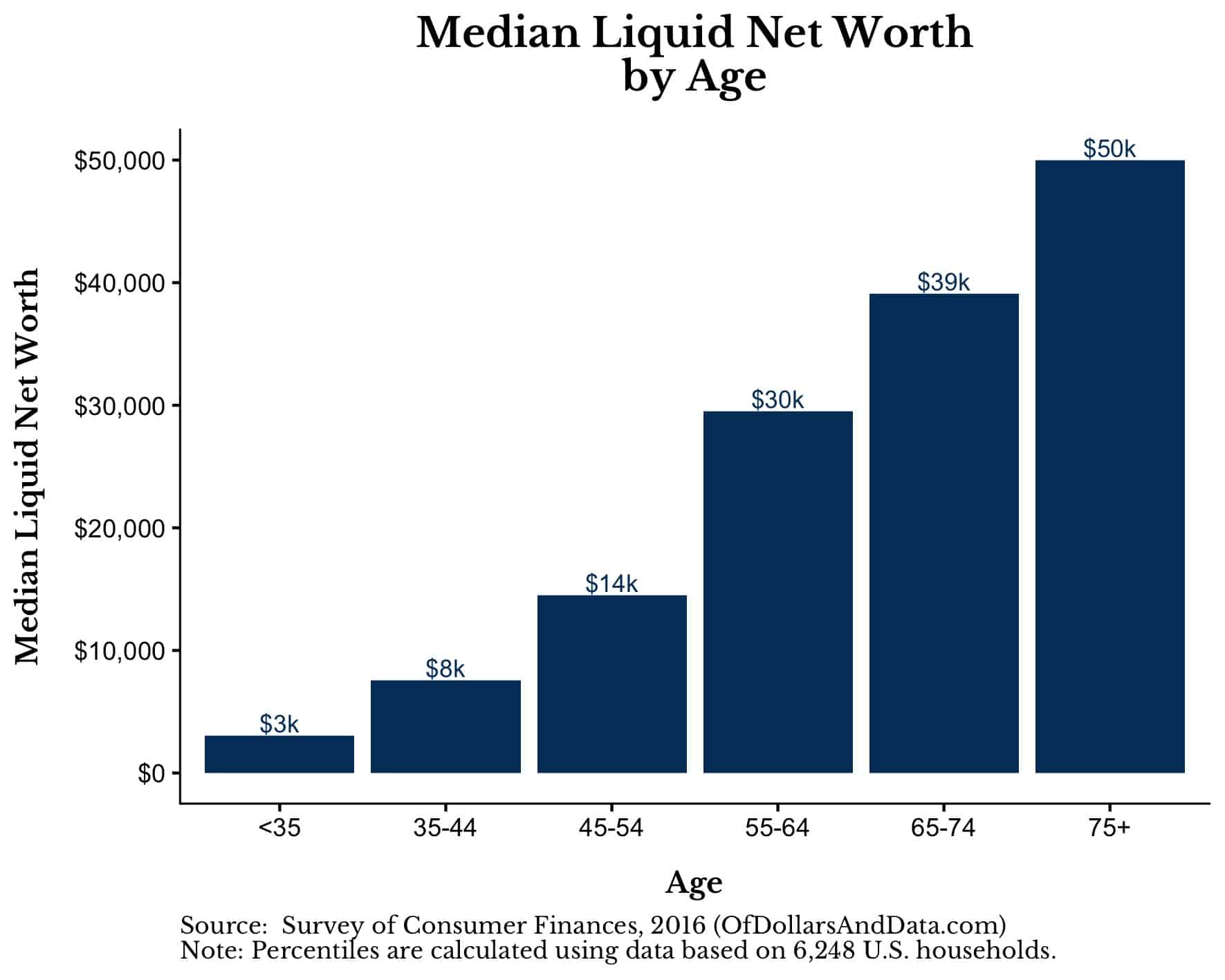
Credible governments have things like the FDIC so normal people don't have to worry about their local credit union going under as long as their account has less than $250k in it. Since the average liquid net worth of Americans is less than $50k[1], that pretty much covers everyone. It has virtually ended the problems of bank runs and panics except for black swan events like 9/11.
Even for things like the 2007 Financial Crisis, being on a gold standard wouldn't change anything. The policy mistake of removing the firewall between traditional banking and investment banking as well as leverage limits would have still led to over-speculation and CDO Ponzi schemes. The gold standard would have just added another knot to the crisis as well as provided some video footage of huge crowds trying to get specie payments and walking away empty handed. Nations like Canada avoided that entire crisis, except for what was unavoidable due to their relationship with the global economy.
Not too worried about it. It only happens during wartime for G20 nations, the last being in the 1920s/1940s. When those nations were on the gold standard.


Food for thought. In 1964 you could take two silver dimes and purchase ~1 gallon of gas. Gas was ~20 cents per gallon. Dimes were 90% silver. Fast forward to 2021. You could take two silver dimes to a coin dealer, sell them for fiat currency, and purchase 1 gallon of gas. Gas is ~$3.50 per gallon, silver is ~$23 per oz, and 2 silver dimes from 1964 contain ~5grams of silver.
But using 2021 dimes, you need 35 dimes to purchase a gallon. Precious metals have kept their value. Fiat currency has lost nearly 90% of its value since moving off the gold standard. The government needs more money, they print it. Based on their promise to pay it back later, with cheaper inflated currency.
Paper currency representing a given quantity of gold/silver/etc is a good idea. When you divorce it from that backing value is when governments print money to inflate. We all lose when that happens.