Pretty hype about this TBH. There is a long history of companies domiciling in say, Monaco, The Cayman Island, Panama etc to avoid taxes and regulations where they mainly operate. My understanding is that the current process in vogue for the mega cap companies is the "double irish dutch sandwich" https://www.investopedia.com/terms/d/double-irish-with-a-dut...
No one, including tax lawyers, will tell you with a straight face that this is the way things were expected/designed to work. All of these tax avoidance strategies are emergent properties of complex systems that are the result of uncoordinated action amongst individual actors that cannot be fixed without collective organization. I support this and 15% seems reasonable to me.
However this article is a little biased -- it's main contributor is a user called "Britishfinance" -- who appears to be a London based corporate shill to take the heat off the City of London being a tax haven.
That's literally a reddit conspiracy theory propped up on r/Ireland. Everything seems to indicate the editor you mentioned is very well informed & doesn't have any COI a part from vague allegations.
Like what do people think, some guy working in the City spent tons of time making extremely well sourced and well constructed articles just to... Divert some sort of "heat" from the entire London financial sector... On Wikipedia? Imo that's absurd, and it's very similar to the type of accusations people (pointing at the original reddit post that popularized the city shill theory) make whenever they find an article that bruises their nationalist ego.
The point that there is no shortage of tax havens in the EU itself, including leading EU nations, is true.
Luxembourg, City of London, Liechtenstein, Monaco, Netherlands, Belgium, the Vatican, Switzerland (sort of), Malta, all for slightly different reasons. I've even read articles from these nations where they point out that the only way they'll ever distinguish themselves is with tax law. Or rather: that they'd be broke if they weren't tax havens.
And then we're remaining silent about "royal" tax havens that are individual companies which get preferential tax treatment from parliaments (e.g. Shell) and, uh, I guess "presidential" Total. These deals, for individual companies, are far more atrocious (and forced on tax departments) than any tax haven you'll find. They are directly enriching favored individuals in a particular country, and get tax advantaged for it.
And to add a more "creative" situation to terminate, Cyprus is a double tax haven (both the Greek and Turkish parts of the Island are tax havens, for different reasons, interesting for different types of individuals and/or companies, but the fact that money can cross the line, even if people cannot, offers interesting opportunities as well). Neither side of the Island will ever have anything to offer the world other than some small tourism industry, so ... for them as well being a tax haven is the only option (other than, I guess, war).
So what do you do about the problem that many of these countries have no real options other than being tax havens?
It's hard to find sympathy for those just leech off the broader society to fund their lifestyle, be it individuals, corporations, or whole countries. What you do is cut them off, and they can deal with it like everyone else.
Completely agree on all points, especially the last one. I'd argue that it's a very vicious way to remove international competition for the US now that they have effectively developed a thriving economy. It's just a much bigger form of regulatory capture Imo and some countries might gain way more by having lower taxes than whatever they would have with a 15% tax rate.
But to be clear my comment was really just about the specific wiki article he linked to and the weird rumours that spawned around it. Otherwise I usually don't even try to comment on anything related to economics or finance here on HN anymore, it's just not the... right platform for that Imo.
> to take the heat off the City of London being a tax haven
What exactly makes the City of London a tax haven? If anything, it is not a tax haven itself but a facilitator to set up structures in some Crown Dependencies.
But that makes it a financial and corporate service capital, not a tax haven (i.e., "a country or independent area where taxes are levied at a low rate")
It’s strange that you recognize new stable equilibriums emerging as unanticipated consequences of global capital liberalization but you advocate for trying to maintain a new unstable equilibrium instead of thinking about viable strategies that may work. As a piece of advice, if your solution requires 100% compliance by random nations in order for you to tax your own citizens/corporations, then your solution is squarely in the “hopes and dreams” bucket and I’d think at this point we had enough of that.
Instead, ask yourself why you can move funds so easily across borders and decide whether allowing these capital flows is a good idea or not. The inevitable cost of allowing them is tax arbitrage but it’s not close to the biggest cost - financial instability, trade deficits, a shrinking middle class and deindustrialization are much bigger costs, and are equally inevitable once you allow these cross border capital flows.
Well there are many types of capital. Fixed capital attached to land doesn't readily flow across borders unless owners spend money to disassemble and salvage it. Financial capital isn't really capital as banks can create money on security of fictitious capital without finding existing deposits for borrowers to purchase speculative assets which do not convey ownership of any fixed capital.
Allowing cross-border flows of floating capital such as machines and commodity inputs and outputs should not be problematic if all new legal tender is initially placed into circulation through public local loans issued on security of the replacement cost of industrial fixed capital physically attached to domestic soil.
Conveyance of state enforced privilege such as deeds, titles, patents can also only be recorded between domestic residents and domestically chartered corporations liable for corporate tax. While these privileges provide security for capital investment they are not really capital themselves.
Allowing foreign investors to purchase shares of domestic corporations does not seem overly problematic as long any deeds, titles, patents held by corporations are directly taxed and there are some distributive offsets and deductions for domestic residents.
This is a specific issue of US based companies hiding 'offshore' revenues that likely do not qualify as truly offshore. Also holding profits in foreign countries in an effort to outlast IRS rules to be able to 'repatriate' funds at a lower tax rate, or even somehow show a loss in the US.
The perfect is the enemy of the good enough, we cannot craft a perfect tax solution, but we can make it better.
Restricting the money flow in and out of a country is something we like to ding China for, and is a big reason why cryptocurrencies have become very popular there; maybe the unstable equilibrium is merely the mechanism we use to tax corporations.
> Restricting the money flow in and out of a country
That's not what's going on here. In a fiat money world, money doesn't move out of a country, it is held in correspondent accounts. E.g. there is a bank account here with your name on it. When you think you are moving your money, you sell that bank account to foreigner, and now their name is on it. They sell a bank account in their native country to you. No money has moved in the course of this transaction, rather you have entered into an ongoing financial relationship in a foreign nation without being subject to that nations laws (beyond a bare minimum of requirements) or tax obligations. That is what "unfettered cross border capital flows refers to". It is not so much something that needs to be stopped as something that needs to be actively allowed, because you need an entire system of international investor rights and banks with pairwise correspondent accounts in both nations to make such an arrangement work. There is a massive infrastructure needed to support this illusion that you can "move" money from one country to another with the click of a link.
And this system didn't exist even 30 years ago, it's a new system.
The question is whether the benefits outweigh the costs. If you allow this you are going to have lots of problems with tax evasion. But I'm not sure what the real upside is here. The only purpose of these foreign capital inflows is to finance trade deficits, and that doesn't seem to be in our interest, either.
Moreover, what we dinged China for is not preventing capital outflows but preventing capital inflows, and we rightly pointed out that this forces trade surpluses, which is kinda the point (see my comment about "only purpose"). So of course China, which is interested in running surpluses rather than deficits, is going to block inflows. The question is why do we allow them?
Thus we are back to the unstable equilibrium of trying to get everyone to agree to maintain this vast international system but promise not to try to tweak it to their advantage. Well, China has pretty clearly demonstrated that it's not going to play along -- neither is Korea or Taiwan, for that matter, so why are we still pretending the unstable equilibrium -- this dream of converting a world with sovereign fiat currencies into one that looks like the old specie flow model -- is a thing that can exist?
The only reason is because for a lot of influential people, these capital inflows are highly profitable -- e.g. for those who can skim a little off the top. Just like Bermuda's tax laws are beneficial to financial advisors and bank staff in Bermuda. But let's not let this minority set the overall national policy: yes, these capital inflows benefit the US financial sector, as US banks can now charge fees to customers all over the world who want to maintain accounts in the U.S, but they do not benefit the US economy nor the US tax base.
Does anyone know why this approach would be preferred over the use of VAT (Value added tax) instead of a corporate profit tax?
I recall a US presidential candidate in the most recent election cycle mentioning this as the solution to the current corporate tax avoidance problem. In fact it was a major part of his campaign.
I am not very knowledgeable of the downsides of a VAT approach and how it could be gamed, but what he seemed to say did make sense to me. The idea was to tax the value created in the location it was created. I suppose the way you could game that system was to somehow show that no (or very little) value was created in the US?
Would moving to taking a small percentage of revenue solve this? A federal sales tax that is included in the price of products that cannot be avoided. Sure the argument against this may be that they will just pass the increased costs down to the consumer, but why wouldn't the same would happen if the corporations start having to pay more taxes in general .. whether on their profits or on something else?
VAT isn't paid by corporations which shelter vast amounts of wealth whilst doing very little real trading, and is the same whether the corporation selling the goods is very low or high margin.
By imposing a tax the company must raise the price of the goods to pay for the tax (or produce the good more cheaply, say with fewer inputs, which reduces the quality of the good somehow, which is the same as raising the price). At a higher cost, fewer goods are sold and so the firm has less revenue and thus lower total profits as well as hiring fewer workers. So the tax burden falls on workers, consumers, shareholders. Exactly how it falls on each group is the theory of tax incidence which has nothing to do with whomever needs to collect the tax for the government. The fact that A collects the tax and sends the check does not mean that A pays the tax.
Here’s an idea. How about the government starts creating its own wealth and resources with investments in nationalized factories, farms ect with some of the wealth it has been given instead of relying on parasitically stealing it from the work of its citizens.
We don't actually need a global minimum tax to make the corporate income tax raise more revenue.
We just need to only record and recognize conveyance of deeds, titles, patents between domestic residents and domestically chartered corporations and eliminate deductions, depreciation, expensing for intangibles.
Federal income tax does not allow depreciation of land, IP and enclosures of ideas should be treated similar to land.
When Apple Argentina sells phones to Apple USA, and Apple Argentina makes profits, while Apple USA always shows a loss, how does this work? Apple Global (which owns both other companies)of course, shows a profit and their stock still goes up.
It is how it was designed to work, to an extent. The Dutch are very deliberately allowing foreign corporations to negotiate their corp tax rate with them, which benefits the Dutch and no one else. It's also a regressive tax
because the proposals on the table are agreements that say access to the markets and banking systems of the countries in which you do business are predicated on a 15% minimum tax rate and without paying the taxes you do not get access to the markets or banking infra which are necessary to run and grow a mega cap company.
Would it really be that difficult for a big company like Google or Facebook to operate from a fleet of floating data centers in international waters utilizing dedicated satellites for connectivity? If you denounce your citizenship and do not declare a new nationality you are only bound by maritime law.
In a situation like that, the place if effectice management and/or the central management and control would probably be how the tax residency is decided.
Offtopic, but what's the story on the usage of "hype" like this? I would have said "pretty hyped" but I feel like I've seen it a few times lately without the "d", enough that I no longer think it's just a typo. Is this the kids innovating again?
Corporations have a fiduciary obligation to work for the interests their shareholders as set out in their articles or decided by their boards and AGMs.
There's absolutely nothing in most jurisdictions that require corporations do seek to maximise value without other considerations and at all cost.
Even if that was the case what "maximizes shareholder value" is highly subjective and/or hard to assess objectively in most cases.
E.g. if you believe (whether true or not) that equalising corporation tax would benefit the finances of your customers (maybe your customers are mostly small cap domestic companies that are damaged by competition with large multinationals that can afford tax sheltering; or maybe you think making such tax sheltering impossible will encourage companies with large cash hoards abroad to actually start spending, since paying tax on the profits means even low returns from reinvesting in expansion will suddenly be relatively more attractive than it used to be), then you might well have a reasonably held belief that such a tax would benefit your company.
This is all just because we are afraid of the T word. A uniform tariff and matching currency export control achieves the same effect, and doesn't impose US hegemony on the rest of the wrold.
So instead of actually fixing the problem - we should just hope that our government arbitrarily applies Tariffs to the right companies in the right amounts?
Certainly that won't ever be abused to screw over one company and benefit another for political purposes, right?
And, seemingly, a tax authority (the IRS) would be better equipped to calculate these amounts anyway.
Sure, but both of those will have other, potentially unwanted consequences. Besides, this isn't just "US hegemony," most of the EU wants this as well (except Ireland), as they want to tax the local profits of multinational tech.
If they would just close the loop holes that allow things like having Apple, setup a subsidiary that licenses its own stuff back to itself so it can move profits around the world ... you'd solve this problem.
Make a rule, if you own >50% of a company, you can't buy trademarks, patents, whatever from yourself.
They don't even have to close the loophole. Just tell the US Apple Corporation (as an example) they can't proceed in their current court cases, as they are not the 'owner' of the IP, they are merely a licensee. Let them fight it in the court systems of the country where the IP is actually in.
Right now, these companies get all the tax/financial protection of another country, but all the legal protection of the US.
Imagine the EPIC vs Apple Battle, if they had to try it in another country, or even better, in every country that 'licences' apple's IP.. Lots more chances for losing.
This is a common misconception but actually Apple Inc. (the US corporation) is the sole owner of the legal rights to Apple's intellectual property. The economic rights are split between Apple Inc. (for sales occurring in the Americas) and Apple's Irish subsidiaries (for sales occurring outside the Americas) but the IP itself remains in the United States.
Source: Apple's Congressional hearing from a few years ago
> Just tell the US Apple Corporation (as an example) they can't proceed in their current court cases, as they are not the 'owner' of the IP, they are merely a licensee. Let them fight it in the court systems of the country where the IP is actually in.
That's just absurd. If you want something to happen in jurisdiction X, you sue in jurisdiction X, not some other place where you might be a citizen or legal entity. Apple can try to sue in Ireland or Netherlands or wherever, but if they are suing a US company for some breach or whatever that happens in US, the Irish or Dutch court will just dismiss the lawsuit for the lack of jurisdiction, as it could not possibly enforce its judgement in the US.
"Just close the loophole" to me sounds like "just fix the bugs" in an API used by every person in the country. That would be an enormous undertaking, not something you "just do". Most likely many benign people rely on particular combinations of these rules such that changing them might have terrible consequences for them. And some loopholes are likely similar combinations of rules, and removing those might create others unexpectedly.
An expert weighing in on the specifics would be nice, since I'm just speaking in vague generalities b/c I don't actually know the specifics, I can only compare it to my experiences in software.
I'm also not arguing that it's not worth doing, just that it's probably not as easy as "just" doing it.
The problem isn't any specific rule or loophole, it's the immense complexity of the system. Removing the loophole they're using today doesn't fix the system, it just leads to corporations using other loopholes.
That's why putting in place a simple minimum tax is a good plan - if there's a complex system but an overarching rule that says regardless of any other rules, you must pay at minimum 15% of profits, then you at least can't avoid that minimum (I mean, except with clever classifications of what your profits are, but at least for the most part it's not feasible for most of the large companies, excepting some like Amazon, to claim that they make no profits).
It's very hard to avoid artificial self dealing between related entities. The OECD transfer pricing arm's length principle [0] is supposed to somewhat solve that.
The problem regarding transfer pricing is that the US, the Netherlands, Ireland, Luxemburg, plus most of the places generally reputed to be tax havens have holes in their law you can fly an Antonov AN-225 [1] through.
Most of the West treats transactions between companies and their disregarded subsidiaries as not occurring for tax purposes (i.e., the transactions are "disregarded").
They should expand that principle to simply disregard transactions between all members of a conglomerated or commonly owned group.
I might be tempted to take it a step further, and say that any interaction that would be taxed between businesses should be taxed if the same interaction happens internally. I really don’t like that the system seems to encourage acquisitions and mergers. If I buy a marketing firm so I don’t have to keep paying another firm for marketing, all those taxable events are now gone. I know my proposal starts to break down quickly and can lead to an accounting nightmare, but it seems like sort of a starting place to meditate on this topic.
You then end up having FAANG setting a company called FAANG which each FAANG owns exactly 20% of the FANNG companies and the sole purpose was to relicensing trademarks patents or whatever.
At the end of the day moving profits around isn't illegal and I dont see how banning it solves that problem. As long as it is taxed somewhere, which is what all country cares.
> At the end of the day moving profits around isn't illegal and I dont see how banning it solves that problem. As long as it is taxed somewhere, which is what all country cares.
Well, that's the crux of the matter, isn't it?
Because they actually are taxed "somewhere", it's just that this usually tends to be a place with very low taxes. We're not talking tax evasion here, but actually legal ways of paying the least tax possible.
The issue with this approach is that some countries can attempt to undercut others with taxes. Of course, this could be seen as "capitalism at work", why should a country charge (tax) more if they can get by with less by being more effective?
The issue is that this doesn't happen in a vacuum. And if BigCorp makes a ton of profit in HiTaxCountry it's likely because the good conditions there are afforded by the taxes (which pay for education, infrastructure, etc). Whereas LoTaxCountry is usually some small island nation with next to no one actually living there, which means little cost for infrastructure, etc, so of course they can get by with next to no taxes. Even though "next to no taxes" on billions and billions of dollars can actually make up quite a hefty amount for a minuscule country.
I am concerned about two things seldom discussed by people who endorse increasing tax revenues in ways like this.
1) I don't like unelected, global, IGOs who have powers over citizens without citizens' consent, such as forcing a tax increase in tax havens which crushes local autonomy in those places. The US can do this by embargoing a tax haven.
Imagine if you are a resident and business owner in Monaco, etc., who is now facing an increase in corporate tax that is only necessary because the US decided to threaten sanctions against your country to make it less attractive to (ostensibly) US corporations. You could make a moral argument about what tax revenue should be but I don't think it's moralistic because of my next point.
2) No one ever discusses fiscal responsibility or whether tax revenue is well spent. The solution is always to increase taxes or to increase the power to collect taxes.
But that's quite literally not what's happening. The problem is companies that do a significant portion of their business in one country using legal loopholes to claim that those operations actually occurred in other jurisdictions where they would have virtually zero tax liability.
Yeah exactly lol. So they pay the lower taxes to another country like Ireland or Malta. Those countries played no role in their ability to produce. Like what did Ireland do to make Apple the success it is today? etc.
Apple wins (lower taxes). Ireland wins (free income from a random corp). America loses (loses tax dollars to invest in infrastructure, education, etc).
Imagine you are a smaller country here. You probably don't want your tax law to be determined by third parties.
If anyone tried to enforce things like this on the US we'd be having a press conference with some general explaining that attacks on our sovereignty will have consequences.
The fact that certain countries can endorse global rules dictating what constitutes a war crime is pretty frightening too. Who are you, Lovecraft? Does the mere concept of global politics scare you?
I think that's a pretty absurd argument. Like some sort of weird variation of fallacious slippery slope. So because someone is for international treaties on war crime he must be for global taxation rates? Would it be ridiculous to not just support a full on global government then since we already have bodies governing war crimes? That lazy line of thinking can be used for pretty much everything
While I have never looked deeply into the topic of big business corporate taxes, I do share a strong suspicion that the corporate tax system is flawed, and would be supportive of reform in the system. Including international cooperation for solving this.
But the way they went about this is disappointing.
There should be a way to solve this that would still allow countries to compete in attracting businesses. They talk as if they want everybody to settle for mediocrity.
> Treasury Secretary Janet L. Yellen has warned that a global “race to the bottom” has been eating away at government revenues.
This literally sounds like something a cartel would say.
As a US taxpayer who sees the fraud, abuse, and general mismanagement of my tax money why would I willingly support the same government getting more?
It is incredibly depressing how little I get from the government vs how much they take from me. The entire system is a sham and I honestly don't want to support it anymore. I'm working as hard as I can to try and escape it at the earliest possible moment.
I always find this kind of thought interesting. The government provides a ton of things. Do you use public roads or sidewalks? Do you live, work or shop in a structure that adheres to building codes? Do you have power? Do you have access to the internet? Do you enjoy food that doesn't kill you? So many of these things wouldn't be possible for the general population without government. It takes money to operate a government. I share the frustration that tax money isn't always (often) spent effectively, but then I ask...what have I done? what would I do differently? At the end of the day, I'm not that interested in doing these things. Sure, I like to complain to my inner circle about how I could do it better, but I've not actually gotten involved. The most I do is vote for people that (on the surface) aren't unhinged and trying to mostly do good, rather than buying into political ideology. So avoiding paying taxes or escaping would just be selfish for someone in my position. Paying these taxes doesn't measurably impact my overall well-being.
Yes, and that is paid for by my outrageous property/vehicle registration/gas taxes. Huge portions of our cities have roads in near 3rd-world conditions. The major arteries of every top-50 US city grind to a halt twice a day, and you have been conditioned to believe this is normal/acceptable. Our bridges, roads, and railways are falling apart.
> Do you live, work or shop in a structure that adheres to building codes?
Yes, and I pay for that directly via the price of homes (home inspection and permit costs are passed on).
> Do you have power? Do you have access to the internet? Do you enjoy food that doesn't kill you?
I pay for all of these things directly out of the money left over that the government does not take from me. In the case of food, I pay taxes again on it when I buy it.
> share the frustration that tax money isn't always (often) spent effectively, but then I ask...what have I done? what would I do differently? At the end of the day, I'm not that interested in doing these things.
Where do you live that the government provides you home, roads, sidewalks, food, power, and water for $0 post-taxes? Because I pay for all those things directly with post-tax income.
>Paying these taxes doesn't measurably impact my overall well-being.
How does 30-50% of your take home not impact your "overall well being"? All forms of calculation that result in a lower number than that have, in my experience, come from ignorance of the comprehensive tax cycle.
What is surprising in the US is they don't teach anyone about taxes in grades 1-12 and even in college it is optional. You can see that translate into even forums like this with potentially wealthier people, but even here many don't recognize all the various levels of taxes and what is contributing to what. Federal income taxes for example are what most people recognize as taxes and that mostly only goes towards federal items, federal meaning, national, such as military, border, and other interstate agencies. We need to literally teach about taxes in school, that is the only way people will learn.
> How does 30-50% of your take home not impact your "overall well being"?
How do you respond to the claim that if income and other taxes were lower, then everything would go up in price to compensate for the extra liquidity in the market?
Everything you described is done with less than 15% of total spending budget that the U.S. currently allocates. The vast majority goes to paying for military spending and benefits to people who pay very little tax.
Which is largely an education problem. Diamonds have overwhelming public support and are essentially a scam. We need to build sustainable, healthy systems that work for our population and don't make naive assumptions like infinite growth.
Social Security Retirement, Survivors, and Disability Insurance are entitlement programs, and by far account for the vast majority of this budget (along with the Medicare that most of these individuals are entitled to have). You do not have a right to it, and you are obligated to participate in the insurance program by paying taxes. They are payed for by the individual worker and in some cases, partially, by the employer, via FICA taxes deducted from your US paycheck. Other taxes may be withheld from your paycheck, which lower income individuals will get money back from the IRS for, upon filing their taxes. But, this is not the case for FICA taxes.
The issue is that actuaries have not properly estimated the costs of things like Medicare, and then Congress has really never updated the tax code to account for proper FICA taxes for future projections.
I personally like to use this site when this sort of thing comes up. It is not a perfect breakdown. But hits on what is going on on. https://www.usdebtclock.org/
Bottom line though is we are taking in about 3.5 and spending about 7. We are well past 'buy one less bomber'.
I would be careful to extrapolate a one-time injection like 2020 going forward, unless you expect a COVID shutdown & resulting stimulus to happen every year from now on. We're still running a deficit, sure, but it's not quite as it sounds.
Social security is effectively a boomer ponzi scheme relying on infinite population growth to sustain itself. It falls apart the first time a generation realizes they can reap more than they sow by having/investing in fewer children, but the bill comes due.
A just system would be something like "invest 15% of your income in XYZ approved categories, or pay a penalty tax on up to 15% of your income". This effectively mandates citizen savings via penalizing irresponsible spending/lack of savings.
"We'll tax you and we pinky promise to pay you back someday... totally investing that money and not spending it now then printing more when we need to pay up" is both so insane and obvious an outcome I suspect leaded gasoline played a role in societal acceptance.
> Social security is effectively a boomer ponzi scheme relying on infinite population growth to sustain itself. It falls apart the first time a generation realizes they can reap more than they sow by having/investing in fewer children, but the bill comes due.
Likewise, not true. I find your comment to be extremely offensive, too.
I have 2 rare immune-mediated neurological diseases affecting my peripheral nervous system plus type 1 diabetes. I worked nearly full-time at university, while going to university full-time, while still making good grades in undergraduate, in electrical engineering. I had to do this just to keep medical insurance so I would not die.
Anyways, I was extremely sick from age 18 on at university. I was misdiagnosed, and my health problems were blamed as "diabetes complications". I found out that I had a very rare neurological disease, that very likely caused my type 1 diabetes, when I was 22.
I was declared disabled by the Social Security Administration at age 21. I am sure I am not the only one, and some people incur costs that cannot be paid for by just "saving up". This especially applies for medical care. In my case, I really had no chance whatsoever to do this.
That's great to hear! The issue I take with your story is not that you got help, but that a government mandated retirement program should never have been retrofitted to provide socialized health care. It is an absolutely terrible design.
I'm not going to write a blog post about my theory for an optimal health care system architecture, but I suspect we would agree that a lot of things are wrong and need to be redesigned.
I'm surprised to hear this sentiment, but honestly I think there's a huge amount that the government does that is invisible to most citizens.
When I lived in China, I was shocked not by how controlled it was (which is what I expected given the western vision of China) but by how chaotic and uncontrolled it was compared to the US. Everything from food, health, and safety inspection, to the enforcement of traffic laws, the regulation of lenders and financial products, academic integrity, I could go on forever. I became aware of these things only when I lived in a place that lacked them.
>I'm surprised to hear this sentiment, but honestly I think there's a huge amount that the government does that is invisible to most citizens.
It's invisible because it provides no true value to them.
Right now you and I are paying for some NSA hacker to compromise American telecom networks, 13 carrier battle groups to put around the ocean doing nothing, literal armies of people in a hundred plus bases on literally every continent that provide NEGATIVE value to your average person on the street, and so much more.
Your car has broken down and you can't afford to fix it, while the government has taken ten grand from you in the last 12 months that could have purchased you a new car. But it's ok, some overpaid bureaucrats are making real progress in abstract geopolitical interests in a country you can't even find on a map! It's a simple example, but people really underestimate how much more they'd have in their pocket if the government wasn't siphoning off cash at every step on the economic cycle. Look at the number of people struggling, and imagine how much we could relieve that by simply stealing less from them.
You missed the point of my comment. It's invisible because it _prevents_ bad things from happening, and it results in a boring world. Just one example: I have only had food poisoning maybe one or two times in my time living in the US. Food safety and restaurant safety is invisible. Or how about fishery management? Have you thought recently about how fisheries in the PNW are _not_ depleted and why that is? Of course you haven't. No one would notice those fisheries unless they disappeared, and they won't because the government is protecting them.
Your examples show that there is money being used in malicious ways, which I don't disagree with, but it doesn't mean that there aren't a huge amount of positive things happening. There are so many of these it's impossible for a single individual to know all of them.
I believe the core problem with your position is you're not acknowledging the orders of magnitude in cost between protecting a fishery or enforcing food safety standards vs say... $10 Trillion to blow up and rebuild Iraq.
You've articulated a few highly non-controversial programs which is fine, but to then project that unto the government as a whole when programs like that are the exception not the norm is unfair.
"Unimaginable theft and loss of life carried out by our government and laundered by "reputable" sources like NYTimes? But what about some fisheries man?! We can't scale back the government!"
>If the US government is taking $10k in taxes from you, you're making over $80k a year.
This is an extreme lower bound looking only at FICA. In reality you have:
-FICA
-State income tax
-Local taxes for your city
-Social security and medicare tax
-Sales tax at point of purchase
-Property taxes (directly if you own a home, indirectly + margin if you rent)
-Gas tax
-Vehicle registration fees/taxes when purchasing
-The payroll taxes your employer pays for paying you, directly suppressing your income/earning potential.
-A whole host of taxes on any capital gains, inheritance, gifts, your phone bill, the list goes on and on.
When you _only_ look at your tax burden in terms of what gets deducted from your check you get a highly misleading figure. This doesn't even factor in what happens when the gov inflates the currency and "taxes" your cash holdings.
America used to have lower taxes across the board for all of these things - look at the 1920s-1950s. You know what else was true in those times? Absolute rates of poverty way higher than today, death rates higher, life expectancy significantly lower, no environmental regulation (smoking everywhere, pollution etc), workplace accidents, no interstate highways, higher crime levels, the list goes on and on. Is there some percentage of tax money that is misappropriated/misused? Sure; but I think the percentage is [relatively] small - 10-20% at most.
Disintermediating the health care system with a public option could lead to the biggest savings in the system overall. The military budget stuff is somewhat disingenuous because it was necessary for the U.S. to maintain a capable military first because of the Soviet threat and later to back the USD as the global reserve currency and secure foreign oil - unless we could get the domestic shale up and running (USD as the reserve currency improves the purchasing power of every American and allows us to live "beyond our means" on an international level - while on the downside making our exports uncompetitive). But nevertheless, if our military went away, Americans would have to take a haircut to their standard of living.
The US is actually not that bad. One thing I think many ppl who have not spent time in developing countries overlook is how much stuff just works in the US. Compared to most EU countries US taxes are much lower. People like to point to Singapore as low tax example, but the difference in scale is such that the comparison is not meaningful.
There is some fraud and abuse, of course. And the huge numbers involved mean that even a small percentage of fraud is a huge number. But there never seems to be any statistics that back up the assertion that government (in general) or the US government (in particular) produces outrageous amount of fraud or abuse.
That is correct, and many of my family members are American accountants and/or CPAs. I suspect that this individual is mixing "fraud and abuse" for "things I don't like and/or agree with paying Uncle Sam [the US government taxman] for". But, that is just a part of life for just about everyone who pays taxes.
If the above individual wants to see widespread corruption, you may want to check out some European Union countries that have this culture. Croatia is a good example, where nepotism is the modus operandi, as in whom you know will get you places in society. Bulgaria is also a great example.
When I think of a country like Croatia, I like to compare it to some locale in the US with a similar total pop (4-5M?). Things start to make more sense then, that's a smallish metro region where that kind of networking is more common.
It's pretty clear that a huge chunk of the US doesn't consider nepotism corruption, given the complete lack of repercussions to Trump for hiring his family into the White House.
It's a little difficult to even understand what they're accusing the government of. The Army had a budget of $111 billion but spent $2.7 trillion and no one noticed? Really? That just doesn't pass the smell test. Most likely, they're misinterpreting something.
I will say that looking up the results of the more recent audits (2020), the summaries frequently talking about failing audits but also of uncovering zero evidence of fraud.
The government does a whole lot of things, but nothing particularly well. Furthermore, the government rarely provides anything itself because what it actually does is hire contractors to do things on its behalf.
Is it really? We could eliminate entire sectors of the federal government and your average person would have no clue. Why do we need 18 intelligence agencies? Why do we need 13 carrier battle groups? What, exactly, do our 100+ overseas bases do for the average tax payer?
None of it makes sense in a supposedly representative government where those who slave away and pay for it get a say in how things are run, or where their collective effort is spent. The current distribution however makes perfect sense if said representative government is an illusion and the taxpayers instead really work to supply the whims of an unelected and unaccountable few. They want to play the great game, and you're gonna go to work to pay for it or we'll send men with guns to your house to take you away. This underlying threat of violence underpins every aspect of our civilization.
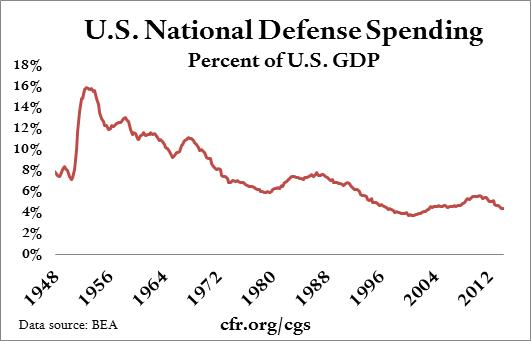
Defense spending has been going down as a percentage of GDP; the strength of the U.S. military is also the primary thing backing the US dollar, so I would be very careful stating "what does that do for me". There are forces at play which are not too visible at the individual level, but you are definitely affected by them just like everyone else.
This is why I used the word sometimes. Obviously the whole military industrial complex is the worst example.
As for the philosophical argument that they take my money by force, I just don't get it. This is the best way we have found to have a civilized society so far. Going far in either direction communism or anarchy is not a good solution. You have to also consider reality when arguing policy.
>As for the philosophical argument that they take my money by force, I just don't get it.
"No taxation without representation" was one of the core driving motivations behind the American revolution. The problem is that I, and I suspect a growing number of others, have completely and totally lost faith in my government to represent my interests while taxing me. The "men with guns" line is just to reinforce that I have no choice in the matter, they are free to do whatever they want with zero accountability and I have to pay them or they send me to jail.
Yeah I get it, I mean I live in DC. I don't even have voting representation. But I still think our current system is pretty good. We just need to make it more efficient, transparent, and accountable.
"Medoicrity" is countries around the world losing hundreds of billions of dollars per year in tax evasion and capital flight. A "cartel" in this case, meaning a (democratic) agreement between major economic blocs to put a floor on corporate tax, and sanction those who violate this, is precisely what you need.
It isn't "countries around the world" that lose taxes and capital. It's a small number of very rich countries, mostly in the West, and primarily the US. This is simply a way for the US to retain economic power (and all the other powers that come from it) while cutting off competitive paths for other countries to compete and get rich. The reason this feels like a cartel is because the proposed policies amount to a joint collusive policy meant to reduce competition.
Exactly. These countries put forth policy they cannot afford and are out-competed via taxation. Allowing them to express force on smaller countries in an effort to reduce their profits seems mind blowingly aggressive.
I guess its the kind of dumb policy we have to put up with until someone points out that those affected by this are likely 'minorities" in western societies and is therefore racist/bigoted. Its the only way to argue nowadays.
It's similar to the clean energy debate. Rich countries telling developing countries that they cannot get rich the same way they did. It's more about securing their positions from competitors than actually helping the poor or whatever.
Also, every country that agrees to this minimum tax loses a bit of sovereignty, because if a member state needs to for example lower their rate to 14% or 10% in the future for a very good reason, they can't.
It’s interesting to see a multinational standard to set a “standard” for taxation.
Seems odd to start with corporate income taxes as it seems pretty efficient to not tax corporations and encourage more distribution to individuals and tax there.
I remember in my microeconomics101 course how taxes on corporate profit are easy to squish around with tax deductible benefits that reduce profit (eg, country club dues are an expense, corporate jets are an expense, 5000 square foot offices are an expense). Since it’s hard to police these expenses, it’s more efficient to just push all profits to salary and dividends to individuals and tax there since there are so many fewer individual exemptions.
The issue is not all owners live within a country. So, in practice it’s significantly less efficient to tax people than companies even if in theory it’s beneficial.
Also, increasing employ income tax rates incentives the company to provide tax deductible benefits and lower salary. The actual solution is to make employee benefits non tax deductible. For example personal use of a Company Car by an employee is taxable to the employee as a non-cash fringe benefit, which is why company provided cars have become uncommon.
On the other hand, pushing too much the tax burden to one payer (corporation, shareholder, employee, consumer) creates strong incentives for tax optimization for that payer. If tax burden is spread over many different taxes will decrease profitability of dodging each individual tax.
I tried to call out the other way is to push the income to individuals so corporate profits are always near zero.
So to apply energy on taxing individuals rather than corps. For corps income is so fluid, I think we get more revenue with tariffs, usage taxes, property tax, VAT, sales, etc.
Profit isn’t as important to corporations as it is to individuals.
Corporate income taxes don’t matter with this as corporate income gets deferred even longer than individuals.
So I think it’s neutral for wealth inequality, since an individual getting $1B in income or a corporation getting $1B in income to a single individual is the same. Or deferring income with trusts, credits, etc.
I think for wealth inequality, the goal is to have more individuals with greater wealth, so this doesn’t seem to affect the number of people impacted.
Punitive taxes and regulation is what heightens wealth inequality.
In any case I find that any appeals to decrease wealth inequality is ultimately no more than greedy appeals to take from the responsible and give to the irresponsible, so I've long since stopped seeing that as a legitimate argument.
The backlash of foreign countries taxing both their companies and US investors would also make such a change a net loss for American citizens. By far the best option is to just raise taxes on US companies and thus lower taxes on American citizens.
How would taxing individuals make the use of expensing 5000 square foot offices, country club dues and private jet travel less attractive for executives? They would just pile up the deductible expenses and take less taxable compensation.
Lower corporate tax rates make it more likely to distribute profit to employees (bonuses) and shareholders (dividends, stock repurchase).
My reasoning is that people prefer direct compensation over perks, and shareholders can’t get perks.
With a high tax rate, there’s more of a benefit to pay deductible benefits rather than bonuses. With lower tax rate, the incentive goes away so corps can just pay directly.
The goal is to get max tax revenue, so whatever equilibrium results in the highest government revenue is preferred. So the comparison should be what brings in the most revenue.
Countries should get taxes back from a corporation at a ratio equivalent to their contributions of a corporations success/profits.
US has a good legal system, fairly educated population, market, etc. Most of these corps would not have made it in a country like Russia, or they would've been taken over in China etc. They need to pay their fair share back into the system that allowed them to thrive.
You will never close all the loopholes. It is impossible and the real people in power don't want it. High taxes, like in most of current society, will always mostly keep the poor poor and eliminate the middle class; politicians just dress it up as redistributing money from the rich.
The rich are extremely mobile, already have wealth and assets that will keep appreciating.
The poor and middle class would need to disproportionately gain wealth if they were to rise to the same position in the power hierarchy, and they are not mobile. High taxes are like fixing positions in place, like a moat to make it difficult for others to rise, since it isn't going to retroactively take money.
Historical data further shows that taxes keep rising but so does inequality.
It's blatantly obvious that you cant control the laws of every country when the game theory makes it obvious that lower taxes makes you more competitive at attracting wealthy people.
>Historical data further shows that taxes keep rising but so does inequality.
I don't know if you're aware of this, but taxes in the west are significantly lower than they were in the 50s, 60s and 70s. The top marginal income tax rate in the 60s was 90% in the UK and 91% in the US. Currently it is 45% in the UK and 37% in the US. Corp tax is currently 18% in the UK and 21% in the US. In the 60s it was 45% in the UK and between 11% and 55% in the US.
I thought I remembered at some point (might have been more than a decade ago) that I heard that most economist thought that corporate income taxes were basically a bad idea? Is this no longer held as a valid belief?
Long term, I would almost prefer if we just moved to taxing people's assets. Maybe we can force corporations to basically pay out most of their profits to shareholders to avoid having them get too large?
> Tuesday's show presented the common-sense, no-nonsense Planet Money economic plan — backed by economists of all stripes, but probably toxic to any candidate that might endorse it.
> Three: Eliminate the corporate income tax. Completely. If companies reinvest the money into their businesses, that's good. Don't tax companies in an effort to tax rich people.
Most economists think infinite growth in a finite world is a good idea. Companies reinvesting in themselves and growing bigger is not inherently a good thing.
Large corporations, in my opinion, are already causing the breakdown of local societies. Deals are done over large areas, less and less people are in control of their own fates. More and more externalities are caused as business leaders are more detached from the realities of their actions. Wages for workers are lower as more needs to be paid to management, and profits get used for stock-buybacks rather than bonuses and higher wages, to please shareholders rather than workers
Also the npr show has: “4. Eliminate all income and payroll taxes. All of them. For everyone. Instead, impose a consumption tax.”
That implies a GST/VAT/sales tax rate of ~35% in my country, changing from progressive to regressive tax. Enforcing it would require both the abolition of cash, and to somehow police the barter economy.
You can make VAT progressive again, e.g. by issuing flat or income-based refunds. Also, I don't see how enforcing VAT requires abolishion of cash, considering that most of Europe has 20%+ VAT rates on top of large income tax, and cash is, if anything, more popular in most European countries than it is in the US.
Worth adding that the liberal economists who favor eliminating the corporate tax in theory tie that policy change to radical increases in income taxes for high-earners; that is to say, it's not the case that all economists support eliminating the corporate tax as an independent intervention.
Not wanting to eliminate the corporate tax as an independent intervention is entirely different from imposing a global minimum corporate tax, which immediately precludes sovereign states from even attempting to do what you (correctly) point out that liberal economists favor.
taxing people's assets is complicated as hell. How much is your house worth. And before you answer that question, have you been in a bubbly market? Quotes for houses in the place I've been have gone up by 10% in the last 4 months.
Now, suppose you have bought a house and suddenly all of your neighbors are rich. An appraiser comes to your place and suddenly you owe taxes and you basically get evicted from your home under a net-worth-taxation regime. 100% guarantee in your "ideal" situation, the rules will be abused to fuck over those with less clout.
Taxing people's assets are complicated. But not because of houses. There are large portions of the U.S. where people are taxed based on their house value. Like in Houston where I pay ~3% of the value of my house every year in taxes.
The real tricky part is small businesses. If I run a small software consulting business or own a bar how much is that worth? Is that the value of the software consulting business with me or without me?
Housing evaluations are very straight forward -- the market is what decides the price. Unless your house is something exotic like a castle or something. Every year the city or region you live in has a process to evaluate this value, and then asks you to pay a tax based on this. Generally if you feel the taxation is unfair, you can just sell the house -- if it doubled in value from the year before, according to the market, you'll probably be happy to pocket that profit. Otherwise property taxes are just how it goes when you're a house owner. Also you normally have a year to pay the tax, so there is lots of time to make a decision.
> Generally if you feel the taxation is unfair, you can just sell the house
let's just be clear about what you're saying. It's okay to effectively force people off of their homes that they have built an emotional attachment to. Perhaps their family has lived there for a few generations. They should just take the money and shut up.
We've had a solution for over 1400 years now. Look up Islam's Zakat laws. Much more affordable at only 2.5% on money above a certain amount that is sitting in the bank doing nothing. Things like produce and livestock have different measures depending on certain things. If you look up history, when everyone paid their Zakat in Iraq during the Ummayad empire, there were no more needy people left to accept it.
that's a very naive attitude. the financial regulators were competing before the 2008 crash. what were they competing for? who could give the most lenient ratings.
what are nations competing for? who can afford to take the least tax revenue
who can afford to take the least tax revenue? already rich countries, or countries that don't give a shit about distributing wealth equally
who continues to get richer? I'll let you answer that one
What do you mean? Credit rating agencies are not regulators. Plus, pretty strict regulations around credit ratings and their essential role in portfolio composition were already in place at the time. In fact you could arguably say that they were actually one of the reasons behind the severity of the crisis.
And even if we put aside that very glaring error aside, if your comment was true Scandinavia or some parts of Europe would've a lot more multinationals than the US, since their corporate tax rates are already lower than in the US. You can also take for example, Spain which has had a ~similar tax rate than the US before 2017, why don't they have a bigger economy per capita if it was that easy and countries were competing to lower taxes?
Corporations aren't individuals btw, and taxing the dividends or capital gains is much more efficient. Eventually, any money you don't tax from a corporation usually flows back to the investors in one way or another. So even if you want higher taxes, corporate taxation is usually just something that "sounds good" or is knee jerk reaction to "stick it" to the big corps rather than to actually get more tax revenue.
That's very debatable, semantics and either way irrelevant. The point is that they were competing, and it was an extreme negative for everyone except the already rich.
The second paragraph essentially just illustrates your lack of knowledge on the topic. Ireland and the Netherlands have an overabundance of multinational corporations. Why? Because Ireland has a crazily low corp tax, and Nl lets large corporations negotiate their corp tax rate when they come into the country.
You're right, corporations are not individuals. They're big scary groups of people with no regard for your health or safety or welfare, who are trained and indoctrinated into a set of goals and beliefs that don't benefit anyone beyond themselves and a group of shareholders. They're cults. They're borderline religions. They should be reined the fuck in, and corp tax is a very good way of doing that
Why would smaller countries who are looking for a competitive edge to attract business ever agree to this? It seems like this is really just in the interest of the US and other big incumbents that rely on large tax revenue already. But even within that group, enforcing such a minimum really has the effect of cementing the incumbents' hold on economic power. So why would any nations other than the US agree to this, when others stand to benefit by gaining economically at the cost of the US? Personally I also find the notion of a global order that prevents flight (of companies, capital, etc.) to be a bit dystopian. I don't want any power (a nation, or a coalition of nations) to have that kind of influence or authority, and this proposal doesn't give me good vibes.
Read the proposal: it doesn't matter whether small countries agree to it. The idea is that if any country levies less tax than the global minimum, the IRS will automatically charge the difference. i.e. if the global minimum is 15% and a company based in Luxembourg is paying only 5%, the IRS will levy an additional tax burden to bring it up to the minimum. No coordination or cooperation is required.
The US can tax US corporations anyway it sees fit.
What do other countries have to do with it?
Read the subtitle:
>The Biden administration wants other countries to back a minimum tax as part of its plan to raise the U.S. corporate tax rate to 28 percent from 21 percent.
This makes no sense. Is the IRS a global institution now?
The US can tax the US company. The US will have a hard time taxing the Luxembourg subsidiary of the US company especially if the parent owns less than 100% of the subsidiary.
> This makes no sense. Is the IRS a global institution now?
It makes perfect sense if you take them as separate concepts.
1. Joe Biden wants other countries to work with the US and set a tax floor for corporate taxation.
2. The US Congress can pass a law that brings corporate foreign taxation in line with how real people (not just fictional ones) are taxed on foreign profits. This doesn't make the IRS any more global than they have been for 100 years.
will there be any penalties for countries that do not agree to this? Say if a country wants to set a lower tax rate than this 15% global minimum in order to attract businesses. Or this country could offer lower taxes in general because they don't want to collect that much tax. After all, how much tax to collect is a structural and public spending issue, and a ideological issue. It is specific to a country, and taxation policies and methods are supposed be the sovereignty of a specific country. I also assume this 15% tax is a tax on company profits. But some countries may want to have lower income tax, but a higher value added tax.
But in the future, when this is established, US and other participants in this scheme might view countries offering significant lower tax as anti-competitive, disruption of the market, disruption of established "international order". Using these talking points, the next logical step is to enact penalties. For example, levy extra taxes on that country businesses' operations and transactions in the judications of all of the participants. Would this be a valid concern?
I wouldn't call it a concern, at least not for me. It's certainly a valid prediction based on historical priors. The US has the scale to make that type of decision for the rest of the world.
Without justifying whether or not this is a good thing to do, large countries have a lot of economic levers to use with smaller countries. (Tariffs, limiting foreign direct investment, etc)
Tax complexity is a function of rates. The higher rates go the more value any particular additional complexity has. Maybe this is a good idea and maybe it's not but to the extent rates are high it's going to be a disappointment as a way to increase revenue.
This article is very sparse on the actual technical details. How would the tax be distributed? What happens if one or a few countries get disillusioned and just stops participating? Isn't that somewhat the plot of the Star Wars prequels?
Is this similar to how the EU has minimum tax rates on businesses? Without recalling too many details, I recall Apple and Ireland being sued by the EU government for a sweetheart tax deal they put in place.
That was because Ireland only made this deal available to Apple, not because of low tax rates. In Estonia companies don't pay CIT unless they pay out dividends, for example.
Ireland also made the deal available to other companies (on a case by case basis.) But it was definitely a too low a tax rate/tax avoidance issue, not an Apple specific issue.
This would establish a standard for global minimum taxes, an instrument of power. The history of such instruments of power being repealed without dramatic catastrophe (warfare) is near zero. The failure of such standards to fulfill their intended purpose is high.
Who exactly is ceding what to who here? Extremely naive people seem to think this is a “let’s hold hands and jump into the pool together” idea, as though they’re holding hands with everyone from Gates, Buffett, to bin Salman, Putin and Xi, and that’s going to work.
How much could you possibly need to live a good life? Certainly not more than, say, $50 per day, right? Let’s simply cap ourselves there.
I say this to demonstrate that “ungodly” always means “more than me,” irrespective of all else. Justification through jealousy. A recipe for a lowest-common denominator society, at global scale.
>How much could you possibly need to live a good life? Certainly not more than, say, $50 per day, right? Let’s simply cap ourselves there
You say that as if it's ridiculous. That sounds fine to me. Warren Buffet espouses exactly the same thing I'm saying. Is that jealousy too?
Ungodly means more than you need. No one needs a billion dollars. The top marginal tax rate was 90% in the 1960s, and guess what? inequality was much lower
To answer your question, this wouldn't create a new organization to collect a global tax. Instead it would give the IRS the authority to tax American companies (say, Google) an additional amount on their overseas earnings. So, if they paid 13% in Irish tax, but the American tax rate is %21, the IRS could charge them the gap (an additional 8%). This would be true in all countries that sign the agreement.
Obviously tax havens would still exist, but they'd be harder for big multinationals (like American tech giants) to abuse.
I think the point is that to do this, tax agencies around the world would have to cooperate with American tax agencies, which just creates another level of overseeing that has never happened before. It is another instance of Americans trying to force their wishes on the rest of the world.
Wouldn't a public company report how much tax it pays in different countries? Why would Ireland's tax authority have to cooperate with the IRS for this to work?
We have these things called "tax treaties" that have existed for decades.
Tax agencies around the world already cooperate with American tax agencies on matters similar to this. In fact, the proposal would actually reduce the amount of inter-agency cooperation required as it would great reduce the amount of treaty-related work the tax agencies have to carry out.
Because if the US did this by itself, all of our crown jewel companies might leave. So the agreement is an attempt to prevent that from happening.
It could still happen. Maybe Amazon would move to the Bahamas, or any other country that doesn't sign the agreement. But the hope is that if most industrialized countries sign on, then that risk would be minimized.
Leave where? Ireland? Amazon might choose to leave Ireland and go to the Bahamas, and that sucks for Ireland, but Amazon's situation doesn't really change. The US can still send a tax bill to Amazon's door.
what defines a US company? A company registered in the US, a company headquartered in US, a company with subsidiaries in the US, a company doing transactions into US jurisdiction?
> Does humanity really want an authority powerful enough to claim dominion over the entire planet?
I believe the word you're looking for there is /did/ not /does/. And the answer is for some, yes, for some, no, but regardless -- it happened for a variety of structural reasons (British Empire, Mongol Empire, etc).
Perhaps a more interesting question is whether such a dominion will work for the future. And for that, I'm not so sure. What's to say that we won't see some kind of three body system between India, China and the West? Not to mention what could happen as South America and Africa continue to ascend. I think the logistics of collecting a 15% global tax will be "interesting" to watch play out.
My two cent is that it’s just inevitable (and personally welcomed). Throughout the history, from tribes to today we have merged in bigger and bigger entities.
And pretending that we can live without a global authority, when supply chains are global, food market are global, most of what happens in politics has global effect is total nonsense IMO. We pretend we live in separate societies with entirely different rules when we are already operating like a single, global organism.
The fact is that all abrahamists follow some version of a silly book in which some sky daddy told a man in a desert that they are the choosen people and that by following that specific man, they have the right to dominion over the earth.
These philosophies also all lay out rules for how and when they may tax, kill and enslave those of the other religion.
So yes, at least 50% of the earth’s population are OK with one group dominating the tax laws of the planet, as long as it is their group.
Well said. Each amount of money will find a "good" reason to be spent, so less money collected means less money wasted (or spent on weapons and armies).
In ideal world that might work, but in reality, the countries that can afford to set low corp taxes do it, and the countries that can't don't. As usual, the rich get richer, and corporations get bigger
The problem already exists in states though. There is a disproportionate number of companies headquartered in Delaware[0]. That's not really fair when most of the actual business is done in other states but Delaware is currently leading the tax rate race to the bottom within the US 50 states.
I love the "have the IRS take the difference", as if the IRS is some corporation that's just gonna stick it in their bank account or pay it to their shareholders
Thank God the US is taking charge of the GLOBAL finances. What could go wrong!?
This is ladder pulling. Who needs smaller countries competing on fiscal rates when all tech should be registered in Dellaware?
Note how it's a small 15% to start with. If this goes through and all the treaties are in place moving it to 25% should be much easier.
Maybe the US should investigate all the creative ways US corporations pay so little tax anywhere. It's a problem caused by US and US corporation and now they come to provide a solution.
Precisely. But instead of solving this problem inside US they want to re-engineer the whole globe.
Most countries are mad about multinationals, most of them rich US multinationals. If the US would do a proper job of taxing their own corporations none of this would be necessary.
Interesting how this is just in time for the Dutch sandwich scheme to expire. Clearly something else was missing!
Yes, the US knows the exact amount their corporations are NOT paying taxes on. Just apply a tax and be done. Instead, they want to define what other countries will do, in order to fix the US tax leaks. I see this more as another attempt to control other countries than a real tax proposal.
Why not just cut the corporate rate to 0 and raise the necessary funds through a VAT? No amount of fancy accounting tricks will eliminate companies' dependence on the US consumer market.
What's stopping the federal government from implementing a VAT? I realize there's a ton of legal and political inertia, but theoretically it seems like it would be an improvement.
In an ideal system everyone would charge a VAT rather than a corporate tax, resulting in a level playing field for foreign profits as well.
It is very simple: just make corporate profits for US corporations (or more sensibly, the difference in taxes) taxable on the US, wherever it is made. This is already the rule for individuals.
Could you walk us through your proposed solution? Like what the United States could be doing that would be a proper job of taxing its own corporations?
Set guaranteed tax rates that make keeping money in the US attractive instead of trying to punish those who find the business practices of other sovereign nations offering better treatment.
What does a proper job of taxing US corporations look like?
Currently, US corporations have a minimum tax of 10% on global income or 20% on US income; sounds like the numbers are proposed to change to 15% and 28% (or something; NYT paywall is loading too fast today, and it's a proposed law so the details aren't set and not worth fighting over); and the US is saying hey, these guys are going to pay 15% on income from your country, you may as well have them pay it to you instead.
The AMT on global income was part of the Trump tax changes, and is a departure from the full corporate rate on global income, but only due when/if money made it back to the US.
I imagine a next step would be charging multinationals headquartered elsewhere but operating in the US the AMT on their global income. That's kind of far reaching though, so if they can get a few major countries on board instead, that's better.
It is overly simplistic to think of a global company, such as Oracle, or Coca Cola, as a single monolithic US corporation. They have literally hundreds of subsidiary companies all over the world, manufacturing and selling into different markets.
They're fumbling around trying to find any way to get out of the messes they keep creating. Yet, no one dares to talk about the true underlying causes.
A large percentage of U.S. corporate ownership is held by foreign taxpayers that would not be subject to U.S. taxation on dividends or capital gains absent a fairly large and radical change in tax law, including breaking more than a hundred tax treaties.
It's much easier to simply impose an AMT and eliminate a relative handful of expense shifting mechanisms (many of which are already covered by a regime known as "transfer pricing").
They would be liable for tax on dividends in their own country, just as US investors in non US companies would be liable for tax at home. No radical change needed (besides abolishing corporation tax).
That's not universally true, because many countries don't tax foreign-sourced income of their citizens, (meaning in this context, dividends paid by a corporation not incorporated in the taxpayer's country of tax residence).
That doesn't require "radical change in tax law, including breaking more than a hundred tax treaties." to fix though. Those countries can deal with it as they see fit.
This sounds like a good idea for the current, somewhat dystopian world we're living in, but have you ever thought about whether huge corporations are even a net positive in the first place?
I think that even if taxing corporations doesn't make sense in terms of tax revenue, it makes sense in terms of stopping companies from growing too large
Imo corp tax should be nil until you get to about 1m profit, and then brutally progressive after that. Small businesses are great, and companies that benefit the consumer by being large can be public-owned and both compete internally and internationally.
You have the opposite of that at the moment. Big companies can shift their profits around the world to avoid corporation tax but small ones have no choice but to pay it.


No one, including tax lawyers, will tell you with a straight face that this is the way things were expected/designed to work. All of these tax avoidance strategies are emergent properties of complex systems that are the result of uncoordinated action amongst individual actors that cannot be fixed without collective organization. I support this and 15% seems reasonable to me.