If you're interested in this sort of thing, there's actually an internet forum of geeks who are quite dedicated to collecting and reviewing the ranges of many, many singers:
Even Yma Sumac, who is often cited when it comes to the widest vocal range, was just barely short of 6 octaves.
Since I've just looked this up: Tim Storms (
https://en.wikipedia.org/wiki/Tim_Storms), the current world record holder when it comes to vocal range, has one of 10 octaves (with the lower end extending into infrasound, i.e. being inaudible to the human ear)!
Mike Patton from Faith No More/Mr. Bungle/Tomahawk supposedly has a range of 6.5 octaves, but some people say it doesn't count because it includes screaming. He does a lot of weird stuff but he's one of my favorite vocalists. Regardless of whether or not his range is 6.5 octaves it is definitely extraordinarily wide.
Tim Storms is an interesting case, I've heard of him before but honestly before I heard his music I would have thought it would be impossible to have the widest vocal range in human history and at the same time make music sound so boring and lifeless.
I'm not into Christian music at all but even still Amazing Grace is a legendary song. However, Tim's rendition of it makes me want to fall asleep.
The deepness of his voice is interesting, but out of all the clips of him singing I haven't heard anything that made me feel like he was a world class talent.
Which is quite different from everyone else mentioned in this thread. I don't particularly like the work of many of the musicians mentioned here but their performances are often astonishingly good.
Nothing IMO, just mentioned that some people have challenged the idea that his vocal range is 6.5 octaves because of it. I didn't say I agree with them.
No Kate Bush? I suppose everyone will have their own favourite omission, though.
I'm surprised that Karen Carpenter is not much different to Taylor Swift. The former sounds a lot deeper, but I guess the difference is in timbre rather than pitch.
I had no idea about the range of Axl Rose. But male singers always have an advantage in that they can hit very low notes and also have access to falsetto. Mariah Carey is also exceptional due to access to the whistle register. Christina Aguilera is one of the more impressive singers on the list for me.
Does "vocal range" necessarily mean the singers can hit every note (or every possible pitch) between those notes? I know from singing myself that the notes in the "overlap" portion between different vocal registers can be difficult. Also some vowels are harder to hit at certain notes than others. This can make some songs problematic even if they are technically within your range.
I'm highly skeptical of the lower ranges. Typically, a professional bass has a range down to around C2, and can hit a loud E2. There are some exceptionally low voices, especially in Russian choirs[1] that routinely hit B1s, maybe even a little lower.
To say that Axl Rose can hit an F1, is simply a mis-characterization of what vocal range is. "There was a time" simply doesn't contain any vocals in that range. Barry White did have an exceptionally low voice, but F#1 is similarly unbelievable.
David Bowie growls out an atonal "Well..." in "I took a trip on a Gemini spacecraft". How anybody assigned that a note value is beyond me.
The women have similar problems. Nine Simone hits an E2? That's an octave below where contra-altos normally operate.
It seems "range" in this article means that the singer once produced a noise that had a vague resemblance to a sung note that was interpreted by some article writer. As opposed to say, something that could actually be written down on sheet music and sung. Which is a shame because this list does include some with exceptional ranges.
As an amateur singer, I feel deeply disappointed by the fact that Chris Cornell isn't on this list. The range this guy had was unbelievable, even in his later years. I personally find it easier to sing Guns and Roses songs than to sing Audioslave or Cornell's solo songs. Such a beast of a singer and composer.
It would be nice if the register(s) used by the artist for different parts of the range were shown in the diagram.
For example it is much easier to sing in head register in the higher ranges than in chest register. And as another example, Mariah Carey's famous high notes are sung in flute register.
I guess we could ask, what is the metric of greatness for art? Quality of work? Popularity? Is the artist who does something perfectly exquisite that profoundly impacts anyone who sees it, but ends up only being seen by a small handful of people more or less great than the artist who's work is ok quality, and a bit inspiring, but is known to billions?
Interesting list, surprised to see Doug Pinnick on there. I'm mainly familiar with his bluesy style with Kings-X in the early 90s and would not have suspected he had that kind of range.
Honestly, you could make an entire list of greatest singers just by looking at whoever worked with Ayreon. That project introduced me to SO many great singers and bands.
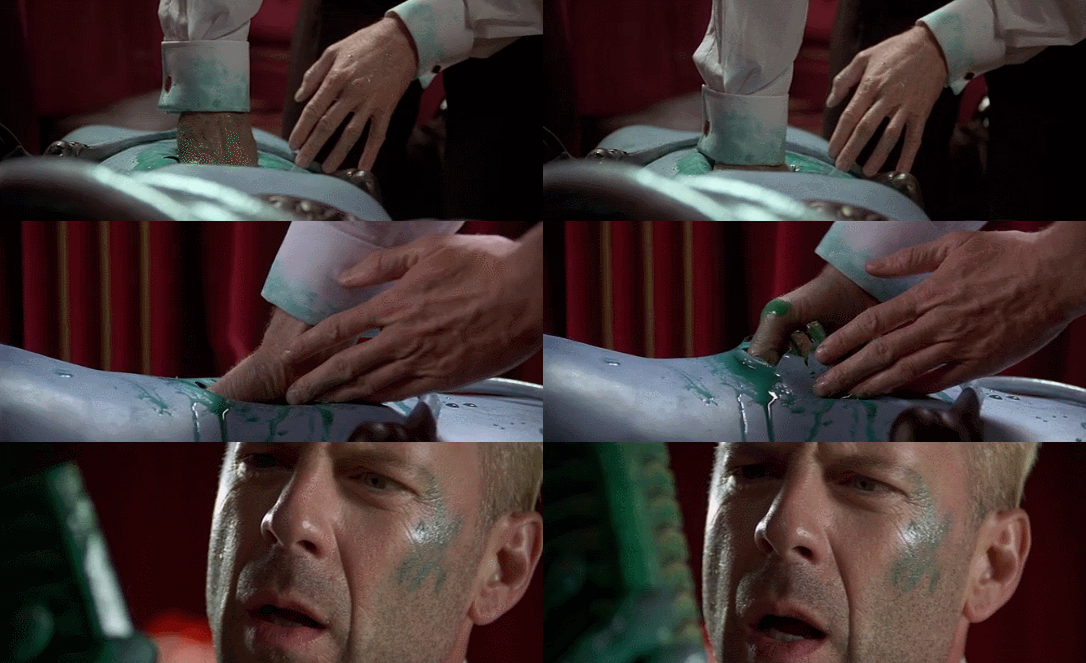
I'm generally OK with the scene, but I know what you mean. For me it's the scene after, when Korben takes the stones out of the Diva, and the illusion breaks down: https://i.gifer.com/1ObZ.gif I consider that one the very rare imperfect shots in an otherwise perfectly crafted movie (I don't even remember off the top of my head which are the others).
Yes, Mike Patton has even a larger range than Axl Rose. He is also much more innovative and experimental, trying a variety of vocal techniques and song styles, which is quite exciting.
This would be super cool if you could play audio of the artist, or just some representation to give an idea of what this means in real life.
I've got no idea what keys play what sound, and even less idea what a "range" is. It would be cool to hear something that would help me understand this.
It's sad that they don't even thought about when in the timeline the vocal note was sang and recorded. The majority of singers shift their vocal range as they age. This is especially true for male singers that usually tend to shift down their pitch.
Damn, now I have to listen to that again. You're a real tough cookie.
Now, I'm missing Ann Wilson here. I've had friends decide they want to try singing Heart songs at karaoke, and I have to warn them: danger! You do not have that much range.
And honestly, Luciano Pavarotti? Frank Sinatra? Frank wasn't known for his range, but kinda strange to leave him of a list of "greatest singers".
There's a song by the french artist Camille called Money Note which is a sortof satire on the competition to achieve vocal range. The lyrics are pretty funny. At the end she hits a C8, although its kindof as a shriek.
I think this is only US pop&rock industry, I'm sure there's singers out there better than this. They are awesome, but I don't buy "World gratests...blah". They forgot Ynwie Malmsteem singers, the guy from "Leonardo" song. Sebastian Bach from Skid Row is there? Well...
It’sa sad day when shallow content like this reaches the HN front-page. Calling a narrow subset of U.S.American/UK artists as “greatest artists of all time” is a big joke on the art of singing.
Others are complaining about missing Nusrat Khan, or Dimash but heck, they didn’t even include Western greats like Pavarotti!
Not to mention there is little accuracy in these ranges. They don't tell you the tonal quality of these high and low notes, which may occur properly in only a single song which the singer can't even replicate live. The idea that Axl Rose can legitimately hit that full range with good technique is laughable.
Agreed. There's also the issue of falsetto versus natural range. It's funny to see Thom Yorke right next to Freddie Mercury with similar ranges, because Thom Yorke uses falsetto all the time, whereas Freddie Mercury typically didn't. It would not surprise me if Mercury's range was far larger on the high end than Yorke's.
To be clear, that's not a criticism of Yorke--there's a lot more to vocal talent than range, and I'm actually a huge Radiohead fan.
Ooor instead of being angry about the page and calling it a sad day, you could be happy about the interesting discussion it generated? Lots of new stuff here I've never heard about that was cool to check out.
Ooor instead of responding only to people's emotions and trying to control them, you could respond to the content of their post and admit they have a point. We all have choices.
Saccharine positivity is ruining HN. In the past few days I've seen HN posts that:
1. Said a company's behavior only looks immoral, but it's actually not their fault, because they're just following incentives.
2. Said volunteerism isn't needed right now because lots of people are out of work.
3. Complained about a long-form article not containing science, because they only read the first few paragraphs of the article.
The first is a reprehensible position, the second is harmfully ignorant, and the third is willfully ignorant. But all they had to do to get upvotes is say these horrible things in a nice tone. Responses which called a spade a spade got downvoted and/or deleted entirely.
This isn't even "being kind". It's not kind to screw people over because you're following incentives. It's not kind to encourage people not to volunteer during a time when the need for volunteerism is at a high. HN is optimizing for a shallow veneer of being kind over actual kindness.
I've considered just leaving HN in the past few weeks, but decided to stick around and try to change things. But at this point, getting downvoted or even banned doesn't feel like much of a loss to me. That's not to say you should care if I leave--you should care that your forum is becoming a place where people pat each other on the back for innovating, whether or not they actually innovate or their "innovations" are uninformed or harmful.
And sure, this did generate some interesting conversation, but the most interesting thing to me is The Range Planet[1] link, which could have been the original submission.
I've made the claim before, in different words, but to be honest I think the post you're responding to is the clearest summary I've personally written. My thoughts on the subject are a work in progress, and I'm not aware of anyone else saying this. I'd be happy to hear if others think the same thing.
The target audience for my post seems pretty sure what it has to do with your post. I'll be happy to clarify if you're actually asking for clarification, but it seems like you're making a statement rather than asking a question.
I’m not angry, I’m just sad at the lack of depth here. A list that calls it self “greatest of all time”, and excludes most of the musical art from the world is not front page worthy. Also it’s pretty callous to assume that everyone in the world listens to US American pop music. I wonder if you would “check out” the cool stuff with a list containing Nusrat, Bhimsen Joshi, Miriam Makeba, Camané etc.
I don't know much about the subject, but take Mariah Carey (not trying to pick on the girls, honest), but she can make a really high pitch sound, so does that count? Or does she have to be able to actually _sing_ at that note for it to count?
I find singing to be boring. You are either born with the talent or not. It’s nearly impossible to practice your ass off to go from tone deaf to the voice of an angel. On the other hand, you could pick up a guitar be tone deaf, practice your ass off, and eventually be a virtuoso. That’s much more impressive than being born with an ability to sing.
Good luck if yoy think that anyone can become a virtuoso on the guitar. I believe you do not really understand what this expression means. And on the singing thing, it's just like playing an instrument, you are born with a baseline hardware (your pipes) and software (your ears). It's a little bit more limited, in terms of how much you can improve from this starting point, than with an instrument, but you can for sure get better through practice.


https://therangeplanet.proboards.com
Here's the Dimash Kudaibergen page, for example:
https://therangeplanet.proboards.com/thread/30/dimash-kudaib...