I've had my iPhone X replaced once after the screen went mental - a bright green line randomly appeared on one side of the screen - now the replacement drops > 50% of all calls :-(
On the MacBook Pro front I've had the sticking keys issue on the left command, C, B, G and 3 keys - so took it in finally after being tortured by this for months - 1 week later and I called them to see what was going on and they said that the whole top piece needed to be replaced, but when taking out the motherboard they have snapped the thing in two.
Making these machines difficult to repair doesn't just effect end users it seems.
Still, I'm glad that Apple are still the sort of company that replace the whole machine in these situations. I'm sure there are bean counters who will be thinking making it harder to get things fixed is the solution though.
Actually it doesn't need to be totally reliable. It just needs to fail at a rate which ensures the cost to apple to replace + refurb is less than the repair + the cost of building a 'repairable' device.
The market demands thinner laptops with amazing battery life. The market - in general - isn't demanding a more serviceable macbook.
> The market demands thinner laptops with amazing battery life. The market - in general - isn't demanding a more serviceable macbook.
It doesn't. This is false. Noone cares about thin laptops. People want light laptops but thin is completely artifical and doesn't improve your experience.
One might say it was Jobs' plan to destroy the laptop industry with it and it worked.
I suspect that when you say "noone," you mean "noone except for all those weird people who bought the first generation of Macbook Air, and then another, and are now ready to buy a third Macbook Air."
Like me. And judging by recent Apple history, I am not an outlier. They have sold a LOT of Macbook Airs, to people who could have bought a "more powerful" machine with a different form factor.
Yes, absolutely I love its light weight. But I also like its profile, and the entire "thin wedge" design principle is to increase the appearance that it is thin.
You're almost right in the way you describe the market, all you have to do is replace "weird people who bought ..." with "people who will buy the next generation of Apple hardware no matter what who bought ...". They might grumble about missing ports, bad keyboards, a buggy operating system and a multitude of dongles which they need to keep around but, and this is the essential part, they still buy the next iteration of the product line as long as it has that party-eaten apple on it. In this sense Apple has achieved something quite remarkable in that they seem to have been able to reverse the common diction of "it is hard to gain trust, easy to lose it" into "it is easy to gain trust, hard to lose it". For that, I applaud them but I also vote with my wallet by not buying their products.
I bought a Macbook Air because I needed a Mac and it was the cheapest one available. To anyone looking at the numbers, though, my purchase looks like another vote for thin laptops.
Thin is not “completely artificial.” I replaced my MBP with an X1 Carbon and am really enjoying how thin it is. I can stick it in the papers pocket in my briefcase, the map pocket in the seats in my car, easily carry it one handed.
I’d love for laptops to keep getting thinner. The X1C is almost thin enough to easily carry around with a stack of papers, but if it were thin as an iPad that’d be even better.
I also love my X1C (6th gen) and how slim it is! I wish though that Lenovo had sort of copied Apple on the charger. I was too spoiled with Apple laptops' charger hooks that come out on which you can wrap the wire around. The rather large X1 charger, with that long velcro wrap, is a bit of an eyesore and not as pleasant to handle and keep in your bagpack or laptop bag.
One of Lenovo's more stupid innovations. IBM thinkpads had a dog bone charger where the cable hooks were made by the ends of the "bone", perfect for fast winding. The velcro went round nicely, once. This poor Ebay image shows what I mean[0]. Those were used upto the last IBM Thinkpads. Not sure when they started.
What did Lenovo do? Made them pointlessly the same shape without a hint of cable management[1]. Along with lots of simple rectangular bricks. Strangely they still seem to keep the fixed cable exiting sideways on nearly all of them - that was for easy cable winding that you can no longer do.
>It doesn't. This is false. Noone cares about thin laptops.
You'd be surprised: "I’m have to admit being a bit baffled by how nobody else seems to have done what Apple did with the Macbook Air – even several years after the first release, the other notebook vendors continue to push those ugly and clunky things. Yes, there are vendors that have tried to emulate it, but usually pretty badly. I don’t think I’m unusual in preferring my laptop to be thin and light" (Linus Torvalds)
I had a 2012 Macbook Air. Used it until 2016 when I spilled coffee on it and frantically replaced it with a 2015 macbook pro within a few days.
A year later I still missed my Air, and figured I could just open it up and try to clean it out with alcohol. Figured although I could take it to someone for them to try to fix it, I could learn something new if I did it myself and if it didn’t work again nbd.
There was sticky coffee on the motherboard and on the case and at the power button, but I took my time to clean it all out, dried it out, and reconnected the battery and it came back to life!!! I was so happy. And when I started using the Air again I noticed how much I preferred the form factor. I immediately made my 2015 rmbp the backup and went back to using the 2012 Air as my main.
They both had similar GHz and the same storage. Ran the same OS. I could write production code just fine on either of them. They ran the same IDE’s and crunched the same numbers. However the Pro did have the better screen. Still I preferred the Air to the Pro because of the form factor.
Every time I let someone borrow my air for a second when we were together they’d complement on how thin and light it was and they liked that. I think Apple figured out a market segment and there’s more of us than you’d think. And unless you’re editing videos for a living the Air is a capable machine.
Yep. My 2012 Air was custom-configured with the i7 processor, 512GB SSD, and 8GB Ram. Odd indeed, but it was a killer combo of ultra-portability and performance. It’s still to this day a very capable machine. Although Apple capped off MacOS upgrades for it at High Sierra.
MacBook Pro had same Ram and storage but with the i5. Difference between the 2012 i7 and 2015 i5 in GHz was negligible as far as I was concerned.
no matter how intelligent, our brains are not designed to handle numbers like 1 million (or even a thousand). our brains our designed for numbers like 7 and 15.
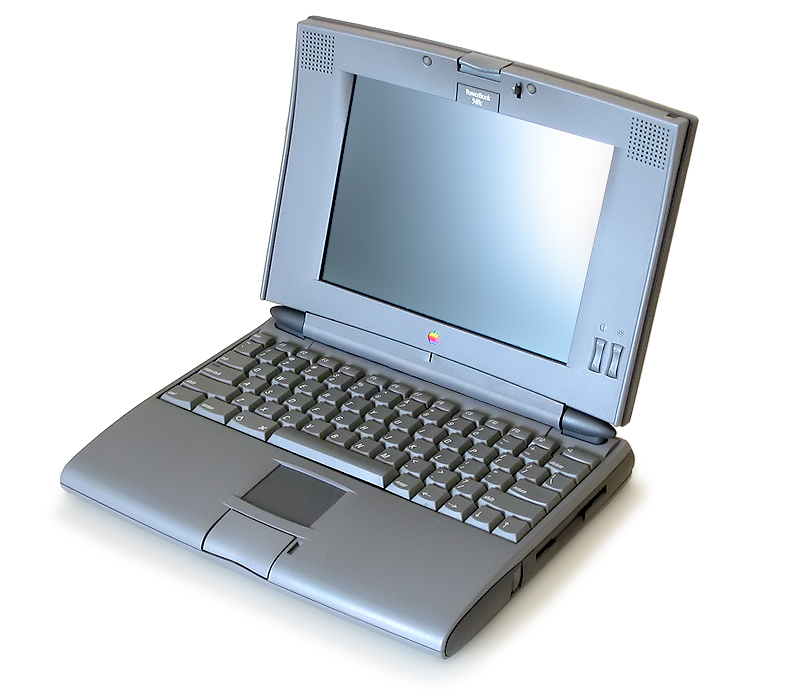
I've owned both of these. They both have good specs for their time. The ThinkPad keyboard was wonderful. The trackpad of the MBP is wonderful but so is its size and shape. The ThinkPad was a brick.
You say no one cares about thin, but once you have seen the MBP, the ThinkPad is a hard sell. (Though you youngsters should try one of those keyboards to see what you missed).
I think this is a bit of a disingenuous comparison. That ThinkPad looks to be around the mid 1990s (maybe early 2000s?). Meanwhile, if you looked at a modern ThinkPad (regardless of your opinion on Lenovo as a company), the keyboard is still category-leading, the weight is almost identical to a MacBook in the same class, and the thickness likewise. Look at, say, the X1 Extreme.
Replaceable RAM and SSD. 4.06 pounds. The MBP 15" is 4.03 pounds.
Now, the keyboard definitely isn't as good as it was (RIP old keyboard, may you rest in peace), but it's definitely still very competitive.
Either way, arguing against "consumers don't really care about having the thinnest brick on the market" by invoking early 90s hardware by comparison is of course a B/S way of arguing things.
I was arguing against "Noone cares about thin laptops." That's a direct quote and different from yours. Not 'thinnest', but 'thin'. Since almost the laptops went thin, someone cared about it.
X1 is 14". It's actually noticeably smaller than a MacBook Pro, other than thickness.
MacBook is actually really bad in the keyboard department when you consider that it's 15" - it has tiny up/down arrows, and no PgUp/PgDown/Home/End. Which is a shame, since these all would easily fit if speakers went elsewhere, and the touchpad was just a wee bit smaller (I mean, seriously, does it really need to be bigger than a 6" smartphone?). For a productivity laptop, these are very weird trade-offs.
Ah, I see, I was thinking about the regular one. Yeah, this one looks like it could have a numpad without reducing the key size, although it would be a very tight fit at the edges.
I don't think anybody truly believes "customers don't care at all" like your example illustrates.
But I think it's fair to say customers don't care about the last 2-3mm of thickness that Apple is sacrificing the ability to repair in order to squeeze out.
I've heard plenty of complaints from ultrabook owners that they find the "knife point edge" design that many of these have unconfortable to handle.
Generally speaking, maxizing a single aspect of a design is rarely a good choice. Making notebooks or smartphones as thin as possible (or pretending to do so, the strategies used here are borderline gaslighting) is not an intrinsic good.
The core of the nobody cares argument is that the utility of shrinking the device is incrementally less and the costs incurred are increasing incrementally more.
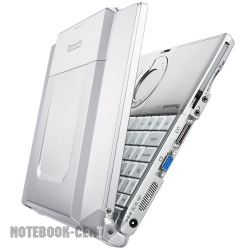
I had a Panasonic CF-Y5 back in the day, a 1.5kg 14" laptop (including a DVD burner!) https://www.notebooks-center.com/img/laptop/regular/laptop_p... and due to that screen protection hump it was some 1.5" thick overall. No need to drag the nineties into this. That sort of laptop, lightweight because of quality materials but enough space for cooling is what laptops should be.
I agree. Laptops should be no thinner than 1.5". I would love a nerd machine that is 2" thick, has no less than ten various ports, has a fat battery that could last more than 24 hours at 'performance' energy settings, most things on replace-able/upgrade-able daughter boards (especially graphics), replace-able CPU on a socket, and four SSD + two optical drives. The replace-able parts following standards like desktop PCs do.
Laptops were the first to succumb to the thin/miniaturization cancer, and phones really took off with it. The best form factor smartphone IMO is still my first cellphone I had: Samsung SCH-i730. It had a screen which slid up revealing a physical keyboard, it had a camera, it had a large extended battery, it even had an extend-able antenna! It was not shy about being thick! I grew up loving tech, and now with faceb0rg + scr00gle spying, crapple + android thin-sh1t hardware, "smart tvs," more and more user-lockout in hardware (intel ME?), I'm finding myself hating it all more and more!
Who is asking for it outside HN and the techy types? Joey Beercan just wants his device to work. Maybe he'll ask his kids to take a look at it first, but after that it's just a trip to the Genius Bar. That's the entire point of paying for the AppleCare in the first place. The large majority of people do not want to deal with fixing things on their own.
> Who is asking for it outside HN and the techy types?
HN and the techy types are a huge market, especially for high end hardware and especially for Apple. I need something I can run macOS on for testing, but I can get the cheapest available Mini (and then not replace it for a decade) and a high end PC laptop to actually use, or I can buy a new high end Macbook.
> Joey Beercan just wants his device to work.
Which is why the first generation or two that can't be upgraded or repaired still sells. Ordinary people haven't figured it out yet. Then some time passes, they go to have it upgraded or repaired and discover it's now slag, so they go to their nearest HN or techy type to ask what to buy instead this time so that doesn't happen again.
There's always going to be that one guy, but here I am ;)
I've been a Mac user since 2006 & own 4 MacBooks, but I just ordered a Lenovo X1 Thinkpad because I'm sure it has to be better quality than the last MacBook Pro I bought. That MBP is a completely unreliable lemon, it's been serviced by the Apple Store 5 times. And when I hear friends complain of broken keyboards, failing SATA cables, and now failing SSDs on their Macs, I just can't trust Apple laptops anymore.
The deciding factor for me was Lenovo's replaceable SSD, which meant I could upgrade it to more storage than a Surface Book 2 (so modularity was important). The fact that the Thinkpad was $1500 cheaper was just icing on the cake, not the deciding factor. I also thought the Thinkpad was likely to be less fragile than a Surface Book 2.
But I do agree the majority of Lenovo's unit sales are probably their awful cheap consumer line that sells in the $400 range, not $3000 Thinkpads.
I bought an X1 less than 2 months ago (after 8 years of MacBooks) for the same reason: it _has_ to be better quality.
I take extremely good care of my laptops, but nonetheless after 3 weeks the screen was scratched, because when it's closed the lid pushes against the keyboard leaving marks (and eventually scratches) on the glossy HDR display. Also the lid doesn't close properly [0] on one side, which just drives me crazy. For a $2000 laptop, I am pretty disappointed.
> But the reason most people choose Lenovo over Apple is not modularity, it’s cheaper price.
Two can play at this game. "But the reason some people choose Apple over Lenovo is not lack of modularity, it's ability to run macOS." It's trying to make the original claim untouchable by discounting diverse evidence with a monolithic justification, even though that doesn't account for everyone, and on net may even make the original claim weaker when all such things are considered.
Also, many of Lenovo's products are the same price as Apple's, and they still sell really well.
What's worse is the fact that they encrypt everything by default so you can't just desolder, dump, and flash the data onto a new board.
They say it improves security, but certainly it's possible to have FDE which can be copied onto a new disk --- you're just doing a bit-exact copy of the ciphertext.
Does the recently revealed hardware encryption problem affect the SSDs used in Macs? I know it's for BitLocker, but maybe you can use the same bug to get your data out.
Apple has recently documented a new data recovery process internally for Macs that utilize its T2 chip introduced with the iMac Pro and the 2018 MacBook Pro. The new process for repair staff is being introduced due to the T2 chip’s advanced security features including hardware encryption for SSD storage that isn’t compatible with Apple’s previous data recovery methods used on older machines.
> Still, I'm glad that Apple are still the sort of company that replace the whole machine in these situations
Huh, in Norway there are multiple cases of them refusing to follow the law when it comes to repairs. Norway has good consumer protection laws, better than the guarantee most companies provide, and Apple is known for not honoring this.
Because one costumer decided he wanted to have his laptop repaired instead of the Apple's usual practice of giving a refurbished device?
That's not what most people want. I would rather have a refurb that is better wear and tear state than my device, and has a new battery, than have my previous device repaired.
I have no affection for pieces of plastic and aluminum.
Apple repairs is weirdly inconsistent. I’ve heard horror stories.
But my own experience has always been good. Myself and a friend have had devices replaced within the warranty period free of charge even though it was clearly our faults.
The problem is when you're outside Apple's warranty, but still inside what the law in EU/Norway gives you. Then they aren't as friendly.
For instance, most electronic devices have 5 years warranty by law here, then it doesn't matter if some company says they give 2 years guarantee. They still have to fix it after 4 years if it breaks.
> On the MacBook Pro [2016] front I've had the sticking keys issue on the left command, C, B, G and 3 keys
I so want to buy the MacBook Air 2018 but am afraid the 3rd generation keys only delay the known problems until I’m out of warranty. I have to wait and see if there is a wave of defects in a year or two to judge its reliability. Why did Apple have to sacrifice reliability for thinness…
How do we know thinness drives sales? If thinner devices, which also are faster with more features etc sell more than the previous edition, the cause is quite difficult to pinpoint, surely?
The fact that devices get thinner and devices are sold in ever more numbers/profitably does not mean the device dimensions are the cause.
It happened while I was using the phone with no impact. Just freaked out in realtime for no reason. At first I thought it was the sun or something casting a green light onto the screen.
Just to provide a counterpoint of data, I’ve been using the X since launch as has my wife, with no display or other issues. I’ve dropped my phone literally 100 times (I’m clumsy and use a case) and it’s still good to go.
"... the screen bends under itself at the bottom edge of the phone before meeting up with necessary chips, in order to reduce the size of the bottom bezel. This 180 degree display bend is very fragile ..."
That's just great - yet again, practicality is sacrificed for the sake of pointless flashy design.
I buy high config apple devices regularly, and they're quite expensive here in India with import duty, rupee depreciation and ppp in mind.
If my products went bad like, I'd be genuinely too disappointed. Luckily I've always had damaged / out of warranty products replaced by apple by being a little persistent.
> On the MacBook Pro front I've had the sticking keys issue on the left command, C, B, G and 3 keys - so took it in finally after being tortured by this for months - 1 week later and I called them to see what was going on and they said that the whole top piece needed to be replaced, but when taking out the motherboard they have snapped the thing in two.
Haha! The display was also behaving strangely so they gave me a completely rebuilt machine. i.e. none of the parts were the originals.
Oh and I should have said originally I'd already dropped something on the screen which shattered and they did charge me the £700+ for repairs at a previous date.
It does make me question how long this machine will last and if I should sell it while it's pristine before anything bad happens to it...
Still, I'm glad that Apple are still the sort of company that replace the whole machine in these situations. I'm sure there are bean counters who will be thinking making it harder to get things fixed is the solution though.
It is possible because customers pay for it. It sure as heck is not coming out of the profit for the shareholders...
I've just had the keyboard recall done on my 2017 mbp after the J key started failing/duplicating when being pressed.
The whole process, although annoying, was painless. The tech gave me the option of them trying to fix it by blowing dust out or just replacing the entire keyboard. I elected for the later given that it's a design fault. The repair took 1 1/2 days which I had done when I was out of town.
Since they glue everything together, getting a new J key also meant a new keyboard, touch bar, finger print reader, speakers, battery and touch pad. Which if there was no recall I can imagine would be a costly exercise. Hopefully after the recent recalls Apple engineers will be looking at making easier to service components.
>Since they glue everything together, getting a new J key also meant a new keyboard, touch bar, finger print reader, speakers, battery and touch pad. Which if there was no recall I can imagine would be a costly exercise.
I think this most illustrates not so much that components should be easier to service in and of themselves but rather that it should be Apple's problem universally, not just for a recall. On a product at this level standard legally required warranty should be more like 4-5 years. Apple (or anyone else) can themselves make the economic call on whether costlier repairs are offset by increased revenue due to feature advantages or other QA boosts, but they shouldn't be able to externalize the cost onto their customers and reap any rewards beyond egregious circumstances. The sticker price should include a reasonable expectation of fitness for purpose over a lifespan in line with the price at no extra cost.
Amusingly, the 13" MacBook Pro non-touchbar where they have defective SSDs are the only ones that have removable SSDs. The touchbar versions are soldered. I wonder if that's a happy coincidence that they're repairable, or if the reason for these defects is that Apple's engineers screwed up the socket since they have basically no experience with those across the rest of the product line anymore.
There's no need to expect that - things keep breaking when they are used. Repairability is becoming a topic, though spreading quite slow, but eventually it will reach the higher ups, and we'll finally get our oldschool thinkpads back. (Hope is a strong emotion.)
I don't understand why there was no standardization effort equivalent to ATX for the classic IBM ThinkPad-era designs.
A standardized form-factor allows easy replacement of motherboard, CPUs, screens, keyboards. Desktop PCs still use ATX cases, ATX power supplies, ATX motherboards.
Desktop PCs can be upgraded while keeping the monitor, keyboard and mouse: the entirety of a high-end gaming PC upgrade can consists of a new motherboard, CPU, RAM and GPU.
There's little reason laptops couldn't have went down the standardization path in the late 1990s. The chassis of a 1998 IBM ThinkPad should be able to components from 2019 without much effort. Just like an ATX desktop case.
2-3 years is a ridiculously short lifespan for a laptop. If one of my laptops failed that quickly I would demand the manufacturer provide me with a replacement under Australian Consumer Law. I've used 8-10 year old ThinkPads that worked fine (battery life was the only issue, but a new battery is not that expensive -- since you can replace those on older ThinkPads).
> I would demand the manufacturer provide me with a replacement under Australian Consumer Law.
Funny you mention that - my MacBook Pro was repeatedly serviced during my 3 year AppleCare period, and I noticed that instead of my warranty status showing AppleCare on the statements, after the first couple of services that status had changed to "Australian Consumer Law Requirement".
They still didn't provide me with a replacement machine though - they just keep replacing the SATA flex cable every few months. I'm switching to a ThinkPad now.
Still happily using my 2011 Air. The battery was very easy to replace (5 minutes). The only thing that’s failed is the charging cable frayed and I got a replacement DC side cable with MagSafe connector for like $9 on Amazon.
The only thing holding it back is I could not for the life of me get Boot Camp working with Win10 — UEFI nonsense.
The new Air is finally actually tempting me to upgrade. Before that there was nothing I thought was worth considering.
That's not a very long time. Business laptops' extended warranty is 5, and to be honest, 5-6 years old laptops - actually, nearly anything since modern sleep and aes-ni - are perfectly enough, so instead of buying new, it really should be possible to fix a hinge, a display, a keyboard once in a while, instead of needing to buy a new machine.
Does anyone know if the new 2018 MBPs are having keyboard failures, or did their "quieter keys" update fix the issues? It's very hard to find information on whether people have experienced problems since this summer - which might be a good thing! But anything definitive?
They do have hardware failures. I bought a new 13" and started having issues about 2 months in with repeating and dropped keys. Apple store did a straight exchange given how new it was, thankfully.
Anecdotally, my first-gen butterfly MB keyboard has been flawless, while I've had half the function keys fail on my fancy mechanical keyboard. (Though they failed due to a issue with the underlying mylar strip, and Kinesis was happy to sell me an out-of-warranty replacement part.)
Yes, the 2018 MBPs with "fixed" keyboards still fail. Slightly less than pre-"fix", but still exponentially more than pre-2016 MBPs. If you get one, you really want to have an external keyboard around because it will fail at the worst possible moment.
Same. I have had a 2017 MBP for awhile, and have had zero issues with the keyboard. I assume it will fail at some point, but otherwise I like the keyboard.
The whole industry has been moving towards smaller, lighter, machines for a while. You don't get smaller and lighter without sacrificing repairability. Screws add weight and size, whereas glue is just as good at holding components in place and adds no extra thickness.
I'm sure there is an inflection point in terms of thickness where you have to switch from screws to glue. And I'm sure there are some laptops that straddle that line and are quite repairable. But it's not correct to say that Apple moving counter to the rest of the industry with respect to repairability.
More consumers have decided to value light and thin over repairable and upgradable.
I wouldn't be surprised if it's almost cheaper to stock/ship whole motherboard units than individual parts. And much easier to guarantee a tighter repair SLA.
Inventory tracking, storing, shipping, and training don't come free.
Especially if, as Apple, they can likely financially push back on their suppliers for some flaws.
Both Dell XPS 13 (and 15) and Lenovo X1 Carbon are super repairable with screwed in batteries, standard SSDs and easy to remove and cheap to replace keyboards and touchpads.
You are really wrong to assume that thin and light can not be repairable. It's what Apple wants you to believe, but this is just not true.
But I think it's fair to say that Apple is the first one to sell mainstream high volume machines like that and use their reputation to make it standard making it both much easier for others to follow without backlash or even forced to follow in search for ever slimmer device.
Half-way through your comment, I though you were going to say it was actually a positive thing that Apple keyboards aren't good enough to type on them...
It feels like Apple is caught in the classic "innovator's dilemma" described in Christensen's book. Constantly being pushed to higher margin products by competition which is focused on the low end market. The problem is, at some point, the "low-end" products become good enough, causing a sudden loss of sales.
The way out is to come up with entirely new products, which Apple has done remarkably well before. I think it's high time they do so again.
I think the drive to create high margin products is making Apple gravitate towards pushing out technologies that differentiate them from the rest, such as the touch bar, or these keyboards. But it may not actually be better.
Okay, forget about Apple's sales and market position- the average consumer doesn't care about that. The question should be, will Apple innovate and improve as it has in the past in a way that benefits customers? And will it do so in a way that doesn't just serve the higher-end market?
Seven years is not that big of a timeline IMO. These changes happen over a couple or more decades. IBM is still around, but it's not really a leader anymore, is it?
I'm pretty sure there will be a sizable market for Apple products. It's just that they might lose the edge after some time.
A prediction of Apple losing its dominance "over a couple of decades" is useless. It's almost guaranteed to occur at some point by statistics alone, in exactly the same way as any single wine glass in a restaurant will eventually be dropped. Plus reversion to the mean, obviously.
And the fate of Samsung, (and some other company I can't even remember but that was dominant for Android phones before that) shows that the Innovator's Dilemma just doesn't apply, at least not yet. The theory's whole stick is that it describes a mechanism that cannot be defended. That's why it's termed a "dilemma". Apple has successfully withstood dozens of attacks with low-end generics, showing quite clearly that this is currently just a regular market.
Samsung and other competitors also show that it's ridiculous to analyse this market in time frames of "decades". At that resolution, it's quite likely that, when the history of this market is eventually written, Samsung wouldn't even show up! The rather wild swings in profits and market share of all competitors also show that for the market segment in general, a single year (which not coincidently aligns with the product cycle) is the adequate granularity. It's only Apple that somehow manages to show a rather strange stability among this volatility.
The person I quoted was the author of the “innovator’s Dilemma”.
The symptoms of it is new entrants coming in from below with “good enough” products that are cheaper. Forcing the market leader to lower prices. Apple has been headed in the opposite direction for years.
He also predicted that “modularity beats integration” as a market segment matures because you have more companies specializing in parts of the product and putting R&D behind it.
But look at what’s happening in the phone market. Apple is consistently bringing out better processors than the rest of the industry. The operating systems are definitely not behind the competitors. By being tightly integrated for instance, they were able to tell developers to submit watch apps using bitcode (?) because they knew four years later they were going to introduce a 64 bit chip got the watch.
Another advantage you are seeing in the market because of integration vs. modularity is that Apple can push OS updates for all of its devices that have been introduced since 2013 in one day. The “modular” Android ecosystem, not so much.
The theory of innovator's dilemma ignores one of the fundamental issues in today's computing world. And that is software lock in. I think we are only just starting to see good enough products that are cheaper. Huawei, OnePlus, Xiaomi all have better software than Samsung, and arguably better design and hardware at similar price range as well. So it remains to be seen whether innovator’s Dilemma as a theory is wrong. All the three companies are only just setting foot in Europe and need a few more years to play out in other parts of the world.
Another thing is that there has never been a company that sell premium products and got 20% of unit sales market share and even higher in usage shares. At least I am not aware of. Apple may very well be the only one in history. And the unit sales, combined with high margin has allowed them to constantly innovate. The original theory behind innovator’s Dilemma never expected the innovator has such high margin and high sales.
And I think it is one reason why Wall Street has low valuing Apple Stock. They have never seen it, there are no case studies in all the text book.
There is really no software lock in. Very little money is spent on the traditional idea of buying apps. Most people are either paying for services that are available for both iOS and Android (Netflix, Hulu, etc) or are paying for consumables for games.
As far as purchased media, music has been sold DRM free on iTunes for almost a decade and you can transfer most of your purchased movies between iTunes, Google, Amazon, and Vudu using Movies Anywhere (completely legal).
Most consumers in the US don’t pay for their phones. All of the carriers offer zero interest payment plans. The difference between a $300 phone on spread between 24 months and $1200 phone spread over 36 months (not a type. T-Mobile is offering 36 month financing on some high end phones) is a lot easier for people to stomache.
Tell that to average consumers. There are people who are even reluctant to upgrade their iPhone because they don't want to do Data Transfer. Let alone transferring to another system, say WhatsApp from or to Android. By far most people don't want to relearn what ever it is on a new system.
The weird thing is that there are lots of new things that Apple is in a unique position to make, that people would pay for, and these things aren’t made. Apple could make tons of money.
For example, they should make iOS devices true companions of Macs, to the point where you can simply use iPhone/iPad as a direct input. (Why they went the 1D “Touch Bar” route is beyond me; it makes much more sense to simply assume people already have great 2D touch screens and find a way to bridge to those.) Then laptops wouldn’t have compromises in multiple areas.
Even on the software side. They make money on the App Store but they could make way more money by giving consumers reasons to actually try things, i.e. “try before you buy”, paid upgrades, etc. They have created a software environment where things feel more likely to be scams than useful, which is nuts.
Apple doesn’t really compete on the low end, low margin side. Lower end laptops and phones have been “good enough” for a while. Yet Apple still sales tons of products.
If you look at the last earnings report from Apple, they've now stopped reporting the number of iPhones sold. Yeah, the revenue would be growing (because they keep jacking up the prices), but I'm pretty sure the reason they made this change is that they're no longer selling that many.
No other manufacturers disclose unit sales numbers. Apple is still selling tons of iPhones because they dominate the top of the market and don’t compete in the bottom, but the market is mostly saturated and now they’re mostly selling replacements to maintain their stock rather than expanding via new markets etc. Most reporting I’ve seen on this suggests Apple expects revenue to shift more toward services and “other products” over time, and they don’t want analysts hammering on unit sales going forward.
They’re surely sensitive to this because Apple has always traded at a low P:E relative to their peers and even the market as a whole. IE. everyone has always tends to bet against Apple and expect them to fall apart “any day now.”
Considering a substantial portion of their compensation to employees is paid in RSUs it makes sense for Apple to try and get out ahead of the narrative and protect their stock price as best they can.
PS. Because of downvotes: doing it because of competition is a possible reason, not THE reason if the unit sales are starting to drop after 15 years. See whataboutism: https://nl.m.wikipedia.org/wiki/Whataboutism
Apple’s unit sales of iPads have been declining sense 2012. This wasn’t the first year of iPhone sells decline - they dropped a lot the year the 7 was introduced.
Not to mention that iPod sales dropped from high of almost 55 million a year in 2008 to less than 10 million before they became basically meaningless and they stopped giving numbers.
So if they were going to not give numbers because a product line was declining in volume. They would have done it years ago.
But more importantly, the only product line that Apple has ever had volume dominance in was the iPod. When has Apple ever cared about volume and market share and not revenue?
"Whataboutism" is really more of a moral concept that doesn't quite fit here.
It's probably easier to see when going back to the original word, which (for reasons that must have included either weed or a stroke) was replaced by this historical tragedy of naming that is "whataboutism", i. e. "hypocrisy".
I went into an apple store and tried the new MacBook Pro — keyboard had keys that didn’t work LOL. The Best demo I’ve ever had, really showcased the true issues I read about on these threads !
I've had my latest gen MBP (retina with touch bar, top spec'd) replaced twice, and on the latest replacement, the whole keyboard assembly - with whatever was attached to it - also replaced.
(Yes, I fully regret selling my previous gen MBP.)
Like another person on here said, these replacements & repairs hurt both the customer and the company.
I don't understand why Apple makes these drastic changes on major products without thorough, repeated, and lengthy QA processes.
It seems like their goal is accomplishing something difficult that can only be done economically by a large manufacturer operating at immense scale. It is a reasonable strategy to effectively create barriers to entry from competitors, and preserve the ability to earn relatively large profit margins.
There have been articles on Hacker News where people talked about it being extremely difficult for a hardware startup to do something as simple as achieving a uniform color to plastic components, or packaging their products in white cardboard like Apple.
One could argue that Apple is not accomplishing the goal of producing a premium product, but whether it is still a good strategy depends on a lot of numbers that are difficult to find. How much of the value of a MBP that is entirely replaced for the end consumer gets recycled back into the refurbished programs? 20%, 50%, 80%? What percentage of units have to be replaced? 1%, 2%, 5%, 10%? What is the margin on each unit sold? How much would fixed manufacturing costs increase if they retooled the entire line to revert to older style keyboards? How much is the damage to Apple's reputation costing them in dollar terms?
I find your "accomplishing something difficult that can only be done economically by a large manufacturer operating at immense scale" point very interesting.
Perhaps they should focus on building a reliable premium product rather than a premium product that suffers failures due to too many gadgets (too put it simply).
As far as what is a better strategy for them moving forward on their policy re: replacement & repairs, they're probably trying to figure out what to do right now based off your mentioned hidden numbers.
I hope they do the right thing by the customer, as many of us are heavily invested in their product line, in multiple ways.
I’ve invested heavily in the Apple ecosystem so it pains me to see these issues. It looks like my best bet is the Mac Mini and hook up higher quality externals. That or I’ll just hope my 2013 MBP lasts long enough for a viable replacement option to appear.
I’ve invested heavily in the Apple ecosystem so it pains me to see these issues.
Same here. I have a MacBook Pro 2016 with AppleCare, that I want to sell before the AppleCare runs out (with some margin) and definitely before the extended keyboard warranty deadline is in sight. I am worried that, since these generations are plagued by keyboard problems, the prices will drop quickly.
I used to buy a new MacBook every 1.5 to 2 years. However, I honestly do not know which model I would buy. I do not want a model with a touch bar (I don't like the touch bar and it is slightly expensive). The MacBook Pro escape wasn't refreshed, it still has the keyboard without the silicon membranes. And the new Air uses much less powerful CPUs. Even if I would go for the Pro with touch bar or Air, I would still be worried that the butterfly keyboard problems are not solved, just postponed.
I agree that the Mac Mini looks like the only reasonable machine, performance-wise and quality-wise. Of course, it's not that handy on the go ;).
I had a 2015MBP at work, upgraded it now... oh man, does the new one suck. I mean, the touchbar is such a spectacularly bad idea, I'm honestly surprised they kept it for so long. I thought my concerns were overblown, but as it turns out, they weren't - the touchbar really is that bad. I'm thinking of going back to my old computer for 3 more years, and giving this back to IT.
Same here. I have a mid-2012 MBPr. The keyboard is utterly fantastic.
I'm hoping sanity kicks in by 2020 and there is a better keyboard. But I am not holding my breath, I'm sure they'll double down and have version 4 of the butterfly keyboard.
I wish I could pay 50% more for a laptop, so even if it's just less fast, 300% thicker, could still survive for 5 years without fainting.
It seems thinkpads or some other dell laptops (or other brands?) have some kind of military grade requirements so they can sustain not only punishments and mistreatments, but also not have those faulty gimmicks that are caused by fragile designs.
It's the difference between wanting a fancy sports car and a good old military vehicle. There are designs that are well thought out, and are just more reliable in the long term. I don't want shiny, performant cool object, I want things to work. Not aiming at apple in particular.
Panasonic (Toughbook), Dell (Latitude Rugged) and Getac all supply Milspec and milspec-ish laptops. I've owned several of these and in certain locales they're quite handy. Also, carrying just a laptop, which already has a carry handle, is lighter than carrying a 1 kg laptop in a soft briefcase. Since shock-proofed hard disk carriers are a bit bulkier than your regular 2.5" disk some of these laptops also have a good amount of stash space.
While more modern Thinkpads seem less physically robust than the old guard (Mg castings and all), even the physically low-end ones are still quite ok (e.g. the E485, which incidentally also has a Ryzen CPU).
Huh. My iPhone X failed that way a week and a half ago.
They can't repair it until "Find My iPhone" is turned off." Do you know how much fun it was to turn it off while my phone was sporadic in what it responded to?
I kept trying to login from my mac to find my lost iPhone but the connection would repeatedly time out. The same thing is happening right now to my new iPhone. It may be that there is congestion because Apple is not provisioning enough iCloud servers for unpaid users in my region.
About time Apple recognized this issue with the iPhone X. We’ve been replacing iPhone X displays nonstop for months due to this issue and the troubleshooting process to have Apple cover it has been a huge pain.
I'm waiting for the EU to finally pass regulations that require a certain level of repairability for electronics. Modern iPhones are almost impossible to take apart and I don't understand how that's okay from any point of view other than profitability. It's such a massive waste of resources on one-use devices.
They last far longer than Android devices, and in part this is due to their construction. They are both refurbished and resold and finally also now almost completely recycled by Apple.
There is no ‘massive waste of resources’ and they are not one-use, and from an environmental perspective they are far lower impact than their ‘repairable’ alternatives, which in practice are rarely actually repaired.
Any legislation that mandates repairability would be a catastrophic environmental disaster.
Seriously!! I have to reboot my iPhone Xs about once a week because it completely fails to search for WiFi successfully ... the system preferences page for connecting to WiFi network just sits at an empty list of networks forever (and sometimes hangs the ui...)
Rebooting the device seems to recover but I hate this.
Not the op, but in NYC walking in and out of the subways is annoying... takes the phone sometimes a minute to re-connect to the cell network. In prior phones w/Qualcomm modems the experience was much faster.
Signal not as strong as previous iPhone 6. Drops to 4G more often in town when this never happened with my iPhone 6.
Since iOS 12.1 update, wireless will just stop sending/receiving data while still showing connection. I will now sporadically lose all cellular signal, until I turn airplane mode on/off, then back to 3 bars.
I've only seen 4 bars on this phone once, at the AT&T store when they gave me a new sim card. Promptly went back to 3 bars when I left the store.
If they buy an iCloud storage plan, iCloud will be their “backup”. If the device fails, their data lives on. Get a new device and all their data is “restored”. Of course it’s a sync service, not a backup service, so you can’t role back. For the average user though I guess this doesn’t matter.
(macOS takes local snapshots if unused disk space permits. So you could revert back some files if the change is recent.)
Most of my time on the computer takes place in the Browser, Office 365, and a few messaging apps. Everything else is in either one drive or iCloud. While I understand that not everyone feels comfortable with their stuff on 'the cloud', I have grown to appreciate the mobility this gives me as far as 'is my stuff backed up'
While probably not for the average user, my father is using a mac pro and mbp quite heavily for photo and video, and he's using a synology nas with time machine enabled. It's been working for a few years now without problems.
Great news that Apple is finally admitting what's been common knowledge and the butt of many jokes in the Mac community.
Armed with this knowledge I'm going to wait till my company gets decent stock of the 2018 MB Airs then report my reproducible but not urgent issue on my current 2017 MBP.
I wish I had the link. A few years back the argument was they could make things slimmer with integrated components. Apple wanted everything to be slim. That was their differentiation.
A year after iPhone X went on sale, they admit to a problem? And 1 more year before their performance throttling kills the usability if this model
What if they delayed admission to reduce repair costs, and minimize brand damage? I don't trust them to be transparent, I hope regulators are watching this pattern.
Is the new Air a safe bet? I'm looking to buy before the end of the year. Does anyone know or suspect whether Apple has or has not fixed their hardware problems?
Louis Rossmann, a highly respected and well-known unauthorized Apple repairman in Manhattan, NYC, explains the problems with Apple product engineering: https://www.youtube.com/watch?v=AUaJ8pDlxi8
I've seen this one. The video in the link above has the name "The horrible truth about Apple's repeated engineering failures." Rossmann's dislike of Apple comes through, but he gives verifiable facts and, in my opinion, makes a really convincing case that Apple engineers hardware with poor reliability, falling short of matching industry quality and engineering standards (while, of course, charging more.)
As for my own thoughts on how they do this, they really create a premium look and feel, which sells products. Less visible aspects take time to come to light, and you have the opportunity to put some spin on it and obfuscate numbers. Obviously, it works amazingly well in practice.
When people say "you can't judge a book by its cover", I think having an ugly cover with good insides comes to mind first (perhaps because books have much more meat than the cover.) On the flip-side, you can have a great cover on bad insides.
In that video, Rossmann details some substandard first-party Apple refurbishing for issues, and how they time and place recalls, extended warranties, etc. for minimum impact to Apple at consumer expense. The facts, without Apple spin, laid out plainly, really show a manipulative, anti-consumer company with a completely contrary facade, in my opinion.
Here, he says that "Apple" (actually a Customs office) sent a letter to him to pay for batteries that were legitimate, later, on Reddit, he admitted he bought fake batteries from China that had Apple logos (and therefore, should be, as they did) caught by the customs (because saying otherwise would get him in jail), his friends at Reddit, deleted the comments, but there are still copies of what he said:
Chinese sellers are often unscrupulous and liars. Louis Rossmann instructed the sellers to remove the logo and they did not, as they could not care less about spending effort doing what the customers wants since it means they won't make more money. Yes, they are that short sighted. https://www.youtube.com/watch?v=FXXQnyWRSSg
Also, he is an ignorant fool that pretends he knows anything about Apple.
He also instructs his audience to go to Apple-related communities to fill everything with Apple hating posts.
If you see his videos's comments, they are full of people hating on Apple.
Louis Rossman is an hate machine, that says that Apple puts chips on their computers just to break them after 3 years, "that's when AppleCare runs out, he says".
Louis Rossman, takes advantage of the lawless country that the United States is, and his friends at YouTube profit from that (he makes about $300K/year from his Apple-batting videos).
The keyboard problem doesn’t make the whole computer unusable, as is claimed by the article. It makes the keyboard unusable -- that is, a person can still connect a USB keyboard.
I went through two MBPs with this issue. Yes, you can technically just keep mashing keys over and over until they stick and/or delete the 2+ instances of the character each time it finally types, or you could technically hook up an external keyboard for the laptop, but... both "solutions" are pretty much showstoppers for a laptop. The issue did make my computer unusable and I was unable to work on it.
Side note: I dropped from 110+ WPM to ~20 WPM because I had three keys with this issue and had to spent 5+ seconds every time I tried any of those keys. The worst part is sometimes it wouldn't register the key and sometimes it would register it on the first try but type the character several times repeatedly. It was literally hell.
Product idea: Key debouncer, a program that listens to key presses and corrects input. If a character was repeated within x milliseconds, it reduces the input to a single instances of the character. Ideally it debounces the input before any key events are passed on to other programs.
Throw on the capability to also detect if a word is missing a character that was typed but not registered and I think you're positioned well for an eventual Apple acquisition.
There is a simpler solution by installing Karabiner-Elements and mapping problematic keys to vk_none. This effectively disables the keys. You can do this for every key available in the built-in keyboard. Then just use an external keyboard.
You can plug an external keyboard into a laptop to get by until you're able to get the built-in keyboard fixed. I'm not sure you can so easily bypass a car's steering column.
-plugging an external keyboard makes the computer not to be a laptop/portable
-you may not own a USB keyboard , you need to buy one and hopefully you have enough ports free or yo will need to buy an USB hub too
-having the device repaired will take a while if you are not into a big city, it won't be fun without your computer, so it is a big deal that the keyboards is shitty and sometimes the replacement one breaks too.
-I hope they will fix the keyboard if it breaks exactly when your warranty expired, otherwise because of on ekey you will have to buy for all the parts that are glued with the keyboard.
Sure, I don't think anyone is suggesting here that the workaround is without drawbacks. As for the USB concern, there are many Bluetooth-compatible battery-powered portable keyboards that one can use to get by.
Just because people think something is not funny doesn't mean they're humourless.
I'll make my point a bit more specific, how is that comment funny in relation to the comment it is replying to? It doesn't even make sense as a reply to it. I could see it as being more humorous as a reply to the comment I was replying to.
It's part of a pattern of sloppy reporting. A recent article of theirs claimed that a design defect made an entire car unusable, when the only thing it rendered unusable was the brake pedal. The laptop could still be used as an awkward flashlight, or a low-power space heater.
This comment is fascinating. Apple is a marketing company first and a technology company second. They market their products as truly premium and many of their users are so taken by Apple's propaganda they refuse to believe Apple could ever be at fault for anything. They make excuse after excuse for why their Macs, iPads, iPhones don't work and they never relate it back to Apple.


:no_upscale()/cdn.vox-cdn.com/uploads/chorus_asset/file/11733899/vpavic_180718_2757_0021.jpg)
On the MacBook Pro front I've had the sticking keys issue on the left command, C, B, G and 3 keys - so took it in finally after being tortured by this for months - 1 week later and I called them to see what was going on and they said that the whole top piece needed to be replaced, but when taking out the motherboard they have snapped the thing in two.
Making these machines difficult to repair doesn't just effect end users it seems.
Still, I'm glad that Apple are still the sort of company that replace the whole machine in these situations. I'm sure there are bean counters who will be thinking making it harder to get things fixed is the solution though.