1. When someone consumes fat, bile is released into the gut.
2. Oatmeal (and other soluble fibers like psyllium husk) capture this bile and it is excreted in stool.
3. In order to create the bile, the liver needs LDL. Because the LDL it used to create the bile was lost when it was captured, it exposes more LDL receptors and pulls LDL out of the bloodstream, thereby lowering LDL levels.
It seems to me that in order to maximize the effectiveness of this LDL-lowering approach, one must not simply consume psyllium or oatmeal, but rather consume them in conjunction with fat. Not saturated fat, obviously, which raises LDL, but perhaps unsaturated or polyunsaturated fats. My expectation is that this would trigger the bile secretion required in order to actually sequester it.
I make steel cut oats in the pressure cooker; you need to put some fat in there to stop it bubbling while it's cooking, so butter has a physical purpose there too. And also tastes delicious.
yes. It also keeps the pasta from sticking together as quickly after you drain it. But an Italian friend made a face and said "it will keep the sauce from adhering to the pasta!!!' so... yeah.
It's useful to add oil after cooking pasta if you're going to save it for later; otherwise you definitely don't want to. I've never had pasta foam over as I cook without a lid (though haven't tried it with oil and a lid); it's also completely possible to cook it without any heat; once the pasta is added, bring back to boil, then turn off the heat, cover, and let it sit until it's done. It only needs about 80C to cook, which the remnant heat will provide.
Also, (and I learnt this much too late in my life), cook the pasta until a few minutes before it's done, and _finish cooking in the sauce_. This is what makes the sauce adhere. Keep a cup of the starchy pasta water to add in case it needs to be loosened a bit.
Possibly, though most likely because of long standing myths. I've never had a pasta pot boil over, but I cook it without a lid; maybe with a lid it makes a difference. I might also try it next time I boil potatoes, which I usually cook with a lid, and have a tendency to froth over if the heat isn't just right.
In my experience, stirring within the first tens of seconds of submersion is enough and it won't stick together again for the rest of the boil. After it's strained is a different matter, but you might as well wait until then if you're going to oil it.
VLDL, a precursor for LDL, is produced in liver. Both are more or less the same chemically, but differ in the amount of fat carried. LDL is VLDL but somewhat processed by body, HDL is a VLDL (LDL) completely processed by body.
Bile is used to process food in the gut. It does not go back into our system. Bile is still produced by liver even in long fasts.
Oatmeals is a kind of elimination diet, much like carnivore diet or rice diet. The later one also lowered cholesterol.
What oatmeal diet really does is it completely eliminates essential fatty acids in food. These fatty acids are critical in VLDL production and, thusly, oatmeal diet reduces LDL levels through less production of VLDL.
I also think you're mischaracterizing HDL as a VLDL. If you search for Apolipoprotein A here: https://www.ncbi.nlm.nih.gov/books/NBK305896/ you'll see that HDL is constructed from it, while VLDL and LDL are part of the Apolipoprotein B lineage.
I'm not sure. It seems like the harder they squeeze, the less they can hold onto. Books, movies, TV shows, audiobooks, music - you can find it all online for free and acquire it pretty safely (torrents/vpn etc). I think the only thing they can really sell us is convenience - and I buy it! But if that convenience is lost to fragmentation, or lack of offline availability (e.g., books), or price, I think people will stop paying and do the more convenient thing. There's a tension there that I don't think they can ignore.
Beware of believing everything is available over torrents: They’re probably hosting, waiting for every library to dwindle, so one day they will close the tap. There are already very few websites that index torrents. It’s a classing monopoly-then-disappear, Google-Reader-then-no-RSS situation.
Until we get robots with really good hands, something I'd love in the interim is a system that uses _me_ as the hands. When it's time to put groceries away, I don't want to have to think about how to organize everything. Just figure out which grocery items I have, what storage I have available, come up with an optimized organization solution, then tell me where to put things, one at a time. I'm cautiously optimistic this will be doable in the near term with a combination of AR and AI.
Maybe I don't understand exactly what you're describing but why would anyone pay for this? When I bring home the shopping I just... chuck stuff in the cupboards. I already know where it all goes. Maybe you can explain more?
One use case I imagine is skilled workmanship. For example, putting on a pair of AR glasses and having the equivalent of an experienced plumber telling me exactly where to look for that leak and how to fix it. Or how to replace my brake pads or install a new kitchen sink.
When I hire a plumber or a mechanic or an electrician, I'm not just paying for muscle. Most of the value these professionals bring is experience and understanding. If a video-capable AI model is able to assume that experience, then either I can do the job myself or hire some 20 year old kid at roughly minimum wage. If capabilities like this come about, it will be very disruptive, for better and for worse.
Have you met people that seem to be able to fix almost anything?
If you can't get a tutorial on your exact case you learn about the problem domain and intuit from there. Usually it works out if you're careful, unlike software.
Then you are equally fucked as the AI will be, so no difference.
Case in point, I remember about ten years ago our washing machine started making noise from the drum bearing. Found a Youtube tutorial for bearing replacement on the exact same model, but 3 years older. Followed it just fine until it was time to split the drum. Then it turned out that in the newer units like mine, some rent-seeking MBA fuckers had decided more profits could be had if they plastic welded shut the entire drum assembly. Which was then a $300 replacement part for a $400 machine.
An AI doesn't help with this type of shit. It can't know the unknown.
But once it knows it’s pretty certain to become common knowledge almost instantaneously. That’s not possible now. What you learn stays localised to you and may be people 1 degree away from you that’s it.
How does that work? None of the current AI models can re-train on the fly. How would the inference engine even know if it's a case of new information that needs to be fed back, or just a user that's not following instructions correctly?
This is correct. What I meant to say was that in due course, re-training on the fly will become a norm. Even without on the fly re-training we are looking at a small delta.
It would be nice to be able to select a recipe and have it populate your shopping list based on what is currently in your cupboards. If you just chuck stuff in the cupboards then you have to be home to know what they contain.
Or you could wear it while you cook and it could give you nutrition information for whatever it is you cooked. Armed with that it could make recommendations about what nutrients you're likely deficient in based on your recent meals and suggest recipes to remedy the gap--recipes based on what it knows is already in the cupboard.
I took home ec in 2001. I learned to use a sewing machine, it was great.
But none of the kitchen stuff we learned had anything to do with ensuring that this week's shopping list ensures that you'll get enough zinc next week, or the kind of prep that uses the other half of yesterday's cauliflower in tomorrow's dinner so that it doesn't go bad.
These aren't hard problems to solve if you've got time to plan, but they are hard to solve if you are currently at the grocery store and can't remember that you've got a half a cauliflower that needs an associated recipe.
Presumably, they won't as this is still a tech demo. One can take this simple demonstration and think about some future use cases that aren't too different. How far away is something that'll do the dishes, cook a meal, or fold the laundry, etc? That's a very different value prop, and one that might attract a few buyers.
The person you're replying to is referring to the GP. The GP asks for an AI that tells them where to put their shopping. Why would anyone pay for THAT? Since we already know where everything goes without needing an AI to tell us. An AI isn't going to speed that up.
Maybe some people just assume there is a “best” or “optimal” way to do everything and AI will tell us what that is. Some things are just preference and I don’t mind the tiny amount of energy that goes into doing small things the way I like.
Dunno, I would not want to bleed my mental faculties for doing even simple planning work like this by outsourcing it to AI. Reliance on crutches like this would seem like a pathway to early-onset dementia.
I fully agree, building something like this is somewhere in my back log.
I think the key point why this "reverse cyborg" idea is not as dystopian as, say, being a worker drone in a large warehouse where the AI does not let you go to the toilet is that the AI is under your own control, so you decide on the high level goal "sort the stuff away", the AI does the intermediate planning and you do the execution.
We already have systems like that, every time you use you tell your navi where you want to go, it plans the route and gives you primitive commands like "on the next intersection, turn right", so why not have those for cooking, doing the laundry, etc.?
Heck, even a paper calendar is already kinda this, as in separating the planning phase from the execution phase.
I'm quite slowly working on something like this, but for time.
For "stuff" I think a bigger draw is having it so it can let me know "hey you already have 3 of those spices at locations x, y, and z, so don't get another" or "hey you won't be able to fit that in your freezer"
This is almost literally the first chapter in Marshall Brain's "Manna" [0], being the first step towards world-controlling AGI:
> Manna told employees what to do simply by talking to them. Employees each put on a headset when they punched in. Manna had a voice synthesizer, and with its synthesized voice Manna told everyone exactly what to do through their headsets. Constantly. Manna micro-managed minimum wage employees to create perfect performance.
I imagine a something like a headlamp except it's a projector and a camera so it can just light up where it wants you to pick something up in one color or where it wants you to put it down in another color. It can learn from what it sees of my hands how the eventual robot should handle the space (e.g. not putting heavy things on top of fragile things and such).
I'd totally use that to clean my garage so that later I can ask it where the heck I put the thing or ask it if I already have something before I buy one...
A good AI fridge would be already a great starting point. With a checkin procedure that makes sure to actually know whats in the fridge. Complete with expiry tracking and recipe suggestions based on personal preferences combined with product expiry. I am totally unimpressed with almost everything I see in home automation these days, but I'd immediately buy the AI fridge if it really worked smoothly.
You want to outsource thinking to a computer system and keep manual labor? You do you, but I want the opposite. I want to decide what goes where but have a robot actually put the stuff there.
That's the problem, though - the computer is already better at thinking than you, but we still don't know how to make it good at arbitrary labor requiring a mix of precision and power, something humans find natural.
In other words: I'm sorry, but that's how reality turned out. Robots are better at thinking, humans better at laboring. Why fight against nature?
I think he means outsourcing everything eventually, but right now, outsourcing the thought process is possible, while outsourcing the manual labor is not.
Yeah there’s more to it than that. Do you want a can of beans to be put in the utensil draw just because it would fit? If it was done as you describe the placement of all of your items would be almost random each time, the bot need to have contextual memory and familiarity with your storage habits and preferences.
This can be done of course, in your statement the phrase “just figure out” is doing a lot more heavy lifting than you allude to
I love the idea of open source hardware, but one issue I struggle with is - what happens when one or more components go out of production?
I suppose one solution is that the maintainers could update their component list (which might involve more than one component because of compatibility issues?). But what if I'm in the middle of purchasing the components only to discover I can't get them all? Maybe the maintainers could sell component kits? That might be a nice way to fund their work. Not sure if that would run into issues with IP laws, though.
Yep, that’s definitely a concern with hardware projects. I guess mass produced hardware doesn’t run into the problem as much because there’s funding for upfront bulk component purchases.
At least with open source hardware you could theoretically modify the hardware to use an alternative component, even if it’s no longer commercially viable.
For a lot of open source projects you can pretty much just source everything from DigiKey or Mouser, so you can buy them all atomically.
"mass produced hardware doesn’t run into the problem"
Happens all the time, as a production model may take a long time to make it through development and lab certification.
In general, large firms will try to warehouse spools for some bespoke design, but the 3 year contact-oxidation garbage-clock starts the second the component spool/tray leaves the manufacturer.
Thus, one may try to mitigate supply chain instability, but in the end you are still just better off avoiding unicorn parts in your work to begin with... Longer chip lot runs with multiple suppliers having identical packages is usually safer. YMMV =3
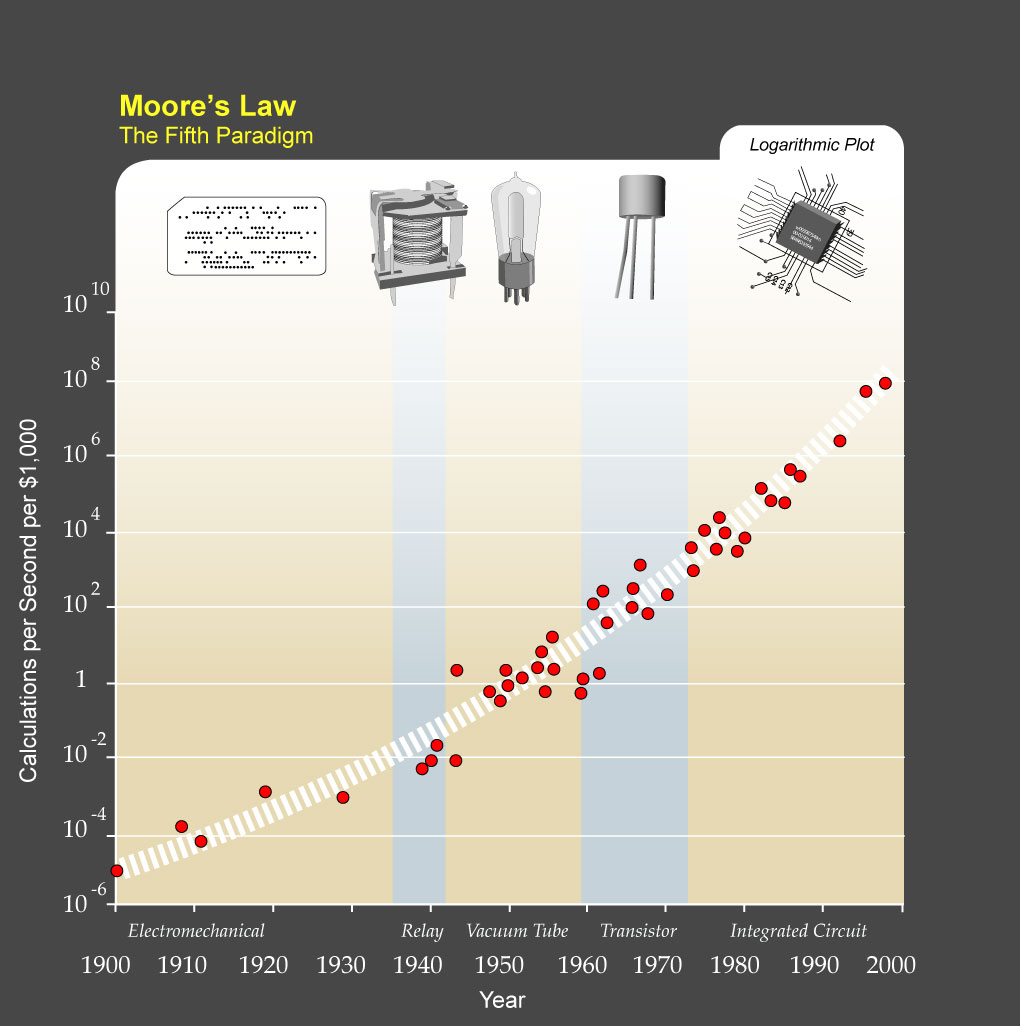
> Moore waited at least five years [1] before deriving his law.
OpenAI has been around since 2015. Even if we give them four years to ramp up, that's still five years worth of data. If you're referring to the example he gave of token cost, that could just be him pulling two points off his data set to serve as an example. I don't know that's the case, of course, but I don't see anything in his text that contradicts the point.
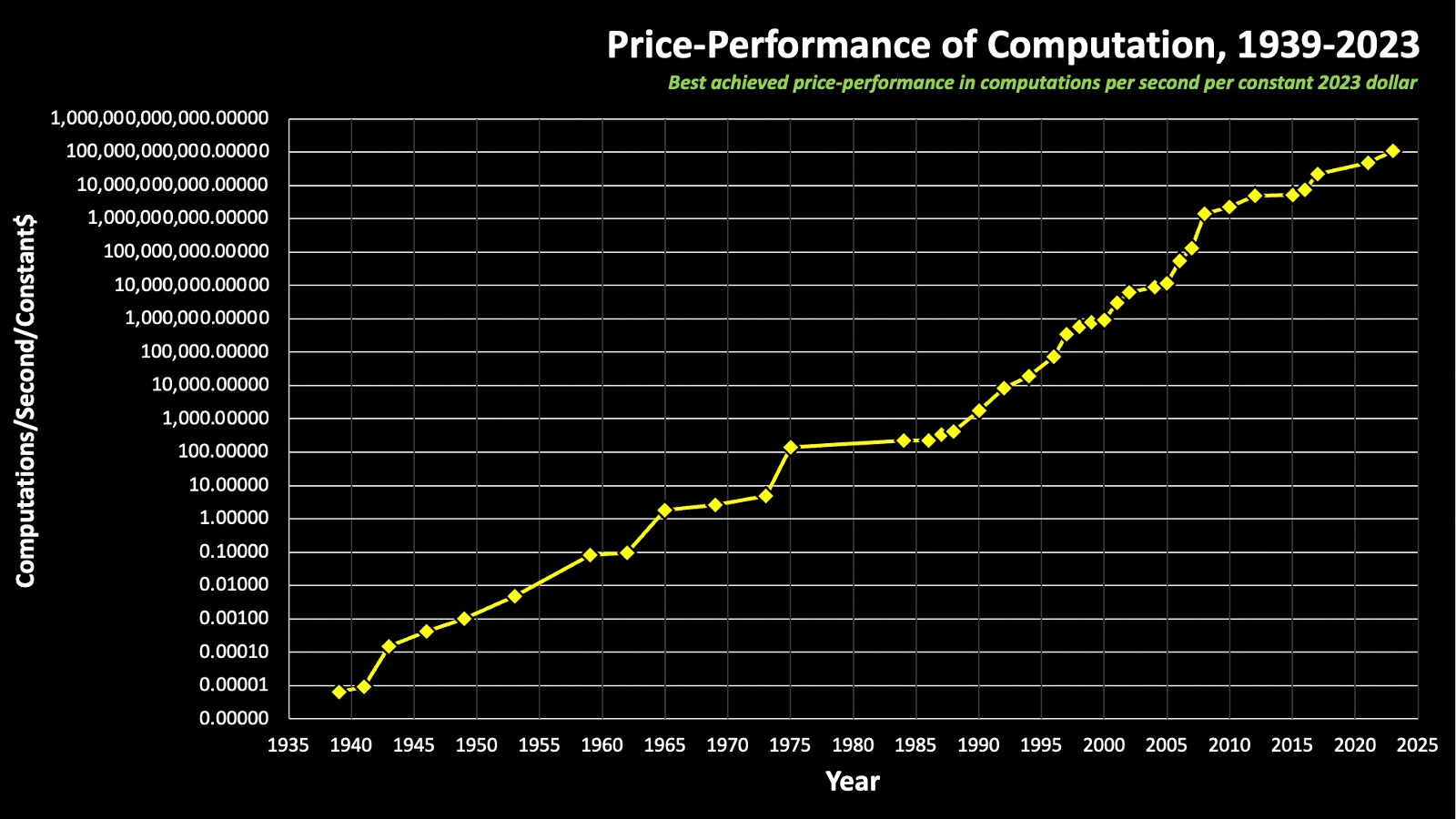
> I don't think that it makes much sense to compare commercial pricing schemes to technical advancements.
Yeah, price performance definitely seems to be the more important metric here. Anyone can get more compute by building a bigger and more expensive chip, but per-dollar metrics can't be gamed so easily. Though even in that plot, it's only doubled every ~2.3 years since 2008.
(I'd be especially interested in amortized price performance, i.e., the number of useful computations from a system over its lifetime, divided by the total cost to build, maintain, and operate it. That's going to be the ultimate constraint on what you can do with a given amount of funding.)
I don't think Google cares. If it works on Chromebooks and most Android phones, their job is done. On to the next API, let's make WebWiFi or WebAI.
WebGPU demos never work for me, so I personally consider the tech dead until that gets fixed. WebGL is barely stable enough to use as well, so I guess I'll just have to keep doing GPU stuff outside of the browser.
When they see a business value on GNU/Linux Desktop WebGPU support for Chrome, note that other Linux kernel based systems from Google already support it.
So that's how it worked with MacOS and Windows? Color me surprised.
But bth, Google doesn't seem to care about Android either. Chrome supports it on Snapdragons and that's it. Do you have Xclipse GPU? Like, I don't know, Samsung's current flagship line Galaxy S24 does? Too bad, not good enough.
I sure hope so - at the very least I will use it for tabletop illustrations instead of having to describe a party's scenario result - I can give them a character-accurate image showing their success (or epic lack thereof).
It’s not really consistent - or anymore consistent than, say, SDXL with IP adapter. Even in their example images the character they’ve input comes out wearing different clothes.
I would say we already had one of those. There's more hand crafted human made content available than anyone cares to read.
While this will enable a certain degree of more spam it will more importantly, on the positive side of things, democratize the creative process to those who want to tell a story in images but lack the skill and resources to churn it out traditionally.


1. When someone consumes fat, bile is released into the gut.
2. Oatmeal (and other soluble fibers like psyllium husk) capture this bile and it is excreted in stool.
3. In order to create the bile, the liver needs LDL. Because the LDL it used to create the bile was lost when it was captured, it exposes more LDL receptors and pulls LDL out of the bloodstream, thereby lowering LDL levels.
It seems to me that in order to maximize the effectiveness of this LDL-lowering approach, one must not simply consume psyllium or oatmeal, but rather consume them in conjunction with fat. Not saturated fat, obviously, which raises LDL, but perhaps unsaturated or polyunsaturated fats. My expectation is that this would trigger the bile secretion required in order to actually sequester it.