However obscure this page might be, I was there just a few days ago. Clicked on it from this article about a tree that was cut down, and it was apparently a big thing in the UK.
https://en.wikipedia.org/wiki/Sycamore_Gap_tree
I've been following the story for a while and it has never been adequately explained by mainstream media. Consider this... They drove for over an hour in the middle of the night in foul weather to a remote location to cut down a particular tree. That suggests some preplanning.
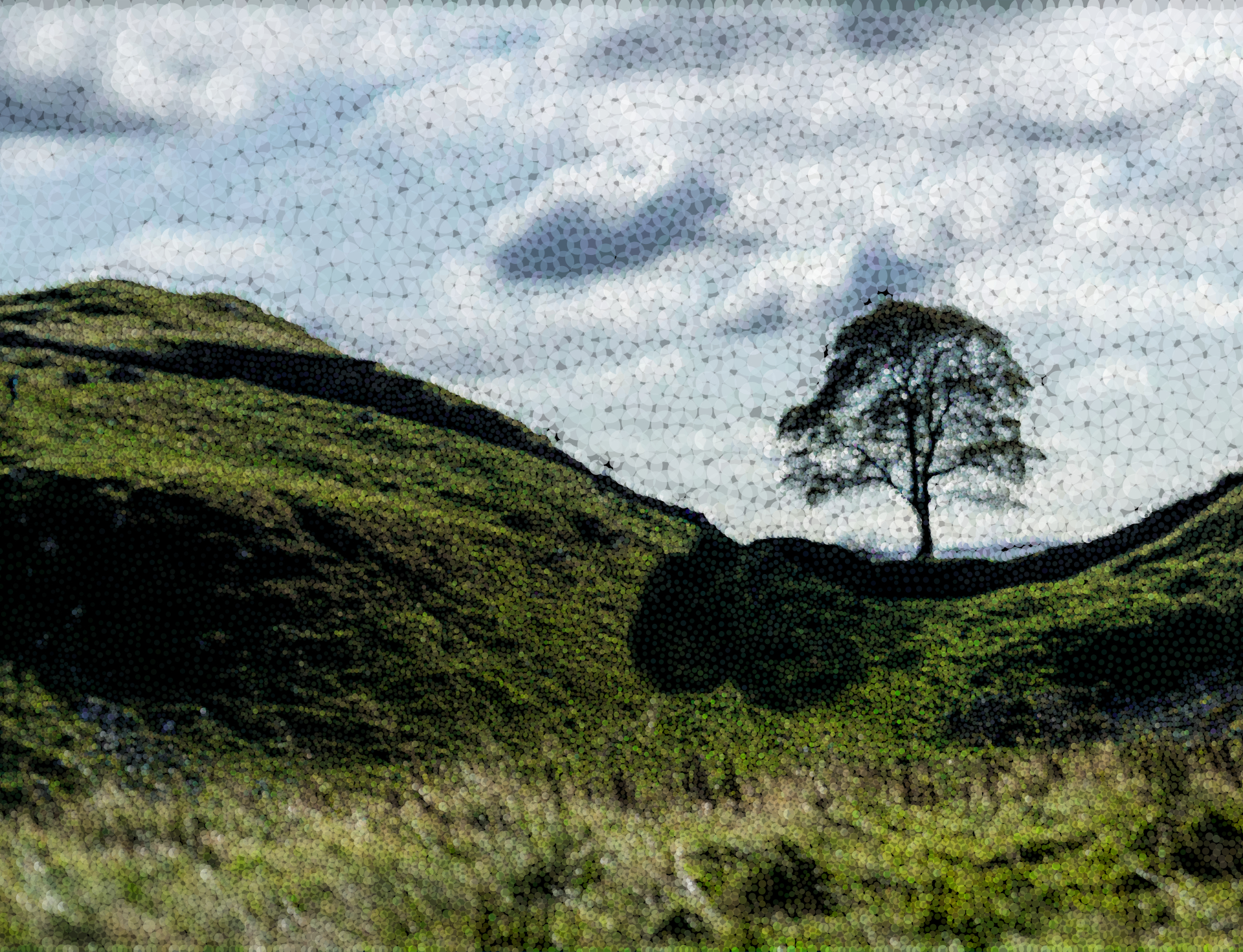
I remember that incident! As a side-effect I discovered that beautiful panorama picture[0], which was perfect for my two-monitors-plus-laptop-screen set-up aside from the low resolution, so I used my stippling notebook[1] to hide that a little bit[2]. I could probably tweak the stippling settings a bit to have prettier output, but it's been my wallpaper for over two years now.
One factor I haven't seen mentioned is the catastrophic decline in quality of Google search. That started pre-llm and now the site is almost unusable to search web. You can access something you know exists and you know where it exists, but to actually search..?
Most SO users are passive readers who land there using search, but these readers are also the feed of new active users. Cut off the influx, and the existing ones will be in decline (the moderation just accelerates it).
Do you mean wire and tool manufacturers? Electrician is mostly a user. Or to avoid flawed analogies - should books on Windows, Office, ... be only limited to a small subset of Microsoft employees? I'd assume the book is for users, what does it matter if the author contributed to the project?
And that's still ignoring that evangelism is also a valuable contribution.
So are you just verifying/factchecking everything it tells you? How is that a good learning experience? And if you don't, you are learning made up stuff, so not great either.
It's a good tool to learn stuff, I'm not trying to argue that, but one has to be fully aware of its shortcomings and put in extra work. With actual tutorials or books you have at least some level of trust.
I mean, I have to verify stuff in human-written tutorials too. Humans are wrong all the time.
A lot of it is just, are its explanations consistent? Does the code produce the expected result?
Like, if you're learning ray-tracing and writing code as you go, either it works or it doesn't. If the LLM is giving you wrong information, you're going to figure that out really fast.
In practice, it's just not really an issue. It's the same way I find mistakes in textbooks -- something doesn't quite add up, you look it up elsewhere, and discover the book has a typo or error.
Like, when I learn with an LLM, I'm not blindly memorizing isolated facts it gives me. I'm working through an area, often with concrete examples, pushing back on what seems confusing, until getting to a state where things make sense. Errors tend to reveal themselves very quickly.
I've never worked on a super big project, so when it comes to python dependancies the issue I always had is some C/C++ packages trying to build locally and fsiling. While this is mostly a problem on windows I've encountered it on mac as well. I assume uv doesn't have a way to solve this?
And the important lesson from that the k/v-like aspect of it. That the "schema" is horizontal (is that a thing?) and not column-based. But I actually only read it on their blog IIRC and never even got the full details - that there's still a third ID column. Thanks for the link.
You will be perfectly fine staying in Budapest with just English; you can learn hello, please, and thank you to be polite. This goes for most bigger European cities, outside of France I guess.




reply