> My initial reaction was that this was a terrible precedent, but after thinking on it more I asked myself, "well what specific laws would I write to combat addictive design?". Everything I thought of would have some way or workaround that could be found...
This doesn't solve the problem though - the enforcers still have to come up with a standard that they will enforce. A line has to be drawn, letting people move the line around based on how they feel today doesn't help. Making the standard uncertain just creates opportunities for corruption and unfairness. I haven't read the actual EU stance on the matter but what you are describing is a reliable way to end up in a soup of bad policy. There needs to be specific rulings on what people can and can't do.
If you can't identify the problem, then you aren't in a position to solve it. Applies to most things. Regulation by vibe-checks is a great way to kill off growth and change - which the EU might think is clever, but the experience over the last few centuries has been that growth and change generally make things better.
And what they actually seem to be doing here is demanding that sites spy on their users and understand their browsing habits which does seem like a terrible approach. I don't see how their demands in that statement align with the idea of the EU promoting digital privacy.
> If you find good matches but not great matches, you stick around.
I dunno, I have difficulty seeing how the dating sites could singlehandedly pull that off in the average case without the site users really leaning in to help. It would seem to run into the basic reality that men and women historically pick the best match from a fairly small pool of people. A dating sites can't do worse than that even if they're trying. If people are willing to use the same standards as all their ancestors then they'd pair off quickly.
It seems more likely that there is just a natural dead-sea effect because of that where the people on the sites over the long term are not the sort of people you'd settle down with, and there is also this subtle idea that the dating site is there to find someone a perfect match (probably doesn't exist to start with). Those are design issues that go a lot deeper than any algorithm the sites might be using.
That's because "matches" are the wrong criterion to look at. In aggregate, matches don't matter. What matters is the population of marriageable (or otherwise amenable to long-term relationships) people. And that's what the dating app calculus works against. Every time 2 marriageable people get together, they remove themselves from the pool. If there is not a significant influx of new marriageable people then over time the marriageability of the pool will decline. As it drops, the concentration of "serial daters" goes up.
In a high concentration of serial daters, no one wants to pair off because there isn't anyone worth pairing off with around.
> If there is not a significant influx of new marriageable people then over time the marriageability of the pool will decline
That seems to be extremely unlikely, people have finite lifespans and are only in the marriage pool for a small fraction of that. More importantly your website could easily be targeted to an even smaller pool say 25-45 and ignoring deaths and divorce your already ~10% turnover per year if you own 100% of the market. Actual numbers depends on what percentage of the pool starts married, becomes a widow etc but their’s plenty of new people to make up for any couples. Further, happily married couples are great advertising.
1 The number of people using these apps.
2. The age group using the apps
3. the type of people using the apps
4. the culture that it has replaced and infiltrated
5 It is the social norm by now to be asked if your on TiXXXr or some other app
The modern interaction have eroded, it is awkward or weird to be approached in public, every middle aged woman or elderly woman has her purse on while shopping at a grocery store, locking the car 6 times and looking back while doing it as if its a James Bond movie. I live in middle class neighborhood and this is the things i see on a daily bases. it is sad.
> If you're in your 40s you aren't looking to date people in their 20s.
My building is full of divorced 40-somethings dating younger. You see it all over media too. Leonardo DiCaprio is famous for this, and he's hardly the only one.
Women date younger too. My wife's TikTok is full of women empowerment videos; the number of videos on her feed that talk about this is not inconsequential.
It's just a reinforcement loop where the more of something you have the more it accelerates. It happens in many places: bank runs (as soon as people start taking money out, more start doing so), the dead sea effect (where the best people leave and people start leaving as the median quality of coworker drops), hiring (where the more capable you are the more likely you are to get hired, so it gets harder and harder to hire the later you are to the game - most obvious with when you're interviewing interns or whatever), and so on.
> The bookkeeper is still there, still needed, but now they're doing the part that actually requires judgment.
The argument might be fundamentally sound, but now we're automating the part that requires judgement. So if the accountants aren't doing the mechanical part or the judgement part, where exactly is the role going? Formalised reading of an AI provided printout?
It seems quite reasonable to predict that humans just won't be able to make a living doing anything that involves screens or thinking, and we go back to manual labour as basically what humans do.
Even manual labor is uncertain. Nothing in principle prevents a robot from being a mass produceable, relatively cheap, 24/7 manual worker.
We've presumably all seen the progress of humanoid robotics; they're currently far from emulating human manual dexterity, but in the last few years they've gotten pretty skilled at rapid locomotion. And robots will likely end up with a different skill profile at manual tasks than humans, simply due to being made of different materials via a more modular process. It could be a similar story to the rise of the practical skills of chatbots.
In theory we could produce a utopia for humans, automating all the bad labor. But I have little optimism left in my bones.
By what logic are the "manual labor" jobs available? And if you're right and they somehow are, isn't that just another way of saying humanity is enslaving itself to the machines?
But the RFC language clearly anticipates there are situations and good reasons leading to a message that does not include a message-id. Google therefore would be rejecting RFC-compliant emails, and they are the ones who have to justify themselves.
Theoretically, anyway, I expect in practice they'll just ignore the issue or have their own good reason. But they should accept emails with no message-id; there it does strain the imagination to see why lacking an ID would make a message unreadable or undeliverable.
There are indeed such situations. Two situations AFAICR, and neither of them apply to when you connect to someone else's MX.
Gmail rejects the vast majority of compliant messages, I think they've stated in public that they reject >99.9% of messages, and hearsay has it that the percentage for with minor errors like this is even higher.
There are good reasons why a message might be unreadable. For example, message-id is often used by the threading algorithms in MUAs and IMAP servers, and many don't test whether their threading code handles ID-less messages. I use one that deduplicates by ID, what do you think it does when the ID is empty or missing? I don't know, I haven't tested and I'm not going to.
A lot of those relevant writings became relevant because of the horrible experiences the author went through forged them into an interesting writer. If we're assuming that we only know retrospectively whether the writing is important then the best course of action would be for people to write as a hobby and make choices that are likely (rather than unlikely) to lead to a comfortable life. Particularly in this current era where we might suspect that writing and publishing a book is getting much easier thanks to technology.
> A lot of those relevant writings became relevant because of the horrible experiences the author went through forged them into an interesting writer.
Sometimes artists suffer, but it's mostly a legend at this point. Plenty of great artists have perfectly fine lives. Look at like, any modern fantasy or sci fi author.
Are you arguing that most good writers from history were poor? This is after all the only "horrible experience" a subsidy would alleviate. I don't think that's actually supported by evidence, most great writers I can think of were relatively extremely sheltered (although they often were sensitive to the horrible experiences of others)
I think the argument is a) most writers have to do a lot of writing to achieve writing consumable/appreciated but sufficient to be considered successful, b) most great writers had to go through some shit in life to incorporate that in their writing to make it interesting in order to be successful.
> I suspect most who go by YIMBY would also oppose this.
Well I'm not sure what you're proposing but if it can be characterised as "mass public housing" it sounds like a terrible idea on the face of it, and most people would probably oppose it on that ground. But the YIMBYs would have to agree that you're allowed to try it if you want, otherwise they'd be NIMBYs, on the basis that they are telling other people they can't build on their land.
> Sure is convenient that we keep having more and more crisis and boogiemen that governments can leverage...
The problem with this phrasing is it makes it sound hyperbolic, but it is important to remember the world is large and there are always, in a literal and normal sense, multiple major crises going on at any moment.
People who don't pay much attention to politics sometimes get confused about why crises elevated by the corporate media get ignored. A big answer is becuase they are elevated for political reasons, usually the crisis is fairly routine in absolute terms.
>there are always, in a literal and normal sense, multiple major crises going on at any moment
True, but my point I wanted to draw attention to, is HOW these crisis are handled now, not that there's many of them.
Every crisis now seems to be exclusively used as a vehicle to justify taking away just a little bit more of your freedom and anonymity, or implement more fiscal policies that will leave you footing the bill but just so happens it will be enriching the wealthy as a side effect.
Because such policies shoved out the door in times of crisis, don't pass through the lengthy public debates and scrutiny regular policies have to go through, so it's the perfect opportunity to sneak and fast-track some nefarious stuff in.
I'm not that old yet, but I don't feel like this backdoor was misused to this extent in the past, like pre-2008 I mean (except 9/11 of course). It definitely feels like politicians have gooten of taste and are abusing this exploit now more with every little opportunity.
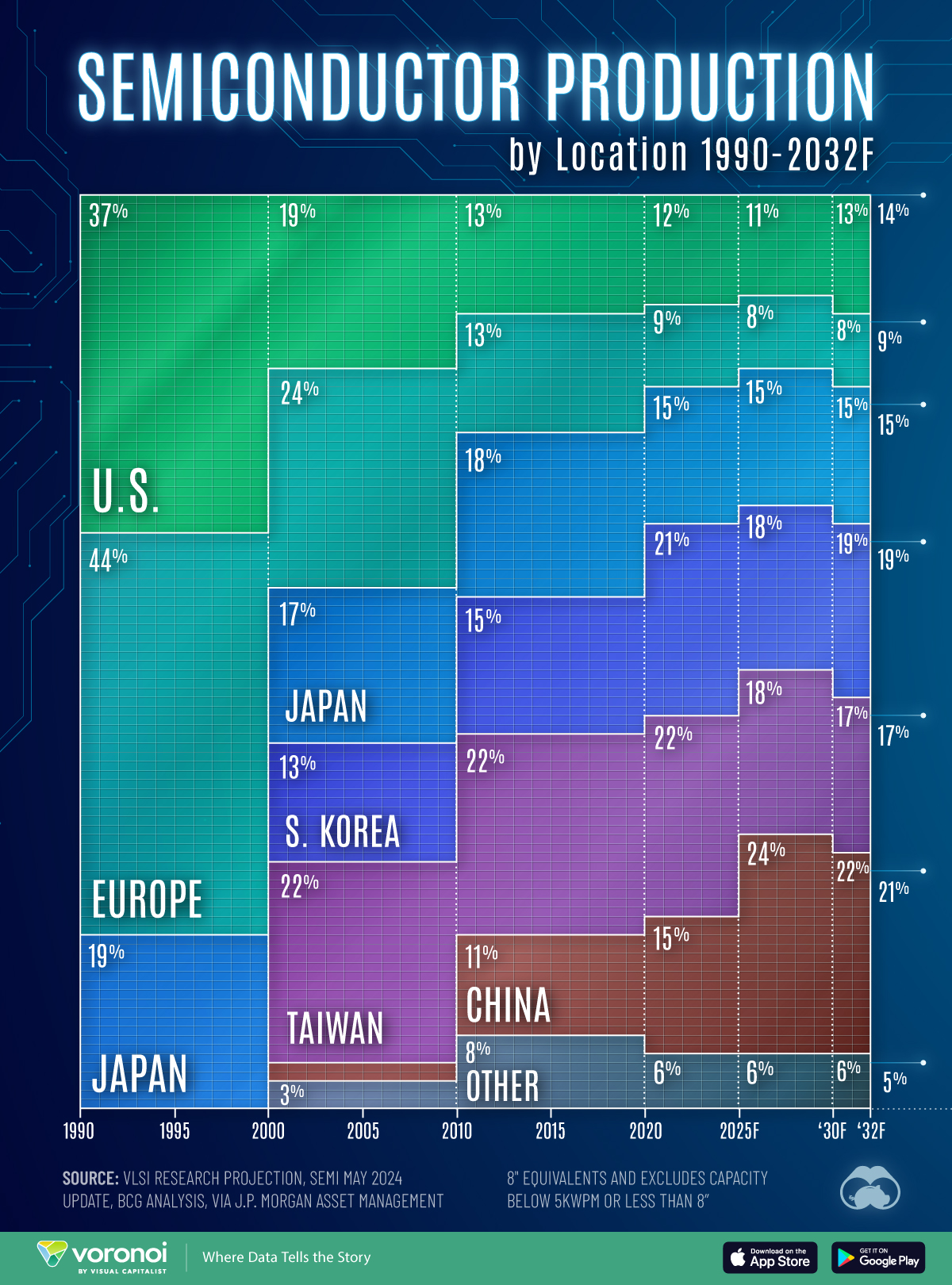
That seems a bit too simple. I saw one particular graph [0] once that really stuck with me illustrating just how decisively Europe was ejected from the semiconductor market. It takes more than just inaction to achieve results like that. In many ways it could be called an impressive feat that only the Europeans could achieve. 44% of production to 9% - losing a steady 1% of the market every year, largest to smallest player. No other region is even in a position to do that badly even if they tried.
It is possible. But that seems out of character for the Europeans, they're pretty consistent about going the distance to make absolutely sure that the next new thing doesn't happen in Europe.
It seems much more likely they had a suite of environmental, social and trade policies carefully calibrated to move semiconductor manufacturing somewhere else.
Part of it is simply the Euro being too strong. Taiwan has a (deliberately) undervalued currency that makes exports a lot more competitive, the EU does not.
It's a super simple strategy with profound effects but somehow still very underappreciated
> Individuals don’t demand solutions to diffuse problems
Markets solve diffuse problems really well, people signal how much their section of the problem is worth solving and the market judges whether the overall problem can be solved cost effectively. Getting food to everyone is a diffuse problem for example.
Tragedy of the commons is different. Markets don't solve how to solve owning things in common and the usual market recommendation is not to do that.


~ Monty Python, Meaning of Line (1983), on The Machine that Goes Ping.
reply