Or not. China just saw two supposedly biggest military superpowers fail to achieve their military objectives. China supplied Iran with tons of most advanced SAM they could muster, and it took Iran over a month to shoot down _one_ 50 year old airframe. Gunning for Taiwan right now could provoke orange one to erase Iran oil infrastructure.
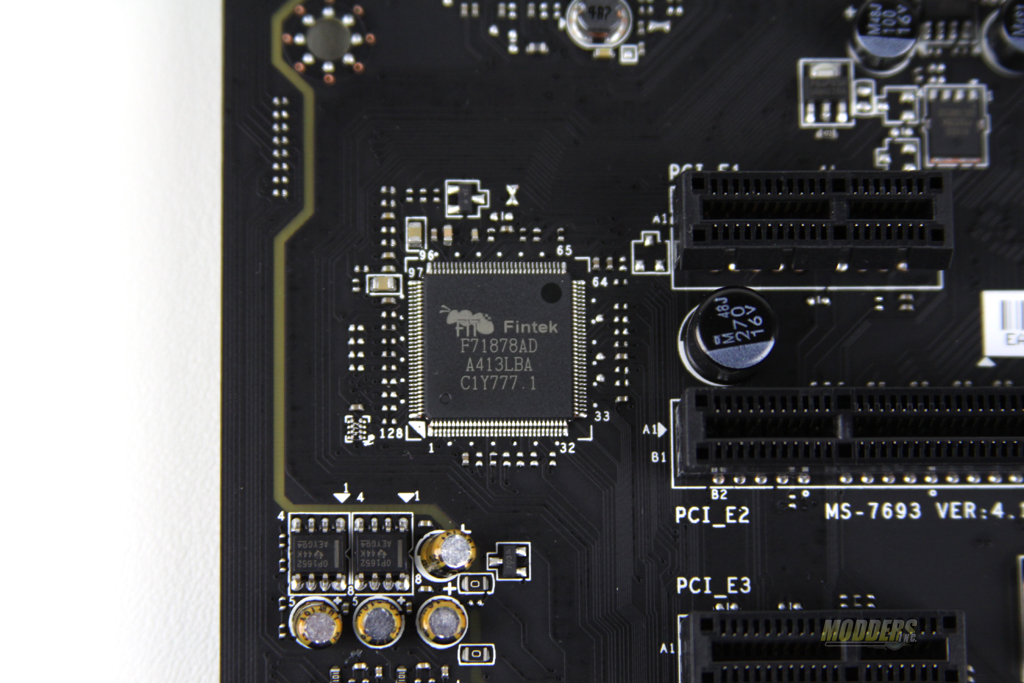
>This board has a Fintek F71878AD, a perfectly capable Super IO controller that can read temperatures, control fan PWM, and monitor fan speeds, but MSI just didn't connect it to the board.
is not true. There is a diagram available for this mobo and U32 (F71889AD) is connected over LPC (modern serial ISA version). Its a full Super IO and it cant be _not connected_ as it also provides keyboard/mouse, serial and printer ports.
The problem must lie elsewhere, most likely bad BIOS.
>Here's what I knew:
> Windows can read CPU temperature directly from the CPU's internal thermal diode, completely bypassing the useless Super IO chip.
why not read temperature directly from Fintek using HwInfo?
Yeah I was going to say that the presence of a PS/2 port almost certainly means it has a SuperI/O chip wired up. You wouldn't be able to shutdown the PC without the LPC bus talking to the SuperI/O. MSI just didn't write code to talk to the fan controller or just didn't bother with displaying it in the BIOS config page.
There are multiple pictures of msi 970 master bios displaying temps and fans just fine so it did work at some point in time. Author either updated to some poorly validated bugfix only/beta bios, or maybe wrong bios for the board.
And I've tried a couple of versions available there.
I was even able to find some beta/unreleased bioses that I've also tested.
Unfortunately, none of them enable fan control or fix temp & fan speed monitoring.
> Its a full Super IO and it cant be _not connected_ as it also provides keyboard/mouse, serial and printer ports.
Maybe the ps/2 port and serial/parallel ports also don't work? Lots of people use USB for human inputs, and few people use serial/parallel ports, so I wouldn't expect OP to have tested those ports.
They probably work on most boards, just like the PWM probably works on most boards. But his board seems to have a broken trace or a faulty chip.
I can show you a HWiNFO screenshot of it not reading anything off the SuperIO except Chassis Intrusion: https://imgur.com/a/dYPETWz
The only way I can get a temperature reading is off the CPU probe directly, which I am already making use of. As the article covers in later parts, I'm using HWiNFO and/or PawnIO to do exactly what you say (reading off the CPU probe sensor) and feed it into a fan curve, which then sends the appropriate duty cycle to the arduino.
In the BIOS there's no temperature reading, no fan speed display, and no PWM control whatsoever.
So maybe MSI did wire up the SuperIO, I can't say for sure, but they definitely didn't wire up something, otherwise the BIOS could at least control the fans or see their RPM.
And I've also tried with multiple BIOS versions, so it can't be BIOS related.
Some people online had working sensors on their MSI 970 boards, some didn't, leading me to believe it must've been a defective batch where they forgot something.
I assumed LLM gave you or validate the idea one of the biggest mobo manufacturers on the planet didnt wire temp/fan control on their flagship Gaming board?
Only one pin comes to mind that would break all temp sensors, fans and Voltage monitoring but not ps2/serial/lpt, that pin is 88 analog ground.
>HWiNFO screenshot of it not reading anything
HWiNFO has this "feature" that makes it hide sensors reporting maximum/minimum possible values. HWiNFO considers such readings sign of a missing/broken sensor. Broken analog ground pin on your motherboard would make all those sensors return bad value.
> full name, email and location in order to manage your hardware and software, yet systemd has had optional fields for those for years and nobody complained.
Why, it's fine to have these values in a corporate environment: name, work email, office location. I'd be fine with an ability to store the birth date, the blood type, the zodiac sign, actually an arbitrary list of key-value pairs, as long as it's optional.
It's only a problem when the OS insists on recording your private information to let you access your private account.
US can just keep bombing Iran into nineteenth century. The very least this will accomplish is no more ballistic missiles for Iran and its affiliated terrorist organizations around the region.
I think Iran getting nukes will probably be the best outcome on balance. It should be a damper on Israeli willy nilly belligerence which is the chief source of issues in that region. Iran hasn't nuked anyone and didn't even particularly wanted to build nukes that hard. Israel is the only country in that region wil illegal nukes so if anyone is an existential threat who must be bombed it should be Israel. But really, rather noboby bomb anyone and to this end Iran getting nukes and perhaps some Arab countries building nukes in response should calm them down.
but backed by nuclear power. Look at the weapons listed in that table, where do you think a cave dwelling terrorist in Yemen gets its hands on a cruise missile, or anti-ship ballistic missile. Its not like they make those in house. It was all Iran.
>Houthi forces began attacking shipping vessels affiliated with Israel passing through the Red Sea on 19 November 2023.
It says but then of course says later on they started attacking more, I am not sure I can take these unreliable persons on face value on the fact that only ships reaching Israel were being targeted. But if that's true I have no problems, I am not Israeli and if they aren't bothering anyone else that will only serve to cool down Israeli warmongering and indiscriminate violence further.
I absolutely do not like any party in this but Israel seems the most misbehaving of the lot. With parties I hate, the best possible outcome is to keep them at razors edge of each others capabilities and busy with each other. In that light, currently I hope Iran bolsters itself and obtains nukes. I doubt it'd increase their belligerence much, rather the more important outcome is that it makes Israel think a bit more before starting brazen invasions of Iran, and should hopefully quickly lead to the gulf countries developing their own nukes causing a balancing of powers. The gulfs weird subservience to Israel would no longer be as much of a geopolitical necessity for them effectively making warmaking quite tough for Israel and silencing most of the violence in the region.
Cyrix was physically incapable of pipelining FPU instructions. Without Pentium Quake would have had to wait two more years for commodification of CPUs delivering similar floating point performance.
Quake needed March 1994 Pentium 90-100 to deliver ~smooth 25fps. Cyrix released similarly performing 6x86MX PR200 in May 1997, AMD K5-PR166 January 1997. Quake was unfeasible till ~1998 at the earliest to be able to sell playable game.



reply