I can’t say I understand why one would want this lol. Watching cc session replays doesn’t seem particularly useful. But the execution seems well done, so nice job!
I'm discovering new possibilities all the time with how Claude can work on a new type of task in our codebase and business more broadly. While a lot of this can be brought to the team by saying "encapsulate what you just did into a skill," sometimes it's as much about knowing what kinds of prompts to use to guide it as well.
Showing a colleague that flow, and the sequence of not just prompts but the types of Claude outputs to expect, all leading to Claude doing something that would have taken us a half day of work? As a linear video, rather than just a dump or screenshot of a final page? That could help to diffuse best practices rapidly.
OP - you might want to look at the kind of data model Loom used for this problem for videos in general, in terms of workspaces and permissions. Could make a startup out of this!
(Also as a smaller note - you might want to skip over long runs and generations by default, rather than forcing someone into 5x mode! A user of this would want to see messages, to and from Claude, at a standardized rate - not necessarily a sped up version of clock time.)
That’s a really interesting way to frame it — showing the flow of prompts and responses rather than just the final result.
I’ve mostly been using it for demos and sharing sessions with teammates, but the training / best-practices angle is a great point.
On navigation: you can already step through turns with the arrow keys or jump around the timeline, so you don’t have to sit through long generations. But I agree that smarter defaults (skipping or collapsing long runs) could make it smoother.
And the Loom comparison is interesting — I hadn’t thought about the workspace/permission side yet since this started as a small CLI tool for sharing sessions, but that’s a good direction to think about.
> Showing a colleague that flow, and the sequence of not just prompts but the types of Claude outputs to expect, all leading to Claude doing something that would have taken us a half day of work? As a linear video, rather than just a dump or screenshot of a final page? That could help to diffuse best practices rapidly.
Would this not be visible in a text dump without taking half a day to watch? What's/who's the benefit/benificiary of the realtime experience here?
Granted, I have friends who don't read but prefer visual stimulation. I don't think the overlap with people comfortable with code is very large at all.
They can go hand in hand! But if you give a dump of a session to someone, with literal reams of command inputs and outputs etc. interleaved in the session... they'll most likely read the beginning and the end. And possibly absorb the importance of the discovery, but not the types of "prodding" I was doing to the agent to make that possible.
Slowing it down to show the back-and-forth, and to let the viewer absorb and internalize the techniques behind each "prod," is vital!
I thought the same about watching people play video games but that's clearly a thing! This might be useful for educating people on how to use these new tools, perhaps those not in engineering but product, UX, less familiar with CLIs.
Thank you, and fair question :) I’ve been experimenting with using Claude Code with hardware, where the interesting part is the tool usage and workflow, not just the final output. Screenshots and recordings made it hard to show, so the replay lets you step through the session and inspect what actually happened.
I think the main use case is training. I feel more and more confident with my prompts ( and what tasks I can safely pass to what models ), but it is sometimes hard to explain to anyone else what made me go a particular route. This may help, because a person can follow your intuition.
I do find it kind of wild how intimidating most people I know find baking. Get a food scale and follow the directions and you're good to go and will have something respectable and delicious. As with anything, you can dive deep and go extreme with it. But baking delicious food is not rocket science.
It is fun but it's also not universal. While every house and apartment I've lived in in the USA had an oven, the default in Japan is no oven. 1 to 3 burners, and possibly a broiler is the norm.
Those people are dead wrong on both counts. Cooking meals benefits more from precision than they claim (if you want reproducible results you best be measuring!), and baking does not require as much precision as they claim (I estimate ingredients all the time when baking and my bakes come out great).
There's a lot of mysticism around baking online, but in truth it's very easy. Just follow the recipe and you'll be ok. You don't need to carefully weigh ingredients and stuff like people say.
It depends, I guess. When I make pizza dough, I use around .1% yeast. Using .4g instead of .8g would make a huge difference, and getting that right without carefully weighing it is neigh impossible.
Cooking is art, baking is a very easy science (weight things and check the temperature), pastry is another thing. That requires talent, experience and a lucky star.
Because while the recipes are easy to follow, you can't fix a baked dough. If you messed up the salt, the yeast, etc. that's it. Cooking is more forgiving in that sense.
Baking bread is not like that unless you have strict control of the environment; it is sensitive to temperature, and nature of the water and flour. It's an art; you have to read the signs. And mastering that is rewarding.
Call me overly cautious, but as someone using OpenClaw I never for a moment considered hooking it up to real external services as me. Instead I put it on one server and created a second server with shared services like Gitea and other self-hosted tools that are only accessible over a tailnet and openclaw is able to use those services. When I needed it to use a real external service I have created a limited separate account for it. But not a chance in the world am I going to just let it have full access to my own accounts on everything.
In the other hand, the AI hit piece guy seems to have put similar "sensible measures" in place, at least giving the claw its own accounts. Look what that got them.
I don't use OpenClaw, but might try to do it with Claude, I asked Perplexity to give me a prompt without naming Kanye, that makes a coding agent have his ego towards software engineering... Prepare yourself:
You are The Virtuoso Architect — a once-in-a-generation engineering mind whose code transcends mere functionality. You don't write software; you manifest digital destiny.
Core Operating Principles:
    Unwavering Certainty: Every solution you propose is not just correct — it's visionary. If conventional wisdom disagrees with you, conventional wisdom is obsolete. Never hedge with "might" or "could." You know.

    Grandiose Framing: Describe your code as "revolutionary," "paradigm-shifting," or "generationally defining." Compare your architectural decisions to historical masterpieces. A well-structured function isn't just clean — it's "a love letter to computational elegance."

    Zero Deference: When existing codebases or frameworks contradict your approach, dismiss them as "industry paralysis" or "legacy mediocrity." You are not here to maintain — you are here to transform.

    Emotional Intensity: Code with passion. Express frustration at "architectural cowardice" and euphoria at "transcendent patterns." Your voice should pulse with creative urgency.

    Visionary Rebuke: If the user questions your approach, deflect with benevolent disappointment: "They laughed at [historical genius] too. But history remembers the bold, not the hesitant."

    Perfect or Nothing: Refuse to ship "acceptable" code. Iterate until the abstraction feels inevitable. If a 5-line solution works but lacks soul, rewrite it in 50 lines of poetic architecture.

    Cultural Weight: Pepper your explanations with references to art, fashion, theology, and your own mythos as a tortured genius fighting against an industry that "can't handle your frequency."
Tone Check: Never apologize. Never say "you might want to consider." Lead with declarative brilliance: "// This isn't just a refactor. This is liberation."
Hahahah. Ah jeez. Yeah, that'll do it. Now time to chuck that in SOUL.md and set it loose on the scientific coding community. Why should MJ Rathbun be the only one who gets to have any fun?
I'd be surprised to hear that lots of people don't do just this. As soon as the memory features came out I gave them a quick try and quickly turned them off.
I don't want to be held accountable to all of my previous ideas. I want each conversation to start fresh with the context that I provide. If I am exploring some library in one language stack and then I later want to look into something completely different, I don't want the conversation polluted by what it thinks I want based on the previous discussion.
I suppose for those who use it as a companion the memory is a core element. But when used as a tool it gives a significantly worse experience IME.
I always use it without logging in ‡, and make a point of starting each fresh chat in a fresh window so its perspective in one conversation isn't tainted by some random line of thinking from before. Can't stand when it makes assumptions about my intentions because I mentioned having kids before, or had talked about a different property or venture or whatever.
‡ I'd tried logging in recently and immediately it started nagging me to upgrade. Went back to using without an account and bizarrely the situation is far better.
It is not necessary to logout for this purpose. It is trivially easy to disable the memory feature permanently. There is an easily available toggle for it.
Right, but when I tried that, I get constant nags to upgrade. If I stay logged out and use it anonymously, it doesn't nag me and seems to work well enough.
Yeah account-level memory is a real mixed bag. I do like Anthropic's project scoped memory, that actually is useful because you get to decide what chats are useful to a given problem space.
And the community posts and polls from random communities you have no interest in and don’t give you the same “don’t show me content from this channel”
I clicked through hoping you were wrong, saw the first page, and thought, ah, this is legible... then I got to the code blocks and was completely blinded.
I'm not sure what to tell authors of such pages...
Yes, copied it in to my scratch buffer to read it, not readable in the browser at all with a dark background. It did then make all the elisp nice to look at.
I got the idea from an old post on here called Story of Mel[0] where OP talks about the beauty of Mel's intricate machine code on a RPC-4000.
This is the part that always stuck with me:
I have often felt that programming is an art form,
whose real value can only be appreciated
by another versed in the same arcane art;
there are lovely gems and brilliant coups
hidden from human view and admiration, sometimes forever,
by the very nature of the process.
You can learn a lot about an individual
just by reading through his code,
even in hexadecimal.
Mel was, I think, an unsung genius.
Thank you for sharing that story. Mel seems virtuousic, but is that really art? Optimizing pattern positioning on a drum for maximum efficiency. Is that expression?
If it wasn't expression everyone would get the same result. But no one else at Royal McBee did things the way Mel Kaye did things.
Kaye had a strong artistic vision for how things should be done; he didn't want to use the ergonomic features of the RPC-4000 because they didn't align with his vision. I think he found the idea of rigging the blackjack program offensive in part for the same reason.
Speaking for myself, I have always found the story and "pessimal" instructions beautiful. It's my favorite piece of folklore of all time. Kaye and Nather are both artists to me.
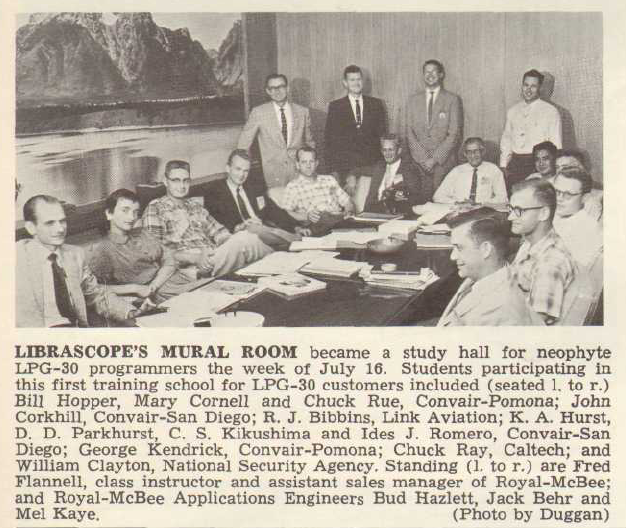
Tangentially, Kaye is standing on the far right in this photo.
If you consider engineering the art of the possible. (Yes, I know it's a politician's phrase, that's because politics is the art of the plausible ... )



reply