Given the mountains, the sun would appear to set when it descends below some altitude angle. Given the equation in the wikipedia article you'd then just solve for the hour angle. (You'd then have to use your latitude to convert the local solar time to Mountain Standard Time.)
Perhaps a rough look-up table for (say) each 10 degrees of azimuth around the observing point that gives the altitude to solve for? Finally a couple of iterations to find what azimuth the Sun will be nearer the actual setting time, perhaps taking the 'flat horizon' setting time as a starting value?
Thank you for the kind words! Yes, I think you're right about the missing factor of rho. And rho^2 is being drawn from a chi-squared distribution, not a chi distribution. (But the mode I stated is correct for a chi-squared distribution --- I must have omitted the squares when typing this up.)
I've found that there can be a lot of randomness for what makes the front page. Not too many people read the "New" page and articles drop off it pretty quickly, so it can be hard for a niche article to attract the handful of votes it needs to appear on the front page. (Though there is a "second chance" feature which helps to ameliorate this issue.) So there's a lot of randomness to what makes it onto the front page.
For instance I submitted an article three times (spaced a year apart). The first two times the article got no upvotes. The third time it got 600+ and hit the top of the front page. It's just a matter of who happens to be looking at the New page at the time.
If someone has less votes and its still something I find interesting, I am more critic of the whole situation to upvote
But if someone already has 400 upvotes and is on the top of the site, I will look more into it with ("woah a lot of people upvoted, lets see why" and then read the comments and some of the comments are really brilliant that it becomes the reason why I upvote the post itself too
I am sure that hackernews doesnt really recommend it but I do feel like its something that I do subconsciously that I have observed and wanted to share. It does feel like random stuff but still in a way which still makes sense for the whole ethos of hackernews.
Mark-to-market can create liquidity crises when coupled with capitalization requirements, though. This can happen in, e.g., bond markets.
Say a bank is sitting on a pile of very safe bonds. If the interest rate suddenly increases, the mark-to-market value of the bonds goes way down. The bank would still expect to get the full value of all the bonds at maturity. But if the bank has to mark-to-market, the current value may be low enough that capitalization requirements force the bank to sell all the bonds in a fire sale. So even though the bank in theory could have held onto the assets and gotten exactly what it had expected from the start, it instead ends up taking a big loss.
I think that's almost what happened to Silicon Valley Bank, except that they weren't required to recapitalize, but all of their customers read their financial disclosures, assumed a mark-to-market loss was an actual loss, and withdrew their money, running the bank.
This article probably omitted it for simplicity, but you would discount the income stream over time. Projected income at the 20 year mark is valued much less than income next year. That helps to account for the uncertainty.
How would this help? If the existing operators refuse to lower rents and leave their spaces vacant then under this scheme no one else can build new spaces which rent at lower rates. You would just be stuck with vacant properties at above-market rates.
You don't need a full fledged theory of quantum gravity to describe Hawking radiation. Quantization of the gravitational field isn't relevant for that phenomenon. Similarly you don't need quantum gravity to describe large elements. Special relativity is already integrated into quantum field theory.
In some ways saying that we don't have a theory of quantum gravity is overblown. It is perfectly possible to quantize gravity in QFT the same way we quantize the electromagnetic field. This approach is applicable in almost all circumstances. But unlike in the case of QED, the equations blow up at high energies which implies that the theory breaks down in that regime. But the only places we know of where the energies are high enough that the quantization of the gravitational field would be relevant would be near the singularity of a black hole or right at the beginning of the Big Bang.
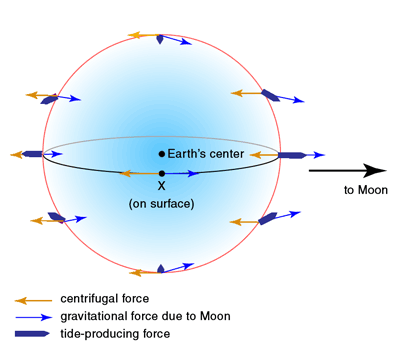
Intuitively you would think that the tide is being formed because the Moon is "lifting up" the water at the point closest to the Moon. But this contribution is actually very miniscule to the tidal effect. Instead the bulk of the tides are produced about 45 degrees away where the tidal force is parallel to the Earth's surface. This has the effect of dragging the water closer to the tidal bulge.
Thank you--the diagram you link is a better explanation of whey the tide "bulges up on the sides of the Earth closest to and farthest from the Moon"--the article left this entirely unclear.
In particular, I could understand how two satellites connected by a cable would result in the cable being stretched. But I still find it hard to wrap my mind around the fact that we get a high tide where the Earth's gravity and the Moon's add (the far side of the Earth from the Moon), but we also get a high tide on the opposite side, where the Moon's gravitational pull is subtracted from the Earth's. The centrifugal force is (I think) a much better explanation. (I realize physicists don't consider that a force, but...)
So yes, tides really are weirder than I think.
(The other facts in the article were actually familiar, e.g. the fact that the tides in Hawaii are quite small, because it's not far from an amphidromic point.)
Tides aren't caused by centrifugal force but by differing gravity. You would be ripped apart by tides falling straight into black hole.
The near part of Earth experiences more gravity from the Moon, the far part less. The Earth moves in the center so the water bulges on the ends. Important part is that the Earth pulls things out their natural orbits.
With circular orbits, gravity and centrifugal force are balanced so could be considered difference on centrifugal force. But that isn't true for all orbits.
But the water on the left is being pulled by everything to the right of it, moon, earth, other water. Why is it left behind? Every single thing is being attracted by the same centre of gravity on the right of the earth
"You would be ripped apart by tides falling straight into black hole." I'm aware of that--Larry Niven "Neutron Star". (The Puppeteers reportedly wouldn't have understood, though.) That still doesn't explain why the water bulges at the side of Earth away from the Moon, because that water would be attracted toward the Moon just as much as the rock it's next to. (There's a trivial difference in mid-ocean, where the water ranges from direct contact with the ocean floor, to a few miles above it. But that's not the same as the gravitational difference of thousands of miles between the Earth's center of mass vs. the far edge.)
but to develop better intuition, think of the sun's gravity as a field in space and nothing is being dragged anywhere, it's just that wherever you are feels appropriate to where you are and where you are going is the path of least resistance, and the places around you feel the same way, and where you all are in relation to each other (in this field) changes its relative position to everything else.
the water of an incoming tide doesn't feel "i'm being dragged uphill", it feels "hey, the earth is moving underneath me". it's all in freefall all the time.
you don't feel like you are rotating at 1000 mph (1600 kph) but you do feel your weight against the surface of the earth. same with the water, except it feels itself being squeezed by everything around it like you only feel that in the entrance to a crowded venue.
so, the water on the side toward the moon and the water on the side away from the moon would mostly perceive the earth as dropping away or coming closer (if they could perceive anything at all) where they are is always their point of reference
It's kind of interesting to compare this to Ptolemy's eras. In the Tetrabiblios, Ptolemy argued that man went through seven ages in his life, each associated with a different celestial object.
1. Infancy --- The Moon. Since the Moon waxes and wanes more rapidly than any other celestial object, this period is characterized by the fastest development.
2. Childhood --- Mercury. As Mercury is the fastest of the planets, at this age children have the short attention spans and flit from one thing to the next.
3. Youth --- Venus. Starting around puberty, a man's mind starts to become focused on love.
4. Young Adulthood --- The Sun. A man comes of age, he starts to think about his work and people begin to take him seriously.
5. Middle Adulthood --- Mars. In his mid 30s a man's demeanor becomes more severe. He realizes he has certain goals he would like to accomplish and there is not much time left to achieve them.
6. Maturity --- Jupiter. By his mid 50s, having achieved what he can in his life, he has arrived at a position of authority in the community. He has gravitas and respect.
7. Old Age --- Saturn. By his late 60s, he starts to decline physically and mentally.
It is worth noting that this exact sequence (the Chaldean sequence) of the seven classical celestial objects follows the same paths as the Serpent of Wisdom coiled about the Tree of Life in the Hermetic Qabalah. This is the western analogue to the Hindu notion of Kundalini, which shares the same serpentine symbolism; both of which represent the process of the psychological maturation of man.
See Liber 777 Col. VII [0], Key Scales 3 through 9 inclusive. Also note that Key Scales 4 through 9 in Col. XCVII, excluding Saturn in old age, correspond to the "Ruach," "soul," "mind," or (one could say) "post-bicameral ego" of man.
I sat down and divided my own life into thematic epochs not long ago. Mine are split differently and more specifically to my own lived experience but I, too, arrived at the fact that I'm entering #5 in my mid-30s. Interesting coincidence!
I suppose that constantly changing and revising the language we use to refer to everything at least has the upside of allowing us to use the latest frontend frameworks every year.
I think you meant to reply to a different comment. I talked about dividing one's life up into periods based on experience and themes, not about linguistic revisionism or Javascript frameworks.
Later on it looks like he classifies him as a "vanity angel" rather than a "strategic angel." It sounds like it can be useful to have someone with name recognition as an investor when you're talking to people who aren't very familiar with the space.
if you are trying to convince people to invest on name recognition vs. knowledge of your space, or ability to move the company forward it doesn't seem like a great guide for getting angels: "be lucky and get someone famous with lots of money".


Given the mountains, the sun would appear to set when it descends below some altitude angle. Given the equation in the wikipedia article you'd then just solve for the hour angle. (You'd then have to use your latitude to convert the local solar time to Mountain Standard Time.)
reply