I think the situation may not reflect cost of hands and housing. But the sunk cost of Hetzner to be in Germany, compared with the break-ground cost to construct their existing model in the rest of the world: I think that part is true. Selling off services in German hosted racks is at this point, massive profit on low price because the sunk cost has already been covered. They are sweating an asset into people like us, who want cheap disk but not the 100% reliable coverage of a contract which gives us replication, offsite, 3-2-1 class services. If they took that into the US the sunk cost component would not be covered, their sell price would be significantly less profitable.
The cost of hands and housing for hands, yea thats marginal in this.
You can't pack up a chemical factory and ship it overseas in a matter of weeks... in any case, BASF has let go hundreds of people last year and shut down part of said plant [1], partially due to staff cost but also due to a move to China planned to be finalized in 2030 [2]. They're aiming for 50% of gross income to come from China... utter madness if you ask me.
> Winterkorn, 74, was initially meant to stand trial alongside the other four executives but recently underwent an operation, leaving him unable to appear.
Yep. The most notable thing about Aldi (and similar competitor Lidl) from a UK perspective is that they pay above average for comparable supermarket jobs and reduce staffing accordingly.
But I remember putting coins into slots for a trolley (and reclaiming them!) when I was young enough to be sitting in the child seat nearly 30 years ago, long before Aldi was a factor in the UK market. Is this really an innovative concept in the US? Are Americans going to be even more impressed when somebody over there invents the magnetic wheel clamps which discouraged taking trolleys back to our university campus? (even when comparatively poor we'd have happily sacrificed the coin...)
I've never seen it anywhere. I have heard of it, but in the two regions I've lived (Northeast and Midwest), never seen it.
I wonder why it hasn't taken off. My son used to work at Walmart after school making around $15/hour to do little more than round up carts in the parking lot and bring them back into the building. Considering how cost conscious Walmart is, I'm surprised.
However, Aldi is putting up a building across the street from my local Walmart, so we'll see what happens :-)
I saw this happen back in 1995. Back then people would leave carts just about anywhere in the parking lot. Then they introduced the concept of the quarter and having to return the cart to the stand. Soon enough it became a habit. And the practice continues till this day.
You'd be surprised at what all counts as an "innovative" concept in the US. Coming over here from Europe as well, the country is 30-40 years backwards in many areas.
The US has that stuff in bad neighborhoods. The wheel clamp is probably pretty standard in the urban areas and/or poor areas. Out in the well-off places where there aren't wandering street people, wheel clamps would be pointless. The expense, including repairs and downtime, is not justified.
The U.S. has that stuff in good neighborhoods too. It turns out the problem is less homeless people, and more affluent people who can't park close by and are too lazy ass to ever bring those carts back.
(I mean, seriously, Tarzana is neither urban nor a bad neighborhood. It does however have an entitlement surplus at the local Whole Foods)
This is an important distinction in general. Many of the ills Aldi attempts to combat generally are non-existent in other grocery stores in some places, thereby only serving to inconvenience those customers for no gain.
The main reason I have always heard mentioned why they have a deposit is that shopping carts are really expensive and they don't want people to take them home, have teens do silly things with them etc.
Maybe that's not so much a problem in the US, where I imagine supermarkets may not be in the city center but mostly reachable by car and thus less foot traffic to take the carts?
But maybe the deposit here in Europe is just silly? I do know many supermarkets lock their carts up for 1st of May for example and anyway, one euro or one of those plastic discs is not hard to come by, so it is not much of a detriment.
> The main reason I have always heard mentioned why they have a deposit is that shopping carts are really expensive and they don't want people to take them home, have teens do silly things with them etc.
I'm sure the deposit is just to encourage people to put the carts back where they belong, reducing the amount of work staff need to do outside the store.
If you're going to steal a shopping cart, the quarter won't factor in.
Yes, they have egress locks activated by magnet that locks the wheels, or they have another physical lock system, at each pedestrian exit to the car-park of my local supermarket -- that's one reason they are really inconvenient for pedestrians accessing the site, they want to have trolley controls.
The exits are narrow with soft soil and low hedges bordering the paths. You can lift a trolley over, but you need some muscle, especially if your trolley is full of shopping.
Push the cart quickly enough and you can defeat the magnetic locking mechanism. Just push it really fast past the boundary where it would lock and keep going until you’re out of range.
Dunno if that still works, but I enjoyed defeating the locking mechanism at Safeway when I was a kid even though I didn’t even want the shopping cart.
And yet... haven't you noticed that supermarkets in posher areas are less likely to have the coin slot? (Asda and Tesco are two whose policy varies by location).
And in supermarkets with large car parks there are return stations all over the car park. Which means you still need to pay trolley herders...
I am not in America, I can't therefore share your observation. But it is not news that crime of all sorts is lower in "posher areas". Of course it is. What's the point you want to go for?
Also, most those large stores just outside of town have vast parking lots, enough so that I bet that a lot of people would decide that it's not worth $0.25 to take the cart all the way back to the building.
In denser cities where it's just not practical to put your supermarkets impractically far away from literally anyone who might sometimes want to buy some food, what you typically see is some sort of system where the wheels automatically lock up if you try to take the cart outside the parking lot. Which, compared to the Aldi system, always seemed to me like a $10 solution to a $0.10 problem.
Having somebody collect the trolleys creates a job, having somebody pack the groceries creates another job, just like having somebody do the refueling of your car at the gas station.
They are not especially demanding or well-paying jobs, but the shift to service-driven economies isn't a new thing nor particularly exclusive to the US.
That's one of the biggest differences between the US and Sweden, and probably most of Europe; access to cheap labor. Too cheap, if you ask me. You could never employ somebody as a greeter here, or to pack your groceries, or to pump your gas, or other extremely menial and near useless jobs. Can people really support themselves on those, or are they forced to work multiple jobs?
It's actually becoming relevant here, because of our recent influx of largely unqualified people/immigrants. There aren't enough simple jobs that can be done without any education, and so politicians are discussing what to do about it. Personally I think it's a big step backwards to have people do extremely basic stuff as busy work. Most stores are removing manned checkouts and replacing them with self checkouts.
> You could never employ somebody as a greeter here, or to pack your groceries, or to pump your gas, or other extremely menial and near useless jobs.
Well, not full time.
Some German grocers have started to employ very young people during Fridays and Saturdays as packers. They look young enough to be still in school, also collect tips with little boxes, but they are not full-time employees but rather "mini-jobbers".
Which is just such a weird transition considering that many of the jobs I did in my youth have now been turned into their own weird job sectors like that.
While delivering papers is now something exclusively done by adults in cars, as an extra income stream for unemployed on social security. I don't know how that can be economic but I see it happening all the time.
> Personally I think it's a big step backwards to have people do extremely basic stuff as busy work.
Some would argue that's been happening on a rather massive scale for a while already. Our productivity constantly increases, so do our numbers, as such it's only a matter of time before we end up with a whole lot of "surplus" humans in terms of labor demand for keeping everything going.
That's odd. In the UK and Denmark, you get youths who look about 16 working in supermarkets, doing the normal tasks: restocking and tidying the shelves, running a checkout. They certainly don't get tips!
The more expensive shops employ more youths, I think the budget stores don't use enough staff to have an older person nearby if the teen is stuck somehow.
A colleague of mine was in our India office once and he said that they had a:
- person that pushes buttons in elevator (at office, not some exclusive hotel)
- person that you ask to to copies at xerox machine in the office
We don’t have any minimum wage in Sweden. What we do have however are strong unions and free higher education. Somehow I get the feeling that as a nation, we care a lot more about the little guy and his social mobility than the US does.
Over here it is very common to have a plastic or metal coin shaped objects attached to key rings for releasing the trolley without a coin, most of those devices can be pulled out immediately, without connecting the trolley back to the trolleys on queue.
I think the concept just doesn't work as well in the US. Parking lots are larger than in Europe. You'd need a guy to move the carts from satellite collections points back to the store anyway.
That’s the same in Europe, there will be a collection point every 50m or so, then they drive round with carts to trail them back to base. I don’t necessarily agree with you for parking lot size, some of the hypermarkets here in France are huge
In the article it actually discusses this - the article states that a lot of US grocers tried to have the coin carts in the ‘80s and ‘90s but there was apparently enough of a consumer backlash to them that they took them away. So it’s more of a cultural thing it seems.
Anecdotally I think it’s not as much of a problem with Aldi today because
1. The Aldi parking lots in USA are all pretty tiny
2. People generally know what they are signing up for when they go to an Aldi
Generally I think that there would still be a backlash today if Walmart implemented coin carts, for instance. Which I really despise because as someone who worked as a cart pusher as a kid it’s unnecessarily infuriating for me to see the pure laziness of shoppers who can’t be arsed to walk 5 meters to drop their cart into the return location and instead push it onto the median next to their car.
Side note I want to take this chance to say that I absolutely love Aldi. There’s one that’s just far enough away from where I live to make it not worth the drive and the second they build one closer I will immediately do all of my grocery shopping there :)
I do my shopping at Auchan and I often opt for the basket because I don't have the right coin on me. They probably lose more than they save because people are buying less. Given the prevalence of contact-less payment in Europe, hypermarkets should consider dropping it.
The system makes more sense for markets the size of a Lidl or Aldi.
I visited a Target store in Madison Wisconsin and that was the first place I ever discovered magnetic wheel clamps on shopping carts. So it exists in the US... it's just not super common.
Living on the West Coast I see carts all the time that have the wheel locks, they just don't do anything.
As a person that has been a cart pusher, carts suck. The wheels, especially at the front where they put the wheel locks are the first thing that break. They barely touch the ground and spin in circles all the time. Stores rarely ever invest in fixing or buying new carts.
I firmly believe that many places in the US simply gave up on it, because what happens instead is people still try to steal them, drag them a great distance damaging them, and they have to go get it anyways. I think we had maybe 3 good carts at the Sam's Club I worked at our of like 200 or 300 carts.
As someone who was hired to literally take carts in from outside, yes the concept of a quarter deposit to use a cart feels innovative to me. Would have saved my back a bunch of pain.
Magnetic, electronic wheel clamps are becoming more common in the US, but yes, they are relatively new to metro areas, promulgating in the last decade.
The only "innovation" with the trolleys is that USA used to be a wealthy enough country that it was OK to pay cart collectors. It's not a stupidity thing, it's a poverty thing.
I would actually say it’s a sign of income inequality. There is that much of a wage gap that your customers are basically paying someone to return their shipping trolley. Apparently this business model works in the USA, Im sure it would work in India or China, but definitely not in France or Sweden
That's an entirely incorrect premise. Every Walmart store has cart collectors. You can see them working throughout the day, collecting carts. Walmart is the largest retailer in the world and employs by far the most people, and they still do it.
Besides, the US is inflation adjusted wealthier today than it has ever been at any other point in its history.
On the poverty front, US poverty is dramatically lower than it was in 1960, and homelessness is near record lows. If you go back to ~1960-1973, the falsely perceived peak of US wealth, it was much worse to be poor in the US. In every possible regard a poor person was worse off in the US prior to 1980, than they are today. That's due to a massive expansion of the US welfare state over that time, which has led to many improvements. That includes healthcare (universal healthcare for the bottom 25% didn't exist; even in the 1980s far fewer people were covered), housing, food security, disability programs, et al.
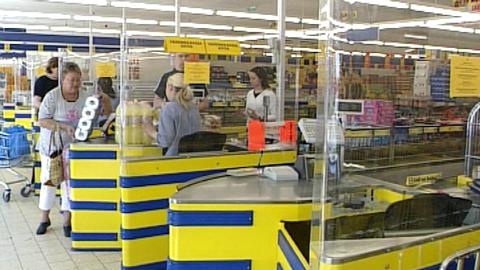
When Lidl came to Sweden most people didn't like to shop there because of their short conveyor belts after the cashier [0] relative to the regular Swedish ones [1][2], so you felt stressed when shopping there. There were no room for your groceries. Usually you put your stuff on the belt, the cashier scans it and moves it along, you pay, and then you pack it in your bags.
It took them four years, then they changed to the same ones everyone else uses.
I know a few stores in Europe that have a wall separating the conveyor belts in two parts [0]. The cashier can basically chose if the product will end up on the left or right end of the belt, giving the customers time to pack their things while already serving the next customer on the other side.
American grocery stores are so comically bad and poorly managed it's hard to imagine for a European until you move here. Trust me, it's a shitshow. The only one that works is Trader Joe's for completely different reasons and personally in my first couple years I was completely obsessed with it, now a little less.
Trader Joe's is garbage though? The produce and meat are poor or almost nonexistent and afaik they don't even have a bulk section so I can't buy spices, rice, beans, etc
I lived in Ann Arbor for a couple years and shopped at Meijers. Not good for European standards. The one on Saline Road (just in case you're familiar with the area) had comically large isles that took forever to scan, the vegetable section would be the standout in the store for sure, much better than Safeway / Vons for sure, and the beer / liquor section was something to behold especially thanks to the local craft brew culture but everything else was just done poorly. Checkouts were INSANELY slow and while there were baggers that would look darts at you if you tried to bag your own groceries, they would routinely forget stuff out and I would drive all the way home to discover I wouldn't have my steaks, or something else...
Sorry, before you say "you haven't tried x regional chain in the US", spend some time in Europe. French chains (Auchan especially) have raised the bar for everyone else, it just hasn't happened in the US yet but I suspect someone at Amazon will look very closely at that model and repeat it here.
I get online, select the stuff I want, and then go pick it up (to save delivery fee) that beats all this efficiency stuff about cashiers and aisles and people and UPC. I don't have to worry about any of that. Just a leisurely drive and then they load up my trunk.
A lot of clever efficiency improvements & innovations look obvious in retrospect. I have come to believe that "obvious in retrospect" is actually a clue suggesting it could make a good patent.
>Mathematica is way more targeted to the "general public" though.
Actually, it's way more targeted to mathematicians. The level of symbolic computation it can do is way ahead of any symbolic toolbox you'll find. When I was in grad school, I used NumPy and my group mate used Mathematica. One day I was looking up identities in Gradshteyn and Ryzhik (a bible for identities), and he asked why I bother as Mathematica had it all. He challenged me to find any identity that Mathematica couldn't handle. I thought this would be easy as G&R has more stuff than any other identity handbook out there, but I lost the challenge.