This time it actually is different.
HN might not think so, but HN is really skewed towards more senior devs, so I think they're out of touch with what new grads are going through.
It's awful.
What is it that new grads are going through? If you are referring to difficulty finding a job, keep in mind that there is both an economic downturn and an over-hiring correction happening in the industry right now. I imagine the AI industry is indeed having an impact in how management is behaving, but I would not yet bet on AI actually replacing developers jobs holistically.
It's amusing to me watching devs talk about the breakneck pace of AI and LLMS, AGI all that sorts of stuff, what that wild future will give us - when there are far, far more difficult problems that lie directly in front of us, mainly getting public infrastructure projects done in normal spans of time, or hell, getting them done at all.
Kind of - the art of fortune telling plays a big part in things
It's not needed now, but we think that it will be needed in the future
It's needed now, but we don't know if we will use it in the future
How MUCH will it be needed in the future
Will there be a future technology that makes this investment unnecessary, or even obselete before the project ever completes
For the latter, a big argument of "No need to invest in commuter trains" argument was "self driving cars are 'just around the corner' and they will make mass transit a quaint thing of the past" was used to deny investment in trains.
> For the latter, a big argument of "No need to invest in commuter trains" argument was "self driving cars are 'just around the corner' and they will make mass transit a quaint thing of the past" was used to deny investment in trains.
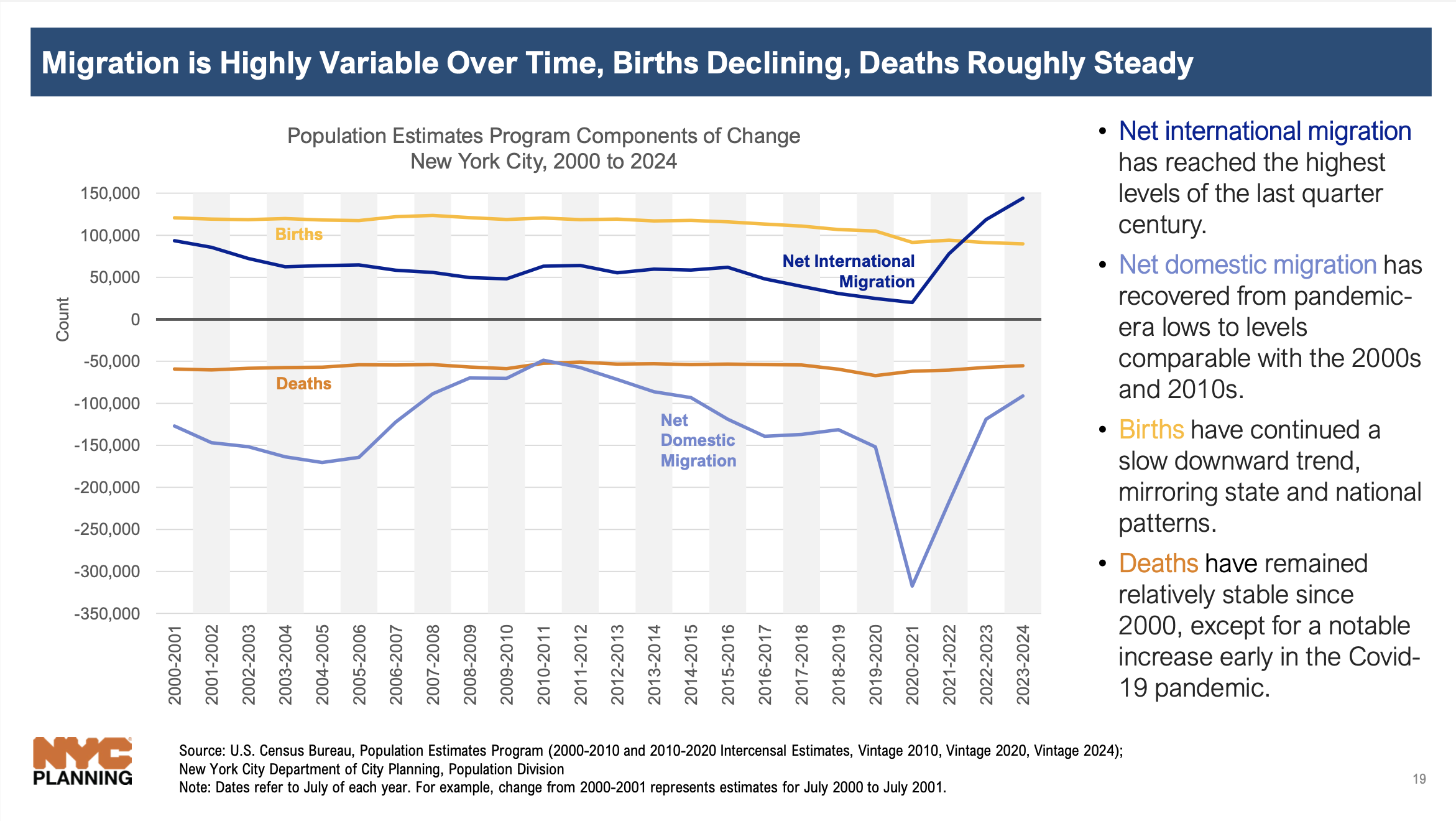
People don’t want to invest in trains because Americans don’t like trains. We have only one real city, and that city’s population consistently has net domestic outmigration. The city’s population is kept stable by a steady supply of international migrants: https://www.cityandstateny.com/media/ckeditor-uploads/2025/0....
Most Americans don’t want to commute sitting next to strangers. It’s not complicated.
They use them heavily when they're available. The NYC subway is very popular and successful, and many see it as a selling point of the city.
> Most Americans don’t want to commute sitting next to strangers.
I never hear city residents talk about 'strangers'. Interacting with others is a pleasure of cities, in fact - it's energizing, it builds social trust. We're social animals. I've never gotten on public transit, or walked down a busy sidewalk, and thought about 'strangers'. Most of those people are pretty sociable.
Some of the people on the subway have eroded social trust by acting antisocially with impunity, a high trust society needs to be beaten into such a diverse and inequal population a la singapore
I'm not sure what you mean, but the NYC subways - and public transportation I've been on in many cities - work well in terms of social trust. The evidence doesn't fit your theory.
Does everything work perfectly all the time? No, not in anything. If you cross the street, maybe someone will drive right into you. But I cross streets without a problem.
No. I generally like Bluetooth speakers - it's nice to share some music and someone's energy, and I mind panhandling less than all the advertising I see in my web browser. At least the panhandler needs the money and doesn't track me, and usually they're pretty friendly and neighborly.
Seriously, what's the big deal? People are looking to confirm all the anti-city hate. Maybe if these people make you uncomfortable, the lack of trust is in the mirror.
In suburbia and places like Tokyo, other people don’t impose their content preferences on me, I choose what I listen to on the train. I dislike ads for the same reason, I get to decide what I want to see or hear. I guess AirPods Pro 3 are closer to giving me that than ever.
Whatever suits you is great. Generally speaking, humans are social animals that live in groups, and sharing space and all that goes with it is natural to us. Many more people choose and want to live in big cities with lots of people around, than in rural places.
> They use them heavily when they're available. The NYC subway is very popular and successful, and many see it as a selling point of the city.
NYC has only 2.5% of the U.S. population and even then it has net domestic outmigration (meaning more people move out every year than move in). The city would be shrinking if it wasn’t for international immigrants, who don’t come to the city for the public transit, but rather the welfare system and ethnic social networks.
> The city would be shrinking if it wasn’t for international immigrants, who don’t come to the city for the public transit, but rather the welfare system and ethnic social networks.
I think your numbers are wrong: the city's foreign born population has been stable for at least 15 years[1]. We're not even at historic highs; those were before WWI.
> the city's foreign born population has been stable for at least 15 years
This statement doesn't contradict the one about international immigrants keeping the city from shrinking. It is easy to imagine how immigrants come to NY, give birth to natural born Americans, who then move out of the city. This process can come to some kind of a dynamic equilibrium with a stable population of foreign born people.
Not only that, when an international immigrant to the city later moves out of the city, like my cousin’s family did, that’s also counted as domestic migration.
Did you hear about the woman in Chicago who was set on fire on a train? Not very sociable.
People use the trains in places like Chicago and NYC not simply because they are available but because owning and driving a car in the city center is very expensive and impractical for most people.
Anywhere less dense, people prefer to drive their own cars.
> Did you hear about the woman in Chicago who was set on fire on a train? Not very sociable.
Did you hear about the other other lawsuit about people burning to death in their cybertruck? Should we compare horrific deaths per passenger? Per mile traveled?
once autonomy becomes ubiquitous, it'll change the safety equation significantly and hopefully eradicate the safety advantage of public transit entirely
If empirical observation is 'technical', then keen eyes can spot the grifters before they can be elected or corrupt the already-elected. Then we just need the will to permanently deter them.
What indication do you have that the construction time for tunnel 3 is due to corruption or even that it's taking longer than necessary? It seems like a very large engineering project; sometimes those take time.
Yeah, I have no idea how long a tunnel of this size is supposed to take, and I’m surprised if many people here do.
It’s a big project, and it is tricky to patch it after release. The thing is supposed to last 300 years, and usually we use infrastructure well past it’s intended lifespan…
Few things in Europe compare to the size of NYC. A potentially comparable project would be the Elizabeth line in London. Took from 1948 to 2008 to agree on a plan and then 15 years to execute it.
The bill in favour of the Elizabeth Line was only put to parliament in 2005, receiving royal assent in 2008. Construction work began in 2009, faced some delays during COVID, but was completed in 2022 (total construction time: 13 years)
Construction on New York's Tunnel #3 began in 1970. It was 28 years before any part of it was operational. A second section came online 15 years later (2013). The final stage isn't expected to be completed until 2032, a full 62 years after construction began. I'm unaware of any comparable tunnel project which has progressed at this slow of a pace.
The Thames Tideway Tunnel might be a better comparator.
It's similar in scope to this recently-completed second phase of NYC Tunnel #3, albeit carrying sewage rather than fresh water: 25 km long, 7.2 m in diameter in London vs 29 km long, 4.9 m diameter in NYC. Flow volumes are likely similar (a sewage tunnel will rarely run full).
Anglosphere construction costs are through the roof in general, same problem is happening in the UK and Canada that isn't happening to places like Spain or Japan, comparing a project to Anglosphere norms is like comparing your cooking to English food
Google claims the original build was supposed to take 50 years, and it will take 62 due to delays from a funding crisis before de blasio.
However, this is only the second phase of the plan, with two more phases broken out into separate projects. I've no idea if those were supposed to be a part of the original 50 year timeline or not.
> What indication do you have that the construction time for tunnel 3 is due to corruption or even that it's taking longer than necessary?
These two questions are casually put next to each other in the same sentence but they're incredibly different. Personally, I don't think that corruption is a significant factor in how long it took. The second question is way too leading/framed - "necessary" doesn't exist past the physical limits.
For example, would the same project have taken the same time in China? No. Does that mean it should've taken as long as it would've in China, as clearly it took longer "than necessary"? Not by definition.
Your link shows that NYC is very corrupt! It ranks #3 in corruption prosecutions since 1976. On a population-adjusted basis, it’s probably #1. Your article tries to account for population, but does so incorrectly. It overlooks that NDIL includes the entire Chicago metro area (over 10 million people), not just the city of Chicago (2.7 million). CDCA includes the entire LA metro area, plus surrounding cities like Santa Barbara (total almost 19 million people). In contrast, SDNY includes just Manhattan and a few counties north of the city (Westchester, etc), totaling about 3 million people. And EDNY includes just Brooklyn and Long Island. The NYC metro area also is covered by DNJ (which is also very corrupt) and probably a bit of D. Conn as well.
Focusing on SDNY, it's about 462 federal corruption convictions per million people (current population) since 1976. D. Mass is at about 107.
The relevant part is the last three decades, as the article explains. The US as a whole has seen a decline in federal corruption prosecutions, but NYC leads that decline. Quote:
> However, beginning in the 1990s, the number of corruption convictions there began to rapidly decline, so much so that by the beginning of the 2020s, Manhattan’s position relative to other areas had flipped. It now boasts the fewest corruption convictions of any major city area.
As noted above, the article uses the wrong numbers for each district’s population. Even just looking at the most recent two periods (2010-present) SDNY has got about double the per-capita rate of D. Mass.
EDNY + SDNY together have about the same population as NDIL (about 10 million), but have a higher number of corruption convictions than NDIL during each period in the chart except 2020-21.
Why do people say NYC is more corrupt? I don't know of evidence or reports. To me, it doesn't seem more or less corrupt than other major cities in the US. It's hard to compare to other countries, where city government may have different roles.
Certainly NY's government and budget are larger than other US cities, for obvious reasons.
Thanks for the link! I'm not sure the incident you name is meaningful, but here is some evidence at last (from 2017):
> "the highest construction costs in the world"
> "The estimated cost of the Long Island Rail Road project, known as “East Side Access,” has ballooned to $12 billion, or nearly $3.5 billion for each new mile of track — seven times the average elsewhere in the world. The recently completed Second Avenue subway on Manhattan’s Upper East Side and the 2015 extension of the No. 7 line to Hudson Yards also cost far above average, at $2.5 billion and $1.5 billion per mile, respectively."
> For years, The Times found, public officials have stood by as a small group of politically connected labor unions, construction companies and consulting firms have amassed large profits.
> Trade unions, which have closely aligned themselves with Gov. Andrew M. Cuomo and other politicians, have secured deals requiring underground construction work to be staffed by as many as four times more laborers than elsewhere in the world, documents show.
> Construction companies, which have given millions of dollars in campaign donations in recent years, have increased their projected costs by up to 50 percent when bidding for work from the M.T.A., contractors say.
> Public officials, mired in bureaucracy, have not acted to curb the costs. The M.T.A. has not adopted best practices nor worked to increase competition in contracting, and it almost never punishes vendors for spending too much or taking too long, according to inspector general reports.
etc. Also, this is based on extensive research:'
> The Times brought the list to more than 50 contractors, many of whom had worked in New York as well as in other cities. The Times also interviewed nearly 100 current and former M.T.A. employees, reviewed internal project records, consulted industry price indexes and built a database to compare spending on specific items. And The Times observed construction on site in Paris, which is building a project similar to the Second Avenue subway at one-sixth the cost.
As for London, they built an entire industry around hiding money for oligarchs who stole it from their own countries. Maybe it's technically legal, but it's morally corrupt AF.
As a German I'll say that even acknowledging there is a corruption problem (while still being unwilling to change it and not voting for the parties that let corruption fester) puts them a good step ahead of all those thinking there's no real corruption.
No studies, personal impressions, so I might well be wrong and maybe they all know but don't care. No majority that cares either way.
As another German, I think there is different kinds of corruption. There is low-level and high-level.
Low-level is when you bribe individual cops, city clerks, etc so they let you go instead of writing a speeding ticket or approving your house building plan.
High-level is when people like Merz receive a political donation from McDonalds, do some self-promotion in one, and then keep/lower the Mwst (VAT) for restaurants.
Germany unfortunately has high-level corruption but as far as I know, very little low-level. I think thats partially why people don't care to vote to differently. Yes, it happens, but there is a large disconnect between what Merz does and how it impacts an individuals bottom line.
If people would have to constantly hand out bribes to anyone then maybe its a different story.
You have to deal with directly affecting real estate owners, potentially 100s of thousands of different ones in NYC. Not to mention 100s of years of underground infra and all the different companies that own that stuff without cutting service to anyone. It's insanely difficult and I'm not sure I understand why you think it wouldn't be.
You're missing what I'm saying. I'm poking fun at devs that think AGI will magically solve all our problems - they have no idea just how insanely complicated physical infrastructure is.
I could definitely see it helping in this space though. I was a project manager for a telco for a bit and there's lots of data in different formats and systems that even today's AI would be great at splicing it all together for one coherent picture.
That is true. In fact it relates to one of current America's greatest truths: coordination problems here are much more difficult than many technological problems. This is what makes many of those "oh so you take those autonomous vehicles, put them on a track for efficiency reasons, then link them together so they can transport more people, and voila! you have a train!" comments ring hollow.
Building a train requires coordination. Building an autonomous vehicle requires technological innovation and convincing a few people at the top levels of government. The specifics matter (and the Abundance guys have done a great job summarizing them) but it's due to an entrenchment of certain styles of laws.
So the answer to "why do Americans build self-driving cars to ease transport when Europeans just built subway systems?" is "we do these things not because they are hard, but because they're actually much easier than the other thing you find easy".
You dont need it, it's just one way to install it. You can just download the appimage and use that as well. The point was to say that @aizk comment was ridiculous
Well, if they suddenly changed the license, we'd get a new Redis --> Valkey situation.
Or even more recently, look at minio no longer maintaining their core open source project!
TS is enormous, has endless training data, and can interact with virtually anything on the Internet these days.
Also, strong typing is very very useful for AI coding context.
What do you mean by "failing tests", are you talking about runtime code? TypeScript erases all types at compile so these wouldn't affect tests. Unless you meant "compile errors" instead.
I've noticed LLMs just slap on "as any" to solve compile errors in TypeScript code, maybe this is common in the training data. I frequently have to call this out in code review, in many cases it wasn't even a necessary assertion, but it's now turned a variable into "any" which can cause downstream problems or future problems


reply