Dowries are a plague on humanity. They’re rooted in the idea that women are property.
I lived in India in the 1970s as a child. At that time the shorthand was “cooking accident” when new brides were killed. As in, “The bride’s father couldn’t pay the dowry. Too bad she had that unfortunate cooking accident.”
The local man who did our laundry had four daughters, and it was considered a curse. He killed himself because he couldn’t pay their dowries, and he knew he’s spend the rest of his life in shame with daughters who were spinsters, or dead.
Not sure how dowries are rooted in the idea that women are property...
If you were talking about bride price then it would make more sense.
In many cultures the men had to pay the father of the bride, thus people in a sense were literally selling their daughters. Still there was a reason for this at the time, in those cultures, women moved to live with the husband family, and at same time their labor was important, it was expected then that the husband's family would pay the bride's family enough money to replace the "lost labor" of having one of their workers moving away.
I don't know the logic behind dowries though, much less why it persists now.
EDIT: making clearer:
Bride Price: Man pays the Woman's father. "buying" her, and giving in payment a value expected to be equal to the labor her father lost with her moving away.
Dowry: Woman's father pays the Man. Never saw someone "buying" something by getting paid for it... thus why I think Dowry has nothing to do with women being property. (instead it is more like Women are a burden you want to offload).
The logic behind dowries was that women were a burden since they would be relying on the husband for food, shelter and protection.
They were leaving their original family, thus reducing the number of people who'd need to be fed and sheltered, while the husband's family was taking on that duty, thus they claimed to deserve compensation.
Such cultures suffered from similar other ills like mistreating or kicking out widows or, in India, the practice of having the wife burn alive on the husband's funeral pyre.
Their persistence nowadays (particularly in wealthier societal strata) is largely cultural inertia and greed, as of course nowadays in all wealth levels it is very normal for women to earn their own living too.
In my family, dowry for the current generation has been passed off as "gifts intended for the couple's married life", which although still doesn't sit quite right with me, is at least not as exploitative and not explicitly asked for. It mostly boils down to expensive gifts of clothes, kitchenware, makeup etc which can be useful when establishing a family.
> They were leaving their original family, thus reducing the number of people who'd need to be fed and sheltered, while the husband's family was taking on that duty, thus they claimed to deserve compensation
Wow, that's an insane perspective. So even your own daughters were thought of as a burden?
In many societies, women's labour was significantly undervalued compared to men's, so the more women, relative to men there are in your household, the more stress it puts on your resources.
Also, if women in a society inherit nothing (Because it all goes to sons), whomever they marry is going to expect a dowry, instead. Which puts further financial stress on the family, to save up for said dowry. Which is made more difficult by point #1.
Also, women often married at a younger age than men, which again, would make the dowry issue financially ruinous for a family. The longer you scrimp and save, the harder it will be for your daughter to get a good match...
----
Here's another fun bit (from ancient Greece, but plenty of other parts of the world shared the same fucked-up dynamic.)
Women weren't allowed to own property. What happens when a woman is the only child, and her dad dies?
She'd be forced to marry one of her close male relatives - usually an uncle, to 'keep the inheritance in the family'. [1]
Inheritance rights play into this a lot. A flip side of Greece I think is Spain where a married women can inherit property in her own name. And dispose of it in her will. In those societies perhaps a dowry is really more the daughters share of the families wealth.
This is going to be a very western perspective, but I thought that historically women's labour has been mostly valued as a homemaker. Is that not the case in a lot of non-western societies?
I'm also wondering if beauty plays a role in dowries. If a woman is beautiful does that mean she might have a lower dowry, or they don't care about beauty at all?
>
This is going to be a very western perspective, but I thought that historically women's labour has been mostly valued as a homemaker.
Homemaker labour didn't pay well. It still doesn't, and it didn't back then.
It's vital to the operation of a household, but it doesn't put food on the table, or earn money, which allow you to buy any of the things the household needs, but can't make for itself.
----
Note: Spinning was a large component of household work - which did allow women to earn money, by selling any surplus textiles they produced. There's a reason that 'spinster' became a synonym for 'old, unmarried woman'.
Unfortunately, keeping your family clothed was a full-time spinning job to begin with - thousands of hours of work a year. And if you were to sell the products you produced outside the household, you wouldn't earn much with them - as a 'profession', spinning did not pay well at all.
The issue is that, as is also sometimes a common mistake in the West, homemaking was seen as a part of being a woman and not as valuable labor. Yes, it's hypocritical, but most of these practices are.
Yes, beauty and other circumstances would offset dowries, since of course if the husband was eager to marry her, he'd try to incentivize it.
>If a woman is beautiful does that mean she might have a lower dowry
Yes in practice this is what happens. There was a nasty rumor going around in my family that one of my distant uncles (a generally dapper guy) married the "ugly" daughter of a rich businessman because the dowry offered was high enough to set him up for life.
Yep, it was very messed up. It also went both ways, my maternal grandmother suffered decades of abuse from her son because she didn't consider her married daughters to be 'her' family. It took a plan of forcibly sneaking her out, moving her away and threatening her son with legal action to get her away.
Even after that she struggled to accept being a 'burden' on her daughters.
This is the first time I've heard of a cultural practice that I cannot fathom. Not "wow that was crazy for the time", but "I don't understand how this ever made sense".
I guess it's borne out of extreme resource scarcity? The idea that someone is a permanent burden regardless of what they do is hard for me to wrap my head around.
> The idea that someone is a permanent burden regardless of what they do is hard for me to wrap my head around
There are millions of such people, but it's not based on sex.
People from the bottom parts of intelligence distribution are a "burden", because no amount of labor they produce will generate more value for society than they consume (in food, housing, healthcare).
In developed countries we are able to collectively shoulder such a burden, because we do not live an a resource-scarce environment like you mentioned (when it comes to basic necessities)
> The idea that someone is a permanent burden regardless of what they do is hard for me to wrap my head around.
Don't get fixated on the "permanent" part of this. Some people can generate positive and negative value through different periods of their lives. Kids < 16 years of age are typically consumers of value. So are seniors of 80+ years.
This is not a bad thing, just a natural cycle of life.
Yes, that's true but like you say most societies try to socialize some of that burden. There seem to be no such socialization in this case.
> Some people can generate positive and negative value through different periods of their lives. Kids < 16 years of age are typically consumers of value. So are seniors of 80+ years
I understand that, which is why I specified "permanent". In this case, women are permanent burdens regardless of how old they are. That's the fucked up bit.
Actually, archeological evidence shows that even in extremely harsh environments, many early humans took care of people who were unable to work.
From the article linked below:
"...an idea of what it must have taken to keep Burial 9 alive. Paralyzed from the waist down and with severely limited arm and neck movement, he depended on others to provide food and water, clean him and move him to prevent pressure sores. 'From the bones alone, we can say this person lived with a disease that required help from others to survive,'...
The people who took care of Burial 9, for example, scratched out a precarious existence using stone tools to fish and raise pigs in prehistoric Vietnam. Signs of malnutrition in the bones of people buried nearby suggested famine was a constant threat. 'In a small society which was very stressed, that means somebody who couldn't contribute or go out hunting or undertake a lot of tasks was supported, accommodated, and adjusted to,'"
I can't really fathom it either, it feels somewhat like a self-reinforcing cycle which may have started from the earlier hunter-gatherer days. I'm just satisfied that in our recent generations we've quickly started to abandon a lot of these malignant ideas.
Lol, is this some sort of act? Having to take care of aging parents and thus them being a burden on their children is a fairly common trope in western film and literature. Common worldwide.
I actually typed out an addendum about children and elderly being burdens but adults not being, but deleted it because I thought it was extraneous since I was specifying "permanent burden regardless of what they do".
Children/elderly are not permanent burdens because they grow up/die and they can sometimes do useful things.
The difference here is that women are classified as burdens regardless of what they do. Cook, clean, take care of the house, your family, your husband, etc. Doesn't matter, you're still a burden. That's fucked up.
I'm in India, looking to get married to someone I have known and loved for a while now. Our families are not too happy about it. Both of us are about 30. We are working professionals with decent finances and fair amount of independence, so despite them not being too happy about it, they're talking among themselves and setting up things.
This context was important given the topic, because a topic that frequently comes up in these family discussions is that
1. the girl's parents insist that if I decide to marry their daughter, they wouldn't "give us anything". This has been said a few times to my face, to my partner, and to my parents too.
2. they've asked a few times subtly if there are any "demands" from my side of the family (most likely to bring it up as another obstacle towards peaceful proceedings).
3. they've offered that they would give some small stuff like a bed, a cupboard, etc. to us as a "blessing for our married life" despite both of us politely declining for it.
It's honestly humiliating and disgusting. Both of us consider ourselves to be educated ("woke", if you will) and quite self sufficient. Not once have I or any member of my family expressed any wishes or expectations of receiving anything from the girl's side.
I've been quite against such practices for years now, from even before I met my partner. I'm even ready to the extent of disavowing my parents if they indulge in any such activity.
But what both of us have ended up realizing is that none of it matters. Society around us is accustomed to doing things in a certain way and it's not just hard, but very very hard for people to let go of such things.
And mind you - it's not just generational. I know of people from my age group, school mates, colleagues, college mates, what have you, who are totally okay with such things and consider it a "norm". Some even go to the extent of supporting their parents and upfront ask the girls for it. And it's not just males, it's all over the place. Females are mostly okay with this, if not encouraging of it. They demand stuff from their parents to "help them start a new life". Maybe don't start a new life if you and your would be partner cannot afford to do so, or come to a solid understanding with your partner on where they stand on such issue?
> In my family, dowry for the current generation has been passed off as "gifts intended for the couple's married life",
I married twice[1] and neither times was the issue of dowry even considered[2]. Nor for anyone I know (close family, extended family, just about every indian person in South Africa).
[1] Serially, not in parallel :-)
[2] Nor "expensive gifts" as a euphemism for dowry.
I had been pretty naive to the euphemism since it seemed to be entirely the wife's family's call (and to an extent the extended family avoided those conversations guessing that we would be opposed to it, having grown up in the West). I only managed to piece it together when it came to marriages in my immediate family. They just claimed that it was stuff that their daughter would end up needing to buy anyway and for the most part that is how it turned out, but I have also heard plenty of gossiping about how someone's daughter-in-law didn't bring X or Y thing.
I still have a few years before I think I'll be ready to deal with relationships, but of course will definitely be making it clear that I have no expectations of 'gifts'.
What I've heard is that it was to ensure that a household was set up for success. Similar to the idea of a hope chest - a girl would assemble all the necessary linen components a house would need by sewing them herself. Once she had accumulated the requisite skills and equipment to run a household, she'd be eligible for marriage.
> Because obviously, the only thing a household needs for success… is linens
I think you take for granted just how difficult and time-consuming it is to produce cloth and material for clothing.
If a woman got married and had one child, there'd be little to no time to make clothing for the second child that followed almost immediately after[1].
[1] Contraceptive, while being an ancient invention, was never widely used until recently (past 50 years, maybe?)
Cloth goods were expensive up until quite recently. People generally didn't have nearly as many outfits as we do now. Being able to repair and manufacture your own clothing and linens was a huge deal.
My wife came with a dowry. When I asked her about it, the rationale she gave was that it's a bit like child support and a bit like insurance.
It's like child support in that her parents wanted to be sure that her needs were met, and the money can be used directly for that.
It's like insurance in that if her health declines or for any other reason I start to view her as a burden, I'm agreeing to keep caring for her anyway rather than divorcing her. They're paying for that.
(I have no idea how much the dowry was -- I just handed her the envelope and she deposited it in her own accounts. I'm an American and accepting a dowry of course seemed weird and foreign, but she insisted that declining it would be improper.)
Well the article paints a pretty clear hypothesis, if you read it -- dowries are rooted in the idea that in a particular kind of society (not the ones where a household is losing out on a woman's labor and hence needs a bride price), the woman who is married off into her husband's household is seen as a burden, an outsider, one more mouth to feed.
Therefore a dowry is both compensation, and a demonstration of value (i.e. take my daughter because she has a high dowry, and is thus more desirable to marry than other girls with less dowry).
> "Dowry usually emerges in highly stratified societies, like caste-structured India and colonial Latin America, whereas the reverse convention, bride price, is more likely to appear in communities with less socioeconomic differentiation, as in much of sub-Saharan Africa. Some critics object to the way “paying” for a bride seems to commodify women, but there is little evidence that bride price harms women’s well-being. Dowry, in contrast, encourages two forms of violence."
Occam's razor says that while bride price does, in theory, objectify women, it also places an objective metric ($$$) on her value – you must pay $$$ in order to receive this precious artifact. Whereas it seems that dowry places the opposite objective metric (-$$$) on her value, i.e., please, take this burden off our hands and we will pay you $$$.
EDIT: An afterthought, it seems what might also be at play is that doing work on something (or, paying a lot of hard-earned money for something) makes us value it more. This is borne out in the Ben Franklin effect, where doing someone a favor makes you like that someone more, not the other way around. [1]
It was like that in India too. Some social critics and authors back in late 19th and early 20th century changed that practice. Dowry started as a pocket-money for the girl, when she leaves her parent's house to go with her husband, because woman is "their" property now. Parents worried about her daughter's well-being there, would do that in consolation that it might help her, should things go south. That generousness was "expected" as time rolled on.
>A modern analog is that the bride's family paying for the wedding.
Does this occur? I havent heard of this. I'm among professionals, and it seems that everyone complains about how expensive the wedding is. I imagine if someone else was paying for it, this wouldn't be a big deal.
Could you explain the culture around marriage and dowries a bit more?
I'm really confused as to why marriage is culturally important when dowries and that level of abuse exist.
Why is marriage common if it's just an excuse to extort the bride's family and it endangers everyone's daughters? From my perspective that's a deal no one would want to take.
It can be a mix of all sorts of cases. Sometimes the expectation is for it to be paid by marriage, but, especially for daughters of wealthier families it has also been a common thing to marry and then use the marriage as leverage because divorces are also often blamed on the woman.
I was reading about dowery/dower/brideprices in the past week, mostly on wikipedia but chased a few links. There is a very interesting hypothesis about the origins of these practices in prehistoric human cultures.
in hoe-based agriculture, which tended to predominate in mobile/migratory cultures, farming was "women's work"
in plough-based agriculture, which tended to predominate where people were stationary and land was "owned", farming was "men's work"
Where women did agricultural work, a brideprice was paid, as per the theory, because a women's productive output was valuable.
Where men did agricultural work, a bride was expected to bring a dowery, paid as a transfer from her family's land-based wealth.
I find it interesting how very rough "logic" from many thousand years ago would continue to affect us today.
One doesn't have to look thousands of years into the past for an agrian fictional/proposed culture.
America had dowries until the mid 1800s and the wealthiest among us globally still predominantly define marriage in romantic and business terms.
The issue that most comments do not discuss, that exacerbates this situation, is the idea that a bride marries into another family and becomes that family's responsibility. Dowry is most often demanded by the parents of the marrying groom, and negative actions are often taken on as a group rather than an individual.
As a result:
- laws are written to impact the entire family.
- The logic is 'one more mouth for the working FIL to feed' esp when marriages are younger and the groom's career is still growing.
- women have limited cultural rights to exit relationships in hindu society with massive repercussions socially and in their employment
I do want to point out for that last one, the stink of divorce has only recently begun to dissipate. Women in the US in our grandparents and great grandparents era could not bank independently, it was very difficult to get even near parity of pay and often kept cash or valuables to pawn so that they would have an exit or a net if their partner was unsuitable or died.
What were the factors that had hoe-based agriculture be "women's work"? One would imagine that the increased strength and endurance of men for physical labour would have resulted in the opposite: when you have the plough and the dray horse, farming is less dependent on physical stature.
The idea of which direction the money was paid being related to the perceived productive output of the woman does make sense. It's the other part of the argument that isn't so obvious to me.
I can look it up, etc. but if you happen to have the links available from history that would speed things up for me. Much appreciated.
I think a lot of folks who don't have an agricultural background mistake how different the processes are. Often when a person uses a hoe in modern times (for example, urban gardeners), they use it the way one would use a plough - long troughs or lines, except that they then plant seeds in a a few locations on the line, with the belief that turning the earth has some significant impact. Tilling can be a valuable process depending on what you are growing, the quality of the soil, when it is done, etc, but it is very distinct from using a hoe to plant seeds.
In practice, planting with a hoe is extremely light work, you turn the earth (or even just make a little hole), plant the seeds, maybe apply some fertilizer, or fresh soil, then close up the hole.
With a plough, you cut a long line, usually with pack animal or mechanical assistance, and then follow and plant seeds along the entire line. This can mean managing a large animal, or operating heavy machinery, or both! Plus there is the issue of removing obstacles (dead trees/plants, rocks, and other debris).
Setting aside the physical requirements for the different planting methods, there is also the issue of the capital cost of farming. https://blog.oup.com/2013/06/agriculture-gender-roles-norms-... is a decent high level article that covers how and why this is thought to contribute to gender roles.
My understanding is that the plow and horse, still required significant muscle to keep it on track, push it into the ground, whilst the horse was pulling forward. Additionally, rocks had to be moved (even in older fields, rocks appear, big rocks, over time).
Another aspect of traditional indian family practice that relates to dowries is how a family's wealth itself flows in estate planning. When the parents die their wealth and land are inherited only by their sons (none given to daughters). The dowry in that respect, also functions as a pre-payment of a share of the family's inheritance to the bride (and her new family,) as she's moving on to a different family.
In middle class and higher families, there is also a large amount of gold and jewelry gifted to the bride during marriage, by everyone in both the bride and husband's extended family. This is generally done in public and can be considered a pre-payment of her divorce settlement. This gold is owned by her and because this transfer is documented and done in public, if the couple breaks up, it would be known in the village whom the gold belongs to.
It's important to keep in mind that these traditions vary greatly within different Indian sub-cultures and even family to family. You can't paint everyone with the same brush of this article. The broader culture is also changing slowly as generations tick by, and women's education and their own capacity generate a salary grows rapidly.
I can imagine in 20 years there will be significant change to all these practices.
In India, the eldest son is also expected to take care of their parents through their old age, and there fore inherits the family house. After watching a good dozen families take care of aging parents, I can say with confidence, that inheritance is an insufficient payment for the human cost of being a carer to your in-laws for 40+ years. I know quite a lot of family feuds that have broken up in the last decade, where the brother finds it hypocritical that the sister never contributed to taking care of the parents but showed up at their death's door for inheritance.
Remember, divorce is non-existent in India. So, any money paid to the the son-in-law or the daughter, can be considered to be going to the same joint account. Again, Dowry is terrible, and fortunately my region does not practice it. But even in cases where it does exist, the monetary exchange is surprisingly even when all the responsibilities are tallied up.
Social systems around the world develop in their own context. Taking them out of that context often leads to head scratchers and blatantly incorrect conclusion.
The impact of this has been felt for more than a decade now. Many of my friends had trouble finding brides, despite being nothing wrong with them - as a result, some of my friends were never married and are in their 40s now. It is absolutely terrible and gut-wrenching to see this Darwinism in action, as if we are wildlife. The people who are responsible for this are all considered "decent" people in society. The values, the customs are from another era, and are not fit for anyone living in modern era. All my Indian friends, please gain some perspective and recognize the ills of "customs" too, along with the good that comes with it. The country and the world will be better for it.
Could you elaborate on this? Maybe set some context in terms of "what culture" because this means something very different in America/Europe than it does in India I think based on the wording.
Yeah. Majority of marriages even today are arranged by the family and it becomes impersonal and somewhat crassly practical. Choices are sorted by their family's net worth, social standing, color(darker complexion is looked down), age and education. Choices usually belong to the same caste. Color has nothing to do with race, like in US. People come in all sorts of colors, even in the same family, like Mendelian flowers and lighter complexion is usually preferred.
This means that if someone is educated but comes from a poor family, they may not find a match. The irony is some of these people pulled themselves up from their bootstraps. It is hard for a groom to find a bride once they are past 30, if they didn't before, because of said bootstrapping.
One thing that steuck me as odd, and out right bizarre, was reading some English language newspaper in Delhi like a decade ago. My assumption, as a liberal European, was a) an English language paper most likely was read by more educated people and b) youth problems, I come to that, are more or less the same. The odd thing so was a whole bunch of readers letters, in a kind of advice collum of sorts, around the question of what to do if your parents haven't found a marriage partner for you yet! I, maybe naively, expected the problem to be the opposite. My impression was, that the younger generation seemed to more conservative regarding arranged marriages then their parents. I might be mistaken so. Back then I made a comment about how us Europeans have a probpem with arranged marriages in the Muslim world, but upheld, at the time, India as this huge, free democracy. And I made a mental note about cultural differences.
I do wonder so, what this does with the people involved. Marriage is hard enough sometimes, and yes feelings don't make it easier, but spending your whole life with a person you don't love or care about sounds horrible. As does being kind of forced to spend your live alone, if that is not your choosing.
* if a man is sentenced on a dowry related charge, his whole family, including babies and elderly grandparents, is jailed with him
* the law requires immediate arrest with no bail based on just a verbal accusation, so the threat of this is often used as a tool during divorce for the wife to get what she wants
Sure, but the same basic concepts are involved. The result is just a different level of restriction by the government - seizing property and restricting some movement vs confinement.
I don't completely understand how dowries are a thing - isn't there a massive gender imbalance in India, wouldn't dowries go the other way? Curious why this is not the case. This is awful.
The very first anecdote has the women committing a particularly vicious killing (and being acquitted!) of an innocent woman because her dowry (which benefited the killers) was considered inadequate so there are some pretty powerful cultural forces at work here that are very difficult to grasp for the average HN reader. China also has a different sort of problem with a worse gender imbalance, giving us two terrible test cases from an outsider's point of view.
Dowry, the opposite of bride price, is a way to marry your daughter into a higher status family. Ours is an extremely status conscious society. For a bride family, it is like buying status. Dowry in its most obscene form is a richer India thing but poor seems to be copying a quite a lot of it. As a corollary, its mostly high caste, and cities and thing. Cities accounts to most dowry related deaths/murders though I am not very sure if underreporting has something to do with it.
In the last, it was mainly a north Indian thing but has successfully been imported by South as well especially Andhra.
People don't generally make decisions about their life by looking at the global scale, they do whatever is familiar to them from their upbringing and their friends and family. If you're used to the idea of dowry, and your potential marriage partner and their family is also used to it, then it's going to keep happening.
In the Netherlands women are no longer entitled to their husbands money after a divorce. This forces women to maintain an effective career or be left behind in poverty. No more "stay at home" mom's.
Sometimes you have to nudge people into freedom.
Why not? The whole point of the thing is that one of the parents might prefer to sacrifice their career, for some time, to care for the kids, and there's nothing wrong with that IMO. In case of divorce why wouldn't the sacrifice count? Or another scenario, one of the partners pursues a less financially rewarding field (say arts, or music, or teaching; or part time work to spend time with kids, volunteer work, hobbies, etc.) - in that case they'd always be at a massive disadvantage, which is just ripe for abuse. Daring to file for a divorce knowing it will put you in poverty overnight takes a lot of courage and things have to be really bad. Not saying one should finance their ex-partner's lifestyle forever, of course, but this is too much.
> Sometimes you have to nudge people into freedom.
I'm not sure it's freedom to force people to work at the threat of destitution.
Gender balance is more like clean air than like butter. Most people will benefit from it, but individual rational choices work in the opposite direction.
> In the nineteen-twenties, dowry payments occurred in about a third of marriages. By 2008, they were near-universal in rural areas, and many regions had seen alarming rates of dowry inflation.
> The expansion of dowry coincides with other worrying changes. Rates of sex-selective abortion appear to have increased in almost all states between 1981 and 2016, especially among wealthy and educated women.
> The payment of dowry, which was expected to die out with modernization, provides a telling example. In Europe, marriage payments mostly disappeared with industrialization
Abortion/family planning for the wealthy and sophisticated, dowry for the poor. National and international. Highly industrialized countries no longer need as many children to work the farm, since they can exploit their colonies and machines. Poorer countries have an extra incentive to create male dominated jobs as human farm/factory equipment foisted on their economy that traditional structures become ugly as they bear. Exploited men exploit women. Being exploited may be lucrative way to make USD, but it's not good for your culture.
There definitely are better and worse among traditional system of inheritance/dowry/brideprice, but I don't feel like dowry is the main thing at play here.
Why does this article contain funny comics in between the paras ? Getting emotionally wrecked and a funny comic appears out of the blue in between the paragraph feels really weird.
I'm not normally emotional, but reading this invoked a rather visceral reaction. I'm from India and spend the first 25 years of my life in India. It's hard for me to parse the truth between the stories not lining up between the parents and the husband.
TFA is about India. Don't automatically apply its perspective to other cultures, because the motivation of dowry/bride price can vary considerably.
When I worked in Arabia, I had occasion to discuss wedding arrangements with some traditional families as they were going through negotiations for a wedding contract. Although they used "dowry", what they were concerned about was not really that or a bride price. When getting married, the husband is expected to give the bride a large lump sum of money. The bride is then expected to hold it in reserve in case something happens with the husband (e.g. divorce or death).
Another example is the historical case of dowries in England, such as you read much about in Jane Austen novels. Because of primogeniture, women couldn't inherit estates, but fathers were still concerned to pass wealth along to their daughters. Dowries allowed a transfer of wealth that couldn't be done through inheritance.
Can someone explain how it relates to property, given that the daughters family pays the dowry. Isn't this like "I'm paying you to take my daughter off my hands". If the girl is property, shouldn't the grooms family pay the daughters family? Like an exchange for the girl?
It would imply the girl is negative-value property, if property at all.
Cultures are different and what the norms associated with even apparently identical practices (dowries in Britain vs dowries in India) could be entirely unrelated.
A more generous reading is that a dowry is the starting capital for the new family. In Russian history the dowry was considered wife’s property, but I understand that this is rare.
You're missing the actual exchange in this situation, which is societal status. The property being exchanged is your daughter and a sum of money; in exchange your family receives higher status and connections. Exchanging family for status has been a strong factor throughout human history because it can give certain legal and monetary benefits.
One justification for dowry that people asking dowry used to give was till 2005, the hindu inheritance law did not have a claim for daughters. So dowry was a way to get that inheritance in advance.
this has always bothered me too, to the point of making me think that the "only a century ago, women were considered property" claim to either be a false oversimplification, or require far more justification than I've ever seen given to the topic.
because like, I can sell my property, in addition to buying it—so I'm not really sure how that adds up, either.
The doctrine applied to married women is called coverture. Coverture deems that a married woman has no independent existence or right, but shares with her husband the benefits and (some of) the rights of he had possesses.
> because like, I can sell my property, in addition to buying it—so I'm not really sure how that adds up, either.
Bodily organs are recognized as property and yet many countries forbid their purchase or sale irrespective of the owner's or purchaser's consent.
> Coverture deems that a married woman has no independent existence or right, but shares with her husband the benefits and (some of) the rights of he had possesses.
this does not sound like "property" to me, at all. it sure doesn't sound like the way things are done today, but, it does not sound like "property" either. as of now, I maintain that this popular shorthand is a poor descriptor.
“the researchers found that a groom's family spends on average about 5,000 rupees ($67; £48) in real terms in gifts to the bride's family. The gifts from the bride's family, unsurprisingly, cost seven times more at about 32,000 rupees ($429). This implied an average real net dowry of 27,000 rupees ($361).”
Growing up in the southern rural part of India, where traditions are deeply rooted, and now living in a progressive Western society, I have been reflecting on a pressing issue that continues to plague our society: dowry. While poverty, lack of education, and gender inequality contribute to this problem, the most terrifying aspect is that society has normalized and accepted it as the status quo. Even among the brightest minds I encountered at a national university, seven out of ten of my acquaintances personally admitted to accepting dowry during their marriages. This stark reality left me feeling a mixture of sadness and disappointment, as it demonstrated that even individuals with progressive thoughts and ideologies on paper still engage in this archaic practice.
The article I read regarding dowry failed to address a crucial point – it presented the issue in binary terms. For women who grow up in rural areas and get married within their local communities, the crux of the problem lies in the gray area. While cases of physical torture inflicted by husbands or their families for dowry exist, they represent a minority compared to the emotional torture women endure if they fail to meet expectations.
Let me share an example involving a close relative of mine. Her daughter was married into a local community, and before the wedding, an agreement was made to provide a dowry of 10,000 euros along with covering the wedding expenses. For my relatives, this was a significant sum, and they managed to gather around 70% of the agreed amount, which they handed over to the groom's family. Unfortunately, their efforts were met with disappointment. The real problems for the girl began a month after the wedding. She was not treated with respect or equality in her new home. Her husband never supported her and constantly criticized everything she did, as did her mother and father-in-law. While they never resorted to physical abuse, the emotional abuse she endured was indescribable. Constant pestering, undermining her upbringing, and calling her unfit for everything took a severe toll on her mental health. She even contemplated suicide multiple times.
Now, at this point, many of you might feel sympathetic and wish to offer advice, which I'm sure can be categorized into the following three options:
Why can't she divorce him and pursue a happier life? It may seem easy for us to suggest, as we are not the ones who have to face the consequences. Unfortunately, in India, especially in rural areas, divorce still remains a taboo, and mental health concerns are often disregarded. She believes that enduring emotional suffering is a better option than going through a divorce. She has resigned herself to her fate, feeling that she cannot change it and must work with what she has. This sad reality is further compounded if she has children, amplifying her sense of entrapment.
Why not report the family to the police and hold them accountable? Let's consider the scenario in which she lodges a complaint. What is likely to happen? The police may issue a warning to the family, given the absence of physical abuse. However, this would only widen the divide between her and her husband's family. The alternative, as we have already discussed, is divorce.
Consequently, she finds herself trapped in an endless loop of suffering, seeking solace and happiness through her children. As a child, I remember her as a beautiful and vibrant charismatic woman. However, when I see her now, all I see is the profound sorrow buried within her eyes. Yet, she still wears a smile for her children and clings to a tiny glimmer of optimism that tomorrow will be better.
This has been an odd article to read. It sounds like it's about 10 years too late, and didn't pass my smell test. I empathize with the stories being told, the unjust tragedies of the subject and the persistence of of dowries. But, the statistics are maliciously sourced.
> By 2008, dowry was near-universal in rural areas, and many regions had seen alarming rates of dowry inflation.
"World Bank found the average net dowry had been "remarkably stable" over time, with some inflation before 1975 and after 2000. And the researchers found an average real net dowry of 27,000 rupees ($361). [1] At an average of $361, dowry sounds more like a formality than a real expense. Any research into dowries also has to weigh it by what it means as a real economic burden."
Dowries consume a substantial proportion of household savings and income: in 2007, the average net dowry in rural India was equivalent to 14% of annual household income. I can't imagine that 14% of a poor family's income in 1 year would play a substantive role in sex selection.
IMO, dowries are a more prominent problem in middle-class societies where the woman is deemed to be 'marrying up'. In those cases you will see numbers that would devastate any family, but I find it to be a natural commodification of a marriage which India has always seen from a more transactional lens than than of irrational love. It is reprehensible in the same way that being a gold-digger is reprehensible anywhere. It used to be doubly reprehensible when it was socially enforced, but that has become increasingly difficult in middle class communities as women have gotten more educated, selective and aware of their own rights. (the anti dowry and anti-domestic violence laws are very harsh on paper in India)
> The expansion of dowry coincides with other worrying changes. Rates of sex-selective abortion appear to have increased in almost all states between 1981 and 2016, especially among wealthy and educated women. Female representation in higher education is rising, yet female labor-force participation, as of 2021, sits at a paltry twenty-three per cent, declining from twenty-eight per cent in 1990.
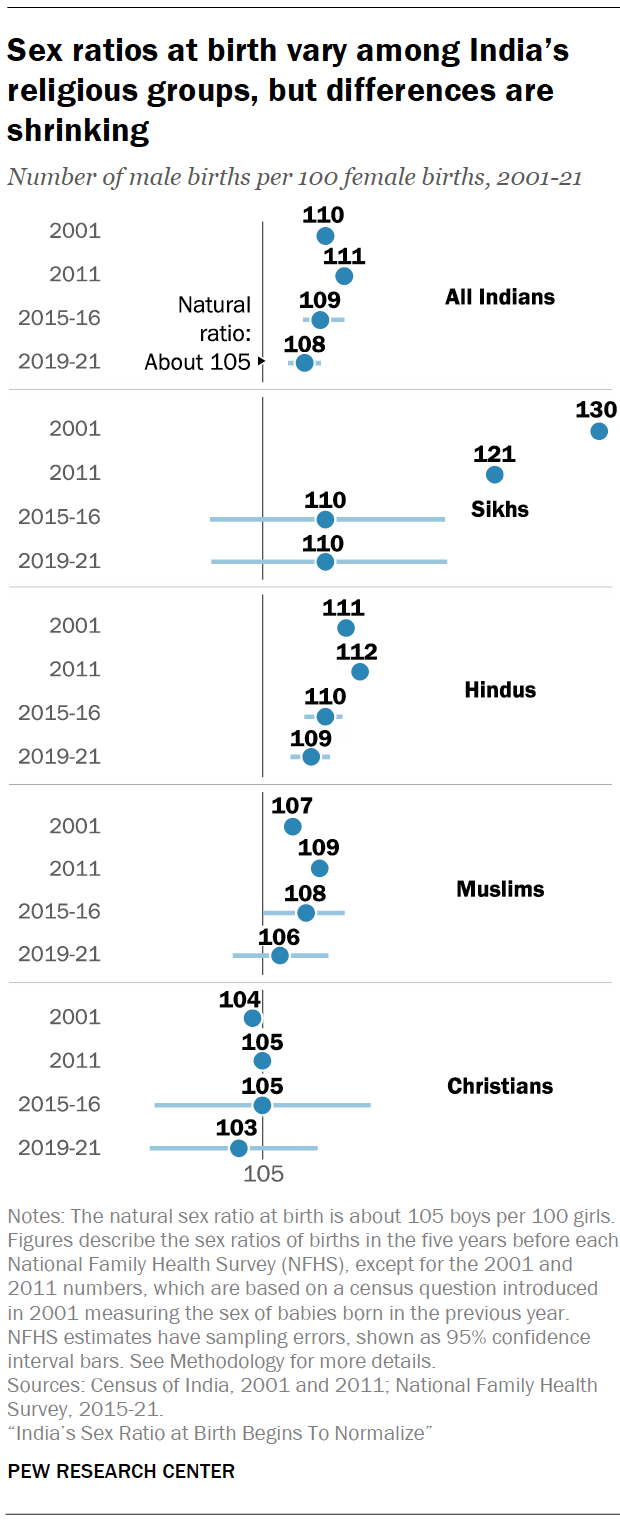
This is the clearest sign of journalistic mal-practice. We have numbers till 2021, and they have sharply declined since 2016. [2] [3] Rates of sex-selective abortion have clearly declined especially among those who can afford ultra sounds.
> Female representation in higher education is rising, yet female labor-force participation, as of 2021, sits at a paltry twenty-three per cent, declining from twenty-eight per cent in 1990. A 2015 study published in The World Bank Economic Review showed that women were less likely to work when their husbands were educated and had high incomes, again underlining the paradoxical effects of affluence. India seems to value women less than when it outlawed dowry, sixty years ago.
I am not sure I agree with the conclusion. As India has moved from an agricultural economy [4] (where women were defacto employed) to physical migrant labor (defacto male employment), there is a natural lack of fresh jobs for low skilled women. While it is a scathing indictment of the one-sidedness of labor force changes in India, it isn't caused by sexism. The article makes it sound as if all trends are pointing downwards, but look at the numbers [5] and they've been sharply rising from 2016 - 2021. Hilariously, a lot of India's problems are due to labor force protections. Neighboring Bangladesh was able to vastly increase their female labor force participation by allowing exploitative textile factories to be built. This led to a massive rise in safe and non-physical jobs for women.
> The Indian state of Punjab, where the majority of the world’s Sikhs live, has one of the most skewed sex ratios in the country
The decline in Sikh female infancide has been quite stark [6]. Long way to go, but an directionally excellent.
______________
I know that : "all stats for women are looking up in India since 2016" is not a narrative anyone wants to buy right now. But there is cause for genuine enthusiasm. There are also signs that the govt. might actually weaken some of the labor restrictions, and we might see some Bangladesh style rise in women-favored jobs, but the optics of "worse labor protections" makes it political kryptonite.
the whole dowry thing is dreadful, but it is not going away onless better articles (and documentaries) are done on it than this one - write clearer, write shorter, and despite the horrible subject, use some wit.


I lived in India in the 1970s as a child. At that time the shorthand was “cooking accident” when new brides were killed. As in, “The bride’s father couldn’t pay the dowry. Too bad she had that unfortunate cooking accident.”
The local man who did our laundry had four daughters, and it was considered a curse. He killed himself because he couldn’t pay their dowries, and he knew he’s spend the rest of his life in shame with daughters who were spinsters, or dead.