This essay is an op-ed that lays the blame for most of California's poverty woes at the feet of a variety of liberal, leftist, progressive, and/or Democrat-initiated policies. From a conservative point-of-view, I can do better.
I propose that California's poverty woes are disproportionately due to a permanent and ever-growing underclass, whose existence and continued plight isn't caused by policies like rent control, welfare reform, and targeted eco-taxes that end up being regressive; but rather, is a simple consequence of individuals desperate for more prosperity and financial security making tough choices for the good of their families.
They are attracted to the cores and fringes of urban areas that play host to islands of productivity and wealth, where they work long hours and multiple jobs in an effort to provide. Some are later-generation Americans born to immigrant ancestors, some are youth from elsewhere in the US trying to flee metros with no growth, some are recent arrivals from regions of the world plagued by poverty and strife, and some are undocumented, working under the table and living in the shadows of mainstream society, more avoidant of law enforcement than groups who suffer the most violence at the hands of the law, and always at the mercy of their employer, handlers, and pure luck.
These groups are there because in California they can capture a larger portion of the effects of trickle-down than in North Carolina, Texas, or New York; and because the state-provided safety net, average people's compassion, and availability of human connections and capital allows them a small, but more meaningful chance of breaking out of the poverty trap.
In other words, the prosperity, concentration of wealth, human capital, and laxer attitude of California allows these marginalized groups a better shot than elsewhere -- especially places like Mississippi and West Virginia, whose poverty is primarily indigenous, and isn't among recent arrivals. California is somewhere where trickle-down does display elements of it working, at the very least in the hearts and minds of those attracted to the state. We can argue about its magnitude all day long, but to flagellate all manner unrelated policies after a myopic reading of statistics is absurd.
As pointed out elsewhere there is a much simpler explanation available in the exclusionary zoning rules, that many feel in our daily lives.
* 41 percent of San Franciscans spend 30 to 50 percent on rent, despite a lot of rent control for longer-tenure residents and a population average income being $104k as well as median $77k.
* Zoning rules have restricted the housing supply so much that the median age of a San Francisco building is 1964, despite multiple boom times after that which should have lead to upzoning. http://demomemo.blogspot.com/2017/02/age-of-housing-stock-by...
* On the peninsula there is one housing unit for every four jobs. Cities have build offices and garnish the income from that, but forces the externalities on housing and infrastructure onto surrounding cities because city boundaries does not reflect where those fall
A lot of problems solve themselves when a one bedroom doesn't cost $3600 per month. We have plenty of space to build up and are mainly limited by zoning that.
There is no question in my mind that when even my tech friends can't afford to live on their own a normal middle class family is in trouble.
I'd suggest to you that your bay area (really peninsula) focus is a little myopic, and that there is a whole lot more California than the Counties of San Francisco, San Mateo, Santa Clara, Alameda, Contra Costa, Salano, Napa, Sonoma and Marin - heck, each of those counties have different problems.
There are two problems at work. One is the poverty of the Central Valley. I strongly suspect this poverty is caused by more traditional problems, such as lack of economic opportunity, poor educational systems and exploitive corporations.
Then there is the "poverty" that is caused by urban planning issues in urban and coastal California. There are families making six figures who can qualify for affordable housing programs here. In no way should a family bringing in six figures be just barely scraping by, but due to the increasing rent burden that’s where many find themselves.
* The problem is state-wide. Cost burdened or severely cost burdened renters; Far north 42%, San Francisco Bay Area 37.8%, Sacramento Region 38.4%, Central Valley 38.9%, Sierra Nevada 36.8%, Central Coast 42.1%, los angeles and south coast 46.1%, Inland Empire 42.7%
* more than half of California's renters and over a third of homeowners with mortgages face high housing costs
* 8 in 10 low income Californians have unaffordable housing costs
The US census shows that people without means can't afford the living costs are self-selecting themselves away:
* A snapshot of more recent U.S. Census migration numbers shows that nearly three-quarters of those who have left California for other states since 2007 earn less than $50k a year.
Does not negate my point - baring some evidence, its not reasonable to assume that zoning is not the cause of a lack of affordable housing in the San Joaquin Valley.
If they had suggested merely that housing costs are an issue for californians, I would not have argued.
For instance, Stockton leads California rent increases with a 10.4 percent increase in rental price between July 2016 and July 2017 and their home prices have increased 92% in the last 5 years. In a supply balanced market this would not happen as the landlors do not have leverage to increase rent this much, and developers/owners don't have the leverage to sell housing for this much more.
I'd also suggest that unless you're looking at county adjusted poverty levels (as in adjusted to cost of living by county) - you're gonna end up with a skewed picture.
That said, the right is correct about something - once you get on the social safety net, its very hard to get off of it, because benefits don't gradually fade out as your income goes up, there is instead a cliff, and all of your social safety net benefits turn off at once - this is why I feel that means tested welfare is social ill, it helps too few, and doesnt provide a soft landing when you dont need help anymore. I'd much rather us do straight up income redistribution (in the form of a minimum income scheme) and medicaid for all.
Then you wouldn't be able to replace welfare. because their kids aren't 18. I'd say limit the payout to the bottom 10-20% in continuous graduations to eliminate any fiscal cliff.
So say the government gives you 12k a year, and your taxes go up by 10k a year, wouldn't that still be beneficial to you?
Something like 30-40% of this program could be paid for by feeding in dollars existing programs, the lions share of the rest of it from the financial transactions tax (sucks if your business is high frequency trading), and a smaller portion from a VAT.
Minimization of poverty is important but I don't believe it can ever be totally eliminated. You and I just have different fundamental beliefs about human nature and motivation.
If the OP is right (and I think he is), the more safety nets and welfare programs there are the more poverty. This is because they have a learned helplessness and are subject to fiscal cliffs preventing them from escaping poverty.
in other words:
Poverty ought to be minimized.
Therefore, if giving people free shit increases poverty, we shouldn't do it.
Everyone over the age of 18 gets a check from the government for 1,000 dollars a month. The only qualification to get the money, is being 18 years old, being alive, residing in the united states and being a citizen or permanent resident of the united states.
Short of creating fictitious people, with fictitious identity documentation, its virtually impossible to cheat it.
So don’t tell anyone that your grandma who lives with you died in her sleep. And definitely don’t mention that your 21 year old brother is off backpacking Asia (how long does he have to be gone for that to even be cheating?)
Well, social security fraud already happens, nothing new there, I'd likely blend this with social security anyhow - so you'd move to the social security schedule upon retirement - in no case however would anyone bring home less than they would under the minimum income scheme.
I'd probably allow anyone who was not working overseas for longer than a year to continue to draw it, its really about your permanent residence and where it is - on the other hand the number of americans who work abroad is astonishingly small - so probably not enough to worry about.
one of them I eliminated by defining the rules in such a way that it wouldnt be an issue - the other requires keeping a rotting dead body hidden somewhere.
Part of what a GMI would need to overcome is ensuring that we have an accurate tracking program - a death should trigger an semi-automated removal from the rolls - as in you need to present yourself.
No system is foolproof, and even the best one in the world is going to have upwards of 2-3% fraud - that said the social security administration historically has been VERY good about tracking them down, and remarkably successful at clawing overpayments back.
In the end, by eliminating means testing you close down a ton of venues for fraud.
and so? they could do that with their paycheck too.
No system in the world is going to stop people from doing stupid shit - you try the best you can, but at the end of the day, people have to choose to do the right thing.
These groups are there because in California they can capture a larger portion of the effects of trickle-down than in North Carolina, Texas, or New York; and because the state-provided safety net, average people's compassion, and availability of human connections and capital allows them a small, but more meaningful chance of breaking out of the poverty trap.
This is correct. Warm winters is also a significant pull-factor.
This is a fantastic point. I count myself among those desperate youth fleeing the stagnation that exists in the rest of our country. I’ve been able to, as a high school dropout, move here to California and teach myself enough skills to make more money than I could have remotely even imagined 5 years ago. I am homeless now though, drifting between motels because even though I have the money to pay for it, I simply cannot get someone to rent me a studio apartment within reasonable commuting distance to my east bay tech job. It’s miserable being unable to put down any roots here, to spend your days begging a landlord just to look at your application. But the thought of leaving and taking my shot at getting by anywhere else is terrifying. The rest of this country is slowly becoming either a racist red state hell hole, or a dead end pit of poverty and despair for anyone with ambition.
Let me get this straight, if you're not in California you're either in a racist, red state hell hole or a dead end pit of poverty and despair? Dropping out of high-school clearly did you wonders.
Maybe you've been through all your options, so excuse me if I'm being unhelpful or ignorant. But have you tried looking for a roommate(s)? Potentially you wouldn't even need to be on a lease that way, and you might make some good social connections. Admittedly, I'm 50+ and not up on the scene for 20-somethings just starting out. But back when that was me I moved to NYC and the Village Voice (newspaper) was full of ads for roommates. That was how many young people expected to live, i.e., in small apartment shared with others. There's nothing wrong with that, it can even be fun; you're young, enjoy it. Isn't this still a common thing in high rent urban areas, the natural way of 20-something living?
The problem is that in many urban areas especially in CA, there aren’t many viable housing options for those who are mid career and want to live alone or start a family. “Just get some roommates, we did that when I was young” can be a little condescending to a 35 year old someone making 150k/year.
Roommates are definitely an option, and I did that for a few years when first moving out here. But I'm pushing 30 now and totally over that lifestyle. It makes me sad to realize this is probably the only realistic option for sticking around long term though.
>Having roommates in your 30s isn't that weird in LA, SF, and NYC.
Agreed, but I think it's weird that that isn't weird. Our parents' generation were able to buy a home, save for retirement, and raise a family on one person's income. Now we sign over half our monthly income to a landlord, and spend the rest on Avocado Toast.
My generation is probably the same as your parents, and even then there certainly weren't many one-income homes doing those things in NYC, SF, or LA. Also, I would say that this generation has gotten used to larger homes and more luxury (e.g., lots of bathrooms). These things simply weren't as normal thirty years ago. (It's the same with cars, which are all bigger and have more luxuries than cars of thirty years ago. Just compare a current Honda Civic with a Civic of 1987.)
The sort of lifestyle you describe is still easily available to two-income families, at least, (maybe one-and-a-half) in most mid-sized cities even in many larger cities. Those cities are mostly great for raising a family. For a single person, often not so much.
At that age peoples' roommates are usually their spouse and their children. If they need to have roommates in addition to those, that is a big problem because with current trends it won't take much discouragement from having children to result in a declining population.
> The rest of this country is slowly becoming either a racist red state hell hole, or a dead end pit of poverty and despair for anyone with ambition.
Not really, but it is an increasingly popular excuse for people trying to mentally justify the stupid decision to stick it out as a homeless person in California.
You might also add the weather. Living on the street, out of a car, in a trailer home, or in a poorly insulated small apartment/house without heating is a lot more comfortable in many parts of CA than in places with harsh winters.
I am absolutely sure that the weather actively attracts homeless individuals, some of whom travel long distances while homeless to take advantage of the dry, temperate weather in some parts of California.
Homelessness is a complex problem, but its mechanisms are largely outside of what I outlined in the parent post. California has 12% of the population of the US but 24% of those individuals accounted as 'homeless'; New York State has 6.1% of the US population but 16% of those homeless. This shows a larger homeless-to-population ratio in New York State than in California.
However, the most outwardly visible facet of homelessness is individuals who are unsheltered, i.e. sleeping in public places or vehicles. The states with the highest rates of unsheltered people (out of total of those experiencing homelessness) was in California, Nevada, and Hawaii, Oregon, and Mississippi [1]. On the other hand, the statewide percentages themselves are not particularly insightful as to the magnitude of the problem, as they aren't weighed by the total number of individuals.
Surprisingly, raw population of unsheltered homeless individuals per metropolitan area, or as a share of total population in a metropolitan area, is a metric rarely aggregated in reports, but from digging though the data [2], one can see that the absolute number of unsheltered homeless individuals is indeed highest in Los Angeles (34000+), San Francisco (~9000), Seattle (~5000+), and New York City (4000+). Weather is certainly a factor in outcomes of unsheltered individuals, but I'm not convinced weather is a factor in contributing causes in the particular concentration of people. It appears that New York City seems to muster more assistance to individuals experiencing homelessness than Los Angeles, where in the latter more people end up on the streets, and San Francisco's problem is, in both absolute and relative terms, not as acute as that of Los Angeles, despite public perception occasionally being the contrary.
I am really not clear what your point is. But here are my "sources," fwiw:
I had a class in Homelessness and Public Policy from SFSU some years ago. I lived in California a total of 12 it 13 years, iirc. Five and half of those were as a homeless person.
I am author of the blog the San Diego Homeless Survival Guide, which means I hear from both homeless individuals and reporters periodically. I still participate on a homeless discussion forum where it is not uncommon for people to ask where they should move to as a homeless person. I traveled from Georgia to San Diego as a homeless person. I went there in part for the dry, temperate weather.
I recently got off the street in part by traveling to someplace cheaper. It is much wetter here than the places I lived while homeless. Nonetheless, it is a relatively temperate part of Washington and seems to attract a lot of homeless. I am fairly confident the relatively temperate weather is a factor.
I don't intend to discount your personal experiences at all, but in San Francisco's 2017 report [1] on homelessness, 69% of counted individuals reported that they were living in SF at the time they became homeless, and of those, 55% had lived in SF for 10 or more years.
Only 10% of total counted reported living outside of California when they became homeless. I can intuitively understand that weather may be a draw, but San Francisco's findings this year, as well as in 2015 don't appear to back that a majority of those experiencing homelessness in San Francisco are travelling there from outside the state.
I did not say it accounts for a majority of homeless Californians. If it accounts for even 5 percent, that would be a lot of people. Your figure of 10 percent coming from out of state actually supports my assertion that homeless people actually travel to California while homeless. The only thing missing is data as to why they made that decision.
The Op-Ed called it the poverty trap: "55% of immigrant families in the state get some kind of means-tested benefits, compared with just 30% of natives."
However, it failed to cite any kind of causality. It seems just as likely that those kinds of benefits are precisely why they come here.
I'd also be interested in knowing if it's truly a trap -- do immigrant families come here, get those benefits, then move up? Or is it the same 55% decade after decade?
immigrants via a loose border? or immigrants that arrived legally? Or immigrants that just came from other states? What does native mean in this context?
For sure it wasn't a serious comment, but there is a more serious facet of it I think. If our states aren't able to properly deal with the poverty that's already here, why are we inviting more of it in?
US psychiatric, APS, and CPS services are poor, and can't adequately deal with the needs of those already here. It's only going to get worse.
I'd also add that being homeless in some states seems like a far more untenable proposition, out in those middle states where the climate gets extreme.
This article has some factual information about it, including statistics from census data and some details. e.g: substance abuse, people being priced out of their homes, etc.
Some economists have started to suggest that exclusionary zoning policy is the main driver of wealth inequality. And California is pretty much the world leader in exclusionary zoning policy.
You make a great point, so I would like to add some facts.
* A snapshot of more recent U.S. Census migration numbers shows that nearly three-quarters of those who have left California for other states since 2007 earn less than $50k a year.
* San Francisco's African American population has declined from 13.4% of the population in 1970 to 6.1%
* 41 percent of San Franciscans spend 30 to 50 percent on rent, despite a lot of rent control for longer-tenure residents and a population average income being $104k as well as median $77k
I understand that this might not be the intended consequence for all people fighting for the current zoning rules, but due to its effects on African Americans and latinos as well as the poor I find the effects immoral.
The current situation makes it almost impossible to grow up with lower middle class parents or work in a low-pay low-skilled position, and mingling with the tech crowd to work your way up.
Anyone supporting these policies knowing this has the right to do so, but not while at the same time claiming they fight for diversity and the dispossessed.
Hold on there. Dropping that 2nd fact seems to be more race baiting than not. The indication of AA population shrinking could be explained by the increase of the AA population in neighboring counties.
According to http://www.bayareacensus.ca.gov, the AA population was increasing throughout the 80s - 2000s in all 8 other bay area counties. They could very well left SF to get better opportunities elsewhere.
* Large urban school districts are experiencing the greatest numerical decrease in Black
enrollment. These districts include Oakland, Los Angeles, San Francisco, Inglewood,
Lynwood, and Compton.
* The largest percentage increase in the Black population occurred in smaller, rural
communities (Susanville, Tehachapi, Calipatria, and Elk Grove). Before 1980, these
communities had a very small number of African Americans.
* More than 2 our of 3 Californias with unaffordable housing costs are people of color
And there are a few more interesting facts in both links, so you are correct that it is a complex problem. That said I don't think you can access the best opportunities in California from where the largest percentage increase in the black population is, but it might be that they also moved to neighborhood populous counties in which case percentage increase is not interesting.
Why Has Regional Income Convergence in the U.S. Declined?
>The past thirty years have seen a dramatic decline in the rate of income convergence across states and in population flows to wealthy places. These changes coincide with (1) an increase in housing prices in productive areas, (2) a divergence in the skill-specific returns to living in those places, and (3) a redirection of unskilled migration away from productive places. We develop a model in which rising housing prices in wealthy areas deter unskilled migration and slow income convergence. Using a new panel measure of housing supply regulations, we demonstrate the importance of this channel in the data. Income convergence continues in less-regulated places, while it has mostly stopped in places with more regulation.
I live in Amsterdam and the city is developing a serious problem with housing and income distribution. There’s a huge portion of the housing stock owned by social housing and a red-hot debate on how does it affect - contributes or mitigates - the problem.
My theory is that unit size is the greatest mitigator, whereby more affluent buyers move out to the countryside to buy larger properties. If larger apartments were allowed in the city — lower tax or land lease prices — it would trigger a price war among Oil Barons over that penthouse on the canals.
That's so strange! They're so progressive and liberal there, though. I can't believe they'd let their fellow citizens struggle to get by and live in poverty!
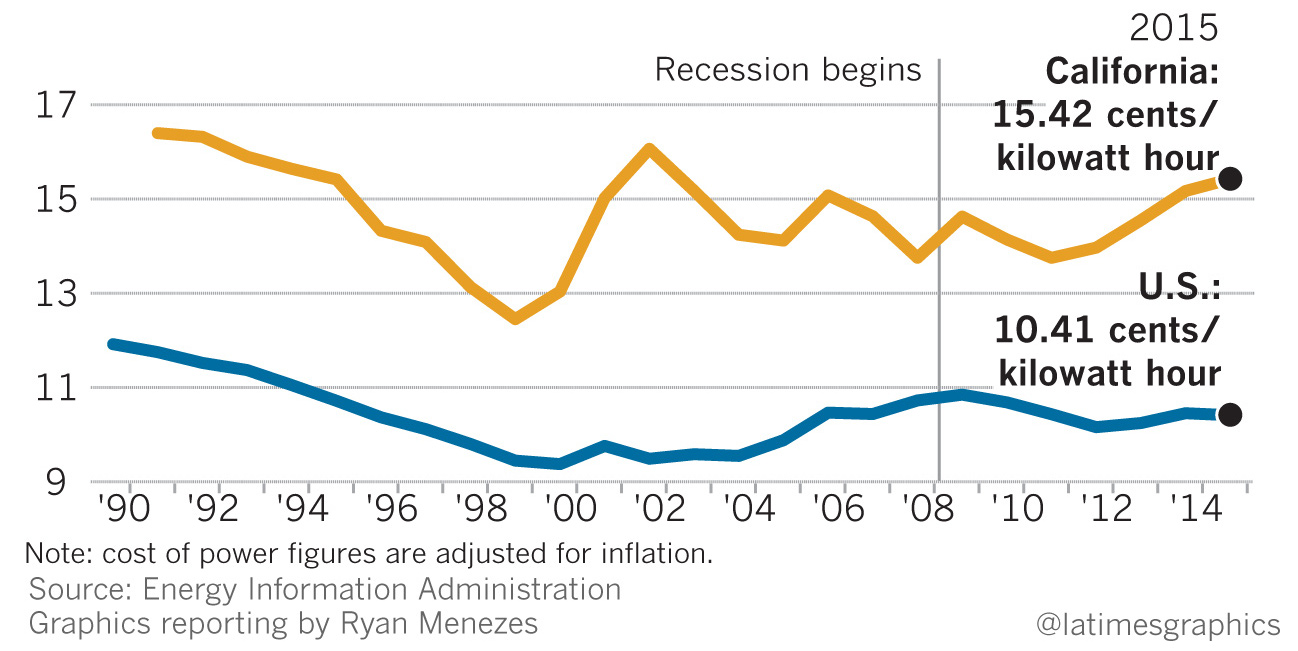
The author has a pretty radical and completely unsubstantiated anti-environmental outlook. He claims that California energy prices are so high because of "liberal" policies including extremely important (but honestly still fairly modest) regulations to help stem carbon emissions - however, California energy prices have been far above the US average for decades [0] and the impact of carbon regulations on the consumer have been minimal, and certainly have nothing to do with California's poverty rate. (Note that most of the east coast lives in states with similar regulations [1], and there too costs have not been pushed onto the consumer).
As to the argument that a ban on plastic bags is causing California's poverty because it hurts the workers in the factories that make them... I think the ridiculousness of that idea stands on its own. California has a poverty problem. It's driven by things like the housing crisis and high consumer prices. Not because we provide any kind of support the poor or the environment.
"The Pacific Research Institute for Public Policy (PRI) is a California-based free-market think tank which promotes "the principles of individual freedom and personal responsibility" through policies that emphasize a free economy, private initiative, and limited government."
Stemming carbon emissions (as well as other environmental toxins), improves life by reducing medical costs due to pollution. Not that CA is perfect at that, see Exide lead contamination in LA.
Cafeteria workers at facebook earn 40k per year and are stuck living in people's garages. Anywhere else in the country, and they'd be thoroughly midclass with 40k per year. It mostly comes down to egregiously awful housing policies that make it 5-10 times more expensive to live here. This hurts everyone.
Other cities manage to do it. Look at red cities like Houston, that are growing every bit as fast and still manage to keep housing costs low. And the population density in TX is roughly same as CA, at least overall. Ultimately, it comes down to the ratio of jobs to housing. The penninsula has 4 jobs to every 1 person place to live. You have to build more housing or get rid of jobs, to make two back into balance. and, for christ sake, get rid of those CEQA laws and anything else that gets in the way of housing costs. We need to start working with developers, not against them.
Is Houston really red? Most of its political representation seems firmly in the urban liberal left. That the city sprawls like crazy is more of a red Texas artifact.
The population densities of Texas and California are about the same overall because they both have vast amounts of unpopulated land. If you look at the density of cities, however, California is much more dense than Texas in general.
>That the city sprawls like crazy is more of a red Texas artifact.
It's actually an artifact of Houston's original charter which allowed nearly unlimited growth via annexation and Houston's use of that annexation power to reclaim its tax and voter base each time they moved outward from the city center. Houston grew from 9 square miles in 1900 to ~600 square miles today. See http://www.chron.com/local/history/major-stories-events/arti... for more details.
Blue dots surrounded by red also happens in California (and indeed, in any state with cities). It’s just that the blue dots are much more dense in California.
I don’t think there is such a thing as a red big city.
Cheaper housing sounds good, but I wonder if it may just lead to lower salaries. Companies are maximizing shareholder returns by keeping expenses as low as possible. Shareholders, essentially, get paid before cafeteria workers, or even tech workers.
salaries aren't paid on a "cost plus" model of "housing" + "schooling" + "discretionary for workers", it is paid based on the negotiating power of the employee. The way salaries might be impacted is through increasing the pool of people willing to work in the SFBA.
When I read this article I was surprised and looked for some data, and while the fact that California is the leader in this poverty metric is true, the claims of why I'm not entirely sold on.
1) The state with the 2nd highest adjusted poverty rate, Florida, has had republican governors since 1999, republicans in both chambers of the legislature and is not a "welfare state".
2) California "welfare" spending per-capita has been dropping for the past 5 years, not rising at some out of control rate [1]
3) The adjustment in poverty rate causing CA to shoot to the top is almost certainly due to high housing costs, which is serious problem but not tied to the welfare state [2]
So while I think it is a useful wake up call that California isn't a perfect place where everybody is doing well, blaming the welfare state is probably not very accurate, and more sane housing policies would probably do far more to help the poverty rates than curtailing support programs. And another thing to note, the rate has been dropping. In 2013 it was 23.4, and now it is 20.4, which I'm sure is mostly due to the economy being much stronger, but at the same time shows this isn't a problem spiraling out of control.
The reason why the welfare spend per capita went down might be because people without the means to pay for the high living costs move away, while we got more high-paying jobs. A snapshot of more recent U.S. Census migration numbers shows that nearly three-quarters of those who have left California for other states since 2007 earn less than $50k a year.
This Op-Ed is picking and choosing facts and associating them together as if there is causation.
Instead of "CA didn't adopt welfare reform ==> higher poverty rates", it could be there are more poor immigrants who move here from Mexico and Central America (along with a myriad of other factors).
Further:
>"Apparently content with futile poverty policies, Sacramento lawmakers can turn their attention to what historian Victor Davis Hanson aptly describes as a fixation on 'remaking the world.'"
The article then goes on to list policies that are more about ideology than making real impacts, including:
>"The political class wants to build a costly and needless high-speed rail system."
Public transportation is obviously valuable and furthers the public interest. Has it been done poorly in California, yes, but if we had trains like Europe it would dramatically increase quality of life for our citizens.
>"enacted the first state-level cap-and-trade regime"
This isn't about "remaking the world" or winning political points. Climate change is real and having real impacts on people's lives.
>"Established California as a “sanctuary state” for illegal immigrants"
Again, this has very real impacts for a significant percentage of our residents. Not just an ideological fluff policy.
>"Banned plastic bags, threatening the jobs of thousands of workers involved in their manufacture"
Plastic is destroying our oceans and causing significant, irreparable farm to our ecosystems. In the cost-benefit analysis, the externality costs outweigh the value of those jobs. When Florida just got an exemption to prevent offshore drilling off their coasts, conservatives reacted positively, recognizing the trade-offs between one economic activity (drilling) and another (coastal tourism) when externalities are involved.
It's so infuriating how conservatives, who used to be a group that understood economics, now willfully ignore sound economic theory when it doesn't fit their talking points.
I agree that it is a shame everything has to be so politicized, both of the left and right, even when a good point is made. We clearly have a problem in California, but it is unlikely that this is because of a welfare system that support people in need.
As pointed out elsewhere a more likely culprit is exclusionary zoning that has increased living costs to unsustainable levels even for high paid employees. A lot of problems solve themselves when having a roof over your head doesn't costs $3600 for a very low-standard one-bedroom.
> It's so infuriating how conservatives, who used to be a group that understood economics, now willfully ignore sound economic theory when it doesn't fit their talking points.
No, their ignorance is based on whoever lines their pockets. This is, of course, something that plagues politicians of all colors (and countries), but corruption or its legal forms are particularly prevalent at self-labeled "conservatives" (not only USA, but also e.g. Germany, where the equivalents of the US Republicans (CDU) and Tea Party (CSU) got the by far biggest chunk: http://www.t-online.de/nachrichten/deutschland/bundestagswah...). And of course, when viewed through that lens, some political decisions come across very clearly, for example:
- drilling vs nature: as long as Greenpeace does not have billions of dollars to lobby or a president favored to the environment, drilling will win. No matter how big the externalities are, because the politician never has to foot the bill and when he does, e.g. because the beach villa gets flooded due to sea level rise, the politician packs up stuff and moves somewhere else while the poor people have to look how they survive
- marijuana vs alcohol/legalization: marijuana has four different and both powerful lobby groups against it: first pharma, which was scared for a long time about the medical effects (but now, at least to some degree, appreciates marijuana), second the religious evangelical nutjobs who'll definitely always find an excuse why one should not smoke a plant that God had created, third the alcohol lobby (which has hit particularly bad press in the last year due to a rise of alcoholism and people recognizing alcohol related violence as a problem, but still it's not at the same level of bad press that tobacco gets) and fourth the racists (which targeted marijuana in order to discriminate against PoC). It took massive amounts of direct democracy to cut the crap in that area, and the work isn't finished (and if Sessions has his way, it is very well possible that the progress may be entirely reverted in a matter of days!)
- tax codes: these are sometimes literally written in a way that requires people to buy professional tax software and/or hire accountants, but not to serve the citizens' needs, and of course the big players have had their part in the creation of the "loopholes" allowing most modern tax evasion schemes
- healthcare: the US system is one of the most expensive in the world, yet inarguably the most rotten-to-the-core of civilized societies - it's no difficult to try to guess where all that money went. That anything resembling "socialism" is a red herring for the "conservatives" and social darwinists is only furthering the line towards inevitable collapse.
It should be said that CA does not have the highest SPM.
DC does (20.4 vs 21). But that's not really the point of the article.
I don't fully understand yet why SPM is better than the "official" poverty metric, or why the calculations involved in SPM create such a dramatic difference between CA's official rate and their "SPM" rate. However, I'm willing to venture a guess that it's a fairly complicated interaction of policies and demographics which don't tell you much about the "success" of more conservative policies on eradicating poverty.
Plenty of conservative states have a higher SPM than plenty of other "liberal" states, so it seems to me that using it as an indictment/evidence for policy approaches on either side is fairly flimsy.
> I don't fully understand why SPM is better than the "official" poverty metric
I'm no statistician but here's what it says in the introduction section: Beginning in 2011, the Census Bureau began publishing the Supplemental Poverty Measure (SPM), which extends the official poverty measure by taking account of many of the government programs designed to assist low-income families and individuals that are not included in the official poverty measure.
I'm not a US citizen so my understanding may be quite off but I assume that since (presumably) the states themselves do the official measure, then that's why they don't account for federal programs?
EDIT: I just realised that while the District of Columbia has the highest SPM, they're probably playing semantics. The article starts with "Guess which state" which excludes DC, a federal district. It's just weasel wording to get at Cali though :)
I hope this gets more visibility on HN, so people can see others do live outside the reality distortion bubble. It was only last week people were arguing whether $150,000 was an average salary for programmers in the bay area.
Pish-posh, everyone knows that poor people are a red state problem. California is a net contributor to the federal budget, along with all the other coastal states, after all.
An oped isn’t a great place to learn about this problem. The author has massive incentives to distort or mislead in pursuit of their argument.
For example, I have heard from state senate staffers that although the state is blue, the notion that progressive forces are in control of the government isn’t true. If you think about it, this makes sense. California is diverse so why wouldn’t the politicians be?
Some Italian friends of mine mentioned some sort of political joke about whatever political party claims to be for the poor, that "they [championing political party] like them [the poor] so much they want more of them". Something to that effect.
Reading this bit of the article below made me think of their laughing together at however you say the above in Italian.
"Self-interest in the social-services community may be at fault. As economist William A. Niskanen explained back in 1971, public agencies seek to maximize their budgets, through which they acquire increased power, status, comfort and security. To keep growing its budget, and hence its power, a welfare bureaucracy has an incentive to expand its “customer” base.
The homelessness problem is one the most straight forward social problems that can be solved, unlike nebulous goals like decreasing crime, improving health, creating jobs, etc. Literally all it takes is building more places to live. The resources and land exist, the only thing standing in the way is political will.
There are at least two Californias. 1. LA and Bay areas. 2.The Central Valley. One is rich. The other is poor.
I grew up in the central valley. The central valley is agriculture, and is disproportionately populated by generally hard working migrants (or 2nd/3rd generations thereof) of Mexico. They pick our fruit and our vegetables, but they are dirt poor. I grew up along side them, land of dirt and chicken coops. They were my neighbors and my friends.
I think you should take a look at their looming pension crisis... California is already taxed to hell, and their balance sheet is not something to be optimistic about.
Ummm... LA has more homeless people than any other city because of the weather. NYC winters kill. LA's outdoors are basically like the indoors most other places. No mosquitoes. Only rare rain. 70 degrees most of the time.
Much of California's poor are created elsewhere and they move to California. It's easier to be homeless in California than most other places.
Indeed that may be a big factor. A better study of who, where, and why is needed to understand the bigger picture. It's premature to fill in details with the typical partisan angles.
There's videos of the long line of tents in orange county making the rounds on social media today. With 1/3rd of the welfare recipients live in California, seems to be a pretty big issue thats not being addressed.
Drum does rebut the causal argument in the LA Times Op-Ed (which is pure ideological dogma detached from facts; the claim that “Democrats have long been free to indulge blue-state ideology while paying little or no political price” is particularly amusing, given that ignores that until recently California has (whoever held the majority, with or without also holding the governor's mansion) had an effective minority-party veto via the 2/3 requirement to pass a budget (and still has a 2/3 requirement to pass new taxes through the legislature) which has prevented anyone from being free to impose any ideology other than one of government inaction-responsiveness.
OTOH, California is not doing okay; Drum provides no reason to disregard the SPM, but even if you do, being just a bit worse than middle of the road by the federal poverty line while being 8th in per capita GDP is, by itself, an alarming number that shows that the aggregate wealth in California is a rising tide they is absolutely not lifting all boats. But to Drum it's somehow “just fine”.
Interesting to see how differently this does today, with an editorialized title, vs the actual title that was submitted a day or two ago and insta-flagged.
Yeah, this is some serious political opinion masquerading as journalism:
Original Title: Why is liberal California the poverty capital of America?
With a permanent majority in the state Senate and the Assembly, a prolonged dominance in the executive branch and a weak opposition, California Democrats have long been free to indulge blue-state ideology while paying little or no political price. The state’s poverty problem is unlikely to improve while policymakers remain unwilling to unleash the engines of economic prosperity that drove California to its golden years.
Good points in this article. Prop 13 and land use regulation here is out of control. It's at the point where the government should be buying neighborhoods at market rate and selling to developers who will build at a high density.
Interesting, saw this article yesterday and it was flagged and gone within minutes. I understand there are some silly and wrong assumptions in it, but is it really that offending and off-topic to be flagged?
Could easily just make a comment saying "This is wrong and here is why..."


I propose that California's poverty woes are disproportionately due to a permanent and ever-growing underclass, whose existence and continued plight isn't caused by policies like rent control, welfare reform, and targeted eco-taxes that end up being regressive; but rather, is a simple consequence of individuals desperate for more prosperity and financial security making tough choices for the good of their families.
They are attracted to the cores and fringes of urban areas that play host to islands of productivity and wealth, where they work long hours and multiple jobs in an effort to provide. Some are later-generation Americans born to immigrant ancestors, some are youth from elsewhere in the US trying to flee metros with no growth, some are recent arrivals from regions of the world plagued by poverty and strife, and some are undocumented, working under the table and living in the shadows of mainstream society, more avoidant of law enforcement than groups who suffer the most violence at the hands of the law, and always at the mercy of their employer, handlers, and pure luck.
These groups are there because in California they can capture a larger portion of the effects of trickle-down than in North Carolina, Texas, or New York; and because the state-provided safety net, average people's compassion, and availability of human connections and capital allows them a small, but more meaningful chance of breaking out of the poverty trap.
In other words, the prosperity, concentration of wealth, human capital, and laxer attitude of California allows these marginalized groups a better shot than elsewhere -- especially places like Mississippi and West Virginia, whose poverty is primarily indigenous, and isn't among recent arrivals. California is somewhere where trickle-down does display elements of it working, at the very least in the hearts and minds of those attracted to the state. We can argue about its magnitude all day long, but to flagellate all manner unrelated policies after a myopic reading of statistics is absurd.